

The fear of making a catastrophic mistake is quietly burning out residents faster than the hours are.
Let me be blunt. Duty hours, EMR clicks, and pager fatigue get all the headlines. But the thing that actually keeps residents awake at 3 a.m. is this: “What if I miss something and ruin someone’s life… and mine?”
That combination—resident burnout plus malpractice anxiety—is toxic. And badly understood. Most programs either ignore it or respond with a one-hour “wellness lecture” that changes nothing.
You need something better. You need a clinical, practical approach to managing the fear of mistakes without pretending errors never happen.
Let’s break this down like we would a complex patient: history, pathophysiology, risk factors, and then real interventions—not slogans.
1. What You’re Actually Afraid Of (It’s Not Just Malpractice)
Residents rarely say this out loud on rounds, but I’ve heard the exact same phrases in workrooms across specialties:
- “If this goes bad, I’m going to get sued and my career is over.”
- “Attending will destroy me if this is a miss.”
- “I triple-checked, but I still feel like I missed something.”
You are not just afraid of malpractice. You are afraid of:
- Hurting a patient.
- Being publicly humiliated.
- Losing your license or future career.
- Getting sued and financially wrecked.
- Being “the resident who killed someone.”
Those fears stack. At 2 a.m., under fluorescent lights with 22 patients on your list, they merge into a free-floating dread that looks a lot like burnout.
Burnout here is not just “tired and cynical.” It is the chronic state of:
- Emotional exhaustion from constant vigilance.
- Depersonalization as a defense (“These are just ‘the CHF in 8’ and ‘the DKA in 12’”).
- Reduced sense of personal accomplishment (“I’m one mistake away from being a fraud exposed”).
That last one is what malpractice anxiety feeds on.
2. The Reality Check: How Often Are Residents Actually Sued?
Let us kill one myth right away: as a resident, you are much less likely to be individually targeted and ruined by a malpractice case than your brain tells you at 3 a.m.
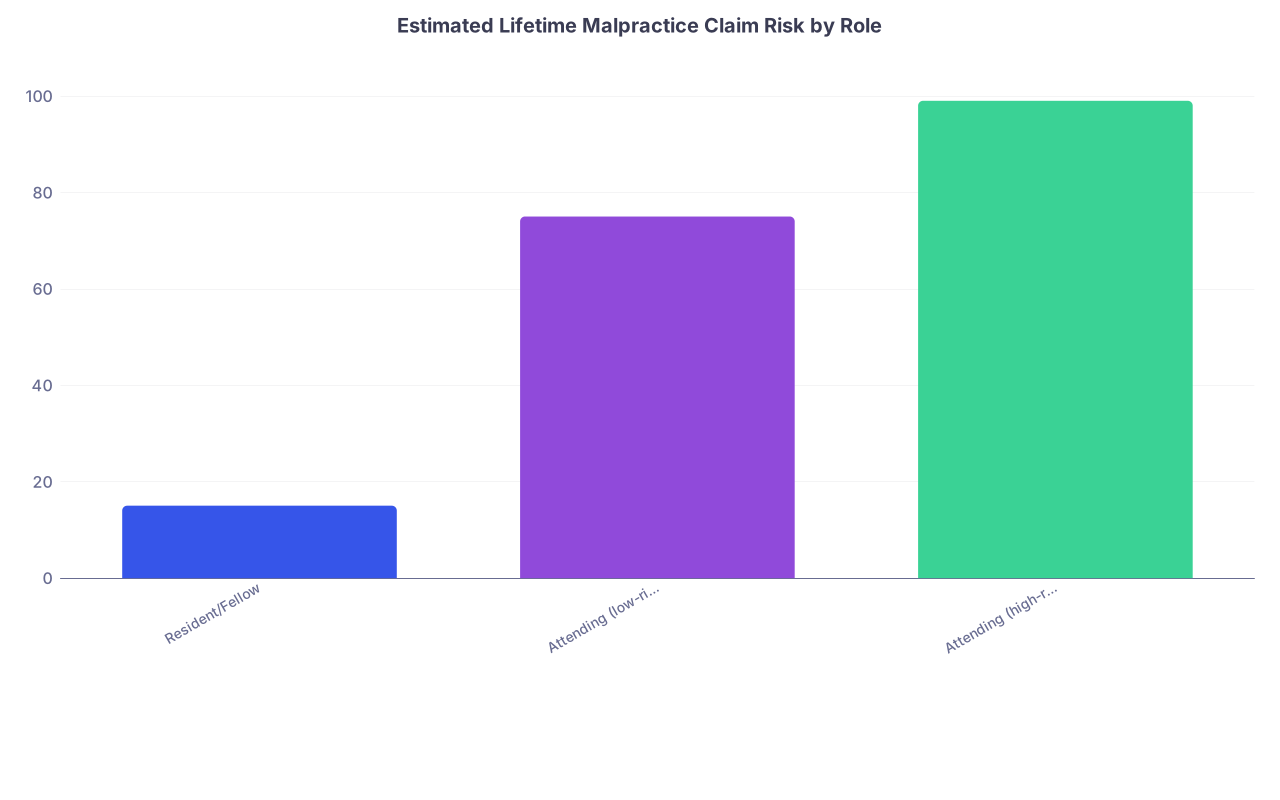
| Category | Value |
|---|---|
| Resident/Fellow | 15 |
| Attending (low-risk specialty) | 75 |
| Attending (high-risk specialty) | 99 |
Interpretation (ballpark, varies by country and specialty):
- Most residents will never be the primary named defendant.
- Residents are often included peripherally in suits, but the hospital and attendings usually carry the main legal exposure.
- Training status, supervision, and institutional policies matter a lot in your protection.
Does that mean you are “safe” and should relax? No. It means your catastrophic story (“I will be destroyed and unemployable over one bad call as a PGY-2”) rarely matches reality, especially when you documented appropriately and involved your attending.
The legal system is flawed, but it is not designed to casually obliterate supervised trainees acting in good faith and within standard practice.
The bigger problem for you is not the courtroom. It is the psychological courtroom in your own head.
3. How Fear of Mistakes Drives Burnout
Think about a typical intern or junior night:
- You are cross-covering 40–80 patients.
- You are fielding pages every 2–3 minutes for several hours at a stretch.
- You have variable supervision—sometimes great, sometimes distant.
- You are constantly asked to make calls with incomplete data.
In that environment, your brain does something predictable: it switches into hypervigilance and worst-case scenario thinking.
“Chest pain? Could be MI.” “Fever? Could be sepsis.” “Bradycardia? Could be impending arrest.”
Hypervigilance is adaptive… until it runs nonstop.
Over time, this leads to:
Decision paralysis
You spend an extra 30–40 minutes agonizing over a plan you could have reasonably executed in 10 minutes. You call consults early, order extra imaging, keep everyone NPO “just in case.” You feel “safer,” but your cognitive load and emotional cost go through the roof.Compulsive double- and triple-checking
You re-open the same chart four times “just to make sure.” That is not thoroughness. That is anxiety burning time and attention you do not have.Avoidance
You start dodging sick admits, difficult procedures, or emotionally heavy family discussions. You cling to “safe” tasks. Learning stagnates. Confidence drops. Burnout accelerates.Identity erosion
You entered training wanting to be competent, decisive, and useful. Instead you feel terrified, overwhelmed, and constantly behind. That mismatch between self-image and daily reality is pure gasoline on burnout.
So no, malpractice anxiety is not a side issue. It is one of the core engines of resident burnout, especially in high-acuity fields: EM, ICU, surgery, OB, cards.
4. Understanding Actual vs Perceived Risk
Here is where your thinking has to level up: you need to distinguish actual clinical risk from perceived personal catastrophe risk.
Clinical risk: What is the chance this patient deteriorates or dies based on their presentation, comorbidities, and available data?
Personal risk: What is the chance this leads to a serious complaint, lawsuit, or board action that meaningfully harms your career?
They move together somewhat, but not perfectly. And your brain wildly overestimates personal risk.
Let’s make this concrete.
| Scenario | Clinical Risk | Personal Career Risk |
|---|---|---|
| Delay of non-urgent CT by 2 hours in stable patient | Low | Very low |
| Missed atypical MI that later arrests | High | Low–moderate (if supervised, documented) |
| Medication dose error caught before administration | None | Almost none |
| Discharge of low-risk chest pain with reasonable workup | Low | Very low |
| Refusal to see a patient when paged repeatedly | Variable | Higher (professionalism) |
Notice something uncomfortable:
Some of the highest career risk situations have nothing to do with pure clinical judgment and everything to do with professionalism, communication, and documentation.
Calling back promptly. Showing up to bedside. Not stonewalling nurses. Documenting your thought process clearly. These protect you more from career harm than ordering the extra “just in case” CT at 3 a.m.
So part of managing malpractice anxiety is shifting from:
“I must never make a mistake” → “I must behave like a careful, honest, communicative physician even when mistakes happen.”
That shift changes how you allocate your finite energy.
5. Building a Personal Error-Management Framework
You are going to make mistakes. Full stop. Every competent attending you admire has stories you have not heard.
The residents who survive and grow are not the ones who avoid all errors. They are the ones who have a system for:
- Reducing preventable errors.
- Catching and correcting errors early.
- Responding when an error reaches the patient.
Let me give you a practical framework.
5.1 Before the Error: Design Your Safety Net
Think like a systems engineer, not a martyr.
Default to structured approaches
- Use checklists for high-risk situations: chest pain, sepsis, altered mental status, pre-op clearance, new SOB. Not fancy laminated posters. Simple checkboxes or mental models.
- Examples: HEART score for chest pain, SIRS/qSOFA for sepsis risk, CURB-65 for CAP severity.
Make “second eyes” a normal behavior, not a panic reaction
- Normalize saying to seniors: “I think this is X, but I want to run the plan by you for safety.”
- Use nurses as allies: “If he looks even a little worse, I want to know immediately.”
Pre-plan routes of escalation
On day 1 of a rotation, ask explicitly:- “Who do you want called first at night for a crashing patient?”
- “What do you consider should-never-wait issues?”
- “If I am unsure but patient looks okay, what is your threshold to be woken up?”
This is not weakness. It is pre-emptive safety design.
5.2 When You Notice a Possible Mistake
Your brain will want to do one of two things: deny/minimize, or catastrophize. Both are useless.
Instead, run a simple “error response script”:
Pause and characterize
- What exactly might be wrong? Diagnosis? Medication? Communication?
- Has it already reached the patient (e.g., drug given) or is it upstream (order pending)?
Stabilize first, paperwork later
- If there is any chance of immediate harm, go to the bedside. Reassess. Fix what you can: stop the med, call for help, get vitals, start fluids, etc.
- Only then start calls and documentation.
Escalate early, not perfectly
- Call your senior or attending: “I think there might have been an error with X. Here is what happened, here is current status, here is what I have done so far.”
- Do not soften it into vagueness. Clarity is safer.
Document your thought process honestly
- Chart the clinical facts and response. Do not speculate about blame. Do not invent a fake rationale that you did not actually have.
Ironically, the residents who are most afraid of malpractice sometimes chart in ways that are actually worse legally—vague, defensive, or dishonest. Any malpractice attorney will tell you: that kind of documentation is devastating.
5.3 After the Error: Protect Your Brain and Your Career
This is the part no one teaches you. The emotional and cognitive aftermath.
There are usually three layers:
Immediate emotional shock
“I might have harmed someone.” You cannot wish this away. It lands hard. Let it. Cry in the call room if you need to. That is not weakness; that is you taking your work seriously.Case review and learning
This is where morbidity and mortality (M&M) either helps or harms you. The worst M&Ms are blame-fests. The best are brutally honest but systemic:- What made the error more likely?
- What could have caught it earlier?
- How do we change the system, not just the person?
Narrative integration
If you never consciously rewrite the story, your brain will settle on: “I am dangerous and incompetent.”
A better narrative:- “I made a serious error.”
- “I confronted it, disclosed it, and learned from it.”
- “I am now the physician who double-checks this scenario ruthlessly.”
You must be active in writing that story. Otherwise shame does it for you.
6. Psychological Tools To Contain Malpractice Anxiety
This is where you will be tempted to roll your eyes. “Mindfulness, CBT… sure.” Let me be specific and concrete instead of hand-wavy.
6.1 Containment, Not Elimination
You will not get rid of fear. Nor should you. A zero-anxiety physician is dangerous.
Your goal is to contain fear so it:
- Sharpens your attention when needed.
- Does not bleed into every case.
- Does not follow you home and destroy your sleep.
6.2 A 3-Part Mental Protocol for Night Float
Use this every time you are about to start a shift, especially nights.
Calibrate your standards
Say this explicitly to yourself as you walk in or change into scrubs:“My job tonight is to be careful, honest, and responsive. Not perfect. I will miss small things. I will not ignore big red flags. That is enough.”
This resets an impossible standard (“no mistakes”) into a workable one.
Name and park the catastrophes
On your way to work or in the locker room, actually label the thoughts:- “I might miss sepsis and someone dies.”
- “I might get sued and ruin my career.”
- “I might freeze and look incompetent.”
Then respond with:
“These are standard catastrophe thoughts. I have heard them before. They are not prophecies, they are noise. I will act based on data at the bedside, not movies in my head.”Define your escalation threshold
Go in with a pre-commitment:
“If I am stuck for more than 5 minutes on a decision with real harm potential, I will call for help. No debate.”
Removing the “should I bother them?” agonizing saves enormous cognitive energy.
6.3 After-Shift “Mental Sterile Technique”
Residents contaminate their off-hours constantly. You replay cases on the commute, in the shower, in bed at 1 a.m. That is how burnout cements.
You need a closing routine, the same way the OR has a closing count.

| Step | Description |
|---|---|
| Step 1 | End of Shift |
| Step 2 | 2-minute case scan |
| Step 3 | Message or sign-out to team |
| Step 4 | Name intrusive thoughts |
| Step 5 | Time-box rumination 5 minutes |
| Step 6 | Deliberate shift close statement |
| Step 7 | Transition to non-medical activity |
| Step 8 | Any active safety worries? |
What this looks like in practice:
Two-minute scan
“Is there any patient I am truly worried is unstable or poorly covered?”- If yes, send a message, add a sign-out item, or mention to incoming team.
- If no, you are done. Anything else is just rumination.
Time-box the rumination
On the commute, tell yourself: “I have 5 minutes to replay anything I want. After that, we’re closed.”
Set an actual timer if you need to.Explicit closing statement
Final line as you step through your front door:
“Shift is over. I have done what I reasonably can. Any remaining anxiety is just echo, not data.”
Sounds corny. Works shockingly well if you repeat it consistently.
7. The Role of Program Culture: What Should Change, Not Just What You Should “Cope” With
I am not going to pretend this is all on you. A malignant program can completely override even excellent personal coping.
Programs that intensify malpractice anxiety usually have:
- Public shaming at M&M with focus on “who screwed up.”
- Attendings who weaponize “You could get sued for that” as feedback.
- Punitive responses to near-misses instead of safety reporting systems.
- No education on how malpractice actually works or how often residents are pulled into it.
Better programs do a few concrete things differently.
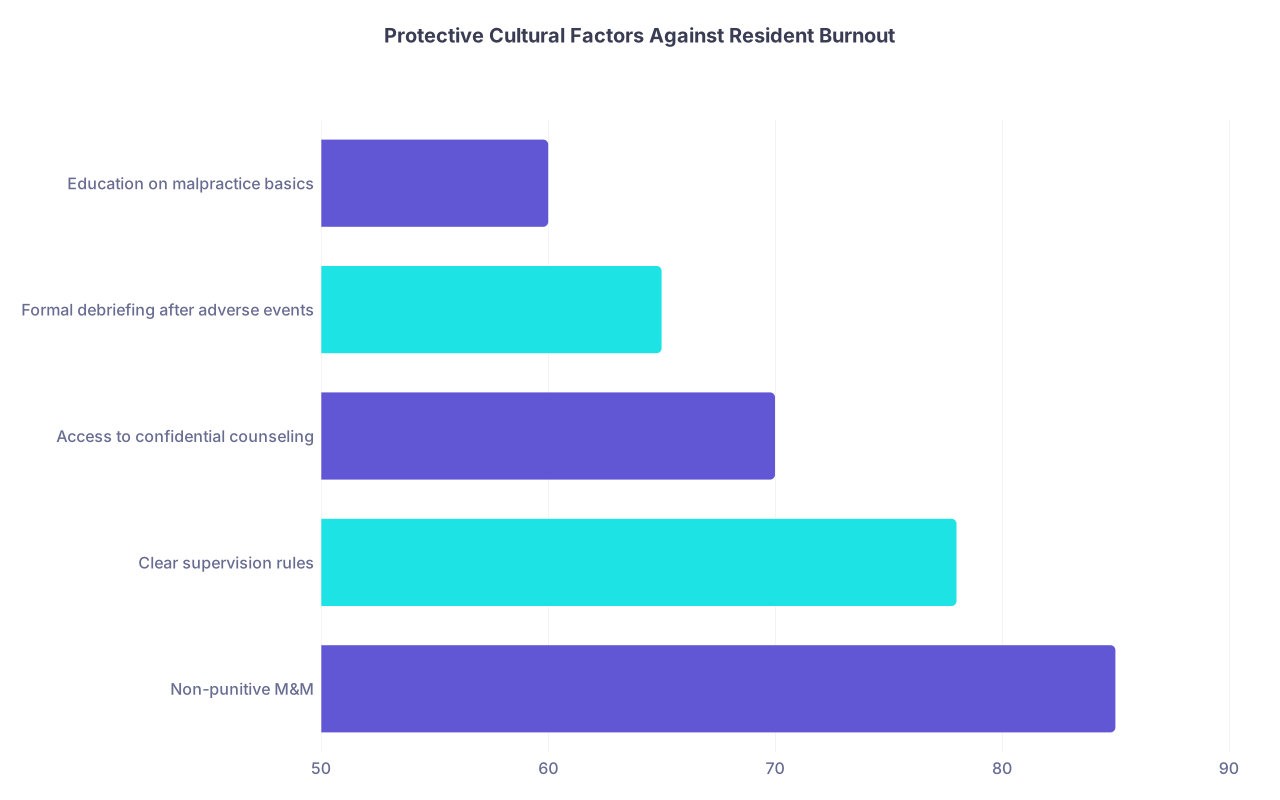
| Category | Value |
|---|---|
| Non-punitive M&M | 85 |
| Clear supervision rules | 78 |
| Access to confidential counseling | 70 |
| Formal debriefing after adverse events | 65 |
| Education on malpractice basics | 60 |
These are the interventions that actually move the needle:
Non-punitive, systems-focused M&M
- No humiliation.
- No “gotcha” style questioning.
- Explicit review of contributing factors: staffing, handoff quality, EHR design.
Transparent supervision expectations
- Clear rules on when juniors must call seniors.
- Attendings who explicitly say: “You will not be punished for waking me up for something concerning. You will be in trouble for not calling.”
Formal debriefs after bad outcomes
- A structured time where the involved team can discuss what happened, what they felt, and what changes will be made.
- Inclusion of psychological support, not just clinical autopsy.
Actual malpractice education
- One dedicated session per year where risk management or legal counsel explains:
- How malpractice works.
- How documentation helps.
- What really happens when a case is filed.
- How residents are usually positioned and protected.
- One dedicated session per year where risk management or legal counsel explains:
If your program does none of this, it is not a resident problem. It is a leadership failure.
8. When Anxiety Has Crossed the Line Into Pathology
Fear of mistakes is normal. Chronic, intrusive, physiologically intense anxiety that:
- Disrupts your sleep most nights.
- Interferes with on-shift function (panic, freezing, avoidance).
- Leads to persistent physical symptoms (GI issues, headaches, palpitations).
- Makes you dread going to work even on lighter rotations.
…is not just “part of residency.” That is an anxiety disorder sitting on top of a stressful environment.
If you are here, white-knuckling through is not bravery. It is self-destruction.
Signs you need more than self-help tactics:
- You repeatedly check labs/imaging after your shift from home.
- You have intrusive images of worst-case scenarios that pop into your head unbidden.
- You are using alcohol, benzos, or other substances to sleep or “turn your brain off.”
- Multiple co-residents or faculty have commented that you look “wrecked” or “on edge.”
Getting confidential help—from a therapist, psychiatrist, or physician health program—is not optional at that point. It is like getting a CT head on a patient with focal deficits and acute neuro change. You are the patient.
A good clinician will not just tell you to “relax more.” You should expect:
- CBT-based tools targeting catastrophic thinking and rumination.
- Guidance on exposure to feared situations without avoidance (sick patients, procedures).
- Sometimes medication to break the cycle enough that tools actually work.
You would not ignore a troponin of 2.1. Stop ignoring the psychological equivalent in yourself.
9. Putting It All Together: A Practical Weekly Checklist
You do not need another 10-point “wellness list.” You need a short, brutal checklist that targets malpractice anxiety and error fear specifically.
Once a week, ask yourself:
- Did I have at least one shift where I consciously set a realistic standard (careful, honest, responsive—not perfect) at the start?
- Did I use structured thinking (scores, checklists, standard workflows) for at least one high-risk scenario instead of pure gut?
- Did I call for help early at least once when I was stuck, rather than endlessly agonize alone?
- Did I run a mental closing routine at the end of at least one shift, rather than ruminating all day?
- Did I talk honestly with at least one peer or mentor about a case that scared me or a mistake I’m worried about?
If you can answer “yes” to 3 or more most weeks, you are actively rewiring how you handle fear of mistakes. That is the opposite of burnout drift.
FAQ (Exactly 4 Questions)
1. How do I know if my fear of making mistakes is actually helping me versus burning me out?
Look at function, not feelings. Helpful fear sharpens your focus on rounds and at the bedside, but you still sleep, still enjoy some parts of work, and can step away mentally on days off. Harmful fear leads to recurrent insomnia, compulsive re-checking charts from home, avoiding sick patients or procedures, and constant dread before shifts. If fear is degrading performance, not enhancing it, it has crossed the line.
2. Can I actually get in trouble for calling my attending “too much” overnight?
In a healthy program, no. There is a clear bias in your favor if you escalate appropriately. The residents who face serious repercussions and career risk are almost never the ones who called too early; it is those who failed to call when they should have. If an attending routinely shames you for calling about legitimately concerning issues, that is a supervisory problem you should bring to your program leadership or chief residents.
3. What should I write in the chart if I realize I made a mistake?
Document clinical facts, patient status, and your response. Example: “Heparin infusion found to be running at 1800 units/hr instead of ordered 800 units/hr. Infusion stopped, patient assessed at bedside. VS stable, no signs of bleeding. STAT CBC and coagulation panel ordered. Discussed with senior resident and attending; plan as above.” Do not speculate about blame, and do not retroactively invent a rationale you did not have. Clear, factual documentation and prompt corrective action are strongly protective.
4. How do I talk about a significant error or near-miss in a future job or fellowship interview?
Owning a serious error can be one of the most powerful examples you give, if handled correctly. Focus on four elements: brief clinical context, the specific error (without melodrama), what you personally did to disclose/address it, and the concrete systems and habits you changed afterward (checklists, earlier escalation, communication improvements). Interviewers are not looking for people who never err. They are looking for people who confront reality, learn systematically, and do not hide.
Key takeaways:
- Fear of mistakes and malpractice is normal, but when unmanaged it becomes a core driver of resident burnout.
- Your real protection is not “never err,” but behaving like a careful, honest, communicative physician before, during, and after errors.
- A few disciplined habits—structured approaches, early escalation, deliberate shift closing, and honest debriefs—can dramatically reduce the psychological load of practicing under constant uncertainty.


