

It is 11:47 p.m. You are on your seventh lap chole of the day, hands in the ports, trying to find the cystic duct that just does not look like the textbook. Your attending is humming, the scrub tech is quiet, anesthesia is scrolling on their phone. You suddenly realize you do not remember tying the last clip. You check. You did it correctly. But you genuinely do not remember doing it.
That moment—that mental “blank,” while your hands keep moving—is exactly the intersection of cognitive fatigue and motor fatigue. And if you are in surgery, GI, interventional radiology, cardiology, OB, EM with procedures, anesthesia, or any procedural heavy month, you know how fast that moment can become the norm.
Let me break this down specifically: what is happening to your brain and your hands in these months, what actually changes after hour 8–10, and what you can do that is practical, realistic, and does not depend on your program suddenly becoming enlightened about duty hours.
1. What Procedural Months Do To Your Brain (And Hands)
Procedural heavy months are different beasts than typical ward months. It is not just “more hours” or “more stress.” The load is qualitatively different.
Think about:
- Repetitive fine motor tasks under time pressure
- Continuous vigilance for rare but catastrophic complications
- Rapid task switching: clinic → consent → procedure → PACU → call → another procedure
- Layered cognitive tasks: anatomy, decision-making, technique, communication, documentation
Your brain is doing three jobs at once:
- Executive control
- Motor planning and execution
- Situational awareness and risk monitoring
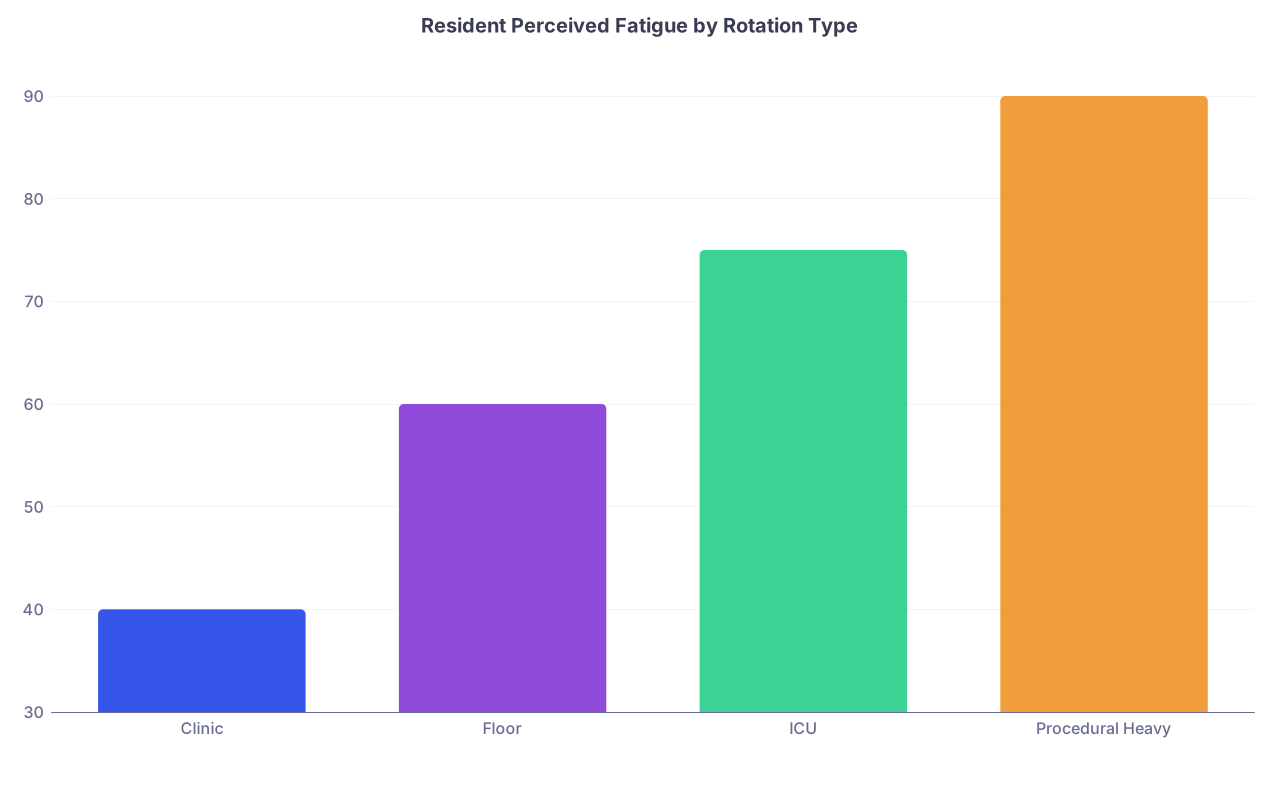
That combination is why the fatigue feels “heavier” than clinic or floor months.
| Category | Value |
|---|---|
| Clinic | 40 |
| Floor | 60 |
| ICU | 75 |
| Procedural Heavy | 90 |
Those are typical survey patterns I have seen: procedural months are consistently rated as the most draining combination of physical and cognitive fatigue.
Cognitive fatigue: what is actually happening
After repeated high-load tasks, you get:
- Slower processing speed: you notice it when simple decisions take just a hair longer.
- Reduced working memory: you forget intermediate steps, or you have to re-check labs you just saw.
- Narrowed attentional field: you “zoom in” too much on one problem and miss the big picture.
Classic example: you get hyper-focused on a bleeding small vessel while missing that the patient is drifting hypotensive and tachycardic, or you fixate on a difficult cannulation while losing track of sedation depth.
Motor fatigue: smaller but more dangerous than you think
Motor fatigue is not just “my hands are tired.” It is:
- Decreased fine motor precision
- Micro-tremor increase (especially late in long cases)
- Slower response to unexpected events (e.g., sudden bleed, loss of wire position)
- More reliance on “muscle memory” with less active monitoring
That can show up as slightly rougher dissection, more “bumping” with scopes, or fumbling with sutures that you normally place smoothly.
The scary part: motor patterns can keep running on autopilot when your cognitive control is partially offline. That is how you can “complete” a sequence of steps with minimal recall.
2. Early Warning Signs: Cognitive vs Motor Red Flags
You rarely go from “fine” to “unsafe” in one jump. There are intermediate warning signs. Residents who survive procedural specialties long term learn to monitor themselves like they monitor vital signs.
Cognitive fatigue red flags
- You reread the consent or orders 3–4 times and still feel uncertain what you just read.
- You ask the same question twice within a short period and do not realize until someone points it out.
- You lose the thread during sign-out or handover and cannot reconstruct the plan without notes.
- Decision paralysis on low-stakes issues: “Do I call the fellow for this or not?” loops in your head.
- You find yourself zoning out mid-instruction from an attending or tech.
If this is happening before lunch, not at 3 a.m. on Q3 call, your cognitive load is already too high.
Motor fatigue red flags
- Your usual moves start feeling effortful: simple purse-string sutures, basic cannulations.
- You notice increased grip strength (over-clutching handles, tense forearms).
- Subtle tremor becomes obvious when you hold instruments in the field.
- Scope control deteriorates late in the day: more mucosal trauma, slower advancement.
- You miss simple catches: dropping needles, fumbling wires, mis-threading catheters.
If your scrub tech starts saying things like “You ok, doc?” or hands you the needle holder slower on purpose—that is social feedback that your motor output looks off.
Combined warning: your “performance anxiety” disappears
This is counterintuitive. Early fatigue: you feel stressed, worried you might mess up. Deep fatigue: you stop caring. Your internal risk monitor gets numb. You just want the case to be over. That “I do not care, just done is fine” feeling in a dangerous case is a huge red flag.
3. How Fatigue Translates To Actual Risk
Let’s be blunt. Residency often runs on the implicit assumption: “We push you hard but you will still be safe.” Not always true.
Research across anesthesia, surgery, and procedural fields is consistent:
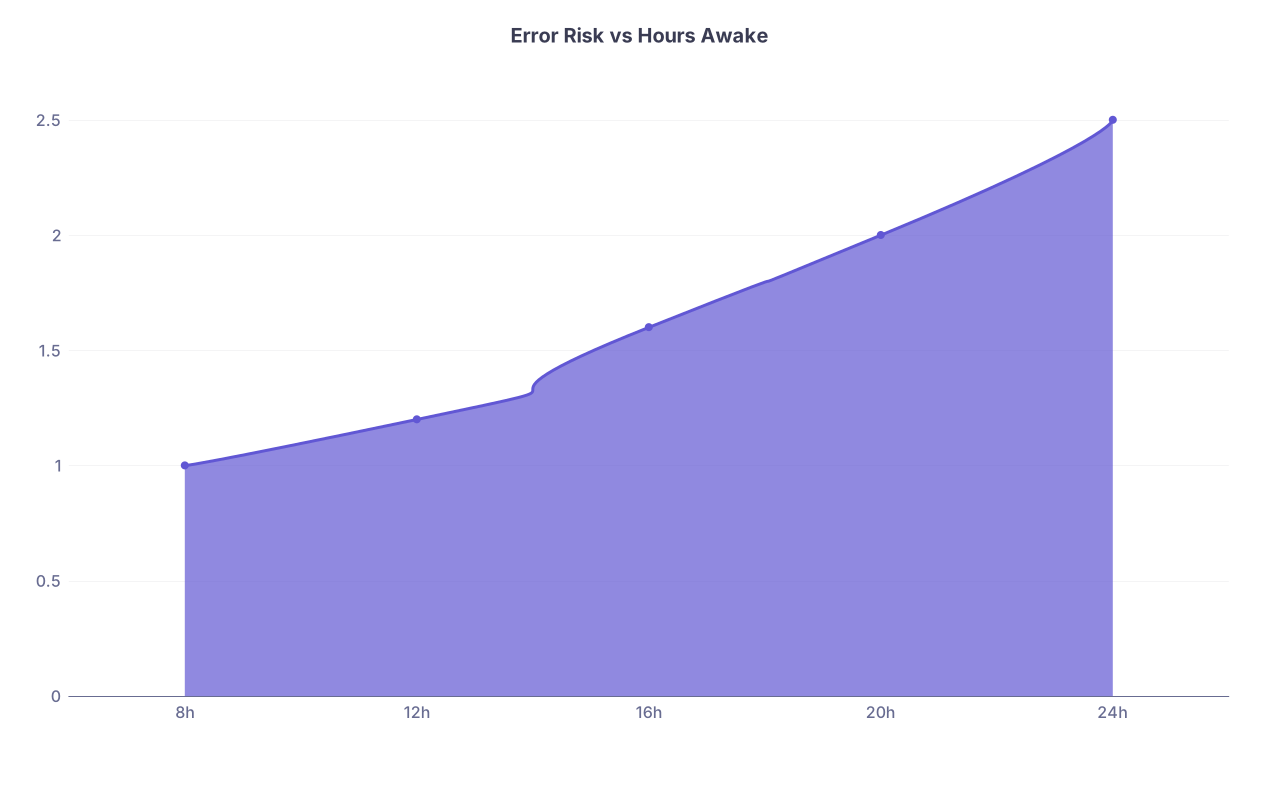
- Error rates rise sharply after 12–16 hours awake.
- Procedural complication rates nudge upward during night and after long work periods.
- Performance on simulated tasks after 24 hours awake looks like working with a blood alcohol level around 0.08.
| Category | Value |
|---|---|
| 8h | 1 |
| 12h | 1.2 |
| 16h | 1.6 |
| 20h | 2 |
| 24h | 2.5 |
That does not mean you will kill someone after hour 16. It means:
- Your margin for rare events shrinks.
- You need more backup for unusual anatomy or unstable patients.
- You must deliberately compensate for degraded performance.
Residents who last in procedural specialties are not superhuman. They are systematic. They accept that their brain is worse after 20 hours and build routines to cover for it instead of pretending otherwise.
4. Strategic Self‑Management During Procedural Months
Now the part you actually care about: what you can control.
I will break it into four domains:
- Before the month (design)
- During the day (micro‑level tactics)
- During the week (macro pacing)
- During call / nights (survival rules)
4.1 Before the month: design what you can
You do not control the call schedule. Fine. But there are levers.
- Sleep bank the week before: aim for 7.5–8 hours for several nights. “Sleep banking” has decent evidence in fatigue science; it will not make you invincible, but it softens the blow.
- Strip nonessential commitments: research meetings, elective clinics, committees—ruthlessly cut for 4 weeks. Protect cognitive bandwidth.
- Negotiate protected post‑call time early: clarify with chief / coordinator: “Post‑call, am I expected to stay for elective cases?” Put it in email so there is a record.
- Pre‑arrange life logistics: automatic grocery delivery, pre-cooked meals, simplified finances. Every decision you offload outside work protects decision-making at work.
| Task Category | What To Set Up Before Procedural Month |
|---|---|
| Sleep | 7–8 nights of >7.5h sleep |
| Food | Meal prep / delivery plan |
| Admin | Pause research/committees if possible |
| Social | Set expectations with family/friends |
| Health | Refill meds, schedule no new appts |
4.2 Micro‑level tactics: inside the OR / procedure room
Here is where most residents either develop good habits or drift into “just grind” mode.
Pre‑case cognitive reset, even 60–90 seconds
Before each case, especially after the first 3–4: step out or turn away from the monitor, close your eyes for 30–60 seconds, and mentally reset:
- Name the patient.
- State the indication.
- Identify the 1–2 highest risk points (e.g., porta hepatis dissection, retroperitoneal wire).
- Decide when you will call for help if X or Y happens.
It sounds silly. It anchors attention back to THIS case, not the four you just did.
Structured micro-breaks during longer cases
Data from microsurgery and laparoscopy is pretty consistent: 20–60 second “micro‑breaks” every 20–40 minutes reduce muscle fatigue and improve precision without lengthening the case.
What this looks like in reality:
- Between critical steps, say: “Pause for a quick micro-break.”
- Hands off instruments, roll shoulders, extend wrists, quick neck stretch, 3 slow breaths.
- Eyes off the monitor. Blink. Refocus.
Many attendings are fine with this once they realize it makes you better, not slower. A few will be annoyed. Do the micro-adjustments anyway—even if you do it silently, just loosening grip and relaxing shoulders.
Instrument / room ergonomics
You will not get a full ergonomic redesign. But minor changes matter:
- Ask for the table height to be adjusted before incision, not after your neck is already on fire.
- Confirm monitor position, especially if you are taller/shorter than average—no heroic neck flexion all day.
- For endoscopy: ensure your stance is stable, elbows relaxed, body close enough to the bed; stop leaning forward like a question mark.
I have seen PGY‑2s shave their fatigue in half just by refusing to operate hunched over at the wrong height.
Scripted “double checks” when tired
When you feel cognitively slow, you need automatic safety scripts:
- Before critical clip/ligature: “Identify. Confirm. Announce.” Say out loud: “This is cystic duct, confirmed by ___ and ___.”
- Before wire removal in IR/cardio: “Wire tip visualized. Line secured.”
- Before closure: quick mental run of sponge/needle count, drains, hemostasis hotspots.
Verbalizing steps re-engages your prefrontal cortex when it is trying to coast on autopilot.
4.3 Macro pacing: managing the week
Your week on a procedural heavy month often looks like variable waves of volume. You cannot fight all of them equally.
You need triage:
Identify your real performance-critical cases
Not all cases are equal for your learning, reputation, or patient risk. For example:
- Complex cancer resections with a high-risk attending
- First‑time balloon pump, TAVR, complex ERCP
- Trauma ex-lap at 3 a.m. with minimal backup
Decide in advance: on days with one of these, you protect your capacity:
- Sacrifice social plans the night before.
- Protect as much sleep as possible.
- Avoid heavy pre‑rounding cognitive work if someone else can reasonably do it.
Accept B‑level performance on low‑yield tasks
Your mental energy is finite. You cannot give A+ focus to:
- Every progress note
- Every minor consult
- Every low-risk, repetitive procedure you have already mastered
That does not mean sloppy or unsafe. It means “good enough, efficient, thorough but not obsessive” for the routine tasks so you have gas left for the big ones.
Create one non-negotiable recovery anchor per 24 hours
On brutal weeks you probably will not get full workouts or restful evenings. But you can build one consistent anchor:
- 15–20 minutes of walking outside post‑call (even if exhausted).
- 10 minutes of stretching before bed.
- A strict 30–45 minute “no-pager” block at home for shower, food, silence.
Residents who say “I’ll rest when this month is over” are usually smashed by week 2. You do maintenance, not catch-up.
5. Call and Night Shifts: Different Rules, Same Brain
Procedural work at night is the worst combination: circadian misalignment plus high-stakes tasks.
Here is how to not destroy yourself:
Pre‑call
- Stop caffeine 6–8 hours before planned pre‑call nap.
- Take a 90‑minute nap, not a 20‑minute sprint nap, if you can. One full sleep cycle helps cognitive resilience.
- Eat something with actual protein and carbs, not just coffee and sugar. Your motor control is worse when hypoglycemic, and I have seen it.
During call
Use a simple mental rule:
- If a decision changes anatomy permanently (cutting, clipping, embolizing, stenting), and you are cognitively slow, stall for 1–3 minutes and re-ground.
- If you feel “weirdly calm” about a high-risk maneuver at 4 a.m., that is a danger sign, not a good sign. Ask yourself: “Would I be this relaxed at 10 a.m.?”
For long overnight cases:
- Ask anesthesia for brief standing breaks when safe: “Can we take 30 seconds just to let me stretch?”
- Rotate micro-tasks: if you can, alternate between intense fine motor work and a simpler task (retraction, camera, etc.) to let small muscle groups recover.
Post‑call
This is where programs often sabotage residents the most.
Non-negotiables if you want to survive:
- Get horizontal sleep as soon as you are allowed to leave. Even 3–4 hours in a dark, cool room is better than “staying up to reset schedule” on heavy rotations.
- Avoid driving home if you are nodding off. Call a co-resident, partner, or use ride share. Residents crash cars more than people admit.
- Do not schedule anything important for post‑call mornings. No dentist, no bank, no major personal decisions.

| Step | Description |
|---|---|
| Step 1 | Pre call prep |
| Step 2 | Night call |
| Step 3 | Post call sleep |
| Step 4 | Light activity |
| Step 5 | Regular shift |
6. Mental Health, Identity, and The “Always Available” Trap
Procedural specialties often breed a toxic identity: “I am valuable if I can always do the case, no matter what.” That sounds admirable. Until it is not.
Here is where burnout quietly takes root:
- You stop acknowledging fatigue.
- You stop asking for backup.
- You start equating rest with weakness.
That culture produces burned‑out attendings who are technically good and personally miserable. You do not want to become that.
Simple mental reframes that actually help
“My job is to be safe and effective long term, not heroic short term.”
Residents fixate on surviving this month. Good proceduralists think in decades. Chronic sleep deprivation and repeated extreme fatigue states are not badges of honor; they are cumulative brain and body damage.
“Requesting help for complex cases when tired is competence, not failure.”
When you say, “I am tired and this anatomy is weird, can you scrub in?” that is the same logic you apply for unstable vitals—condition changed, support needed.
“I am allowed to be a technician today and a learner tomorrow.”
On deep-fatigue days, your goal is: do safe, efficient work. You are a technician. Fine. On lighter days, push your learning edge. Residents burn out trying to max learning every single case regardless of capacity.
When to escalate beyond self‑management
You should not white-knuckle through:
- New-onset intrusive thoughts about harming yourself
- Persistent derealization (“everything feels unreal”) during procedures
- Recurrent panic or near-panic states in the OR / lab
- Episodes where you completely lose time (“I did 20 minutes of work and have zero memory of it”) regularly
At that point, we are past “residency is hard” and into “this is unsafe and treatable.” That is where you talk to someone: trusted attending, PD, mental health professional. Yes, it is awkward. Do it anyway.
7. Working With Attendings and Teams Without Looking “Weak”
You are right to be wary: some attendings interpret any mention of fatigue as lack of commitment. Others are actually reasonable but no one has ever modeled how to talk about it.
Use language that frames fatigue as a safety / optimization issue, not a complaint.
Phrases that work better
Instead of:
“I am exhausted, I can’t do another case.”
Try:
“I can do another case, but I am noticing I am slower and I want to be safe. Is there a way we can structure it so that I handle the less critical parts and you take the high-risk step?”
Or:
“This is my seventh case; I would appreciate a quick timeout to make sure I am fully oriented before we start. Can we review the key risk points?”
Specific. Professional. Safety-focused. It signals self-awareness, not fragility.

Using the rest of the team
You are not the only one who sees your fatigue:
- Scrub techs notice your fine motor performance.
- Anesthesia notices your decision latency.
- Nurses notice if you skip safety checks you usually do.
Invite them in:
“Today is case 6; if you see me rushing past a step I normally do, please call it out. I will not be offended.”
That one sentence can catch a lot of near-misses.
8. Physical Conditioning: Yes, It Matters, But Not Like Instagram Says
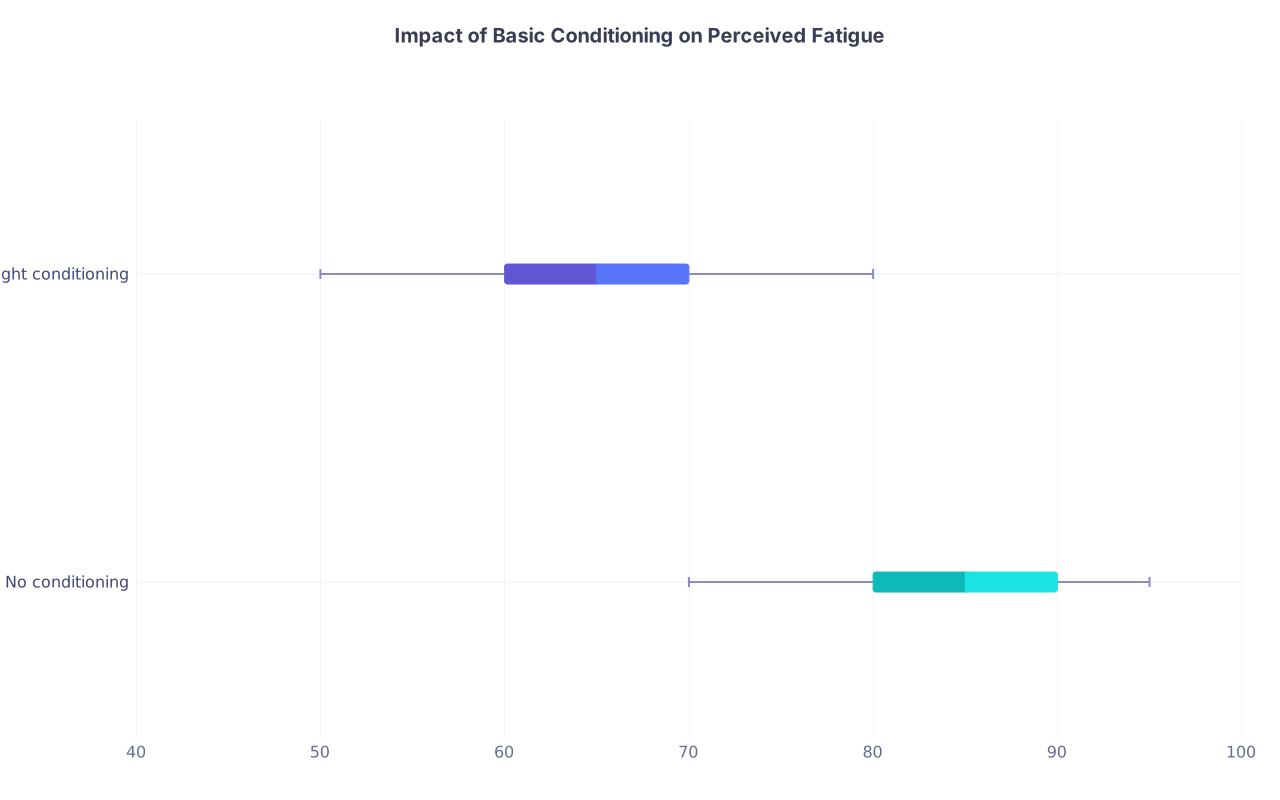
No, you do not need to become a triathlete. But you cannot ignore basic conditioning in a job that demands hours of static standing and fine motor endurance.
Minimum viable physical prep during procedural months
2–3 sessions per week, 20–30 minutes, focusing on:
- Upper back and shoulder strength (rows, face pulls, light weights or bands)
- Forearm / grip endurance (light farmer’s carries, wrist curls, theraband)
- Core stability (planks, dead bugs, bird dogs)
5–10 minutes a day: quick mobility before bed or pre‑shift:
- Neck stretches
- Shoulder rolls and pec stretches
- Wrist flexor/extensor stretches
This is not about aesthetics. Stronger postural muscles and forearms fatigue slower. That directly affects how you feel in hour 5 of standing in lead.
| Category | Min | Q1 | Median | Q3 | Max |
|---|---|---|---|---|---|
| No conditioning | 70 | 80 | 85 | 90 | 95 |
| Light conditioning | 50 | 60 | 65 | 70 | 80 |
9. Building Long‑Term Burnout Resistance in Procedural Fields
Zoom out from this one brutal month. You are training for a career where procedural bursts will keep happening: new technology rollouts, heavy call, staff shortages.
People who stay functional long term share a few traits:
- They know their early warning signs and respect them.
- They have simple, repeatable routines for sleep, food, and micro‑recovery.
- They refuse to let “always available” become their entire identity.
- They cultivate at least one domain outside medicine where they are not on a pager.

You do not build resilience by pretending you are not tired. You build it by treating your brain and body like critical instruments that allow you to do this work at a high level.
Stop thinking “I have to survive this month.” Start thinking “This month is stress testing my system; what do I need to change so I can do this for 20 years without breaking?”
FAQ (5 Questions)
1. How do I know if what I am feeling is normal fatigue versus true burnout?
Normal fatigue is transient: you feel drained after a heavy day or week, but with one or two lighter days and real sleep, you feel your baseline interest and focus return. Burnout is more persistent and global: emotional exhaustion, cynicism toward patients or colleagues, and a sense of reduced personal accomplishment that does not lift with a single day of rest. If you dread every shift for weeks, feel detached from patients, or think “none of this matters anymore,” that is burnout territory, not just being tired.
2. Is it ever appropriate to refuse a case because I am too fatigued as a resident?
Yes, but you must be precise with how you frame it. Instead of flat refusal, anchor it in patient safety and shared responsibility: “I am past 24 hours up, and I notice I am making more small mistakes. I am concerned about being primary on a complex case without additional backup. Can we adjust roles or get another operator?” If leadership ignores repeated, well-articulated safety concerns, that is a program-level problem, not a personal failing.
3. Do micro-breaks and stretches actually help, or is that just wellness talk?
There is hard data, especially in microsurgery and laparoscopic work, showing that structured micro-breaks lower muscle fatigue, reduce discomfort, and maintain performance metrics without extending case time in any meaningful way. I have watched residents go from shaking in hour 4 to stable hands simply by using brief, regular off-loads instead of white-knuckling through. So yes, they help, and they are one of the few interventions you fully control.
4. What should I do if my attending mocks or dismisses fatigue or safety concerns?
First, do not escalate in the room. Focus on getting the case done safely. Later, document what happened factually (date, time, case, exact comments). Then take it to someone with authority and some psychological safety: chief resident, associate PD, or PD. Present it not as “they were mean,” but as “I raised a fatigue and safety concern; here is how it was handled; I am worried about patient safety and resident well-being if this is the norm.” If your entire leadership shrugs, that is a serious red flag about the culture.
5. Can improving my technical skill alone reduce fatigue, or is this mostly about sleep and schedule?
Skill absolutely changes the equation. The more automatic and efficient your basic moves are, the less cognitive and motor bandwidth they require, which means you fatigue slower and have more reserve for complex parts. However, skill does not make you immune to sleep deprivation or chronic overload. Think of it this way: technique raises your ceiling; sleep and sane scheduling prevent the floor from collapsing. You need both if you want to perform at a high level for years, not just survive residency.
Key points: Cognitive and motor fatigue on procedural months are predictable and manageable if you treat them like clinical problems—identify warning signs, apply targeted interventions, and escalate when safety is threatened. Build simple, repeatable systems for micro‑breaks, sleep, ergonomics, and communication. And stop glorifying “always available” heroics; sustainable, safe practice wins over the long run.


