

The biggest lie in surgical training is that burnout is just “part of the culture.” It is not. Most of what crushes residents in the OR is predictable, patterned, and—if you are strategic—highly modifiable.
You will not fix burnout in surgery by “self-care” alone. You fix it by getting very specific about OR‑level stressors and dismantling them one by one.
Let me walk through how.
1. The Real Stressors: What Actually Breaks You in the OR
People like to talk about hours, call, and documentation. Important, yes. But for surgical residents, the operating room itself is where a disproportionate amount of psychological load sits.
Here are the actual culprits I see repeatedly:
Status anxiety in the room:
- Scrub tech eye-rolls when you fumble.
- Attending sighs when you are slow.
- Feeling like every move is judged, recorded, and weaponized.
Cognitive overload:
- You are tracking anatomy, instruments, next step, hemodynamics, and the attending’s mood—simultaneously.
- One missed step, you get barked at.
- One hesitation, someone else takes over.
Time pressure and “production mentality”:
- Turnover metrics.
- “We are behind already.”
- Pressure to move fast before you actually have the skills to be fast.
Unpredictable humiliation:
- Public pimping with no boundaries.
- Being called out in front of the whole team for something that was never taught.
- Sarcasm passed off as “teaching.”
-
- Standing still for 6 hours while retracting, shoulders on fire.
- No water, no bathroom, no break—because “we just have one more thing.”
Constant role conflict:
- You are supposed to learn and be efficient.
- You are supposed to speak up and not slow anything down.
- You are “the surgeon in training” and also “the easiest person to blame.”
That mix, repeated daily, is exactly how burnout accelerates.
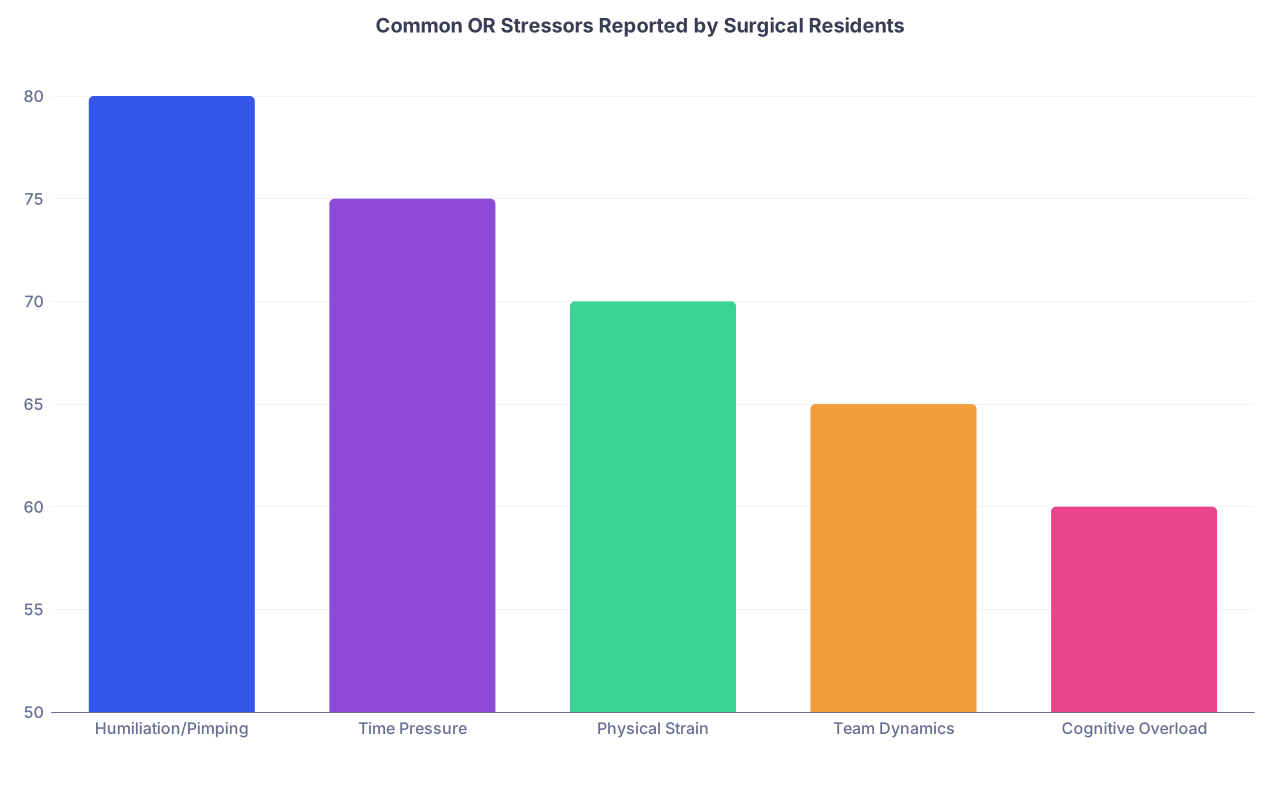
| Category | Value |
|---|---|
| Humiliation/Pimping | 80 |
| Time Pressure | 75 |
| Physical Strain | 70 |
| Team Dynamics | 65 |
| Cognitive Overload | 60 |
If you want to prevent burnout, you do not start with vague resilience. You start by targeting these drivers.
2. Pre-OR Tactics: Controlling the Case Before You Scrub
Most residents underutilize the only calm part of the process: before the patient is in the room.
A. Script a “Micro-Pre‑Brief” with the Attending
The worst OR stress comes from mismatch between what you think your role is and what the attending expects.
You kill that mismatch with a 60‑second pre-brief. Literally 60 seconds.
Example script at the board or in pre-op:
“Dr. Patel, for this laparoscopic cholecystectomy, would you be okay if I do the initial access and dissection in Calot’s, and you do the critical view and clip/cut? Also, anything specific you want me to focus on or avoid today?”
Why this matters:
- You define your role explicitly.
- You frame yourself as intentional and teachable.
- You reduce the background anxiety of “When will they let me do something / am I overstepping?”
If they say, “Today I want to move fast, I’ll do most of it,” you have your answer. You can shift your internal target to observation, anatomy, and energy conservation instead of battling disappointment for 2 hours.
B. Mental Rehearsal: Not Generic Visualization—Step-Level
Residents are told to “review the case.” Too vague.
You prevent cognitive overload by rehearsing:
- The sequence of steps you will perform.
- The exact words you will use during high-stress communication.
Example for a lap appy, junior level:
- Positioning: “Supine, both arms tucked, surgeon left side, assistant right.”
- Port placement: “10 mm umbilical camera, 5 mm suprapubic, 5 mm LLQ.”
- Dissection sequence: find cecum → follow taenia → identify appendix → open meso → divide base.
Then rehearse the hard moments:
- “Suction please, can I have more reverse Trendelenburg.”
- “I am having trouble seeing the base clearly, can we adjust the camera or the retraction?”
That way, when people get snappy, you are not building language from scratch under pressure.
C. Physical Prep Specifically for OR Endurance
“Hydrate, sleep, exercise” is generic nonsense if you do not adapt it to OR realities.
Think: reduction of micro-strain and maintaining blood sugar over 4–8 hours.
Minimalist approach:
- 10–15 minutes of shoulder / neck mobility in the morning (bands or doorway stretches).
- Pre‑case snack with protein + complex carb (Greek yogurt + granola, peanut butter sandwich, not just coffee and air).
- Preload with water before scrubbing, anticipating no breaks.
You are not training for CrossFit. You are training to hold a retractor without shaking at hour five.
3. In-OR Tactics: On-the-Table Stress Management That Actually Works
Once you are scrubbed, you do not control the schedule, the attending, or the anesthesiologist’s sarcasm. You control three things: your body, your mouth, and your attention.
A. Body Position: Mechanical Fixes for Physical Misery
I have watched residents destroy their backs because they think suffering is a badge of honor. It is not. It is a future disability.
Specifics:
Table height:
You want the operative field near your umbilicus or slightly below. If you are shrugging your shoulders to reach, ask:
“Can we drop the table 2–3 centimeters?”
Say it early. Not after your traps are on fire.Feet and stance:
Slight bend in knees, weight distributed, feet about shoulder width. Locking your knees + leaning forward = guaranteed fatigue and presyncope risk.Retractor technique:
Do not “dead lift” the retractor. Stack your skeleton. Tuck your elbows close, let your torso support the arm, mini micro-movements every few minutes to redistribute strain.
You prevent burnout by not having every case feel like a physical punishment.
B. A Simple In-OR Mental Reset Protocol
People recommend “mindfulness” like you can just meditate mid-suture. You cannot. But you can build fast, invisible resets.
I use a 3‑step, 15‑second version you can do even while holding instruments:
Micro body scan:
Ask yourself: jaw tight? Shoulders up? Breath shallow? Relax each one 10–20%. Not floppy. Just out of fight-or-flight.One full deep breath cycle:
In through nose for 4, hold 2, out through mouth for 6–8. Nobody notices one breath. Your heart rate will.Re-anchor with a single focus phrase in your head:
“Next step: expose the cystic duct.”
Not past errors, not future humiliation. Just the next concrete step.
Do this every time:
- You get snapped at.
- You feel yourself flushing or sweating.
- You realize your mind is spiraling (“I am terrible, they hate me, I should quit”).
You do not need 10 minutes. You need consistent 10‑second interventions.
C. Managing Pimping and Verbal Pressure Without Melting
Pimping itself is not the enemy. Chaotic, hostile pimping is.
You cannot stop attendings from asking questions. You can control your responses, and this dramatically reduces your stress.
Three rules:
Answer concise and structured.
Say you are asked: “What are the components of the Calot triangle?”Do not ramble.
“Common hepatic duct, cystic duct, and inferior edge of the liver. Historically, the cystic artery was included, but current definition uses the liver edge.”Admit uncertainty cleanly.
If you do not know, say:
“I am not sure. My best guess is X because Y.”
Or: “I do not know the exact number, but I know the range is around…”
That shows thinking, not laziness.Deflect humiliation with neutral language.
If someone says, “Did you even read for this case?” you can say:
“I did review, but I missed that point. I will read specifically on that tonight.”
You are not there to win a courtroom drama. You are there to show learning behavior consistently. That is how you protect your self-worth from bad pedagogy.
4. Communication Tactics: Protecting Yourself While Preserving the Team
Most residents underestimate how much communication style affects OR stress. Clear, brief, assertive communication lowers everyone’s blood pressure—including yours.
A. Standard Phrases That Make You Safer and Less Anxious
You should have a few memorized lines for high-stress moments.
When you cannot see / are lost:
“I am not confident about the anatomy here. Can we pause for a better view before proceeding?”When you are at your cognitive limit:
“I am at capacity with my current tasks. Can we adjust roles for a minute so I do not miss anything critical?”When something feels wrong with the patient:
“Something looks off to me. The field is getting more bloody / vitals have changed. Can we reassess before the next step?”
You will feel like you are slowing things down. You are not. You are preventing errors, which every good attending actually cares about.
B. Managing Conflict with Scrub Techs and Nurses
A toxic scrub tech can ruin your day. But you do not have to accept abuse as “just how it is.”
Tactics:
Use task-focused language, not personal.
Instead of: “Why are you not giving me the right instruments?”
Try: “For this step, I am looking for a long DeBakey, not the short one. Can we swap?”Set a quiet boundary when behavior crosses the line.
Low voice, calm:
“I understand we are behind, but comments like that make it harder for me to focus. I am trying to move efficiently.”
If the environment is consistently hostile, document concrete incidents (dates, direct quotes) and bring them to your chief or PD. Chronic low-level OR disrespect is a major burnout driver that programs often underestimate.
5. OR Case Mix, Autonomy, and Burnout: Being Strategic, Not Passive
Not all OR days are equal. Some are “battery charging”; some are “battery draining.” You need to recognize the pattern.
| OR Day Type | Burnout Risk | Characteristics |
|---|---|---|
| High-autonomy teaching | Low | Guided, graded responsibility |
| Observation-heavy | Medium | Minimal hands-on, little feedback |
| High-volume, low-teaching | High | Many cases, fast, no discussion |
| Toxic team dynamics | Very High | Humiliation, blame, sarcasm |
| Long complex rare case | Variable | High cognitive load, can be rewarding |
A. Seek High-Yield Cases Intentionally
You cannot control the entire schedule, but you usually have some influence through chiefs, coordinators, or the board runner.
Be explicit about your goals:
- “I would like more basic laparoscopic cases where I can do most of the case.”
- “I need more vascular exposure before I graduate.”
- “I have been on mostly observation days this month; can I be on a service with more junior-level cases?”
Being passive about case mix is a fast way to feel like a retractor stand for 3 years.
B. Track Autonomy, Not Just Numbers
Logging “number of cases” is necessary for ACGME. It is useless for your psyche.
Keep a simple private log:
- Case type
- Your level of autonomy (0–3 scale: 0 = just watching, 3 = you did most of it)
- Attending style (supportive, neutral, toxic)
Patterns will emerge:
- Which attendings consistently entrust you with more.
- Which days leave you demoralized.
Then you can:
- Ask to scrub with attendings who match your learning style.
- Mentally buffer yourself for days with known toxic players (and lean harder on your post-OR recovery plan those days).
6. Post-OR Decompression: Protecting the “After”
The damage from OR stress does not end with skin closure. It keeps running in your head unless you shut it down properly.
A. A 5–10 Minute Post-Case Debrief—Even If Informal
The gold standard is a quick, structured debrief with the attending. Many will not initiate it. You can.
As you are de-gowning or heading out:
“For my learning, can I ask you two quick things?
- One thing I did well today?
- One thing I should focus on improving for next time?”
You get:
- Concrete positive reinforcement (which residents chronically lack).
- One clear improvement target, not a generalized “I suck” narrative.
If they are rushed: “If you have time later, I would really appreciate a quick email or note about those two things.”
Even 30 seconds of focused feedback can cut through hours of rumination.
B. Interrupting the Rumination Spiral
What burns residents out is not just the bad case. It is replaying the bad case at 2:00 a.m. for the next 3 nights.
I push residents to standardize a “rumination cut-off” protocol:
Set a limit:
You are allowed 10–15 minutes after the case to mentally review what went wrong and what to change.Write down 3 bullet points:
- What happened.
- What you will do differently next time.
- Anything you need to read or practice.
Once written, you are done.
Every time your brain replays the scenario, you tell yourself:
“Already processed. I have an action plan.”
Then redirect attention to something sensory: shower, walk, music.
You are training your brain that OR errors are data, not identity.
7. Program-Level and Culture-Level Guardrails
You cannot single-handedly fix a malignant culture as a PGY‑2. But you are not powerless either. Burnout prevention becomes real when programs hardwire certain OR practices.

| Step | Description |
|---|---|
| Step 1 | High OR Stress |
| Step 2 | Decreased Performance |
| Step 3 | Attending Frustration |
| Step 4 | Increased Criticism |
| Step 5 | Resident Anxiety |
| Step 6 | Sleep Disturbance |
| Step 7 | Higher Burnout |
Breaking that loop requires structural changes. A few high-yield ones:
A. Formal OR Behavior Standards
Programs should have explicit, written expectations for OR conduct. Not generic “we value respect” nonsense. Actual behaviors.
For example:
- No yelling, name-calling, or personal insults.
- Feedback directed at actions, not character (“This technique is unsafe,” not “You are incompetent”).
- No teaching by humiliation.
Residents can push for this through the residency council, wellness committee, or ACGME surveys. The key is documenting patterns, not just anecdotes.
B. Protected Teaching Cases
Every program claims to “value education.” The proof is whether specific cases are intentionally slowed down and structured for resident learning.
One approach:
- Each junior gets at least 1–2 “teaching cases” per week:
- Non-time-pressured.
- Explicitly planned as graded autonomy opportunities.
- Debriefed after.
This alone can massively reduce burnout because it reassures residents that their training is not an afterthought to RVUs.
C. Structured Support After Adverse Events
A bad outcome or complication can emotionally gut a resident, especially if it happens in the OR where everyone sees it.
Programs need:
- Automatic debrief within 24–72 hours.
- Psychological support and access to peer or faculty mentors trained in second-victim support.
- Explicit messaging: “Complications are part of surgery, and we learn from them; they are not moral failures.”
When this is missing, residents internalize every complication as evidence they should not be surgeons.
8. Putting It Together: A Sample “OR Burnout Prevention” Micro-Plan
Let me be concrete. Here is how a single day can look if you are intentional.
You are a PGY‑2 on general surgery. Two big cases: an open colectomy and a lap chole.
Morning:
- 10 minutes: You read your 1–2 key steps for each case, visualize your specific role.
- Before first case: You ask attending, “For the colectomy, could I handle the midline incision and some of the mobilization? Any particular things you want me to focus on?”
During the case:
- You adjust table height early.
- You use the 15‑second reset whenever you feel flustered or get snapped at.
- When unsure about planes, you say, “I am not fully confident in the plane here; can we confirm before proceeding?”
After the case:
- As the patient leaves: “Could I get one thing I did well and one thing to improve for next time?”
- You jot 3 bullets in your phone or notebook: “Need to practice knot tying faster; review anatomy of left colon; better retractor angle to avoid fatigue.”
Evening:
- 10–15 minutes: You read one focused resource on your weak point from today’s case.
- When your brain tries to replay the attending’s irritated comment at midnight, you say: “Already processed. I have an action plan. Done.”
This is not idealized wellness brochure stuff. This is how residents who survive and grow actually operate.
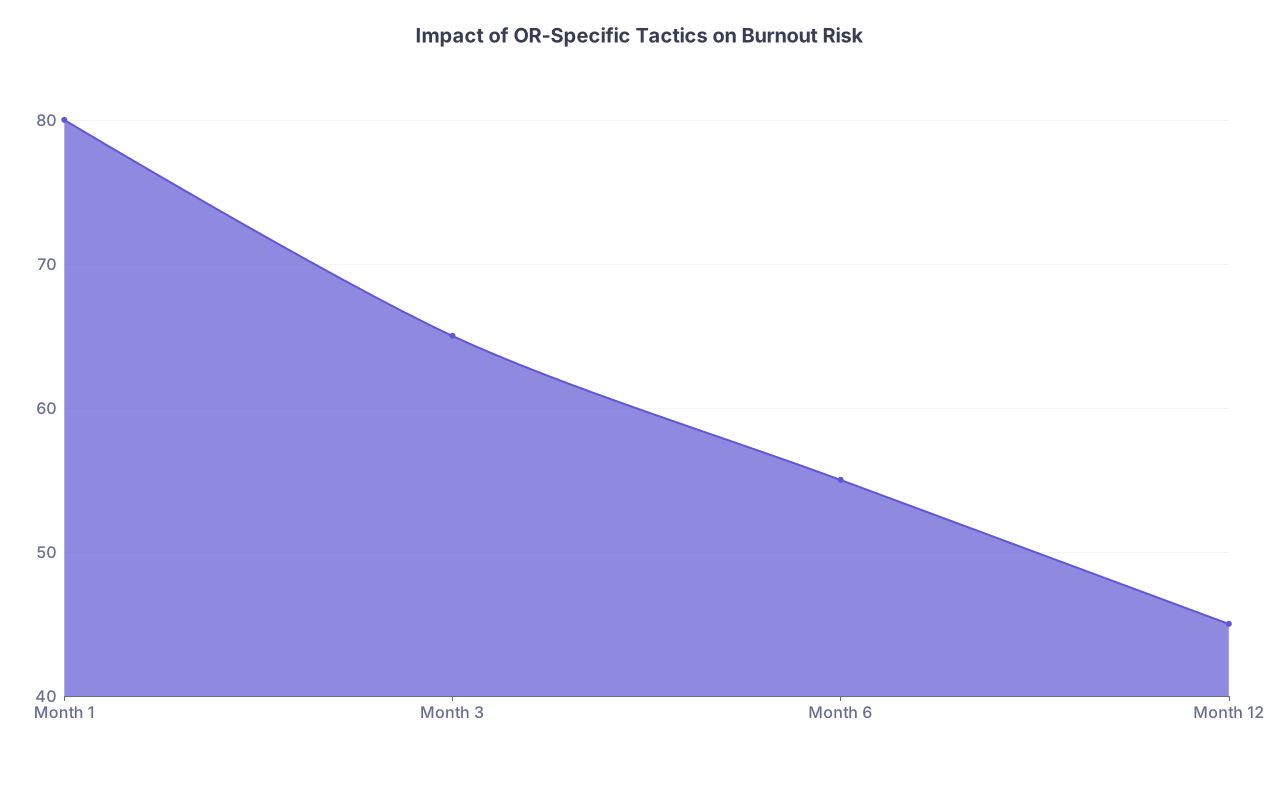
| Category | Value |
|---|---|
| Month 1 | 80 |
| Month 3 | 65 |
| Month 6 | 55 |
| Month 12 | 45 |
Over months, residents who systematize these micro-tactics report:
- Lower perceived toxicity (even in the same program).
- Increased sense of mastery.
- Less dread walking into the OR board area.
Not because their program magically improved. Because they stopped going in unarmed.

FAQ (Exactly 4 Questions)
1. What if my attending is consistently demeaning in the OR—do I just endure it?
No. You do not “have to” accept outright abuse as the price of training. First, protect yourself in the moment with neutral, task-focused responses and your internal reset tactics so the damage is minimized. Then document patterns: date, case, direct quotes, witnesses. Bring this to a trusted chief, associate PD, or ombuds. One bad day is life. A sustained pattern of humiliation is a professionalism issue. Programs rarely act on vague complaints but will respond to specific, repeated behaviors, especially if multiple residents report the same thing.
2. How do I balance speaking up for safety with not being labeled “too slow” or “scared”?
The trick is to frame your concern as performance-focused, not fear-based. For example: “I want to be safe and efficient, and right now I am not seeing the anatomy well enough to be either. Can we adjust X so I can proceed more confidently?” Good surgeons respect that. If someone labels that as weakness, that is a reflection of their insecurity, not your competence. Long term, the residents who speak up selectively and clearly are trusted more, not less.
3. I feel like I never get hands-on time in the OR. Is that a burnout issue or just typical early training?
Chronic lack of autonomy is absolutely a burnout driver. Watching case after case without meaningful participation erodes your motivation and identity as a surgeon. Early PGY years will be observation-heavy, yes, but you should still see a gradual increase in responsibility: skin closure → simple laparoscopic steps → portions of open cases. If months go by and you are still just retracting, raise it with your chiefs and PD, using your case/autonomy log as data. “I have done 40 lap choles and only done the camera work” is concrete and actionable.
4. Do these OR-specific tactics actually help if my overall workload and call schedule are brutal?
They help more than you think. You might not have the power to change your call schedule tomorrow, but you can change how much psychological and physical damage each OR day does to you. Residents often notice that once OR stress becomes more manageable—less humiliation, less rumination, fewer physical aches—they suddenly have more bandwidth to handle the same workload. Is it enough in a truly malignant environment? Sometimes not, and then the “tactic” is planning an exit strategy or transfer. But for many programs, the difference between barely hanging on and actually growing is this: you stop treating the OR as chaos and start treating it as a system you can game.
With these OR-specific tactics in place, you are not just “toughing it out” through residency—you are building the habits that will let you operate, teach, and lead without burning out later. The next step is applying this same level of precision to your call nights and ICU rotations. But that is another conversation entirely.


