

You are post‑call in the MICU workroom. It is 9:40 a.m. You just signed out a 43‑year‑old with metastatic colon cancer, intubated, on three pressors, worsening lactate, and a spouse who keeps saying, “Do everything. He is a fighter.” You charted “poor prognosis,” you documented the fifth family meeting this week, and you still feel like you are harming more than helping. You are not just tired. You feel wrong inside.
That is moral distress. And if you keep racking it up week after week without a plan, it becomes burnout with teeth: cynicism, disengagement, emotional blunting, and sometimes “I should just quit medicine” at 3 a.m. on night float.
Let me break down, very specifically, how to build a targeted burnout‑prevention plan around ICU rotations and moral distress. Not fluffy wellness posters. A deliberate, resident‑level strategy.
1. Get Precisely Clear: What Moral Distress Actually Is in the ICU
“Burnout” gets blamed for everything from being annoyed at Epic to having a panic attack in the stairwell. That vagueness is useless. Moral distress is narrower and sharper.
Moral distress = you know the ethically appropriate action, but you feel blocked from doing it, or you are compelled to participate in care that violates your core values.
In the ICU, common patterns:
Treatment you believe is non‑beneficial or harmful
The classic: multi‑organ failure, no meaningful chance of recovery, but full code, escalating vasopressors, dialysis, CRRT, maybe ECMO. You push norepi up another notch and feel like you are torturing a body, not caring for a patient.Conflicting goals of care
Family demands “everything,” team thinks comfort care, consultants are hedging, attending is conflict‑avoidant. You are the one standing in the room absorbing the rage, tears, and confusion.Resource constraints
No step‑down beds, no transfer to tertiary center, staffing crunch, limited time for family meetings. You are forced into rushed decisions or delayed conversations that you know are suboptimal.Hierarchy/power problems
You disagree with the plan (for example, cracking a chest on a clearly unsalvageable arrest), but speaking up feels unsafe or futile. You leave the room with your stomach clenched.
These are not “I am tired” problems. These are “my professional identity is colliding with what the system is asking me to do” problems.
You need to separate them mentally from generic stress:
- Fatigue: “I cannot keep my eyes open.”
- Overload: “I have too many tasks for the time I have.”
- Moral distress: “I am doing things that feel wrong, and I cannot stop.”
Why do you care about this distinction? Because the countermeasures are different. Sleep fixes fatigue. Better task management helps overload. Moral distress needs ethical, emotional, and systemic strategies.
2. Know the Trajectory: How ICU Moral Distress Turns into Burnout
Moral distress itself is not the enemy. It is data. It is your internal alarm that something about the care environment or decision making is misaligned with your values.
It becomes dangerous when:
- It is chronic (case after case, month after month).
- You have low perceived control or voice.
- There is no structured way to process it (no debriefs, no mentorship, no ethics support that actually gets used).
- You start coping with detachment instead of engagement.
The progression usually looks like this:
Stage 1 – Acute moral distress:
You feel upset after specific cases. You talk about them with co‑residents or your partner. You still care deeply.Stage 2 – Moral residue:
The cases stack. You remember the family whose wishes were ignored, the patient who died during a code you believed should never have happened. You begin to dread “those conversations.”Stage 3 – Crescendo effect:
Each new morally distressing case hits harder because of the residue from prior ones. You snap quicker. Or you shut down faster.Stage 4 – Moral injury / burnout:
You feel betrayed by the system, or by senior physicians, or by your own role. You start telling yourself: “This is all futile. None of this matters. People are just numbers.” That is not a personality change; it is a protective shell.
If you do not intervene before Stage 3–4, ICU months become personality‑shaping in bad ways. I have watched smart, empathetic interns enter residency wide‑eyed and leave their third‑year MICU convinced that every family is manipulative and every code is theater.
So the prevention target is not “never feel distressed.” That is impossible and honestly undesirable. The target is: do not let distress silently accumulate into residue and cynicism.
3. Map Your ICU Risk Profile: Where and When You Break
You need a personalized risk map. Not some generic self‑care checklist.
Look at your last ICU or high‑acuity month and ask yourself three questions:
Which types of cases stuck with me for more than 48 hours?
Examples I hear over and over:- Young patient with devastating anoxic brain injury and parents insisting on full code.
- Older patient clearly dying, but a subspecialty attending pushing for “one more intervention.”
- Withdrawal of care where you felt the process was rushed or poorly explained.
When during the rotation was I most emotionally brittle?
- Post‑call morning
- Week 2 (fatigue peaks, novelty drops)
- Last few days (pre‑switch, emotionally exhausted, already half checked out)
Who on the team made distress better or worse?
- The attending who actually sat in on the family meeting versus the one who barked, “Just tell them the prognosis and move on.”
- The fellow who asked, “How are you doing with this case?” versus the one who turned every question into pimping.
Write this down. Not in your head. Real notes, even just a half‑page in your phone or a small notebook:
- “Trigger cases: non‑beneficial escalation, unclear goals of care, kids’ parents demanding miracles.”
- “Worst time: night 2–3 of nights, post‑call day when I skip breakfast and don’t decompress.”
- “Helpful attending style: direct but humane, willing to lead family meetings. Toxic style: conflict‑avoidant, dumps communication on resident.”
This becomes the backbone of your prevention plan: you are not managing “ICU stress” in general; you are targeting your high‑risk patterns.
4. Build a Pre‑Rotation Contract With Yourself
You are about to start another ICU month? Good. Do not walk in “hoping it will be better.” Plan it.
I like a simple one‑page “ICU contract” you write before day 1:
Section 1: Non‑negotiable physical safeguards
You cannot think straight about ethics when you are physiologically wrecked.
Examples:
- Caffeine cap: “No caffeine after 4 a.m. on nights, 3 p.m. on days.”
- Minimum sleep floor: “If I am slept less than 4 hours post‑call three days in a row, I will email chief to flag it.”
- Baseline movement: ten minutes of walking outside after the shift three days a week. Not for fitness. For nervous system reset.
Section 2: Moral distress red flags
List 3–5 phrases or behaviors that mean, “I am crossing from distress into burnout territory.”
Common ones:
- “I do not care what happens to this patient anymore.”
- “I hope the code just fails so this is over.”
- Avoiding opening the chart on certain patients because it makes you feel sick.
- Fantasizing about walking out mid‑shift.
Those are not shameful. They are alarms. Your contract should state: “If I notice any of these for more than two days, I will do X, Y, Z” (we will get to what those are).
Section 3: Communication commitments
- “I will ask to be included in at least one goals‑of‑care family meeting per call day if possible.”
- “I will speak up to my attending or fellow at least once per week when I see a clear mismatch between interventions and the stated goals of care.”
Not for heroics. For alignment. Staying aligned reduces moral residue.
5. On‑Shift Tactics for Moral Distress in Real Time
You are in the room. The patient is clearly dying. The family is clinging to “full code.” The fellow wants to “give it another 24 hours” despite multiorgan failure. You feel your chest tighten.
There are three layers you can control in real time:
A. Micro‑level: Regulate your own physiology
If you stay in sympathetic overdrive, you lose nuance. Your brain collapses to black‑and‑white: “They are wrong, I am right” or “This is pointless.”
Fast, practical moves (30–90 seconds):
- Tactical breathing: in for 4, hold 4, out for 6–8, repeat 4–6 cycles as you sanitize your hands or walk out of the room.
- Grounding: pick 3 objects in the room and silently describe them in detail to yourself (“blue pump, white tubing, red label”). It yanks you out of rumination.
This is not mindfulness theater. It is how you keep the thinking brain online long enough to make a good decision or say something useful.
B. Team‑level: Clarify and document goals early
Moral distress explodes when goals are vague. Your job is not to decide goals alone, but you can nudge the team relentlessly towards clarity.
Before or after rounds, you can ask:
- “Can we explicitly state the goals of care for bed 7 today? Are we still pursuing full recovery, or are we shifting towards comfort and time with family?”
- “Does today’s plan actually match that goal? Because we said comfort, but we are adding vasopressin and another line.”
This does two things:
- Forces attendings/fellows to confront mismatch between stated goals and plan.
- Puts the ethical tension in the open, not just in your head.
Then document clearly: “Discussed with attending: overall prognosis poor, focus on comfort and family presence, not escalation. Code status remains DNR/DNI per patient’s prior wishes.”
Documentation matters. When the night cross‑cover wonders why you did not escalate, that note is protection—ethically and professionally.
C. Patient/family‑level: Stop being the apology buffer
Residents often absorb distress by smoothing over bad communication from others. That is a fast track to burnout.
You cannot rewrite what the surgeon told them yesterday (“We are going to fix this”), but you can:
- Use clear, non‑euphemistic language:
“His heart, lungs, and kidneys are failing. We do not see a realistic path back to the kind of life he had before.” - Name uncertainty honestly:
“I cannot predict the exact hour or day, but we are measuring in days, not weeks or months.”
Do not overstep your attending’s frame, but do not lie to make people feel better. Lying is rocket fuel for moral distress.
6. Structured Debriefing: Not Just Venting in the Workroom
Residents say, “We debrief all the time—we complain constantly.” That is venting. It helps 5%. The other 95% requires structure.
Here is a workable, 10–15 minute debrief format you can use after a particularly rough event (futile code, conflict‑laden withdrawal, ugly family meeting):
Step 1 – Call it out
“Can we take ten minutes after sign‑out to debrief that last case? It was rough.”
Step 2 – Brief facts (1–2 minutes, no rehashing drama)
Intern or senior summarizes: diagnosis, key events, what happened at the end.
Step 3 – Each person answers 3 questions:
- What felt right to you in how this was handled?
- What felt wrong or unfinished?
- What do you wish had been different (about timing, communication, decisions)?
Step 4 – Label the moral issues explicitly
Name them:
- “Conflict between family’s insistence on full code and patient’s previously expressed wishes.”
- “Pressure from consultant to escalate when ICU team felt it was futile.”
- “System issue: no earlier palliative involvement because consult took 48 hours.”
Step 5 – Extract one concrete learning or change
Not “we should communicate better.” Useless. Something like:
- “Next time we see rapid decline with unclear goals of care, we will set a family meeting by day 2, not day 5.”
- “We will ask for attending‑to‑attending conversation when consultant demands escalation that contradicts ICU plan.”
You can do this even if your attending is uninterested. Residents and fellows alone can run this. I have seen programs where seniors protect ten minutes at the end of every call night just for this.
7. System‑Facing Moves: Use the Power You Actually Have
You are low in the hierarchy, but you are not powerless. You see the front‑line ethical crashes clearer than anyone.
Here are levers residents underuse:
Early palliative care or ethics involvement
Stop treating palliative and ethics as “failure” or “last resort” consults.
If you have:
- Recurrent family‑team disagreement about code status or escalation.
- Clear mismatch between prognosis and treatment intensity.
- A team split (“half of us think this is futile”).
You can say: “I think this case would benefit from palliative care and maybe early ethics input. It might help us align treatment with what the patient would want.”
If your attending agrees once or twice and sees the value (less time in circular family meetings, clearer documentation, less conflict), it becomes normalized.
Feeding back patterns to leadership
One resident complaint is easy to ignore. But consistent patterns, described concretely, can move things.
Do this after the rotation, not during week 1 when everything feels like a crisis.
Send a short, specific email to the program director or ICU director:
“Over this last MICU month, I noticed recurring moral distress around delayed goals‑of‑care conversations. Multiple families heard “we are doing everything” for a week before they finally heard a clear statement about prognosis. It might help if we had:
- A template or prompt in the ICU admission note to document preliminary goals of care by day 2.
- A default practice to consider palliative consult for patients with 2 or more failing organs expected to be in ICU >7 days.”
You are not ranting. You are identifying a process problem and proposing a practical fix.
8. Post‑Rotation Repair: How to Actually Discharge the Moral Residue
Once the ICU month ends, most residents do the worst possible thing: try to forget it.
That is how residue hardens.
Block 60–90 minutes within the first week after the rotation. Solo or with a trusted co‑resident who was on with you.
Run through this sequence:
List the 2–3 cases still in your head
Patient initials, room numbers, basic story. Do not avoid the ugly ones.For each, write answers to three prompts:
- What about this case violated my values or felt ethically wrong?
- What, if anything, did I do that I am proud of in that case? (There is always something.)
- What was outside my control that I am still unfairly blaming myself for?
Identify the themes
Maybe:- You are particularly wrecked by young patients with poor neurologic recovery.
- You hate feeling like a passive bystander when seniors avoid difficult conversations.
- You feel sick when you have to perform “futile codes.”
Translate at least one theme into a behavior for the next ICU
Example:
Theme: “I feel worst when families are unclear for days and then are blindsided.”
Behavior: “On my next ICU month, I will ask attendings on day 1–2 for each high‑risk patient: ‘Have we told the family how sick they really are in plain language?’ If not, I will push for that conversation earlier.”
This is how you convert residue into growth rather than scar tissue.
9. A Targeted Personal Toolkit: What Actually Belongs in Your Burnout Plan
You do not need twenty things. You need a small toolkit you will actually use.
Here is a structured way to build it.
| Domain | 1–2 High‑Yield Tools You Should Choose From |
|---|---|
| Physiologic base | Sleep floor, caffeine cut‑off, brief movement after shift |
| On‑shift regulation | Tactical breathing, grounding, brief step‑out reset |
| Communication | Early goals‑of‑care questions, clear language with families |
| Team process | Mini‑debriefs after high‑impact events, explicit moral issue labeling |
| External support | Palliative/ethics consults, mentor check‑ins, therapy/peer support group |
Pick one from each row and commit. That is your plan. Put it somewhere visible. Your phone lock screen. A Post‑it in your ICU coat pocket.
10. When You Are Already in Trouble: Triage, Not “Be More Resilient”
Sometimes residents read all this after they are already deep in the hole. Nightmares about codes. Dreading any ICU shift. Feeling emotionally flat.
If that is you, this is not about optimization. It is triage.
Specific signs you are beyond normal stress:
- You feel intense dread days before starting ICU or nights to a degree that is disproportionate.
- You avoid certain patients or conversations because they trigger panic or rage.
- You think often, “I should not be a doctor,” not just “I hate this month.”
- You have intrusive memories or physiological reactions (heart racing, sweating) when you recall specific crises.
Stop trying to self‑manage that exclusively. You need at least one of:
- A confidential session with your institution’s mental health provider or an outside therapist familiar with medical trauma.
- A candid conversation with a trusted faculty mentor who can help you adjust rotations, build support, or protect you from punitive responses.
- In some cases, a schedule adjustment: spacing ICU months, avoiding stacking ICU + nights + oncology back‑to‑back.
This is not weakness. ICU work can create something very close to PTSD when there is repeated exposure to ethically fraught suffering with limited control. You would not tell a trauma patient to “do more yoga.” Apply the same logic to yourself.
11. Concrete Examples: What This Looks Like in Real Life
Let me make this less abstract.
Example 1: The futile code
You are the senior on nights. An 82‑year‑old with septic shock, biventricular failure, multi‑organ failure arrests. Code is chaotic and long. ROSC, then another arrest. Attending pushes to “keep going, family wants everything.” You walk out feeling nauseated.
Targeted actions:
- Next day (or after sleep), you ask for a 10‑minute debrief with the night attending, intern, and nurse. You say: “What felt wrong about that code to each of us? What could we do differently next time, including earlier goals‑of‑care conversations?”
- You write a de‑identified reflection email to yourself or your mentor, describing what specifically felt like a violation of your values.
- For future similar patients, you proactively ask on admission: “Given this prognosis, can we clarify now what the patient would want if their heart stops?”
Example 2: Family insisting on miracles for a brain‑dead patient
You feel like you are participating in a charade: pumps on, ventilator humming, no hope of recovery.
Targeted actions:
- You ask your attending: “Can palliative care or ethics help us with this conflict? I am worried we’re continuing interventions the patient would not want.”
- You document clearly: “Brain death determined per protocol. Life‑sustaining measures ongoing while family processes and explores organ donation.”
- Off‑shift, you process with a peer or therapist specifically about the conflict between your values (honesty, non‑maleficence) and the system’s approach.
Example 3: Chronically distressed resident
Every ICU month leaves you more cynical. You catch yourself saying “I hate families.”
Targeted actions:
- You flag this as a red‑flag in your contract.
- Before the next ICU rotation, you schedule a standing 30‑minute check‑in midway through with a mentor or therapist. You treat this as non‑optional, like clinic.
- You use a simple tracking system: each week, you write down 1 case that reaffirmed your values, not just the awful ones. You need counter‑examples.
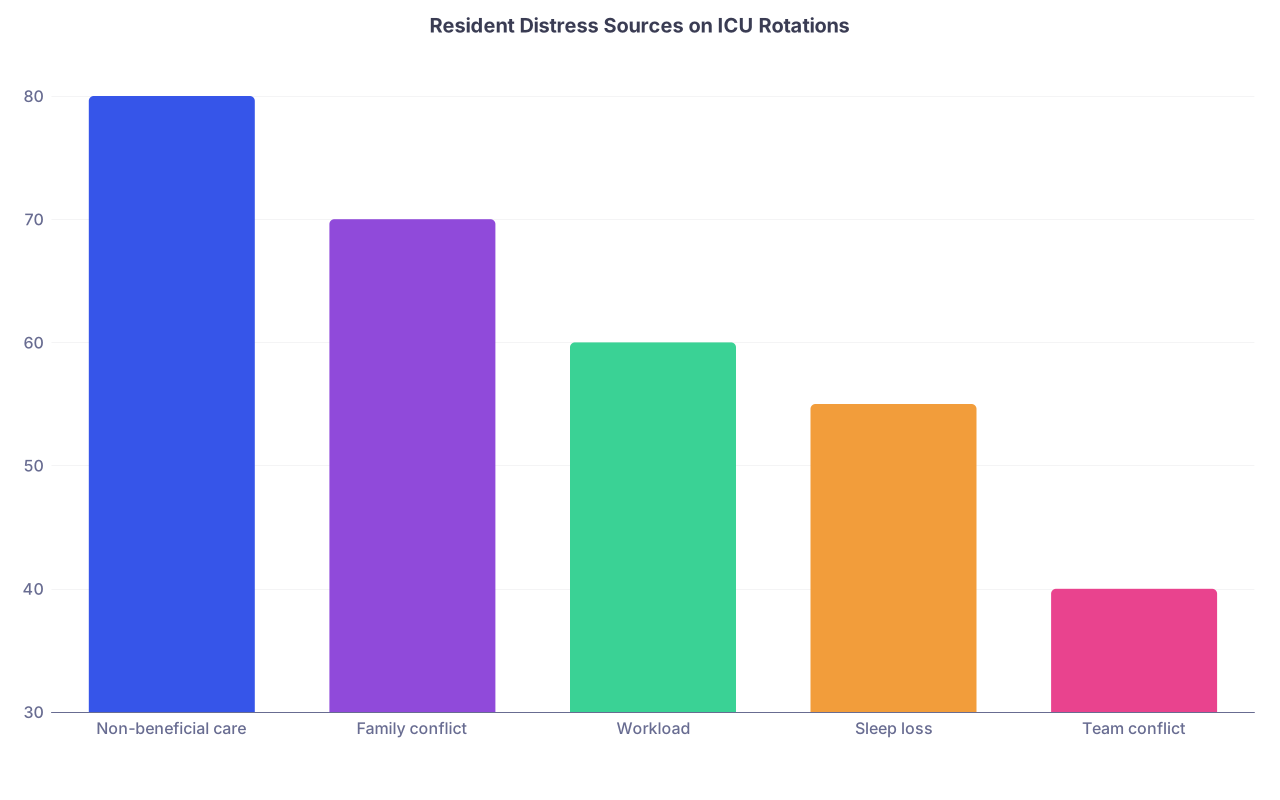
| Category | Value |
|---|---|
| Non-beneficial care | 80 |
| Family conflict | 70 |
| Workload | 60 |
| Sleep loss | 55 |
| Team conflict | 40 |

| Step | Description |
|---|---|
| Step 1 | Distressing ICU Case |
| Step 2 | Clarify goals of care |
| Step 3 | Regulate and document |
| Step 4 | Discuss with team |
| Step 5 | Peer/mentor debrief |
| Step 6 | Log learning point |
| Step 7 | Mental health support and schedule review |
| Step 8 | Can I act now? |
| Step 9 | Still distressed after 48 hours? |
| Step 10 | Persistent or severe? |
FAQ (4 Questions)
1. How do I tell if what I am feeling is “normal ICU stress” or moral injury that needs professional help?
Normal stress feels time‑limited and situation‑bound: you are exhausted post‑call, maybe tearful after a specific bad day, but you recover baseline interest and empathy between rotations. Moral injury leaks outside the unit. You ruminate about cases at home, feel guilt or anger weeks later, and start doubting your worth as a physician or person. If you have intrusive memories, sleep disturbance, or persistent thoughts like “I am a bad doctor” or “this system is fundamentally immoral,” that crosses into territory where a therapist or psychiatrist is not optional—it is appropriate care.
2. What if my attending shuts down any talk about futility or ethics and just says, “We do what the family wants”?
You are not going to fix that attending. What you can do is narrow your scope: document clearly the medical facts and prognosis, use honest language with families within the attending’s frame, and seek external supports (palliative, ethics) when reasonably possible. Off‑shift, use structured debriefs with peers or mentors to prevent internalizing that attending’s worldview as the only way. You are allowed to disagree ethically while still executing the plan safely.
3. Is it unprofessional to say no to extra ICU shifts or swaps because I am already burned out from recent moral distress?
No. It is professional to recognize when your capacity to provide ethical, attentive care is impaired. You do not need to give a TED talk explanation. “I am at my limit after two back‑to‑back ICU blocks and need a non‑ICU month to recover” is sufficient. If you have a trusted chief or PD, name it precisely: “I am experiencing significant moral distress from recent ICU months and need a break from that environment.” That is safer for you and for patients than silently agreeing and degrading further.
4. Does talking about cases over beers with co‑residents count as “processing” moral distress?
It helps a little, but not enough. Unstructured venting tends to loop the anger and injustice without moving toward meaning, learning, or change. It is better than isolation, but it does not discharge the residue. For real processing you need at least one of: structured debriefs, reflective writing, targeted discussions with mentors, or therapy. The beer sessions can be the social glue that makes the harder conversations possible, but they are not a full solution.
Key points to keep in view:
- ICU moral distress is not generic burnout. It has specific drivers—non‑beneficial care, blocked ethical action, misaligned goals—and demands targeted strategies.
- You need a pre‑planned toolkit: concrete on‑shift tactics, structured debriefs, and post‑rotation repair—not vague “self‑care.”
- When the distress starts leaking into your identity and life outside work, that is not a resilience failure. It is a sign you need external support and system‑level adjustments, not more stoicism.


