
The way most residents handle cross-cover nights is unsustainable, dangerous, and completely fixable.
You are not burning out because you are weak. You are burning out because you are running a high‑acuity triage system off raw willpower and caffeine instead of off clear algorithms and predefined defaults.
Let me break this down specifically.
The Real Problem: Cross-Cover as Cognitive Ambush
Cross-cover nights are engineered to create decision fatigue:
- You are responsible for patients you barely know.
- You get interrupted every 3–5 minutes.
- Every page arrives stripped of context and urgency labeling.
- Everyone wants “orders now.”
That is a perfect storm for burnout because it destroys three things that protect your brain:
- Predictability
- Clear priorities
- Bounded responsibility
Instead, you get:
- Constant context switching
- Unfiltered, unprioritized demands
- Emotional pressure from nurses, families, and sometimes other services
The fix is not “be more resilient.” The fix is building hard triage algorithms and default pathways so your system makes most of the decisions, not your half‑alive 2 a.m. frontal lobe.
Think of yourself less as an individual hero and more as an air traffic controller with checklists.
Core Framework: A 4-Step Triage Algorithm for Any Page
You can run 90% of cross-cover off a single mental flowchart.

| Step | Description |
|---|---|
| Step 1 | Page received |
| Step 2 | Scan for red flags |
| Step 3 | Go now / call RRT |
| Step 4 | Clarify and classify |
| Step 5 | At bedside in minutes |
| Step 6 | Call back, plan, see soon |
| Step 7 | Phone orders, defer exam |
| Step 8 | Queue for later or sign out |
| Step 9 | Reassess after intervention |
| Step 10 | Document & update task list |
| Step 11 | Type of issue |
Step-by-step.
Step 1: Red-Flag Screen in <10 Seconds
Every page, before you do anything else, you run a micro-screen:
Ask yourself or the nurse (if not obvious): “Is this a potentially life-threatening change or time-sensitive deterioration?”
Immediate red flags:
- “Patient unresponsive / difficult to arouse”
- “New chest pain” (especially with vitals change)
- “O2 sat dropped below 90 on usual oxygen”
- “Respiratory distress / increased work of breathing”
- “SBP < 90 or MAP < 65, new”
- “HR > 130 or new arrhythmia”
- “Acute neuro change” – new focal deficit, confusion, seizure, severe headache
- “Active heavy bleeding” – GI, post-op site, hemoptysis
- “Fever with hypotension or rigors in high-risk patient” – neutropenic, post-op, lines
Your default:
If yes → You move. Now. Either physically to the bedside or you activate RRT/Code depending on severity.
Do not waste time asking for twelve extra details while you sit. You can always cancel alarm escalation; you cannot rewind the stroke or PEA arrest.
Step 2: Classify the Call – Put It in a Bucket
Once red flags are excluded, classify. This is your anti–decision fatigue move.
Four buckets:
Bucket A – Emergent/unstable
Needs bedside in minutes, possible escalation.Bucket B – Acute but stable
Needs evaluation and decision within 30–90 minutes, but no one is dying in the next 10.Bucket C – Symptom/routine management
Can often be managed via phone orders with chart review; bedside visit sometimes deferred to later if still needed.Bucket D – Nonclinical/clerical
Pure documentation, order clean-up, pharmacy clarifications, “diet order expired,” etc.
This classification alone reduces anxiety. You know which ones can safely wait, which cannot.
Practical Nurse-Call Algorithm: Exactly What to Ask
One of the biggest drains at night is inefficient communication. You get paged with:
“FYI, BP a little low.”
You call back. Ten questions later, you discover they are actually fine.
Create a default script. You do not have to say it word-for-word, but hit the same structure.
For Any Vital-Sign–Related Call
Ask, in order:
- “What are the current vitals?”
- “What were the vitals an hour or two ago?”
- “What has already been done?” (fluids, position change, O2, pain meds held, etc.)
- “How does the patient look to you right now? Any change in mentation, color, breathing?”
If this is a hypotension page, your internal algorithm:
- SBP < 90 or MAP < 65, plus any of: altered mental status, cold/clammy, tachypnea, chest pain, or decreased urine → Bucket A. Go or RRT.
- Isolated SBP 90–100, patient comfortable, mentating, on chronic BP meds → Bucket B/C. Consider holding meds, 250–500 mL fluid bolus if appropriate, recheck in 30–60 minutes.
For Pain/Anxiety/Insomnia Calls
This is where many residents bleed time.
You need:
- “Where is the pain / what kind?” (chest, abdomen, surgical site, headache)
- “Is this new or ongoing?”
- “Any associated symptoms?” (SOB, lightheaded, neuro changes)
- “What has helped so far today?”
Then you map to either:
- Potentially dangerous symptom → chest pain, neuro changes, new severe headache, rigid abdomen → Bucket A/B, see.
- Chronic/post-op/known source, already evaluated → Bucket C, adjust meds per protocol.
You should build 2–3 default order sets in your head:
- Post-op pain ladder (PO and IV rescue strategy)
- Chronic pain patient overnight plan
- Insomnia/anxiety plan that does not wreck next day’s exam or cause delirium
The point: you are not re-inventing the wheel on every call.
Disease-Specific Micro-Algorithms That Save Your Brain
Now the meat: common cross-cover scenarios where decision fatigue eats you alive. I will outline specific algorithms you can actually run at 2 a.m.
1. “The Sat Dropped” – Hypoxia Overnight
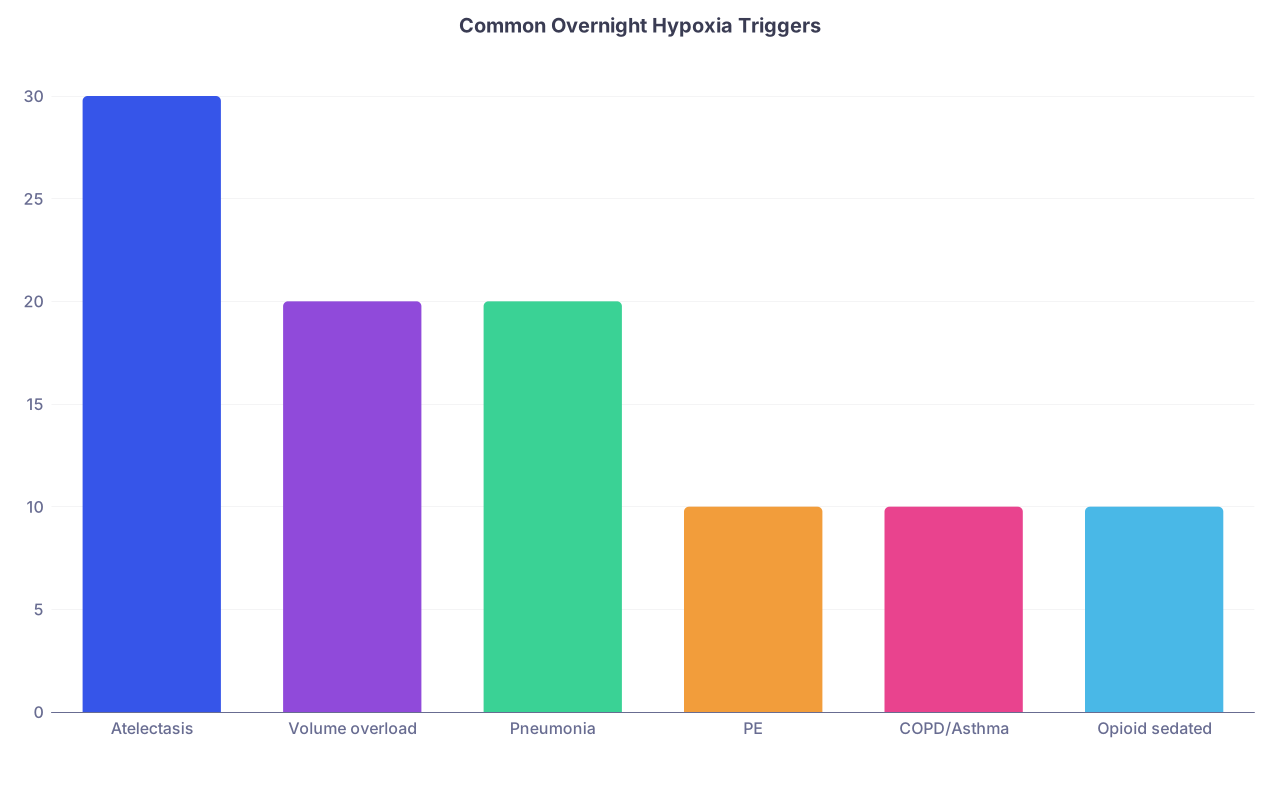
| Category | Value |
|---|---|
| Atelectasis | 30 |
| Volume overload | 20 |
| Pneumonia | 20 |
| PE | 10 |
| COPD/Asthma | 10 |
| Opioid sedated | 10 |
Script when paged: “Patient’s O2 sat dropped to 86%.”
Ask:
- Current O2 modality and flow?
- Was the sat checked on finger or ear? (poor perfusion matters)
- What is their baseline O2 need?
- Associated symptoms: increased work of breathing, tachypnea, chest pain, confusion?
- Position? Just walked? Just got pain meds?
Algorithm:
- If on room air → sit them up, repeat sat, apply 1–2 L NC. Recheck.
- If on their usual O2 but now lower sat AND increased work of breathing, tachypnea, chest pain → Bucket A/B. Go evaluate.
- If sedated from recent opioids, normal RR borderline (10–12), no distress → consider low-threshold naloxone, hold opioids, close nursing monitor.
At bedside, think in three buckets:
- Ventilation issue – opioid, COPD, neuromuscular;
- Oxygenation issue – pneumonia, pulmonary edema, PE, atelectasis;
- Equipment/position trickery – probe off, hand cold, on side with lung down.
If you suspect mild atelectasis in a post-op day 1–2, stable vitals, mild hypoxia:
- Sit up, incentive spirometry, ambulate if safe, modest O2 up-titration.
- Reassess in 30–60 minutes.
If any hemodynamic instability or high suspicion of PE, flash pulmonary edema, or pneumonia in a borderline patient → do not be heroic. Call senior/attending early.
2. “BP is Low” – Hypotension Without Panic
Resident meltdown often starts with these pages because no one taught them structure.
Your phone triage:
- Vitals trend last several hours?
- Urine output trend?
- Recent meds? (diuretics, ACEi/ARB, beta-blocker, opioids)
- Fluid balance last 24 hours? Diarrhea, vomiting, fevers, bleeding?
- Overall clinical picture – mentation, skin, breathing.
Then sort into three patterns:
- Likely relative hypotension in a chronically hypertensive but well-looking patient (e.g., SBP 95 from usual 160, but MAP 70, asymptomatic) → often okay.
- Medication-related dip – post-diuresis, just got anti-hypertensives or sedatives → usually fixable.
- True shock picture – tachycardia, low UOP, altered mental status, mottled skin → Bucket A, escalate.
Bedside quick actions:
- ABCs.
- Is there an obvious source: sepsis, bleed, cardiogenic, hypovolemia?
If you think hypovolemia or sepsis and no contraindication → 500–1000 mL crystalloid and see if MAP climbs and HR drops.
If no response and patient known HF / at risk for overload → involve senior. Think pressors and ICU, not just “another liter.”
The burnout reduction part is this: you are not guessing. You run the same script every time.
3. “Fever to 38.5” – Not Every Fever is a 3 a.m. Crisis
The worst pattern is the resident who runs to every fever like it is sepsis, then burns out in week 3.
You need a fever triage:
Phone questions:
- Immunosuppressed? Neutropenic, transplant, on high-dose steroids or biologics?
- Indwelling lines, prosthetic valves, post-op status?
- Hemodynamics: BP, HR, RR, O2 sat.
- New localizing symptoms: cough, dysuria, headache, abdominal pain, wound redness.
- Recent culture status, antibiotics on board, prior organisms.
Algorithm:
- If neutropenic, post-transplant, or hemodynamically unstable → Bucket A.
Draw cultures, lactate, labs, broad-spectrum antibiotics per protocol. No delay. - Post-op day 1–2 low-grade fever, hemodynamically stable, no localizing symptoms, already on appropriate prophylaxis → Bucket B/C.
Might not need an immediate in-person evaluation at 3 a.m. if they were just seen earlier that evening and are clinically well. But if you have any doubt, see them.
You standardize:
- What labs you order (cultures ×2, UA, CXR in certain groups).
- When you broaden antibiotics vs just watch.
- When you absolutely must call your senior or attending.
Again, the point is to avoid reinventing this at different hospitals. Your personal fever algorithm is part of your “resident operating system.”
4. Acute Delirium and Agitation – Protecting the Staff and Your Sleep
Night delirium is a huge drain. Everyone is stressed, and the pressure to “just give something” is intense.
Your approach must be algorithmic:
- Is this hyperactive delirium or another condition (e.g., acute stroke, severe hypoxia, hypoglycemia, withdrawal)?
- First, fix reversible triggers: pain, hypoxia, infection, urinary retention, constipation, medications (benzos, anticholinergics, high-dose steroids).
- Non-pharmacologic: lights on, reorient, family call, 1:1 sitter if available, glasses/hearing aids.
When you go to meds, have defaults:
- Elderly frail patient → low-dose antipsychotic (like haloperidol 0.5–1 mg IV/IM), avoid benzos unless alcohol withdrawal.
- Younger, robust, non-demented → can tolerate somewhat higher doses.
Document a clear safety rationale: danger to self/staff, pulling lines, etc.
If you build a standard delirium plan with the day team (especially for high-risk patients), you reduce 3 a.m. improvisation dramatically.
Page Management: Building a Real-Time Queue Instead of Constant Panic
What destroys your brain is not just the content of the pages. It is the uncontrolled flow.
You want a minimal but structured page management system.
Step 1: Every Page Gets Logged
Simple notepad, back of patient list, or the hospital’s task system:
- Time
- Room / name
- One-line issue
- Bucket (A/B/C/D)
That alone drops your cognitive load. You are not relying on memory to track the 17 open loops.
Step 2: Batch Nonurgent Tasks
This sounds trivial. It is not.
Nonurgent pages:
- Diet orders
- “PRN ran out, can you renew?”
- “Can you discontinue the NG order that is not being used?”
- “Family wants update” (when you are not the primary team and this is not about code status or acute change)
You stack these into 30–45 minute blocks of “clerical cleanup.” You do not jump the moment a non-urgent page arrives, unless your culture is extremely rigid and punitive about response time (rare in residency; nurses care much more about safety than instant-click service).
Step 3: Fixed Reassessment Points
For any “we will recheck in 30–60 minutes” plan (e.g., mild hypotension, borderline sat, low-grade fever) – write yourself a timed task.
Your job is not to remember; your job is to re-open your list every 15–20 minutes and ask: “Which C/B bucket tasks are coming due?”
Over time, this replaces the weird anxiety of “I know there was someone I was supposed to recheck” with concrete tasks.
Decision Fatigue: Where It Actually Comes From (And How Algorithms Fix It)
Let me be blunt. Decision fatigue on cross-cover is not because:
- You are making truly complex, deep diagnostic calls all night.
- You are doing critical thinking continuously.
It is mostly:
- Micro-decisions about “Is this urgent or not?”
- “Should I go now, in 30 minutes, or not at all?”
- “Is this my patient or day team’s problem?”
- “Should I wake my senior or will they roll their eyes?”
That stuff chews your brain.
Algorithms fix this by:
- Pre-defining what counts as emergent, urgent, routine.
- Pre-defining your default actions for each common scenario.
- Pre-defining escalation thresholds.
You reserve real mental energy for the outliers, which are actually uncommon.
Concrete Triage Escalation Rules (So You Do Not Constantly Second-Guess Yourself)
Another hidden burnout driver: fear of under- or over-calling your senior/attending.
Build explicit rules with your seniors early in the rotation. If they will not give you any, make your own and share them.
| Scenario | Escalate to Senior/Attending |
|---|---|
| New need for pressors | Immediately |
| Increased O2 to >6 L NC or HFNC | Immediately |
| New neuro deficit or seizure | Immediately |
| Suspected sepsis with hypotension | Immediately |
| Uncontrolled agitation/violence | After first-line measures |
You can add more, specific to your service:
- Any unplanned transfer to ICU
- Any new RRT or Code Blue
- Unexpected death or major decompensation
You tell your senior on day 1:
“My practice is going to be to call you for X, Y, Z categories overnight. If you want that tuned differently, let me know.”
That does two things:
- Sets expectations – they cannot complain you did not call for X if they agreed earlier.
- Frees up your mental bandwidth – you are not constantly thinking “Is this enough to call?”
Pre-Shift Setup: Reducing Night Chaos Before You Even Start
The best cross-cover nights are won at 4 p.m., not 4 a.m.
1. Identify the Landmines
During sign-out, you should be extremely suspicious of:
- “They were a bit soft on BP but probably fine”
- “They seem a little more confused than usual”
- “We just increased their opioids, but monitor closely”
- “Mildly hypoxic earlier, but we did not pursue much”
These are your likely 2 a.m. pages. For each one, ask:
- “If they worsen overnight, what is your preferred first step?”
- “Any threshold where you would want me to call you at home?”
- “Can we set some PRNs now instead of me scrambling later?”
2. Build ICU/Step-down Filters Upfront
If you are cross-covering a mix of ward and high-dependency patients, make a list before the shift:
- Sickest 5–10 patients and their active problems
- Code status / goals-of-care issues in flux
- Any one-whiff-of-ICU patient still on the floor
You glance at that list between pages. If one of them gets even a small destabilizing event, your threshold to assess is much lower.
RRT/Code Decisions: Hard Lines, Not Vibes
A surprising number of burnout stories start with “I did not call RRT when I should have” or “I called and got shamed for over-calling.”
You are not there to preserve some imaginary “RRT quota.” You are there to keep patients alive.
Build hard lines for when you must strongly consider RRT / Code:
- Persistent SBP < 90 despite appropriate fluids
- New or worsening respiratory distress with O2 > 4–6 L NC or need for NRB
- Acute mental status change of unclear etiology, especially with other vital abnormalities
- New chest pain with ischemic EKG changes or hemodynamic instability
- Seizure that is prolonged, recurrent, or associated with failure to return to baseline
If you are hesitating and the patient looks bad – you call. Full stop.
That policy protects patients, but it also protects your brain. You are not playing poker with the Rapid Response Team to impress some imaginary judge.
Protecting Yourself: Micro-Habits That Actually Work
These are not fluffy wellness tips. These are operational habits that reduce burnout on cross-cover.
1. Aggressive Use of Checklists
Cross-cover “brain”:
- Running patient tally with sickest flagged
- Standard order sets mentally for: hypoxia, hypotension, fever, pain, delirium
- Page log with bucket categories
You externalize as much as possible. The less you carry in pure working memory, the less exhausted you feel at 6 a.m.
2. Fixed Micro-Breaks
I have watched high-functioning residents absolutely fall apart because they never took 5 silent minutes.
Set micro-rules:
- Every 90–120 minutes, sit down, drink water, no EHR, no phone, for 3–5 minutes, barring literal code situations.
- Eat something substantial before midnight, even if only for 7 minutes.
You will think you “do not have time.” You do. You are swapping 5 minutes now for 30 minutes of being useless at 4 a.m.
3. Post-Shift Debrief – But Only 5 Minutes
After a bad night, write down:
- 2–3 cases that triggered the most stress
- What information you were missing
- What algorithm or checklist would have helped
Then adjust your mental playbook. Over 10–20 nights, your cross-cover “OS” becomes bulletproof. That is how you turn experience into less burnout, not more.
Visual Summary: Where Your Energy Actually Goes
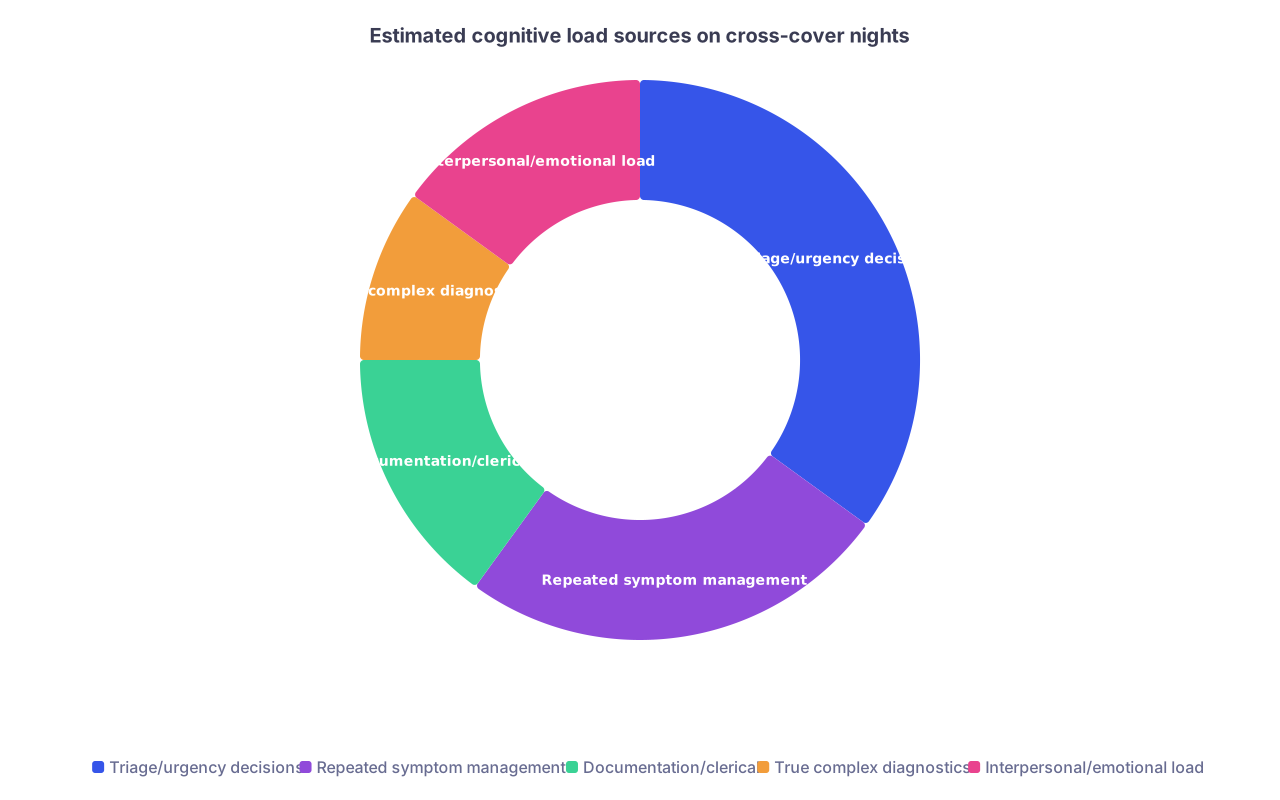
| Category | Value |
|---|---|
| Triage/urgency decisions | 35 |
| Repeated symptom management | 25 |
| Documentation/clerical | 15 |
| True complex diagnostics | 10 |
| Interpersonal/emotional load | 15 |
Most residents overestimate the “true complex diagnostics” part. It is there, but it is not what is killing you. The triage/urgency and symptom repetition are. Which is exactly where algorithms help.
Putting It All Together: A Real Night Example
Let me walk you through a typical 30-minute slice of cross-cover once you have these systems in place.
Time 23:10
- Page 1: “Room 418, BP 88/52.”
- Page 2 (while calling back): “Room 612 complaining of 8/10 pain, wants more meds.”
- Page 3 (voice mail light): “Pharmacy needs you to adjust DVT prophylaxis dose.”
You:
Log them with times and quick notes, assign buckets.
- 418 hypotension – bucket A/B depending on triage.
- 612 pain – bucket C.
- Pharmacy – bucket D.
Call 418 nurse immediately. Run your hypotension script:
- Verify vitals trends, meds, exam impression.
- Decide if they are truly in shock pattern or just a bit low in comfy patient.
- Likely go see them now.
On your walk to 418, you place quick orders on mobile/EHR for 612:
- Increase PRN dose within safe range or add rescue dose; plan to see them after 418 if needed.
After stabilizing/evaluating 418, document brief note, add “recheck BP in 30–60 minutes” to your task list.
Swing by 612 if pain persists despite PRN. Spend 3–4 minutes adjusting plan, clarifying expectations about pain control vs complete elimination.
Sit at workstation for 3 minutes, address pharmacy dose change, maybe batch it with any similar pending clerical tasks.
Compare that to the scattered approach:
- Sprint randomly to 612 first because they are loud.
- Get frustrated.
- Forget to reassess 418 BP.
- Get called back by bother nurse, now more anxious, and you feel guilty and behind.
One approach builds control. The other accelerates burnout.
Final Thoughts
Three key points:
- Cross-cover burnout is mostly a systems failure, not a personal weakness. Your brain is being abused by unstructured triage and constant micro-decisions.
- You can cut decision fatigue dramatically by using clear triage buckets, disease-specific micro-algorithms, and explicit escalation rules. They turn chaos into checklists.
- The residents who survive night float intact are not the toughest; they are the ones who aggressively externalize cognition – logs, scripts, defaults – so their half-asleep brain is following a playbook, not winging it.
You will still have bad nights. But they will stop feeling like a random ambush and start feeling like running a protocol. That difference is exactly what keeps people in this job long enough to become the kind of attending others want to work with.