

Most EM residents are not burning out because they are “weak” or “not resilient enough.” They are burning out because the workflow is engineered to crush them.
Let me break that down specifically.
Emergency medicine residency has a very particular set of workflow patterns: relentless task switching, asynchronous responsibility, fragmented teams, non-stop interruptions, and zero natural “endpoints.” Those patterns are not incidental. They are structural. And if you pretend you can fix structural problems with yoga and better snacks, you will get steamrolled.
The goal here is not to convince you that EM is hard. You already know that. The goal is to map exactly how EM workflow drives burnout in residency, and then give you concrete adaptations that actually work in the real world of 30-board EDs, boarding crises, and cranky attendings who think “back in my day” is an argument.
The EM Workflow Reality: Why It Feels Different From Every Other Specialty
EM is not just “busy.” It is patterned chaos.
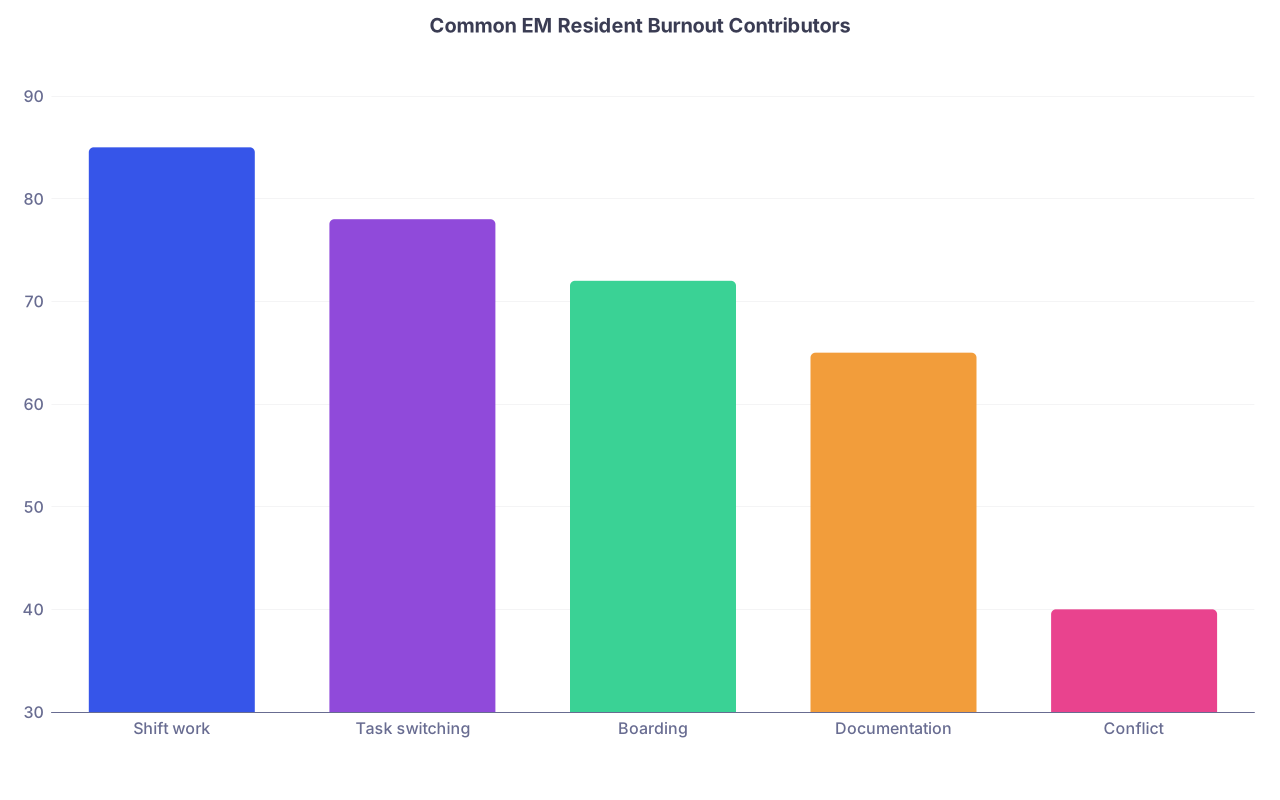
| Category | Value |
|---|---|
| Shift work | 85 |
| Task switching | 78 |
| Boarding | 72 |
| Documentation | 65 |
| Conflict | 40 |
Look at how the work is structured for you compared to, say, an IM ward month.
Internal Medicine:
You round on 8–12 patients, mostly the same people, day after day. You know where they are, you know the plan, the team is stable. Epic inbox is awful but at least it has a queue. Work has some continuity and some natural stopping points.
Emergency Medicine:
You walk into a different crew every shift. Your “panel” is whoever shows up in triage right now. You may never see them again. You carry:
- 8–20 active patients at once
- 10+ different complaint types
- 5 simultaneous dispositions, all stuck behind bed availability
- Constant “quick questions” from nursing, consultants, EMS, techs, families
Nothing is queued. Everything is interrupt-driven. There is no “I will get to that in an hour” without risk. That is cognitively expensive.
And burnout is, at least partly, chronic cognitive overload.
The Core Workflow Patterns That Drive Burnout
1. Constant Task Switching and the Myth of “I’m Just Bad at Multitasking”
You are not bad at multitasking. The human brain is bad at multitasking.
Emergency medicine forces you into extreme task switching:
- Writing a note
- Interrupted by EMS with STEMI at the door
- On way back, grabbed by nurse: “Room 12’s BP is 70”
- Fix 12, then CT tech calls: “We need consent for 18”
- While you are on the phone, trauma activation overhead
- You re-open the note. You cannot remember what you were documenting.
That pattern, repeated hundreds of times a shift, is a direct path to:
- Decision fatigue
- Errors of omission (“I swear I ordered that troponin”)
- Emotional exhaustion (“I never feel caught up”)
This is not a personal failing. This is a workflow design.
How to adapt (resident-level, realistic):
Work in micro-batches, not single-tasking fantasies.
You will never get 30 undisturbed minutes. So stop expecting it. Instead, batch tasks:- “I am going to only put in orders for my next 3 new patients for the next 5 minutes.”
- “I am going to do only dispo work (call accepts, write discharge instructions, finalize plans) on my dispo-ready patients now.”
The batching window is tiny. 3–7 minutes. But those pockets of semi-focused work reduce cognitive thrash.
Use a visible, dirty, written list.
Whiteboard square, index card, folded sheet in your pocket—whatever. The EHR trackboard is not enough.Column it:
- Column 1: “New / Needs H&P”
- Column 2: “Labs/Imaging Pending”
- Column 3: “Ready for dispo / cleanup”
Every interruption, you glance, re-anchor, and decide. Without this, you rely on working memory. That fails at patient 5 or 6.
Standardize your “reboot ritual.”
After any significant interruption (trauma, code, angry family meltdown), you do the same short sequence every time:- Walk to trackboard
- Scan all your patients
- Mark 1–2 must-do-now tasks
- Do those before anything else
You are not “wasting time.” You are protecting against errors and overwhelm.
2. Asynchronous Responsibility and the “Never Done” Problem
In the ED, your work has no clean finish line. As soon as you dispo one, another appears. In a busy shop, you never hit true zero.
This creates a specific burnout pattern: the sense that nothing you do makes a dent.
I have watched PGY‑2s hit 2 a.m., 22 patients seen, still 30 in the waiting room, and say out loud: “I could run for 12 hours and it will look exactly the same.”
That feeling—futility—is a core driver of depersonalization. Why care deeply about the next person when the conveyor belt never stops?
How to adapt: create artificial closure. On purpose.
You will not fix volume or boarding. You can fix how your brain perceives progress.
Concrete strategies:
Define 2–3 “anchor metrics” per shift.
Not RVUs. Not “patients per hour.” I mean resident-centered metrics. Examples:- “I will do 3 high-quality family conversations tonight where people feel truly heard.”
- “I will run the initial resus on at least 1 sick patient and own that room.”
- “I will close the loop on every troponin—no missed callbacks.”
You pick. You tell your senior or attending at sign-in if you want accountability. That transforms an endless conveyor belt into a shift with a few meaningful wins you can actually track.
Shift-end audit (5 minutes, non-negotiable).
Do not just drop your badge and sprint to the parking lot every time. Once you sign out:- Sit down somewhere quiet (workroom, car)
- List 3 patients you took good care of
- One thing you handled better than last month
- One small process change for next shift (e.g., “start notes earlier,” “pre-chart on first two patients,” “ask for feedback mid-shift”)
This is not journaling for Instagram. It is cognitive reframing. It fights the “I did nothing all night” illusion.
Aggressively protect handoff quality.
Sloppy sign-out amplifies the “never done” stress: you leave worried, come back to an annoyed colleague.Make your sign-outs:
- Terse but high-yield (“This is what we are waiting for, this is my contingency”)
- Realistic (“If CT is negative, safe to go, instructions ready”)
- Documented in the EHR in a line or two
Knowing you left clean handoffs allows your brain to actually leave.
3. Shift Work, Circadian Wreckage, and Cognitive Wear
Emergency medicine residency schedules are often designed with more regard for staffing templates than human physiology.
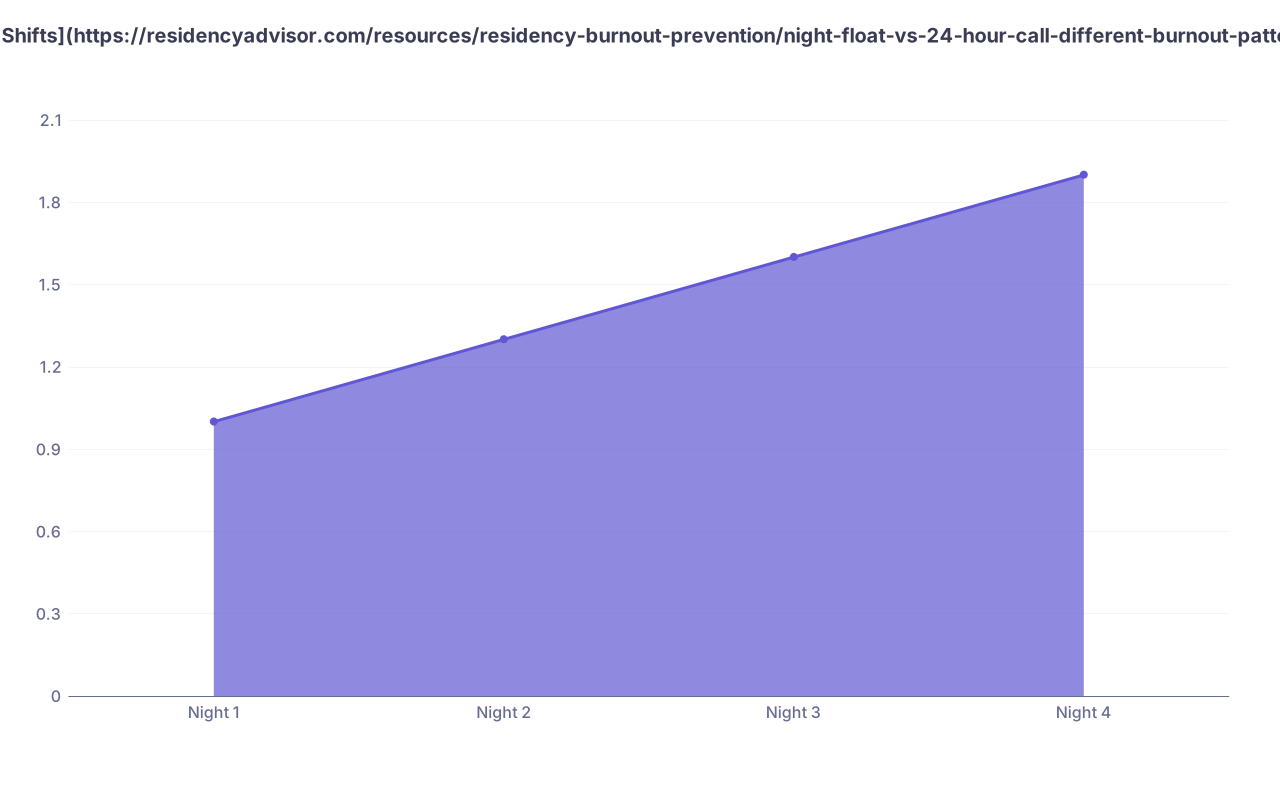
| Category | Value |
|---|---|
| Night 1 | 1 |
| Night 2 | 1.3 |
| Night 3 | 1.6 |
| Night 4 | 1.9 |
You know the patterns:
- Flip from days to nights to evenings within 3–5 days
- “Black cloud” blocks with 7–10 ED shifts in a row
- Post-night obligations: didactics, mandatory meetings, “can you just swing by this committee thing”
Effects:
- Attention lapses on nights 3–4
- Emotional volatility (“Why am I snapping at nurses?”)
- Anhedonia on off days—you are too wrecked to enjoy them
Adaptation here is partly individual, partly political.
Personal-level adaptations (you can start this week)
Pick a night-shift sleep strategy and stick to it.
The worst thing is inconsistency. Two classic models:Full flip:
- Post-night: sleep 5–6 hours (08:00–13:00)
- Stay up until 02:00–03:00 night before the first night
- On last night, short nap (08:00–11:00), then early to bed (20:00–21:00)
“Anchor sleep” model (for frequent switches):
- Protect a core 3–4 hour block every day that is dark, quiet, and consistent (e.g., 14:00–18:00)
- Add surplus sleep around that, but never give up the anchor window
Most residents do a chaotic hybrid. That is why they feel constantly jet-lagged.
Non-negotiable pre-night routine.
Before night 1, treat it like a long-haul flight:- Caffeine intentionally delayed until 22:00 or later
- 20–30 minute nap early evening
- Light exposure management: bright light at the start, sunglasses on the way home
Ditching the “I will just push through” hero act probably gives you the biggest cognitive return.
Protect one real off-day per block.
Not an “off” day where you do taxes, groceries, EMR training, and family obligations back-to-back.At least once per 7–9 shift block: zero medicine, minimal life admin, something that signals “I am a person, not just a resident.”
System-level moves (you push for these with your chiefs/PD)
You are not powerless. Programs respond when enough residents show up with data and specific proposals.
| Pattern Type | More Harmful Version | Better Version |
|---|---|---|
| Nights | Scattered single nights | Clustered 3–4 night blocks |
| Flip pattern | Day → Night → Evening mix | Gradual forward-rotating shifts |
| Post-night duties | Mandatory AM didactics | Recorded or afternoon sessions |
| Stretch blocks | 10–12 shifts in a row | 6–8 with protected off-day |
You walk in not just saying “we’re tired,” but “this is the pattern, this is the evidence, and here is a feasible alternative that keeps coverage intact.”
4. Boarders, Throughput, and the “Hostage Situation” Feeling
This one is uniquely toxic lately.
You are trained to resuscitate, rapidly diagnose, and dispo. Yet half your board is “medically ready, no inpatient beds.” You become an inpatient service without the structure, or respect, of inpatient medicine.
Burnout mechanism here:
- Role mismatch: you are not using the skills you signed up for
- Learned helplessness: no action you take creates the outcome (disposition) you want
- Moral distress: watching sick patients suffer on hallway stretchers you know are not safe
Adaptation: separate what you can control from what you refuse to silently normalize.
Clinical craft: treat boarders like a micro-service.
Silently resenting them does not help you or them. Instead, streamline:- Batch updates: round on all your boarders every 1–2 hours in a sweep, not one at a time haphazardly
- Shared mental model: write super-clear status lines in your notes and on handoff tools
- Simplify orders: use ED boarder order-sets if your shop has them to reduce decision fatigue
Boundary setting around scope.
There is a difference between helping and being exploited.You push back (professionally) on absurd requests like:
- “Can you admit this chronic back pain to medicine just to get PT consult?”
- “ED will just re-order inpatient med rec and reconcile every 24 hours.”
Use phrases like, “That is outside of our ED scope, let us loop in admitting to clarify the plan.” Calm, firm, on record.
Channel frustration upward, not sideways.
Yelling at the hospitalist or the nurse does nothing. They did not close 20 inpatient beds.Instead:
- Document unsafe conditions (boarding in hallways, delays in time-sensitive care)
- Bring actual numbers to QI or GMEC meetings
- Get involved in throughput committees if you have the bandwidth—yes, I am serious
It will not fix things this month. But staying completely silent guarantees nothing changes in 3 years.
5. Interruption-Heavy Communication and Relationship Burnout
Burnout is not only about workload. It is about the relational environment.
The ED is structurally primed for conflict:
- Consultants who see you as a “dispo machine” sending them trash
- Nurses juggling 5–6 patients, furious about one more order at 03:00
- Families who waited 6 hours in the lobby and now see you for 90 seconds
You are in the middle of all of that. All shift.
If every interaction feels adversarial, you burn out faster, no matter how “resilient” you are.
Adaptation: learn high-yield micro-communication habits that de-escalate instead of inflame.
These are small, but in residency they compound.
Lead with the headline in consults.
Worst pattern: 3-minute meandering story, burying the lead. Consultant becomes hostile.Better pattern (10–15 seconds upfront):
- “Hey, this is EM resident on call. 65-year-old with chest pain, troponin 0.18, dynamic EKG, hemodynamically stable, no prior CAD. I need cardiology to evaluate for admission and possible cath.”
You sound clear and competent. They relax. Your own stress drops.
Use “acknowledge + ask” with nurses.
Example:- Nurse: “Room 9 has been asking for pain meds for an hour.”
- You: “You are right, I am behind. If we give them IV morphine now, can you keep an eye on their BP? I’ll re-evaluate them in 15 minutes.”
You are not groveling. You are showing you heard them and you are sharing a plan.
Give families one strong moment of presence.
You cannot hold hands for 30 minutes with every family. But you can create one 90-second moment of full focus.- Sit down
- Phone away, hands off keyboard
- “I have about 2 minutes right now and I want to make sure I answer your most important question. What is the main thing you are worried about?”
That small shift changes the tenor of the entire visit. Relational burnout drops when you get fewer adversarial encounters.
Cognitive Strategies: Actually Thinking Differently Without Lying to Yourself
Burnout is not purely “workload – coping.” It is also story.
The story many EM residents silently run:
- “I am failing if I cannot empty the waiting room.”
- “I should be able to handle nights like an attending who has done this for 12 years.”
- “Everyone else seems fine; something is wrong with me.”
These stories are garbage. They make an already punishing workflow feel unbearable.
You do not fix this with toxic positivity. You fix it with more accurate framing.
- Redefine “good EM doctor” to match reality.
Old, perfectionistic metric:
- Never misses anything
- Always on time
- Clears patients rapidly
- Never needs help
Updated, reality-based metric:
- Detects and manages true emergencies reliably
- Communicates clearly with team and families most of the time
- Keeps errors detectable and correctable by building in checks (notes, lists, cross-checks)
- Knows when they are at capacity and asks for redistribution
The second version is resilient. The first one breaks mid-PGY2.
- Name the system-level problems—out loud.
Phrase you need in your vocabulary: “This is a systems problem, not a personal failure.”
Example uses:
You feel like trash after 3 nights flipping from days.
→ “My sleep is wrecked because this flip pattern is physiologically brutal, not because I am lazy.”You cannot keep up with 19 patients and 2 resuscitations.
→ “This is a volume/safety mismatch, not a sign I chose the wrong field.”
Naming that difference decreases shame. Shame fuels burnout more than fatigue alone.
- Deliberate exposure to meaning.
No, this is not “gratitude journaling.” This is operationalizing why you picked EM:
- Screenshot or print 2–3 patient messages / feedback notes that genuinely hit you
- Keep them in your locker, on your phone, or taped inside your badge
- When you are questioning your life choices at 03:30, look at one
It will not fix understaffing. It will keep you tethered to a version of yourself that is more than a throughput unit.
Structural Levers: What You Push For As a Resident Group
You cannot solve national EM workforce or hospital boarding as a PGY‑2. But you have more leverage locally than you think, especially as a unified resident body.

High-yield targets to advocate for:
Scheduling sanity:
Forward-rotating shifts, clustered nights, protected post-night didactic alternatives.Documentation support:
Scribes, dictation, or at least streamlined templates for common complaints to shorten after-shift charting.Formal debriefs:
Not every code, but regular, structured debriefs after big traumas / pediatric deaths. Ideally within 24 hours. That is how you prevent single events from metastasizing into chronic cynicism.Protected resident space and expectations:
That “resident room” that is actually a storage closet / open hallway? Fix that. You need one physically and psychologically safe place per shift.Clear escalation pathways:
When the ED is unsafe (too many boarders, not enough nurses), there should be a real, endorsed route to say “this is not ok” without being labeled “not a team player.”
If you try to push for 20 things, you get zero. Pick 2–3, be specific, bring data, and be willing to help design the solution.
Quick Reality Check: When You Actually Need Help
There is “I am tired, this rotation is rough, I need to tighten some systems.”
Then there is: “I am not ok.”
Signs you are drifting into the second territory:
- You feel nothing with critical cases you used to care about—just annoyance
- You are fantasizing about quitting almost daily, not just on bad shifts
- You are using alcohol or other substances just to sleep or forget
- Thoughts like “they would be better off without me” are showing up
This is not weakness. This is a predictable endpoint of chronic overload in a punitive culture.
At that point, adaptations are not enough:
- You talk to someone: program leadership you trust, GME mental health, therapist, peer support.
- You push for schedule adjustments if needed, even temporary.
- You treat this like any other serious medical condition—because it is.
I have seen residents pull back from that edge with the right support and the right workflow changes. But not by “toughing it out.”
FAQs
1. How many patients at once is “too many” for an EM resident?
There is no magic number, but past a certain point your error risk and stress spike exponentially. For a PGY‑1, 4–6 active patients may be a safe ceiling early, 8–10 later in the year. For PGY‑2/3, 10–14 is common, but beyond that, especially with multiple critical patients, it becomes unsafe. The key is not the raw number but the mix: three GI bleeds and two septic shock cases are not equivalent to eight ankle sprains.
2. Is it normal to dread shifts, even if I like EM overall?
Yes. Dreading specific shifts—nights after a flip, certain overcrowded community sites, weekends with known staffing issues—is extremely common. Persistent, generalized dread across all shifts for weeks to months is more concerning and usually signals a mix of burnout, schedule chaos, and sometimes depression. That is when you should not just white-knuckle it; you get eyeballs on the problem (chiefs, PD, mental health).
3. How do I balance learning with just surviving the shift?
You stop expecting formal “teaching moments” every hour. On brutally busy shifts, the learning is in pattern recognition, prioritization, and communication. On lighter shifts, you push for specific teaching: “Can we debrief that chest pain case?” or “Can I walk through your thought process on that LP decision?” If you are never getting clinical reasoning teaching, that is a program problem worth naming.
4. Does working part-time moonlighting during residency always worsen burnout?
Not automatically, but it is risky. Moonlighting in a well-supported environment can build confidence and financial breathing room, which can actually reduce stress for some senior residents. But if you are already struggling with fatigue, sleep, or emotional exhaustion, adding extra shifts—especially nights—almost always pushes you over the edge. Rule of thumb: if your baseline residency schedule already has you at 7/10 stress, moonlighting will likely make things worse.
5. What is the single most effective workflow change I can make tomorrow?
For most EM residents, a written, actively updated patient list with status columns is the highest-yield change. Get your active patients out of your head and onto a simple grid you glance at every 5–10 minutes. It reduces cognitive load, missed tasks, and that horrid “I am forgetting something” feeling. Everything else—better consult calls, cleaner notes, safer discharges—builds on that basic external brain.
6. How do I know if EM itself is a bad fit for me versus just residency being hard?
Patterns to watch: If you enjoy acute care in controlled settings (sim, ICU, trauma OR) but always loathe the multi-tasking, interruptions, and unpredictability of ED shifts, even when well rested, then the core EM workflow may genuinely not fit your cognitive style. If, however, you occasionally have shifts where you feel “in flow,” enjoy the pace, and feel competent—especially when team dynamics and schedule are decent—then it is probably residency structure, not EM itself, that is grinding you down.
Bottom line
Emergency medicine residency burns people out not because they are fragile, but because the workflow is relentless, interrupt-driven, and structurally misaligned with human cognition and physiology. You will not fix that by “being more resilient.”
What you can do is:
- Build concrete, small-scale workflow adaptations—lists, batching, routines—that protect your brain on every shift.
- Redraw your internal story about what a “good EM resident” looks like, away from impossible perfection and toward safe, sustainable practice.
- Use your collective resident voice to push for schedule, documentation, and culture changes that make burnout the exception rather than the default.
That is how you adapt. Not by pretending the fire is smaller, but by upgrading how you move through it.


