

The perfectionism that got you into residency will burn you out if you do not surgically downgrade it.
You already know the generic wellness talk. “Self-care,” “give yourself grace,” “no one is perfect.” That language bounces right off high-achieving residents. You did not get here by being average, and you are not going to suddenly be okay with “good enough” because someone told you to be.
So let me be blunt: the problem is not that you are a perfectionist. The problem is that your perfectionism is miscalibrated for the reality of residency.
This is a technical problem. It needs a technical solution.
This guide is about exactly that: how to dial perfectionism back just enough to prevent burnout and error, without turning you into the sloppy colleague you secretly resent.
1. Understand Your Specific Flavor of Perfectionism
“Perfectionism” is too vague. You need to know precisely what you do that is burning you down. Residents tend to cluster into a few clear types.
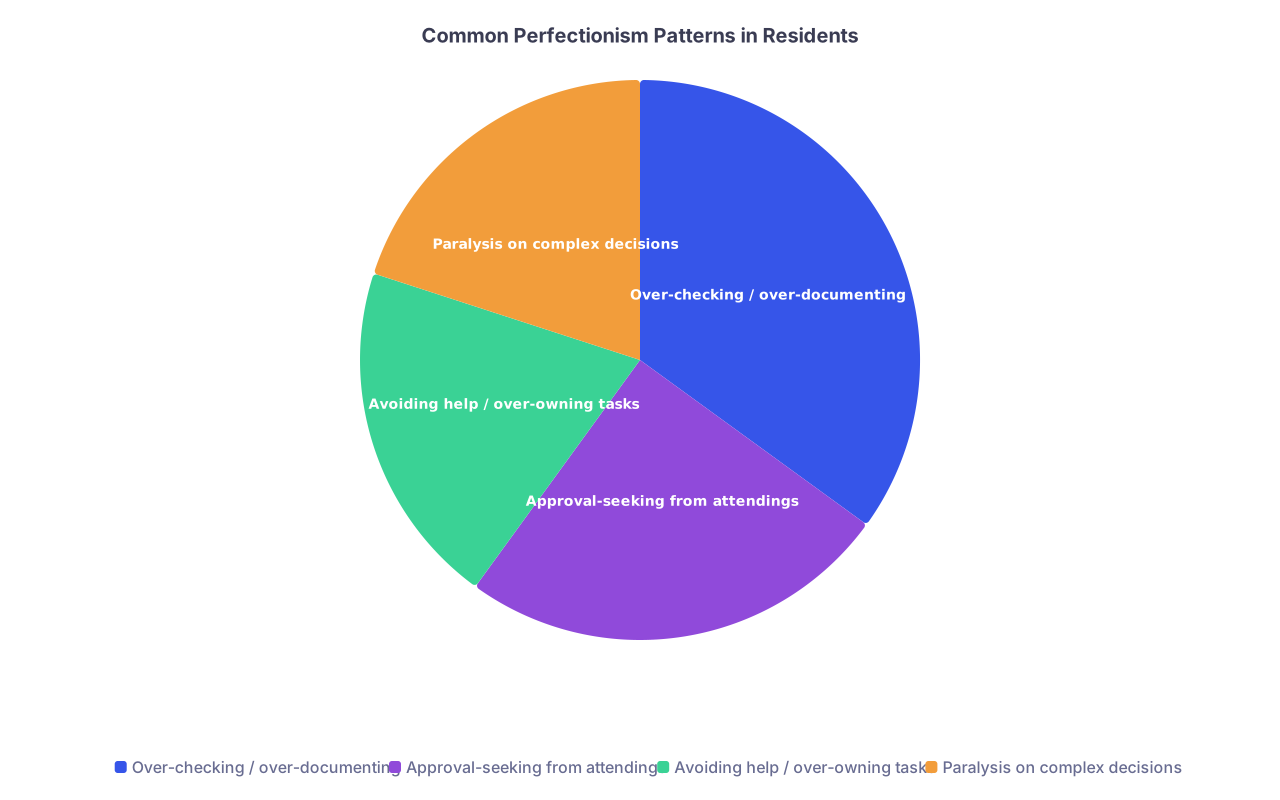
| Category | Value |
|---|---|
| Over-checking / over-documenting | 35 |
| Approval-seeking from attendings | 25 |
| Avoiding help / over-owning tasks | 20 |
| Paralysis on complex decisions | 20 |
The 4 dominant resident patterns
The Over-Checker
- Re-checks every order three times.
- Reads the entire chart before writing a single note.
- Stays 2 hours post-shift to “clean up” documentation and sign-outs.
- Emotionally convinced: “If something is missed, it will be my fault and I will kill someone.”
The Attending-Pleaser
- Crafts notes for the attending, not for patient care.
- Obsessively anticipates questions to avoid ever saying “I don’t know.”
- Tracks facial expressions on rounds like vital signs.
- Emotionally convinced: “My worth equals how impressed my attending is.”
The Lone Wolf
- Refuses to escalate early or ask for help (“I should be able to handle this”).
- Hoards tasks instead of distributing to co-residents or nurses.
- Compresses breaks, food, bathroom into “later,” which never comes.
- Emotionally convinced: “Needing help = incompetence.”
The Paralysis Analyst
- Freezes on complex or ambiguous decisions.
- Opens six UpToDate tabs, three guidelines, and still delays the order.
- Spends 40 minutes on a problem that required a safe-enough decision in 8.
- Emotionally convinced: “If I don’t find the absolute best answer, I’ll be wrong.”
You will have elements of all four, but one or two dominate. Do not move on until you can say, in one sentence:
“My perfectionism mainly shows up as ________, and it costs me ________ every day.”
Example: “My perfectionism mainly shows up as over-checking every order and rereading my notes, and it costs me 60–90 minutes after sign-out every day.”
That level of specificity is what lets you change behaviors, not your personality.
2. Separate “Safety-Critical” from “Psychologically-Driven” Perfectionism
Not all perfectionism is bad. Some of it is literally why patients are alive.
The move here is not “perfectionism vs no perfectionism.” It is precision targeting: where does rigor prevent error, and where is it just you trying to control anxiety or image?
Think like this:
- Some tasks demand near-zero error (central line sterile technique, chemo orders).
- Some tasks tolerate small, non-harmful imperfections (note structure, exact phrasing, formatting).
- Some tasks benefit from speed + adequacy over exhaustive thoroughness (sign-outs, initial plans pending final data).
Let’s classify concretely.
| Task Type | Safety-Critical Need | Common Over-Perfection Trap |
|---|---|---|
| High-risk medication orders | Very high | Re-checking 5–6 times |
| Central line / LP / procedures | Very high | Rehearsing mentally for hours |
| ICU ventilator / pressor changes | High | Avoiding asking RT/ICU nurse input |
| Daily progress notes | Moderate | Obsessive formatting / literature quotes |
| Sign-out summaries | High | Writing essays instead of key bullets |
| Pre-rounding data review | Moderate | Reading every single note daily |
Build an internal “precision map”
You need a mental map that says: where do I insist on 99%+ accuracy, and where is 80–90% absolutely fine?
For example, on a general medicine service:
99%+ zone (non-negotiable):
- Anticoagulation dosing and drug interactions.
- Insulin regimens in brittle diabetics or DKA.
- Chemo, immunosuppressants, narrow therapeutic index drugs.
- Code status discussions and documentation.
90% zone (good enough, adjust later):
- First-pass assessment and plan at 6 a.m.
- Draft discharge summary that you refine once final labs come back.
- Antibiotic choice among several guideline-consistent options.
80% zone (stop overworking it):
- Template and style of progress notes.
- The perfect differential in the note vs your working mental list.
- Exact wording of sign-out as long as key items are unambiguous.
Your perfectionism must live mostly in the 99% zone. If it spills heavily into the 80–90% zones, that is where burnout builds.
Here is the diagnosis question:
If I do this task at 80–90% instead of 100%, does patient safety meaningfully change? If the honest answer is no, you are allowed to pull back.
3. Replace “Be Perfect” with 3 Operational Standards
Telling yourself “I should not be a perfectionist” is useless. You need replacement standards.
I teach residents three operational standards that actually work on the wards:
- Safe enough
- Clear enough
- Teachable enough
1. “Safe enough”
Definition: The plan or action minimizes meaningful risk given information available now, with a plan to reassess.
Operationally:
- Does this plan align with major guidelines or widely accepted practice?
- Have I ruled out the couple of catastrophic alternatives that cannot be missed?
- Is there a timed reassessment built in? (“If lactate not down in 4 hours, then…”)
You are not required to produce the perfect strategy. You are required to avoid obviously dangerous ones and to have a reassessment loop.
2. “Clear enough”
Definition: Anyone covering this patient can understand what you did, why you did it, and what you are watching for.
For notes and sign-out:
- Is the one-line summary accurate and updated?
- Is the problem-based plan logically grouped?
- Are pending items and if-then’s explicitly stated?
You are not writing for a journal. You are writing so the night float at 3 a.m. can avoid paging you.
3. “Teachable enough”
Definition: If an attending or senior asks you to justify the plan, you can explain the key reasoning without pulling ten papers.
Example script:
- “I am choosing ceftriaxone and azithro instead of levofloxacin because of his prolonged QT and prior tendon issues. Coverage is equivalent otherwise.”
- “I am holding ACE inhibitor today due to soft blood pressures and AKI. I will reassess tomorrow.”
You do not need the full trial memorized. You need to show that your thinking is grounded and modifiable.
4. Micro-Adjustments for Each Perfectionism Pattern
Now the practical part: how to actually dial it back on a busy call night without losing your mind.
A. Over-Checker: Time-box and Externalize
You should absolutely check your work. But triple and quadruple checking is not safer; it is just anxious repetition.
Use structured checking instead of infinite checking.
Time-box high-yield checks
- Example rule: “For routine med orders, I get one deliberate check. For high-risk meds (heparin, insulin, chemo), I get two checks with a hard stop.”
- Use your phone timer on days you drift: give yourself 30–60 seconds per non-critical order set, 2 minutes for complex ones.
Create a 5-item order checklist For example:
- Right patient
- Right drug and dose
- Indication makes sense
- Major renal/hepatic adjustment considered
- Drug–drug interaction glance (pharmacy or decision support)
Run the list once. Then stop. If you still feel anxious, write: “Checklist done at [time].” Externalizing this tends to calm the loop.
Cap end-of-day “cleanup”
- Hard rule: No more than 30 minutes post-sign-out unless there is an active unstable issue.
- Prioritize:
- Orders that affect overnight care.
- Sign-out updates.
- Key documentation for billing/compliance only if absolutely required today.
- The note beautification you are doing at 9 p.m. rarely changes patient outcome.
B. Attending-Pleaser: Shift from “Impress” to “Inform”
If your emotional thermostat is set to “attending approval,” residency will wreck you. Attending expectations are inconsistent, biased, and sometimes absurd.
You want a different goal: accurate, efficient communication that reflects sound reasoning.
Concrete shifts:
Limit note optimization to one pass
- Write the note using your usual template.
- Do a single “clarity pass”:
- Fix any ambiguous statements.
- Make sure assessment matches data.
- Remove unnecessary literature citations unless specifically requested.
- Then stop. If your attending wants a different style, adapt that one feature, not the whole identity.
Script for when you do not know Residents overwork to avoid this sentence: “I am not sure.”
Use this format instead:
- “I am not certain about X. My current thought is Y based on Z. I plan to check A and B, and I would appreciate your thoughts.” This sounds competent, deliberate, and teachable. Which actually impresses good attendings.
Track what actually gets you positive feedback Over a week, note what attendings really praise:
- Was it your perfectly worded note?
- Or the fact that you called early on a decompensating patient?
Over and over, I see residents realize their perfectionism is calibrated to the wrong audience.
C. Lone Wolf: Force Escalation and Delegation Thresholds
Trying to be the entire care team yourself is not “strong.” It is dangerous.
You need clear escalation rules that are almost embarrassingly simple.
Physiologic escalation rules Create non-negotiable triggers:
- Any new SBP < 90 with symptoms → page senior/attending.
- Any new O2 requirement increase by ≥ 2 L or need for non-rebreather → escalate.
- Any acute mental status change not clearly explained → escalate.
You follow these even if you “think you might handle it.” Your personal pride is irrelevant when physiology is screaming.
Task delegation rules Simple test: If a task does not require MD-level judgment, you do not hoard it.
- You do not personally wheel the patient to CT unless there is no one else.
- You do not stay to call every pharmacy when a nurse or case manager can help.
- You do not create elaborate home care plans alone when social work is available.
Use the “if I collapse” thought experiment Ask: If I passed out right now, could someone else pick this up? If not, you are under-delegating and under-documenting. That is not perfection. That is fragility.
D. Paralysis Analyst: Commit to Iterative Decisions
Your brain wants more data, more reading, more reassurance. Residency will never give you enough.
Use iterative decision-making instead of waiting for full certainty.
Define a decision deadline
- For non-urgent but important decisions (e.g., anticoagulating a borderline-risk atrial fib patient): “I will decide within 30 minutes.”
- For moderately urgent issues (soft BPs, borderline labs): 5–10 minutes.
Set an alarm if necessary. When time is up, you choose the safest reasonable option, not the theoretical best.
Use “trial plans”
- “We will start low-dose diuretic now and reassess I/Os and weight at 4 p.m.”
- “We will trial BiPAP for 1 hour; if no improvement in vitals, call ICU.”
A plan that explicitly includes reassessment is vastly safer than delaying any plan for hours.
Pre-decide your information sources For a single question:
- Max 1 guideline.
- Max 1 UpToDate article.
- Max 1 quick attending/senior curbside if still unsure.
Once that loop is complete, you act. Any further searching is anxiety, not learning.
5. Technical Tools to Keep Yourself from Sliding Back
Habits during residency do not change from “insight.” They change from structure.
You are tired, interrupted, and under pressure. So you need external scaffolding: simple tools that interrupt old patterns automatically.
A. Rounds Prep: The 3-Line Pre-Round
Most perfectionist residents over-prep. They reread entire chart histories daily. Useless.
For stable patients, force yourself into a 3-line pre-round:
- Overnight events / new issues.
- Today’s key objective data (vitals trend, labs, imaging if any).
- Next concrete step or decision point.
Example:
- “No acute events; one desat to 88% on RA, now back at 95% on 2L.”
- “Cr improved from 2.1 to 1.8; WBC trending down.”
- “Plan: wean O2 as tolerated, reassess mobility and possible home O2.”
If you want more detail, fine. But the rule is: do not exceed 2 minutes per stable patient for pre-rounding unless something is actually off.
B. The “Two-Column” Reality Check
When you feel perfectionistic pressure on a task, pause for 30 seconds and scribble:
Left column: “If this is 90% instead of 100%, what realistically happens?”
Right column: “If I push for 100% here, what is the cost (time, sleep, other patients)?”
Most residents, when honest, write:
- Left: “Note will not be as pretty; attending may mildly critique formatting.”
- Right: “Lose 45 minutes of sleep; delayed discharge for another patient; I am more irritable and sloppy tomorrow.”
Seeing this imbalance on paper forces your brain to adjust.
6. Burnout Physics: Why Perfectionism Backfires Clinically
This is not just feelings. There is a hard operational argument against miscalibrated perfectionism.
Look at what happens as your workload rises.
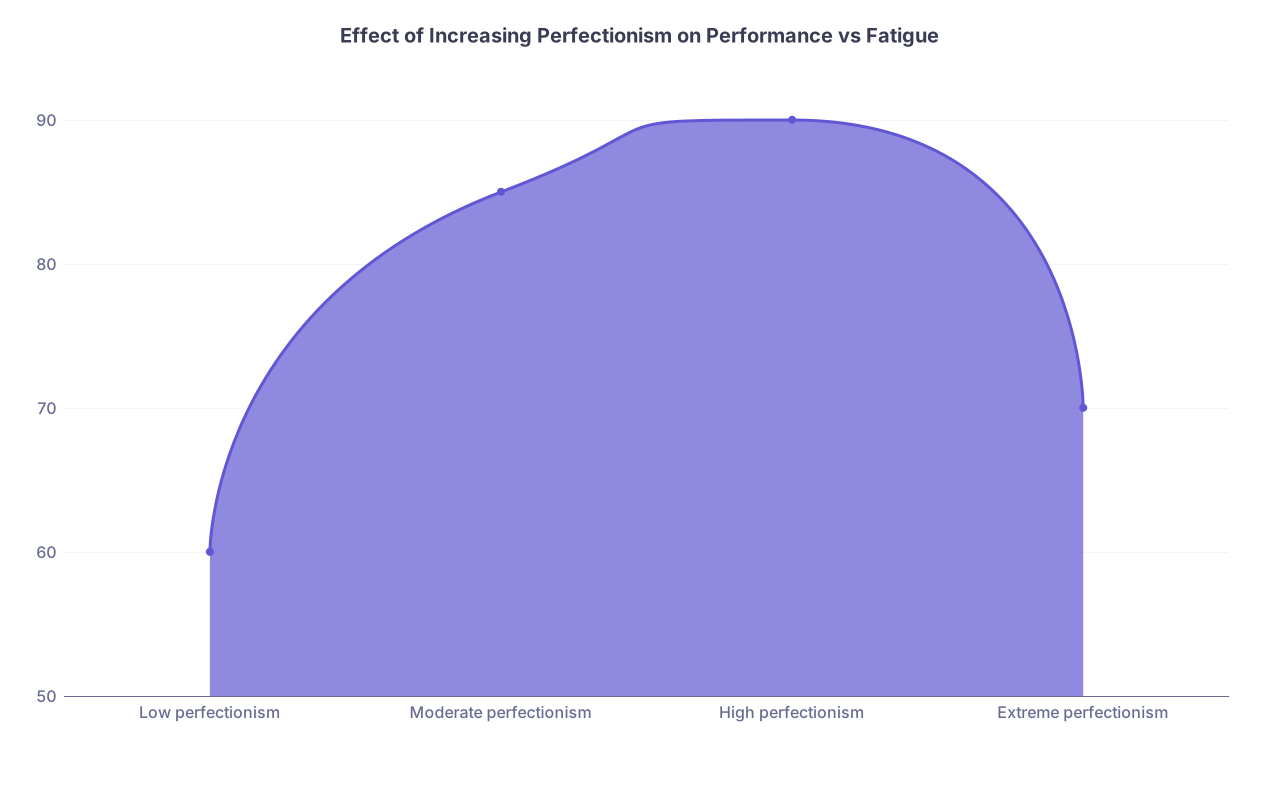
| Category | Value |
|---|---|
| Low perfectionism | 60 |
| Moderate perfectionism | 85 |
| High perfectionism | 90 |
| Extreme perfectionism | 70 |
Interpretation: Up to a point, higher standards improve performance. Past that, fatigue and cognitive overload tank your actual effectiveness.
In real resident terms:
When you stay 2 extra hours to polish every note, you worsen your:
- Situational awareness.
- Patience with staff.
- Ability to recognize subtle deterioration on the next shift.
Chronic sleep deficit impairs:
- Executive function (prioritization, multitasking).
- Working memory (you forget to follow up that crucial lab).
- Emotional regulation (you snap, avoid help, shut down).
Your perfectionism feels like it is preventing error. In reality, it is moving the error:
- Away from documentation details.
- Toward missed big-picture issues, poor communication, and fatigue-driven mistakes.
That is how good residents eventually cause serious errors. Not through ignorance. Through exhaustion and tunnel vision.
7. Calibrating to the System You Actually Work In
Residency is not an exam. It is a messy, constrained system with:
- Limited nursing ratios.
- Incomplete handoffs.
- Attendings with conflicting preferences.
- EMR nonsense that will never fully make sense.
Trying to behave like you are taking a closed-book test with ideal conditions is delusional. The environment does not support that.
Better to align with how high-functioning residents actually operate.
How top-performing, non-burned-out residents behave
Patterns I see over and over:
They are ruthless with priorities.
- They will leave a less-important note imperfect to respond to a sick patient.
- They will choose safe-good over perfect-slow.
They use simple, boring tools:
- One master to-do list for the day.
- Standard phrases for sign-out (e.g., “If X, then Y. If Y fails, call me/senior.”).
They sleep.
- They will say no to one more “nice to do” chart review at midnight because they know they are back at 6 a.m.
- They understand fatigue is a safety issue, not a personal weakness.
They ask early, then learn.
- They do not waste 45 minutes guessing when a 5-minute attending call can clarify.
- They then review the topic after, once the patient is safe and time allows.
You do not need to become them overnight. But you do need to accept this: the system rewards sustainable, reliable performance, not theatrical over-functioning that implodes in PGY-2.
8. A 14-Day Protocol to Dial It Back (Without Freaking Out)
You are not going to rewire lifelong perfectionism in one go. But you can run a controlled “trial” on yourself.
Here is a realistic 14-day protocol you can use on any rotation.
Days 1–3: Observe and Measure
Pick one shift per day and log:
- How many minutes you stay after sign-out.
- How many times you re-check orders.
- How many notes you re-open purely for formatting/wording, not new data.
End of each day, answer:
- “Where did I spend extra time that did not clearly improve safety?”
You are just collecting data. No change yet.
Days 4–7: One Lever Only
Pick one perfectionism lever to adjust:
- Either: limit post-sign-out work to 30 minutes,
- Or: one re-check per routine order, two for high risk,
- Or: limit yourself to one “clarity pass” on notes.
You are not changing everything. Just one behavior.
Track:
- What you feared would happen.
- What actually happened.
You will likely discover the system did not collapse.
Days 8–11: Add a Communication Standard
Layer in “clear enough” deliberately.
- Before sign-out, ask: Is my one-liner accurate? Are there clear if-then conditions?
- Spend 2–3 minutes improving clarity, not volume.
Discipline yourself: no extra stories, no literature lectures in sign-out. Just what the covering doc needs.
Days 12–14: Run a “Fatigue vs Quality” Experiment
Pick two days with similar workload.
- Day A: behave as your old perfectionist self.
- Day B: use your new limits (checked orders, capped post-sign-out, iterative decisions).
End of each:
- Rate fatigue 1–10.
- Rate how many real safety concerns occurred.
- Rate how many actual attending complaints happened about your “decreased perfection.”
Compare. Most residents see this:
- Fatigue lower on Day B.
- Objective quality unchanged or improved.
- Shame stories about “sloppiness” not matched by reality.
That gap between what you fear and what actually happens is where change sticks.
9. What to Do When the Guilt Hits
You will feel guilty when you stop at 90%. Expect it.
Your brain has wired “overwork” to “safety” and “moral adequacy.” Breaking that link will feel like you are being careless.
When that hits, use a short script:
- “This plan is safe enough for now.”
- “My documentation is clear enough for others to act.”
- “I can reassess at [time/event].”
- “I am protecting my future patients by not burning myself out today.”
You are not lowering your standards for fun. You are recalibrating them to reality.
You are moving from fantasy perfection to professional reliability.
There is a difference.
Key Takeaways
- Your problem is not “being a perfectionist.” It is misplacing perfectionism onto low-yield areas while ignoring its real cost in fatigue and big-picture safety.
- Recalibration is a technical task: define where you need 99% accuracy, where 90% is enough, and build simple rules (checklists, time-boxes, escalation triggers) around that.
- Sustainable residents are not sloppier. They are selective. They apply rigor to safety-critical actions, use “safe enough / clear enough / teachable enough” as their standard elsewhere, and protect their sleep as a clinical tool, not a luxury.


