

Clinic overload is not “just part of residency.” It is one of the fastest, quietest paths to burnout—and most programs handle it poorly.
You are not burning out because you are “bad at time management.” You are burning out because panel management is structurally misdesigned for how residents actually work and learn. Let me break that down, and then I will give you concrete ways to protect yourself without abandoning your patients.
1. What “Panel Management” Really Looks Like In Residency
Most residents are sold an idealized vision of panel management: continuity, longitudinal care, biopsychosocial context, relationship-centered medicine. All true. All valuable.
What you actually experience looks more like this:
- 1–2 half-days of clinic per week while juggling busy inpatient rotations
- A panel of 100–300 patients, many with complex chronic disease and social barriers
- An inbox that never sleeps: refill requests, portal messages, lab follow-ups, prior auths, abnormal imaging, forms
- EMR alerts that treat everything as urgent
- Faculty who say “just close your inbox every day” while you are cross-covering 20+ inpatients or on nights
That gap—the romantic narrative vs the daily grind—is exactly where burnout starts.
The 4 Components Of Outpatient Overload
There are four primary overload streams:
Face-to-face visits
Overbooked templates, double-booked slots, “work-ins,” late arrivals, no-shows that randomly free or wreck your schedule.Non-visit care (NVC)
Messages, refills, lab recalls, imaging follow-up, care coordination, disability/FMLA paperwork, school notes, pre-op clearance queries.Cognitive overhead
Remembering “who is this patient,” tracking multiple open threads for each, updating problem lists, recs from multiple specialists, external records.System friction
EMR clicks, poor inbox design, archaic workflows (“fax this form,” “print and sign and scan”), inconsistent routing rules, and no clear policy on what staff vs resident vs attending handles.
If you are struggling, you are not uniquely fragile. You are standing under four fire hoses with a paper cup.
2. Why Panel Management Burns Residents Out (Specifically)
Burnout is not just about “too much work.” It is about mismatch: responsibility without control, expectations without tools, emotional investment without recovery time.
Panel management in residency nails all three.
Asynchronous, Invisible Work
Inpatient work is visible: your team knows how many patients you have, what your census looks like, which admissions came at 3 am.
Outpatient panel work is different. You get:
- 20 inbox messages in a day, but nobody sees the number
- A dozen abnormal labs to act on, each needing chart review and calls
- Three forms that each take 15–20 minutes to handle correctly
This work:
- Often happens “in the cracks”: early morning, post-call, between admissions
- Rarely gets protected time or documentation credit
- Almost never gets recognized in your “productivity” metrics
So it feels like you are always behind, yet never “working” in a way that counts. That is corrosive.
Responsibility Without Real Ownership
You are told these are “your” patients. You are also told:
- You will graduate and hand them off
- The attending is ultimately responsible for every order, every refill, every note
- Your schedule is built for you, often without your input
- Patients can be added to your panel without you even being asked
So you have enough responsibility to feel guilty when things slip, but not enough control to fix the upstream problems (template design, staffing, EMR workflows).
Burnout recipe.
Continuity With Constant Disruption
True continuity takes time and predictable presence. Residency gives you neither.
You rotate:
- 2 weeks on ICU
- 4 weeks wards
- 1 week nights
- Then back to clinic for a half-day before disappearing again
Yet labs, imaging results, and messages arrive 7 days a week. So care becomes:
- Fragmented—“seen by covering resident,” “per on-call note,” “per outside ED note”
- Reactive—dealing with crises or confusion rather than planned follow-up
- Emotionally draining—because you remember the complex diabetic with unstable housing and feel you are failing them, but also have zero structural ability to do better
When your emotional investment in patients exceeds your structural power to care for them well, that gap feels like moral distress. Chronic moral distress is a straight line to burnout.
3. The Mechanics Of Panel Management: Where Residents Get Crushed
Let me dissect the specific traps I see over and over.
Trap 1: Unbounded Inboxes
Many residents I have worked with have 100–400 unread messages at some point in PGY-2. Typical pattern:
- No clear expectation about inbox volume or turnaround
- No consistent attending backup or RN triage
- No automatic coverage system during off-service months
- Guilt about “bothering” attendings or clinic staff
The inbox becomes a shame object. You avoid opening it. The pile grows. Every clinic day starts with dread.
Trap 2: Panel Size Without Reality Check
Programs love big panel numbers. “You will have 200 continuity patients by end of PGY-2.” Sounds impressive. It is also meaningless if you do not control:
- No-show rates
- Complexity (e.g., 10 well-child visits vs 10 multi-morbid Medicare patients)
- Visit frequency expectations
- Non-visit workload per patient
Here is the truth: a panel of 120 complex adults with high message/lab volume can be more work than 250 relatively healthy patients.
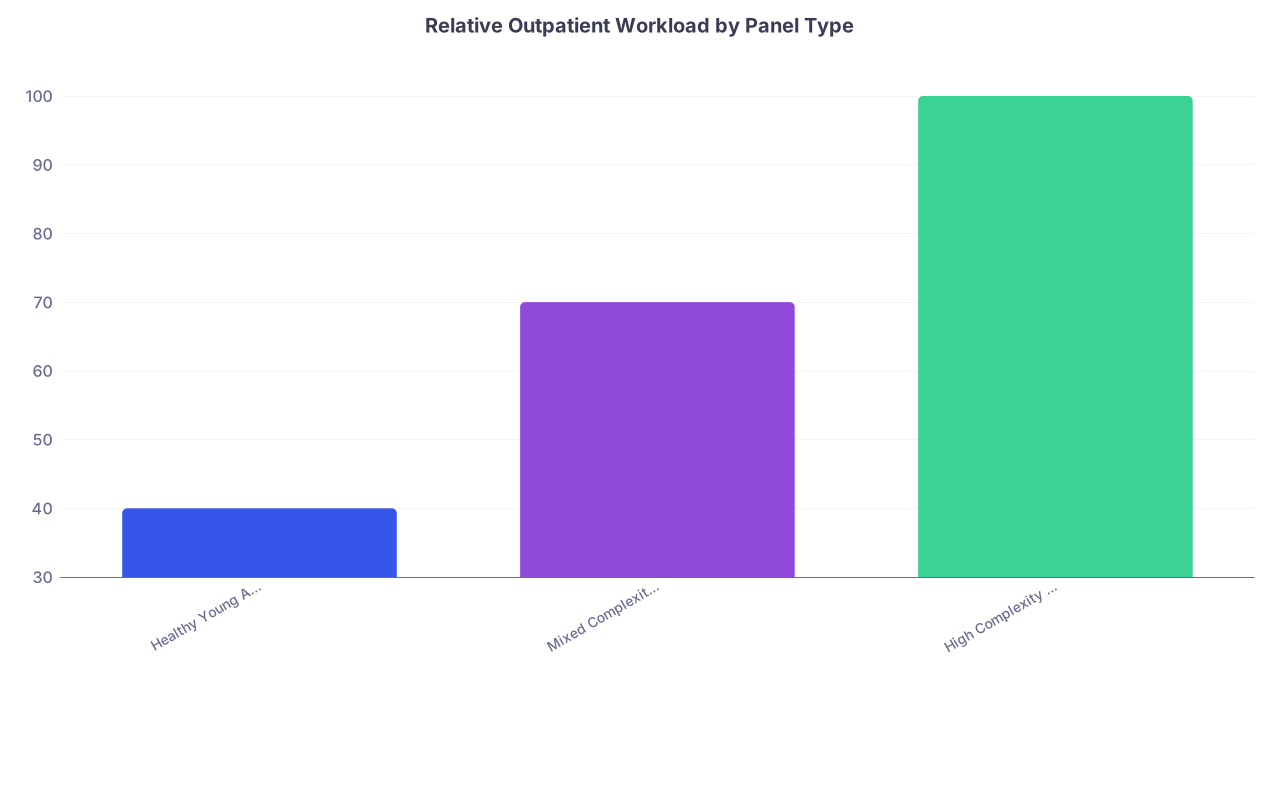
| Category | Value |
|---|---|
| Healthy Young Adults (150) | 40 |
| Mixed Complexity (200) | 70 |
| High Complexity (120) | 100 |
Those scores are not RVUs—just a rough relative load index. Many residents are assigned high-complexity panels without anyone recalibrating their clinic time or support.
Trap 3: “Resident Will Do It” Culture
You have seen this:
- “Just send it to the resident, they can fill out the disability packet.”
- “Forward to resident for med reconciliation, they know the patient.”
- “Resident will call back with results.”
Every time the RN or clerk or attending decides the resident is the path of least resistance, your invisible workload jumps.
You are cheaper. You are assumed to have “flexibility.” That gets weaponized.
Trap 4: EMR Design That Pretends You Have Only Clinic
Go look at your inbox filters. Default views rarely consider your schedule:
- No automatic pausing or rerouting when you are on nights or ICU
- No “batching” of low-acuity tasks to a specific weekly block
- Risk-based triage is often primitive or nonexistent
The system acts as if you are a full-time outpatient physician. You are not. You are a rotating resident with wildly variable bandwidth.
4. Concrete Strategies To Prevent Burnout From Panel Management
You cannot fix your EMR or rewrite the residency contract. You can, however, make very targeted moves that change your reality.
4.1 Negotiate Explicit Inbox Coverage Rules
Do not rely on informal “just message the attending if you are busy.” That is a burnout trap.
Push for written rules for:
- When you are on nights
- When you are on ICU/ED/float
- Post-call days
- Vacation and conference
You want something like:
| Resident Status | Inbox Owner | Expected Action Time |
|---|---|---|
| Regular clinic week | Resident | 48 business hours |
| Inpatient wards | RN + Attending | 48 business hours |
| Nights/ICU | Attending only | 48 business hours |
| Vacation/conference | Assigned backup | 72 business hours |
Then you tell every attending and RN you work with: “When I am on X, Dr. Y is primary for inbox. Please reroute anything urgent directly to them.”
You are not “dumping work.” You are forcing the system to acknowledge reality.
4.2 Design Your Own Template Guardrails
You might not control everything, but you can usually negotiate some:
Push for limits on add-ons. Decide in advance:
- Max 1 same-day work-in per half-day
- Or designate specific “urgent” slots instead of random add-ons
Protect one “buffer slot” late in the session for:
- Follow-up calls
- Form completion
- Lab result documentation
Ask to remove chronically no-showing patients from peak slots (e.g., first morning slot) or pair them with slots where a no-show is less damaging.
If you see both kids and adults, cluster visits by type when possible. Cognitive switching fatigue is real—bouncing from newborn visit to uncontrolled CHF to ADHD follow-up to complex pain will fry you.
4.3 Build a 15–20 Minute Weekly Panel Management Block
This sounds trivial. It is not.
Set a recurring event: “Panel Management – Protected” for 15–20 minutes at the same time each week, ideally on a lighter day.
During that window:
- Do not answer pages unless life-threatening
- Do not open new notes
- Only:
- Work the inbox (oldest first)
- Close result loops (labs/imaging)
- Scan the registry for overdue DM/HTN/anticoag labs
- Make 1–2 high-yield phone calls (e.g., patient who keeps missing appointments)
You are doing two things here:
- Creating a visible block of outpatient brain time that isn’t squeezed between inpatient chaos.
- Demonstrating to your program “resident panel work needs scheduled time,” which you can later leverage when the volume becomes clearly mismatched.
Perfect? No. But it is a lot better than pretending you will “catch up” at 9 pm after wards.
4.4 Use Tiered Thinking: Not Every Message Needs A Full Visit
Residents burn out trying to practice full guideline-level care in every inbox message. You need a tiered system in your head.
Think in three tiers:
Tier 1 – Quick disposition (≤2 minutes)
- Simple refill that meets clinic protocol
- Normal lab with standard template response
- Administrative messages (school note for mild viral illness already seen)
Tier 2 – Requires brief chart review and targeted response (5–10 minutes)
- Mild symptom change in a known patient
- Slightly abnormal labs that may need small med tweak or close follow-up
- Confusing message that you can clarify with 1 portal/message reply
Tier 3 – Needs structured visit or phone visit (15+ minutes)
- New symptom complex (chest pain, neuro deficits, concerning weight loss)
- Complex mental health issues, worsening suicidality, med changes
- Recurrent poorly controlled chronic disease despite multiple recent changes
When in doubt between Tier 2 and 3, downgrade your ambition and upgrade to a scheduled visit. That protects your bandwidth and your patients.
5. Tools, Shortcuts, and Systems That Actually Help
You cannot grind your way out with “working harder.” You need systems. Let me give you a few that actually move the needle.
5.1 Smart Phrases and Templates That Are Worth Your Time
Residents love to say “I’ll just free-type, templates slow me down.” That is false past a certain scale.
Build 6–10 high-yield templates:
- Normal lab result + reassurance + return precautions
- Mildly abnormal lab + med change + recheck plan
- Routine medication refill (chronic, stable) + follow-up timing
- Pain med policy explanation + no early refills script
- Mental health: safety planning + urgent resources + follow-up instructions
- Missed appointment follow-up + outreach attempt documentation
A generic but effective structure:
“I reviewed your [lab/test]. The result shows [brief interpretation]. Based on this, the plan is: [1–2 simple steps]. Please contact the clinic or seek urgent care if you experience: [3–4 specific red flags]. I recommend we [follow-up plan].”
Once built, these templates turn 5-minute messages into 30–60 second tasks, without cutting quality.
5.2 Use Registries and Bulk Thinking
If your EMR has disease registries (diabetes, hypertension, anticoagulation), use them purposely in your panel block.
Once every 1–2 months:
- Pull your DM registry
- Identify the worst-controlled 5–10: A1c > 9, repeated no-shows, recurrent ED visits
- Focus on just those patients for calls / closer follow-up / care coordination
Same for:
- Patients on warfarin or DOACs with missed labs
- “High utilizer” lists, if your system has them
High-yield panel management is about risk concentration. Not heroics with everyone.
5.3 Result Management Workflow That Does Not Eat Your Brain
Abnormal results are a huge source of anxiety. Build a consistent pattern.
For each result:
Triage severity quickly:
- Dangerous and urgent: call patient or arrange ED / urgent visit
- Significant but not emergent: message + expedited follow-up
- Mild or expected: template message + plan
Document the loop closure:
- Note in EMR: “Result reviewed, patient informed via [phone/portal], plan as above.”
- Future-lab or follow-up visit order already placed before you close the result
Offload to staff when safe:
- For normal results with no med change required, allow RN to notify via protocol message when your clinic allows it.
You are aiming for a consistent mental script: see result → categorize → act → close loop → move on.
6. Emotional Boundaries: Caring Without Being Consumed
Here is the part people avoid saying aloud: panel management can feel like drowning not only because of tasks, but because of how much you care.
Shift Your Internal Standard
If your internal bar is “every patient gets perfect evidence-based care, fully coordinated, with every social determinant addressed, every time” you will never feel finished.
A more realistic standard for residency:
- “I will provide safe care.”
- “I will prioritize the highest-risk issues.”
- “I will not ignore dangerous patterns, even if I cannot fix everything.”
- “I will show up with honesty and effort, not perfection.”
Sounds soft. It is not. This is how long-career physicians survive.
Learn To Tolerate Imperfection By Design
You are not an outpatient superhero. You are one node in a flawed system.
Healthy mental moves:
- When you hand off a patient post-residency, write one strong summary note and let it go. You have done your part.
- When you are on ICU and cannot respond to messages within 24 hours, remember that the coverage plan exists for a reason. You are not “abandoning them”; you are reallocating to higher-acuity patients temporarily.
- When you notice long-term system failures (no social work, impossible referral wait times), channel that into concrete feedback or QI projects later, instead of endless self-blame now.
This is not detachment. It is disciplined compassion.
7. Program-Level Fixes You Should Push For (Without Making Enemies)
Some of this you cannot fix alone. But you can nudge.
Data Is Your Friend
Burnout complaints get dismissed. Numbers do not—at least not as easily.
Track for 4–6 weeks:
- Average inbox messages per week
- Average time you spend per week on panel work (even rough estimates)
- Number of abnormal labs requiring action
- Number of forms / letters handled
Use a simple table like this when you meet your clinic director:
| Metric | Weekly Average |
|---|---|
| Inbox messages | 65 |
| Lab results requiring action | 18 |
| Forms/letters completed | 6 |
| Non-visit care time (hrs) | 3.5 |
Then say: “This is invisible in our schedules. Where can we create protected time or better triage?” Calm. Data-driven. Harder to ignore.
Push For RN/MA Protocols
Big impact change:
- Refill protocols for chronic meds with stable patients
- Normal lab result notification by RN using scripts
- Pre-visit planning by MA/RN to close care gaps during scheduled visits
Even a small shift—RNs handling normal labs, MAs pre-pending health maintenance items—can decompress your panel load.
Advocate For Reasonable Panel Sizes
Use your data. If you and your co-residents clearly show that 180 high-complexity patients with 70+ weekly inbox items each is unmanageable with current clinic time, ask directly:
- “Can we cap resident panels at X?”
- “Can we shift very high-utilizer patients to faculty panels with more stable presence?”
- “Can we adjust clinic templates for those with very high-risk panels?”
You will not get everything. But you will often get something if you are specific.
8. What A Sustainable Outpatient Week Actually Looks Like
Let me put this together into a realistic, sustainable pattern. Assume a resident with 1.5 clinic days per week and moderate inpatient work.
You aim for:
Before each clinic half-day (10–15 minutes)
- Scan inbox for urgent items only
- Check for same-day critical labs or messages
- Flag 1–2 high-priority patients for extra attention
During clinic
- Use templates aggressively
- Avoid opening the inbox between every patient; batch at mid-session or end
- Use team members (RN, MA, front desk) intentionally
Weekly panel block (15–20 minutes)
- Work oldest inbox items first
- Close out pending results
- Make one “high-yield” outreach call
- Update any registry-driven tasks
Monthly mini-review (20–30 minutes)
- Look at your 5–10 highest-risk patients
- Identify patterns: repeated ED use, uncontrolled DM/HTN, repeated no-shows
- Plan 1–2 targeted interventions: joint visit with social work, integrated behavioral health referral, pharmacist visit, group visit, etc.
Is this perfect? No. But it moves panel management from chaotic, guilt-driven reaction to structured, time-bounded effort. That is the difference between chronic anxiety and manageable stress.
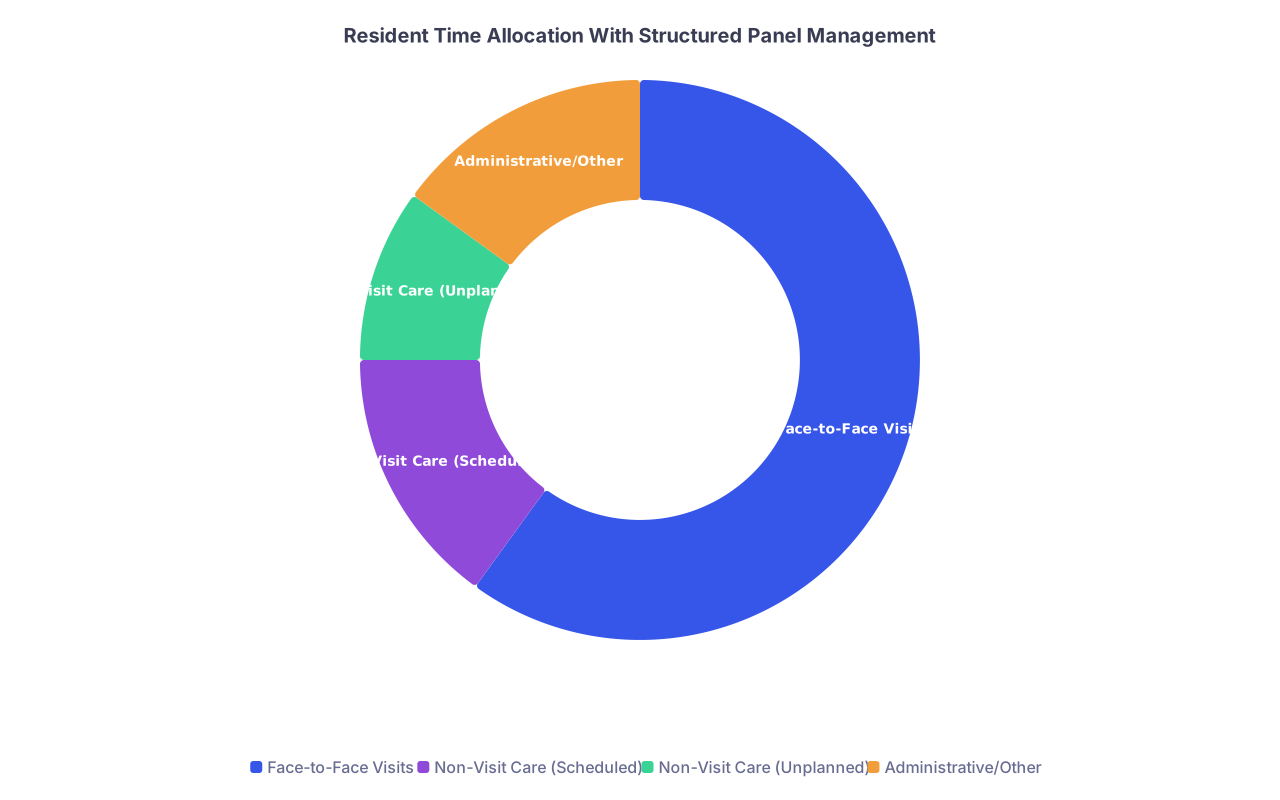
| Category | Value |
|---|---|
| Face-to-Face Visits | 60 |
| Non-Visit Care (Scheduled) | 15 |
| Non-Visit Care (Unplanned) | 10 |
| Administrative/Other | 15 |
The goal is not to eliminate non-visit care. The goal is to shift more of it into the “scheduled” slice instead of the “unplanned” one that invades your nights and weekends.
9. When You Are Already Drowning
If your inbox is already out of control—hundreds of messages, months of backed-up labs—you do not fix this with “better personal efficiency.” You need a reset.
Steps:
Tell someone with authority the truth.
“My inbox has 280 messages and I am not confident everything is safe. I need help to reset this.”Request a structured catch-up block.
Half-day or even 2–3 hours of protected time, with explicit coverage of your other duties.Work the backlog with a supervising attending or senior.
- Sort quickly into urgent vs non-urgent
- Close what can safely be closed with templates
- Escalate uncertain items immediately
Use that event as leverage for systemic change.
“This will just happen again unless we have formal coverage rules and scheduled panel time.”
Shame keeps residents quiet. Silence keeps systems broken.

| Step | Description |
|---|---|
| Step 1 | Inbox Items |
| Step 2 | Immediate Call or Visit |
| Step 3 | Quick Template Response |
| Step 4 | Brief Review and Message |
| Step 5 | Schedule Visit or Phone Visit |
| Step 6 | Document and Close |
| Step 7 | Urgent? |
| Step 8 | Tier 1 or 2 or 3 |
This is the mental model you want to internalize: rapid categorization, intentional action, quick closure.

FAQs
1. My program says panel management is my responsibility, but I have no protected time. What is a realistic first ask?
Start small and concrete: ask for a recurring 20–30 minute weekly block of protected time specifically labeled as “resident panel management” on your schedule, with explicit understanding that you are not to be paged for non-urgent issues during that window. Pair the ask with data: a 2–3 week log of your inbox volume and non-visit care time. It is harder to argue with a graph showing 60+ messages a week than with “I feel overwhelmed.”
2. How many panel patients is “too many” for a resident?
There is no magic number, but I start to worry when residents with mostly complex adults exceed 150–180 active patients without strong RN/MA support and at least 1.5 clinic days per week. What matters more than the raw number is complexity, message volume, and how many non-visit tasks each patient generates. If you are carrying 200+ patients and spending several hours a week on panel work outside scheduled time, that is a red flag worth raising.
3. I feel guilty triaging some things to visits instead of handling them by message. Is that bad care?
No. That is realistic care. Many issues that look simple in a portal message (e.g., “I feel more tired lately”) are actually complex once you ask 3–4 follow-up questions. Shifting those from endless back-and-forth messaging to a structured visit or phone visit is safer for the patient and more sustainable for you. Good outpatient care is not about minimizing visits; it is about matching the format to the complexity of the problem.
4. What if my attending is unsupportive and insists I “just keep up” with everything?
You cannot win a one-on-one philosophical argument with someone who thinks suffering is a rite of passage. You can, however, bring data and widen the audience. Document your message volumes, after-hours work, and any safety concerns (delayed lab follow-ups, near-misses). Then bring that to your clinic director or program leadership with specific asks: formal inbox coverage policies, capped add-ons, or scheduled panel time. Frame it as a patient safety and education issue, not just your personal wellness. That shifts the conversation from “you need to toughen up” to “our system is under-resourced for the work we are assigning.”
Key takeaways:
Panel management during residency becomes toxic when invisible workload, fragmented schedules, and vague expectations stack on top of each other. You protect yourself by making the work visible, time-bounded, and structured—using explicit coverage rules, small but real protected blocks, and tiered decision-making. And if you are already drowning, you do not quietly tread water; you escalate, reset, and use that moment to push for system change.


