

What do you do when you realize you’ve started dreading going to work… and you’re only six weeks into PGY‑1?
If that hits a little too close, good. Better to catch this early than to be the intern crying in the stairwell at 4 a.m. wondering how it got this bad.
The first 90 days of residency are a perfect storm:
- New identity
- New responsibilities
- No guardrails
And you’re exactly the kind of person who’s vulnerable: high-achieving, perfectionistic, used to suffering quietly.
Let me walk you through the most common burnout traps PGY‑1s fall into early—and how to not be the next cautionary story.
1. The “Say Yes to Everything” Trap
This is the classic intern mistake. You’re terrified of being seen as lazy, weak, or “not a team player,” so you say yes to everything.
Extra cross-cover? “Sure.” Pick up that extra clinic? “No problem.” Stay two hours late to help with discharge summaries that aren’t yours? “Of course.”
You think you’re proving you belong. In reality, you’re teaching everyone that abusing your time is acceptable.
Why this burns you out fast
- Your work expands to fill all available time.
- No boundaries → no protected sleep, no real days off.
- You become the default dumping ground for everyone’s least desirable tasks.
I’ve seen PGY‑1s who were great clinically get quietly wrecked by this. By October, they’re:
- Behind on notes every single day
- Snapping at nurses
- Forgetting basic orders
- Secretly Googling “leaving residency after intern year”
How to avoid it (without looking like a jerk)
You don’t have to be rude. You just have to stop being infinitely available.
Use phrases like:
- “I can help with X, but then Y will be delayed—what’s the priority?”
- “I’m at capacity with my own patients right now. Is there someone else who can help with that?”
- “I can do this today, but I won’t be able to stay late tomorrow.”
This does three things:
- Signals that your time is finite and you’re already working hard.
- Forces seniors/attendings to clarify priorities instead of just adding more.
- Protects you from the slow creep of “always saying yes” becoming your identity.
Big red flag:
If you never hear yourself say “no” or “I can’t take that on right now” during a week, you’re walking straight into burnout.
2. The “I’ll Fix This With More Hours” Trap
New interns make this deal with themselves:
“I’m behind. I’ll just power through it. Stay later. Come earlier. Work on my ‘off’ time.”
Spoiler: the work never ends. You just run yourself into the ground.
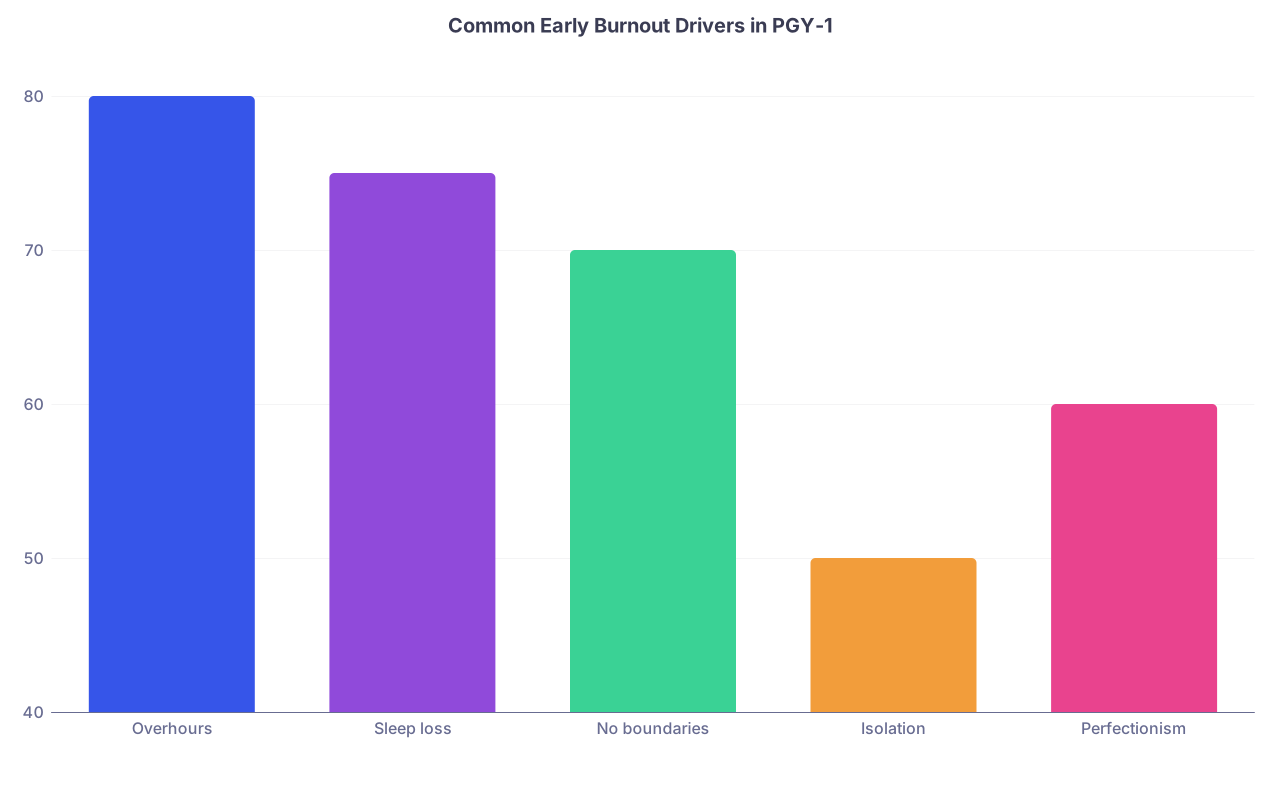
| Category | Value |
|---|---|
| Overhours | 80 |
| Sleep loss | 75 |
| No boundaries | 70 |
| Isolation | 50 |
| Perfectionism | 60 |
Why this backfires
- Extra hours give temporary relief, then your baseline expectation shifts.
- Attendings notice you’re “always here” and subconsciously rely on that.
- Your efficiency decreases as you get more exhausted—so you need even more hours.
You think:
“Once I get faster, I won’t need to work like this.”
But because you never let yourself rest, you don’t get much faster. You just get more frazzled and error-prone.
Signs you’re in this trap
- You regularly stay >90 minutes after sign-out “catching up.”
- You bring notes home on your “day off.”
- You’re running on caffeine and panic more than anything else.
What to do instead
Set a hard time boundary 3–4 days per week.
Tell yourself: “I leave the hospital by X time unless patient care would clearly suffer.” Not for perfection. Not to have every box checked in Epic.Let some tasks be “good enough.”
That note doesn’t need to be a literature review. That cross-cover H&P doesn’t need to be a masterpiece. Safe and clear? Yes. Beautiful? Optional.Ask seniors for workflow help, not just medical help.
Wrong question: “Can you explain hepatorenal again?”
Better: “Can you show me how you organize your day so you aren’t here until 9 p.m.?”
If your solution to every problem is “I’ll just work more,” you will be burned out by month three. Not maybe. Definitely.
3. The Lone-Wolf Superhero Trap
“I don’t want to bother my senior.”
“I should be able to handle this.”
“They’re all busy, I’ll just figure it out.”
This is dangerous. And not just for you—your patients pay for this one too.
What this looks like
- You sit on a question for 45 minutes, spiraling, instead of asking.
- You try to manage sick patients alone because you don’t want to “overcall.”
- You pretend you’re fine when you’re absolutely not.
I watched an intern sit on a hypotensive patient overnight because she didn’t want to “wake the chief.” By morning, the story was: “Intern missed sepsis.” Was that fair? Not entirely. Did anyone blame the chief for “sleeping through it”? No. They blamed the PGY‑1 who didn’t call.
Why you do this
- Medical school punished you for “not knowing.”
- You’re terrified of looking incompetent.
- You think struggling in silence earns respect.
It doesn’t. It makes people nervous about you.
How to not fall into this
Use a simple rule:
If you’d pause and think, “If this goes wrong, will they ask why I didn’t call?”—you call.
Also, deliberately normalize asking:
- “Hey, can I run this patient by you quickly?”
- “I’ve got a plan, but I want to make sure I’m not missing anything.”
- “I’m okay managing this, but I’d like a second pair of eyes.”
Nobody senior to you is mad you asked early. They’re mad when they get blindsided late.
Big red flag:
If you’re regularly documenting “discussed with senior” without actually having discussed it, you are deep in this trap and already half burned out.
4. The Sleep-Doesn’t-Matter Lie
PGY‑1s talk about sleep like a badge of honor.
“I got 3 hours.”
“I slept in my car for 20 minutes.”
“This week was brutal, I haven’t really slept since Tuesday.”
You know who talks like that? People who are about to start making scary mistakes.
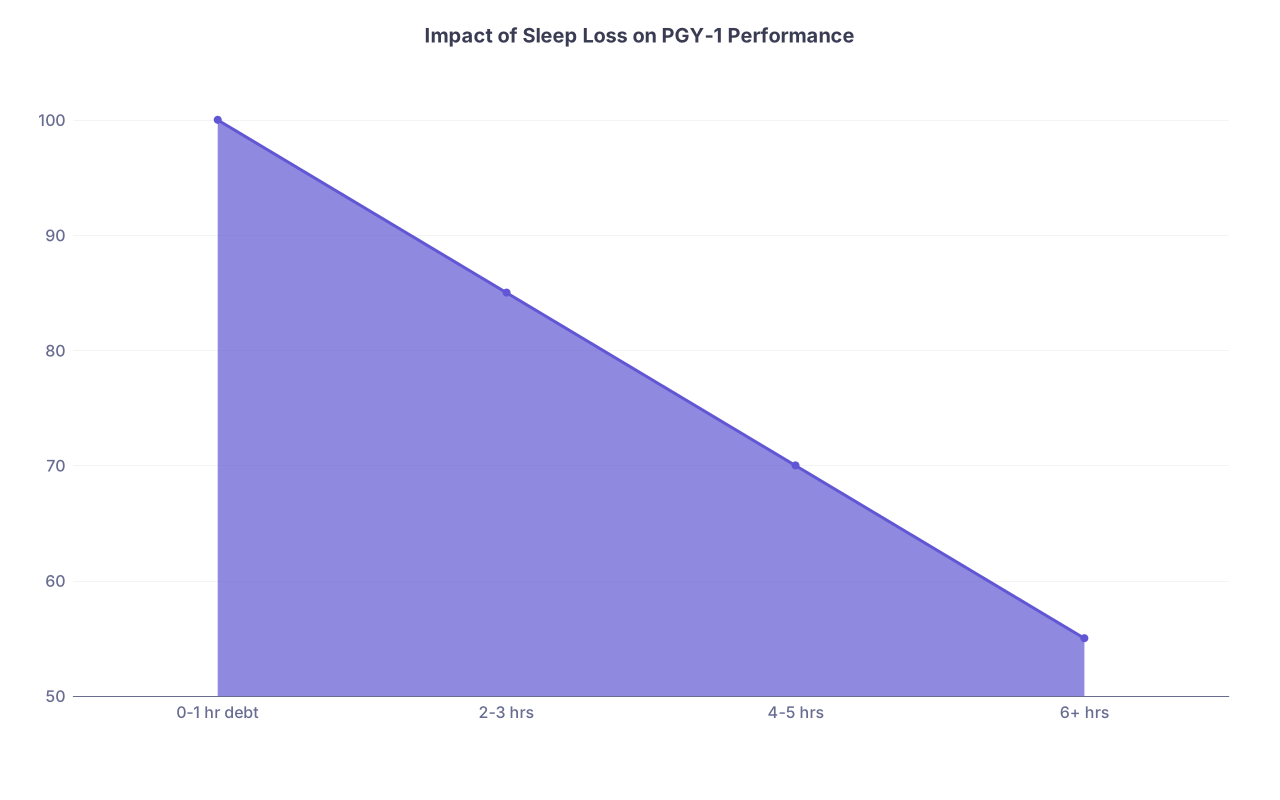
| Category | Value |
|---|---|
| 0-1 hr debt | 100 |
| 2-3 hrs | 85 |
| 4-5 hrs | 70 |
| 6+ hrs | 55 |
(Interpretation: as accumulated nightly sleep debt increases, functional performance plummets.)
Common intern mistakes about sleep
- “I’ll just catch up on my day off.”
- “I can function fine on 4 hours.” (You can’t. You’re just used to feeling awful.)
- “I should stay longer and finish this instead of going home to sleep.”
By week 4 of this pattern, you’re:
- Emotionally flat
- Cynical
- Forgetful
- Slower at everything
Sound familiar?
Simple non-negotiables
No, you can’t create an 8-hour nightly routine like a lifestyle blogger. But you can avoid the worst mistakes.
- Post-call: go home. Don’t “just finish a few notes” and then somehow still be there at noon. Sleep.
- Stop screens 15–20 minutes before sleep. You don’t need perfect sleep hygiene. You just need “slightly less bad.”
- Use short, strategic naps (20–30 min). More than that during the day and you’ll feel like you got hit by a truck.
Warning sign: if you choose to scroll on your phone for 90 minutes instead of sleeping “because my brain is fried,” you’re self-sabotaging. That doom-scroll is expensive. You pay for it at 4 a.m. when your pager doesn’t stop.
5. The “Off-Days Are for Catching Up” Trap
A disturbing number of interns do this:
- Use “days off” to do leftover notes
- Answer patient messages
- Catch up on reading consults
- Feel guilty anytime they’re not doing something residency-related
So their brain literally never turns off.

Why this guarantees burnout
- You never get full psychological distance from work.
- Your nervous system never downshifts from “threat” mode.
- Even fun things feel like you’re “stealing time” from work.
There’s a reason people hit a wall around October. They’ve basically had zero genuine time off since orientation.
How to fix it
On your next day off:
- Pick a protected block (even just 4–6 hours) that is 100% non-residency.
- No Epic. No “just checking messages.” No “quickly reading that article.”
- Do things that remind you you’re a human, not a productivity machine: walk, see a friend, watch trash TV, cook, sleep, whatever.
If you must catch up:
- Time-box it. Example: “I’ll spend 90 minutes max on notes from 8–9:30 a.m., then I’m done.”
- Don’t lie to yourself that you’ll “just do a quick thing.” Set a timer.
Red flag:
If you can’t remember the last time you had a day—or even half a day—where your brain wasn’t half at the hospital, your burnout risk is high.
6. The Toxic Comparison & Imposter Trap
You’re surrounded by people who look like they’re crushing it:
- The intern who finishes notes early
- The senior who never seems stressed
- The co-resident who still goes to the gym 5 days a week
So you decide the problem is you. That you’re weaker. Less capable. Not cut out for this.
This mental loop is gasoline on the burnout fire.
The part you don’t see
- That “perfect” intern might be going home to cry.
- That always-on senior might be on their second divorce.
- That gym-5x/week co-resident might be failing their in-service.
You see the surface. You don’t see the cost.
How this accelerates burnout
- You stop asking for help because “everyone else is fine.”
- You double down on self-criticism instead of course-correcting.
- You interpret normal struggle as personal failure.
What to do instead
When you catch yourself thinking “Everyone is better than me”:
- Force yourself to say it out loud to someone you trust. A co-intern, chief, friend. You’ll realize quickly how common this is.
- Ask seniors directly: “How were your first 3 months of intern year really?” You’ll hear horror stories. That’s good. It normalizes the chaos.
Measure yourself against:
- Your own trend, not others. Are you a bit more efficient than 3 weeks ago? Are your notes tighter? Are you calling for help a bit earlier? That’s the metric.
- Safety and integrity, not perfection. Are you safe? Honest in your documentation? Owning mistakes? That matters more than being the fastest.
If you’re mentally writing your own “I don’t belong here” narrative, you’re not just sad. You’re in a high-risk zone for full burnout.
7. Ignoring the Early Warning Signs
Burnout doesn’t hit all at once. It smolders first. The early 90 days are full of soft warnings that interns love to ignore.
Here are the big ones:
Emotional signs
- You feel numb when bad things happen.
- You’re suddenly more irritable—with nurses, family, your partner.
- You dread opening the EMR.
Cognitive signs
- Simple tasks feel overwhelming.
- You reread the same note three times and still can’t process it.
- You start making little mistakes you wouldn’t have made as an MS4.
Behavioral signs
- You start skipping meals regularly.
- You abandon exercise completely, not just scaled back.
- You’re drinking more, or reaching for sleep meds nightly.
| Pattern | Probably Normal Adjustment | Early Burnout Warning |
|---|---|---|
| Feeling tired | Tired after call, better after rest | Tired all the time, even after off days |
| Emotions | Occasional frustration | Persistent cynicism or numbness |
| Cognitive function | Slower at first, then improving | Getting progressively more scattered |
| Days off | Sometimes just crash and sleep | Never feel rested, always behind |
| Self-talk | “This is hard but I’ll learn” | “I’m failing; I don’t belong here” |
If you see yourself in that right-hand column and shrug it off? That’s the mistake. That’s how people end up in serious trouble by mid-year.
8. Not Using the Safety Valves You Actually Have
This one frustrates me because I’ve watched it go bad too many times.
Hospitals and programs love to talk about:
- Wellness resources
- Counseling
- Fatigue mitigation
- “Supportive culture”
Then you know what happens? Interns don’t use any of it until they’re breaking.
The quiet rules you think exist
- “If I admit I’m struggling, they’ll think I’m unsafe.”
- “If I see the mental health provider, it might affect my career.”
- “Everyone else is pushing through—I should too.”
Reality check: programs are much more scared of the resident who crashes out of nowhere, disappears, or makes a catastrophic mistake than the one who says early: “I’m not okay; I need help.”
The safety valves you’re probably ignoring
- Program leadership you actually trust. Usually one APD or chief who’s known for being decent. Use them.
- Occupational health or resident counseling services. Confidential. Often free. Underused.
- Schedule adjustments. Swaps, pulling you off a rotation that’s clearly crushing you, temporarily reducing call. It does happen—for the people who say something early.
Here’s the ugly truth:
If you wait until you’re having panic attacks in the stairwell or actively thinking about quitting medicine, the path back is longer and messier. Catch it three months earlier? Often fixable with smaller changes.
A Quick Reality Reset
Let me be blunt:
The first 90 days of PGY‑1 are not the time to prove you’re superhuman.
They’re the time to:
- Prove you’re safe.
- Prove you’re able to learn.
- Prove you understand your own limits.
The residents who last and actually like their careers are not the ones who stoically absorb unlimited abuse from the system. They’re the ones who quietly, consistently refuse to make the same mistakes everyone else did.
They:
- Say “no” sometimes.
- Leave on time when it’s safe.
- Ask for help early.
- Guard their sleep like medication.
- Use days off to actually be off.
- Treat early burnout signs as alarms, not background noise.
You don’t need a perfect wellness plan. You just need to avoid the obvious traps.
FAQs
1. How do I know if what I’m feeling is normal stress vs real burnout?
Normal stress:
- Comes and goes
- Eases noticeably after a good day or a real day off
- Still allows moments of satisfaction or pride
Burnout:
- Feels constant, regardless of the day
- Persists even after time away from the hospital
- Comes with cynicism (“None of this matters”), emotional numbness, or a strong urge to escape
If your baseline has shifted to “I feel dead inside” more days than not for a few weeks, stop calling that normal. That’s early burnout.
2. Won’t setting boundaries make me look lazy or uncommitted?
Not if you do it right. Lazy is blowing off work, disappearing, or dumping tasks on others. Healthy boundaries are:
- Prioritizing patient safety over perfect documentation
- Saying “I’m at capacity” instead of silently drowning
- Leaving on time when your work is truly done
Seniors and attendings with actual judgment can tell the difference. The ones who can’t? You don’t build your entire career around impressing them.
3. What should I do this week if I already feel close to burned out?
Three concrete steps:
- Tell one person in your program the truth. Chief, APD, senior you trust. Use the words “I’m worried I’m burning out.”
- Protect one full block of off-time. Half a day. No EMR, no reading, no “catching up.” Prove to yourself you’re allowed to rest.
- Fix one thing about sleep. Even if it’s just committing to a 20-minute wind-down and not using your phone in bed.
Doesn’t fix everything. But it slows the slide. Then you can make bigger changes.
4. Should I ever consider changing programs or specialties because of early burnout?
Not in the first 90 days based purely on emotion. Everything feels worse early.
But if:
- You’ve had consistent, severe distress for months
- You’ve tried reasonable fixes and used available support
- Multiple rotations confirm “this environment/specialty is a bad fit”
…then yes, talking to a trusted mentor or PD about long-term fit is rational, not weak. Just don’t make a permanent decision based on your worst week of intern year.
5. Is it actually safe to tell my program leadership I’m struggling?
Nothing is risk-free, but staying silent is usually riskier:
- Higher chance of serious medical error
- Greater likelihood of crashing hard and needing extended leave
- More damage to your reputation from unaddressed performance issues
Most programs would rather hear “I’m struggling, help me course-correct” than “I’m resigning effective immediately” or “I made a huge mistake and didn’t realize how bad off I was.” Choose the lesser risk.
Remember:
- Don’t try to prove your worth by sacrificing your health.
- Don’t ignore early warning signs just because “everyone’s struggling.”
- Don’t wait until you’re at the breaking point to pull the emergency brake.
Your goal for the first 90 days isn’t to be impressive. It’s to still be a functional human being at day 91. Protect that like your career depends on it—because it does.


