

Last week, a PGY-3 sat in the call room at 4 a.m., staring at an empty coffee cup like it personally offended her. She said, “I’ve got eight months left, and I swear I don’t know how I’m going to make it through next week.” The scary part? She wasn’t dramatic. She was just… done.
If you’re reading this, you probably know that feeling way too well.
You’re not just “tired.” You’re fantasizing about walking out mid-shift. You’re googling “non-clinical careers for doctors” on your lunch break. You’re counting rotations not in months but in survival units: “If I can just make it through this week of nights… then the next ICU block… then boards…”
And the question that keeps looping in your head is brutal:
What if I’m already burned out before residency even ends? Can I still succeed, or did I already ruin my career?
Let me answer that fast and clearly:
You can still succeed.
But not by pretending you’re fine and white-knuckling your way to graduation.
The Fear Underneath the Burnout
The obvious fear is “I can’t keep going like this.”
But that’s not the only one, right?
There’s the other stuff:
- “If I admit I’m burned out, they’ll think I’m weak.”
- “If I slow down, I’ll fall behind my co-residents.”
- “If I ask for help, I’ll get labeled as ‘a problem.’”
- “If I feel this bad now, I must not be cut out for this specialty.”
- “What if this never gets better and I’m stuck like this for 30 years?”
This is the mental trap a lot of residents fall into:
“Real doctors are exhausted and miserable and still keep going. If I can’t do that, I must not be good enough.”
I’ve heard attendings casually joke, “You’re not really a resident until you’ve cried in the stairwell,” like that’s some kind of personality test instead of a warning sign. People normalize things that are absolutely not normal:
- Not sleeping more than 4–5 hours most nights
- Leaving shifts late every single day
- Getting snappy with patients or nurses because your fuse is shot
- Feeling dread every time your phone or pager buzzes
- Thinking, “If I get into a minor car accident on the way to work, at least I won’t have to round today”
If any of that sounds familiar, that’s not “just residency.”
That’s burnout. And pretending it’s just “part of training” is how people crash.
Can You Be Burned Out and Still “Succeed”?
Let’s define “succeed,” because that word messes with people.
Most anxious residents mean:
“Can I still become a competent, respected attending with a decent life, even though I feel like I’m barely keeping my head above water right now?”
My answer: Yes. Unequivocally yes.
But success might not look exactly like the rigid picture you had in MS1.
Here’s where it gets messy.
I’ve watched people in these situations:
- A surgery resident in her last year who took a medical leave for depression, came back, finished on a slightly delayed timeline, and is now a happy breast surgeon with a sane practice.
- An IM resident who switched to a less intense fellowship path (hospitalist instead of heme/onc) because her body and brain were cooked. She now has protected time, decent hours, and likes medicine again.
- A resident who almost quit EM in PGY-2, negotiated a schedule change, got a therapist, and finished. Now does 0.8 FTE in a community shop, with more days off than he ever thought he’d see.
Burned out during residency ≠ doomed forever.
What it does mean: something about the way you’re currently living and working is unsustainable. And ignoring that has consequences.
Let me be blunt:
You can power through residency burned out. Lots of people do.
But they often:
- Start their attending job already empty
- Make rash career decisions from a place of exhaustion (“Screw it, I’ll just sign the first contract with the highest salary”)
- Carry emotional scars and resentment into every future job
So yes, you can still succeed.
But “succeeding” while half-dead inside is not the flex we pretend it is.
How Do You Know It’s Actually Burnout (and Not Just a Hard Rotation)?
You second-guess yourself. I know.
“Maybe I’m just weak.”
“Maybe everyone feels like this.”
“Maybe next block will be better.”
Sometimes it is just a brutal block. But sustained burnout looks different.
Here’s the pattern I keep seeing:
| Area | Burnout Pattern | Temporary Exhaustion Pattern |
|---|---|---|
| Duration | Weeks to months, across rotations | Days to 1–2 weeks, tied to a block |
| Emotion | Numb, cynical, detached | Tired, frustrated, but still engaged |
| Recovery | Days off don’t really help | One good weekend helps a lot |
| Self-talk | “I hate this; I hate myself in this” | “This sucks but it’ll end soon” |
| Identity | “Maybe I made a mistake becoming a doctor” | “This is temporary pain” |
If you have months of:
- Dreading work even on lighter rotations
- Feeling nothing when good things happen (thankful patients, compliments, milestones)
- Constant thoughts like “I’m failing everyone” or “I don’t care anymore”
- Brain fog so bad you worry about missing something critical
That’s not just “it’s a busy month.”
That’s your brain and body hitting the red line.
The Ugly “What Ifs” You’re Probably Thinking
Let’s drag some of those worst-case thoughts into the light.
“What if this means I picked the wrong specialty?”
Honestly? Maybe you did. Some people do.
But burnout alone doesn’t automatically mean that.
I’ve seen:
- Peds residents convinced they “hate pediatrics” during back-to-back PICU + wards blocks… who later thrived in outpatient general peds with reasonable hours.
- Surgery residents sure they “chose wrong” during a malignant trauma rotation… then come alive in a supportive private group.
Residency is often the most extreme, least realistic version of a specialty. You’re seeing:
- The sickest patients
- The worst hours
- The roughest personalities
- The least autonomy, with the most responsibility
That’s like judging whether you like flying by your worst turbulence flight in a thunderstorm, while the pilot is yelling at you.
If your only data is residency, your read on the specialty is biased as hell.
The better question is:
“When I imagine the non-residency version of this work—more control, fewer hours, more experience—do I feel even a flicker of ‘I could like that’?”
If the answer is a hard, consistent “no,” then yeah, maybe you’ll pivot later.
But you don’t have to solve that today, from the bottom of the burnout pit.
“What if I never feel normal again after this?”
You won’t feel like your old normal. That version of you hadn’t seen what you’ve seen.
But I’ve watched people go from:
- Crying in the bathroom on call
- Sleeping entire weekends away
- Feeling nothing but dread
To:
- Actually enjoying their days off
- Laughing with colleagues again
- Feeling proud instead of just guilty or numb
It doesn’t magically happen on graduation day, but things do change:
- Your schedule becomes predictable (or at least more under your control)
- You can say “no” to extra shifts or committees
- You’re not constantly being evaluated and judged on every single move
- You stop living in terror of “what will this attending think of me”
Is there some damage that needs tending? Yes.
Does burnout permanently break you? No. Not if you address it instead of swallowing it.
“What if I can’t safely care for patients anymore?”
This is the fear no one wants to say out loud.
Burnout affects:
- Attention
- Memory
- Patience
- Empathy
- Judgment
Everyone likes to pretend they’re still “fine.” But I’ve heard residents say:
- “There are days I’m more scared of what I might miss than any test I’ve ever taken.”
- “Sometimes I catch myself hoping they don’t page me so I won’t have to think.”
That’s not laziness. That’s overload.
If you’re at the point where you’re genuinely worried you’re unsafe, that’s not a sign of failure. That’s a sign your insight is intact. The dangerous ones are the people who are destroyed and deny it.
That kind of fear means:
You need backup. You need slower. You need support.
Not more self-hatred and “try harder.”
What You Can Actually Do When You’re Already Burned Out
I know you want a fix that doesn’t rock the boat.
“I’ll just sleep more, drink less caffeine, and it’ll be fine.”
If that worked, you wouldn’t be reading this.
I’m not going to sugarcoat this: you may need more than minor tweaks. But that doesn’t always mean blowing everything up.
1. Get someone objective in your corner
Not your co-residents (they’re drowning too). Not your mom (she just wants you safe).
You need someone who can say, “Here’s what’s normal suffering vs. not okay.”
That might be:
- A therapist who knows physician burnout
- Your primary care doc, if you trust them
- A confidential wellness program through your hospital (yes, some are actually decent)
And yes, the licensing/board question pops up here. I know you’re thinking it.
A lot of states and hospitals are finally moving away from punitive mental health questions. Many now ask about impairment rather than “Have you ever seen a therapist?” But even if your state is behind the times, your life and safety matter more than a hypothetical future form.
2. Adjust something tangible in your schedule
You probably can’t change the fact that you have an ICU month.
But you might be able to change:
- How many extra “voluntary” things you keep saying yes to
- Whether you really need that side moonlighting right this second
- If you can swap one brutal block for a less intense one
- If you can get a few continuity clinic sessions moved during a crisis month
You’re trained to say yes to everything. That’s how you got here. But at this level of burnout, every yes costs you more than you think.

| Step | Description |
|---|---|
| Step 1 | Notice severe burnout |
| Step 2 | Seek urgent help with chief or PD |
| Step 3 | Schedule mental health support |
| Step 4 | Discuss schedule or leave options |
| Step 5 | Identify 1-2 concrete changes |
| Step 6 | Monitor over 4-6 weeks |
| Step 7 | Maintain changes |
| Step 8 | Revisit bigger options |
| Step 9 | Unsafe or near unsafe? |
| Step 10 | Improving? |
3. Have the terrifying conversation (with the right person)
The idea of telling a program director or chief resident “I’m not okay” is nauseating.
You picture:
- Being judged
- Losing letters
- Being seen as weak
But I have also seen:
- Residents who asked for a slight schedule tweak and got it
- People who got a short leave, came back, and still matched into fellowships
- Chiefs who actually shielded someone a bit when they were clearly struggling
Not every program is safe. I’m not naïve. But if there’s anyone in leadership you halfway trust—an APD, a chief, a mentor—you at least deserve to float the possibility of:
- Spacing out ICU/trauma months
- Exempting you from non-essential committee work
- Allowing a brief leave to get your feet back under you
Worst-case scenario thinking says: “They’ll destroy my career.”
Reality, more often: “They already know you’re struggling. You’re just finally naming it.”
4. Redraw what “succeeding” looks like for now
Burnout can’t be fixed while you’re still grading yourself by impossible metrics:
- Be the most prepared intern
- Be the favorite resident
- Get the matching fellowship
- Impress every attending
- Keep up with research, QI, leadership, teaching, boards prep, and also somehow “have a life”
Minimum viable success while burned out might look like:
- Don’t harm patients
- Ask for help when you’re unsure
- Pass the rotation (not ace it)
- Get through the month without collapsing
Is that lower than what you wanted? Sure.
Is that okay for a survival period? Absolutely.
You’re not going to live like this forever. You’re trying to get from “on fire” to “stable enough to think clearly again.”
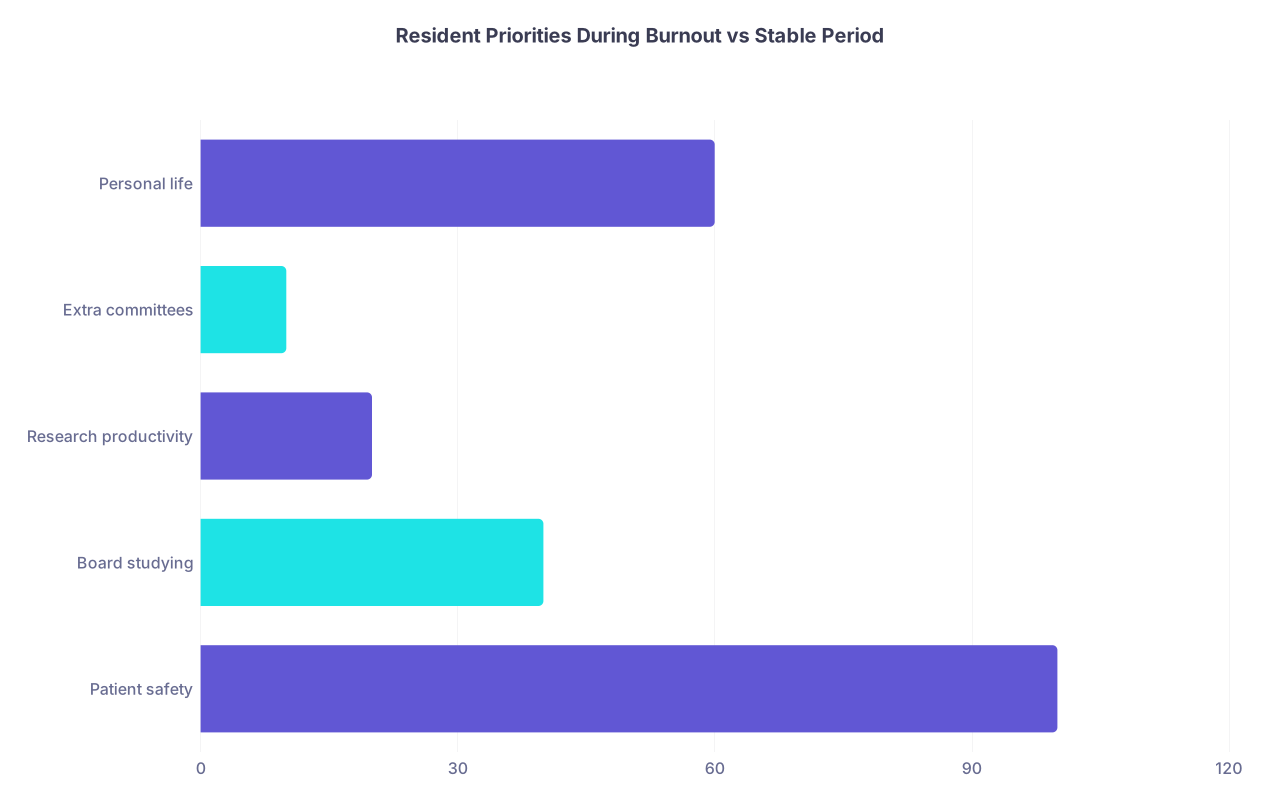
| Category | Value |
|---|---|
| Patient safety | 100 |
| Board studying | 40 |
| Research productivity | 20 |
| Extra committees | 10 |
| Personal life | 60 |
The Career Anxiety: “Will This Follow Me Forever?”
Here’s the part residency never explains well: your future career is more flexible than it looks right now.
You’re scared that:
- If you slow down, fellowship is gone
- If you take leave, no one will want to hire you
- If you switch paths, you’ll be seen as flaky
Reality is messier and kinder than that.
People:
- Take an extra year and still match into solid fellowships
- Decide not to do fellowship at all and build great careers as generalists
- Take a non-clinical year later (admin, education, research, industry)
- Move into part-time, shift-based, or outpatient-heavy jobs
You’re not signing your forever contract right now. You’re not locked into this exact level of misery as an identity.
Residency sells one narrow image of success: the tireless, always-on, “give me more patients” machine.
Real life has many more versions:
- The hospitalist who works 7-on/7-off and actually enjoys his off weeks
- The outpatient doc with 3 clinic days and 2 admin/teaching days
- The EM physician who negotiates a lower FTE and lives modestly but sanely
Burnout before residency ends doesn’t blacklist you.
It just means you’ll probably be more intentional—and maybe more ruthless—about what you accept in your next job.
When It’s Really, Truly Too Much
I’m not going to pretend everyone can or should just “hang on until graduation.” Some people:
- Need a leave of absence
- Need to go part-time temporarily (if possible)
- Need to step away completely from that program or even that specialty
Those stories are quieter because people are ashamed of them. But I’ve seen them turn out okay:
- Someone who left surgery, took time off, came back in anesthesiology and was much happier.
- A resident who completely left clinical medicine and found a meaningful role in medical education and curriculum design.
- A trainee who took a year away for severe depression, returned, finished, and now is a well-respected community doc.
The fear says: “If I step off this track, I’ll never get back on.”
The truth: the track is bendier than you think. And your health is not replaceable.
If the only way you see to “succeed” is to permanently damage yourself, that’s not success. That’s slow self-destruction.
The Quiet Truth You Won’t Hear on Rounds
You’re not failing because you’re burned out.
You’re burned out because the system you’re in runs on people ignoring their limits.
The fact that you’re worried about it, that you’re asking, “Can I still succeed?” instead of just going numb and cruel—that’s actually a good sign. You still care. You still want to be good. You still want a life that isn’t built entirely on exhaustion.
Residency will end. That part is non-negotiable; the calendar keeps moving whether you’re ready or not. The real question is: who do you want to be when you walk out of that building the last time as a resident?
You don’t have to be the strongest.
You don’t have to be the most decorated.
You don’t have to “prove” you can destroy yourself and still stand.
You just have to get out with enough of yourself left that you can build a life you actually want.
Years from now, you’re not going to remember every note you signed or every page you answered. You’re going to remember the moment you finally decided your well-being counted, too—and what you chose to do about it.


