

It’s 2:30 a.m. You’re in the call room, staring at the ceiling. Your chest feels tight, your pager feels like a bomb, and this thought keeps looping: “I can’t keep doing this… but if I tell anyone—especially my PD—my career is over.”
You’ve probably already scripted the disaster scenario in your head:
- You admit you’re burned out.
- Your PD suddenly sees you as “weak.”
- You lose prime rotations, letters, maybe even fellowship options.
- And worst of all: someone quietly whispers the words every resident dreads—“is this person safe?”
So you do what most of us do: keep your head down, keep saying “I’m fine,” and hope you don’t actually crack.
Let me say the scary part out loud: yes, there are risks. There are bad PDs, toxic cultures, and programs that talk wellness but weaponize vulnerability. I’ve seen it. You probably have too.
But the idea that any mention of burnout to your PD will automatically ruin your career? That’s not just exaggerated—it’s dangerously wrong. And that kind of black-and-white thinking is exactly how people end up in real trouble: suicidality, major mistakes, leaving medicine entirely.
So let’s untangle this in a way that’s actually useful, not sugar-coated.
First: Burnout vs “I’m Unsafe to Practice”
Here’s the line that matters, and it’s not subtle.
- Burnout = exhausted, cynical, depleted, maybe numb, maybe crying in your car, but you’re still basically functioning.
- Impairment / safety issue = you’re so depressed, anxious, sleep-deprived, or mentally checked out that patient care is at risk (or you’re close).
Programs react very differently to those two categories.
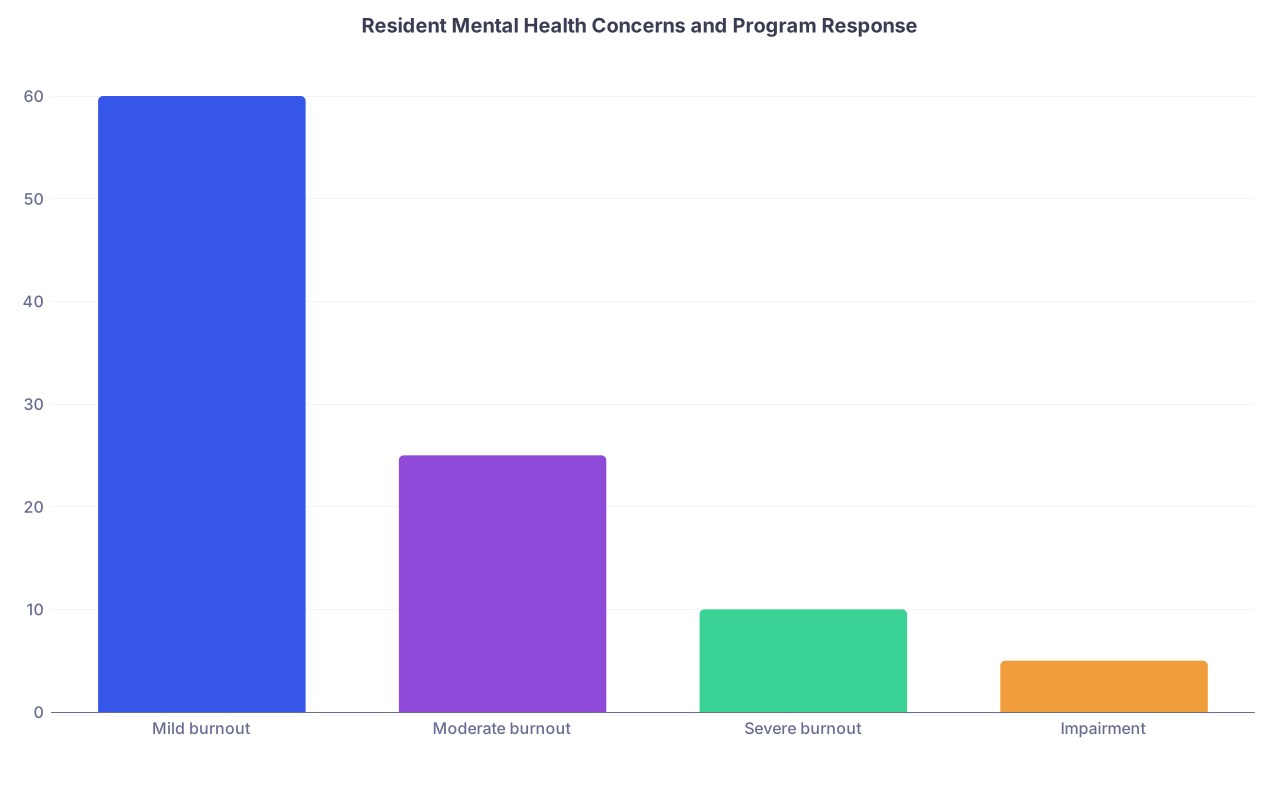
| Category | Value |
|---|---|
| Mild burnout | 60 |
| Moderate burnout | 25 |
| Severe burnout | 10 |
| Impairment | 5 |
The fear in your head usually skips straight from:
“I’m tired and miserable” → “If I say that out loud, they’ll treat me like I’m impaired.”
Reality is more like:
- Lots of residents quietly admit to being burned out.
- Good PDs see it constantly and don’t equate “burned out” with “dangerous.”
- The moment things cross into “I might hurt myself or someone else,” they have to act differently. And honestly, they should.
You’re terrified that any mention of struggle drops you into category 4. It doesn’t.
What PDs Actually Worry About (And What They Don’t)
Here’s the unfiltered version from what I’ve seen and heard:
What most PDs don’t automatically freak out about:
- “I’m overwhelmed on nights.”
- “I’m having trouble keeping up with the workload.”
- “I’m feeling really burned out and not myself.”
- “I’m struggling with the emotional side of all these deaths/complications.”
What does set off alarms:
- “I think I might hurt myself.”
- “I’ve been making big mistakes and I’m scared.”
- Coming in visibly intoxicated or altered.
- Not showing up. Chronically late. Vanishing mid-shift.
- Colleagues reporting major concern about your safety or patient safety.
The problem is, you probably bundle all of that together in your head as “things that will ruin me if I say them.” So you say nothing. For way too long.
A PD hearing “I’m struggling with burnout and I want to fix it before something bad happens” is very different from them finding out later that you were barely holding it together for months and hiding it.
One makes you look unsafe and dishonest.
The other makes you look self-aware and concerned about doing a good job.
Real Risks: Where Things Can Go Bad
Let’s not pretend there’s zero risk. There is. Here’s where it can bite you:
Toxic PD / toxic culture
The “we survived, so you should too” crowd. You say you’re burned out, they label you “not resilient,” and it shadows evaluations, letters, opportunities. This absolutely happens in some places.Documentation that lingers
If things escalate to formal remediation, leave, or serious mental health impairment, there may be documentation. Some PDs are actually careful and fair here; others… aren’t.Gossip / reputation
In small programs, if you talk to the wrong person in the wrong way, the story gets twisted: “X can’t handle it,” “X is unstable.” That stuff spreads faster than anyone admits.
So yeah, you’re not totally paranoid.
But here’s the part you’re probably underestimating:
The risk of not saying anything early is often worse than the risk of talking to the right person, in a controlled way, at the right time.
Because quiet burnout rarely just plateaus. It often slides into mistakes, unprofessional behavior, or complete collapse. And those are the things that really wreck careers.
Choosing Who To Talk To (Hint: It Doesn’t Have To Be Your PD First)
You don’t have to go from “silent suffering” to “direct confessional to PD” in one jump. That’s way too big a leap when you’re already fried and scared.
Here’s a more realistic ladder of options:

| Step | Description |
|---|---|
| Step 1 | Notice burnout signs |
| Step 2 | Talk to trusted co-resident |
| Step 3 | Reach out to therapist or physician hotline |
| Step 4 | Confide in chief resident |
| Step 5 | Decide if PD conversation is needed |
| Step 6 | Plan conversation script |
Possible people before your PD:
- Trusted co-resident a year or two ahead of you
- Chief resident you actually like
- Faculty mentor not directly in your evaluation chain
- Confidential therapist (honestly underrated)
- Employee assistance program counselor (if actually confidential in your system)
Your goal with these people isn’t to dump everything and hope they “fix your life.” It’s to:
- Reality-check how bad things are.
- Get a sense of your PD’s actual personality and track record.
- Strategize: “Is this something we can solve without looping in the PD?”
or
“How do I bring this to the PD without detonating my reputation?”
How To Talk About Burnout Without Setting Off Every Alarm
You’re scared that if you say “burnout,” they’ll hear “I’m about to harm a patient.” So you need to frame it carefully and specifically.
Think: professional, concrete, and solutions-focused. Not panicked oversharing.
Something like:
“Dr. Smith, I wanted to talk because I’ve been feeling pretty burned out the last 2–3 months. I’m still doing my work and I care about doing it well, but I’m noticing I’m more exhausted, more irritable, and it’s taking a toll. I don’t want it to get to a point where it affects patients, so I wanted to check in early and get your thoughts on how to adjust things or what resources might help.”
What that does:
- Shows insight and responsibility.
- Emphasizes patient care as your priority.
- Makes it a shared problem-solving conversation, not “please fix my life.”
What you don’t want to do:
- Walk in with, “Everything is awful, I hate this program, I can’t do this,” with no sense of what you’re asking for.
- Sound like you’re blaming everyone else for your distress.
- Give them reason to wonder if you’re about to walk out mid-shift.
You can absolutely be honest about how miserable you feel. Just anchor it with: “I want to get better and keep being a good resident. That’s why I’m here.”
What Reasonable Programs Often Do (That Doesn’t Ruin You)
Here’s what I’ve seen good PDs and chiefs actually offer when someone brings up burnout early and reasonably:
- Schedule tweaks: moving you off brutal rotations back-to-back, adjusting calls, giving you a lighter elective after a brutal block.
- Protected mental health appointments: letting you attend therapy without drama.
- Informal mentorship: pairing you with a mentor, checking in more regularly.
- Time-limited leave if things are worse than you admitted at first.
- Shielding you from extra non-essential “opportunities” (a million committees and side projects that look nice but drain you).
| Situation | Common PD Response |
|---|---|
| Early burnout, still functioning | Support + small adjustments |
| Moderate burnout, struggling | Schedule changes + resources |
| Severe burnout, near breakdown | Leave + formal support |
| Safety concerns / impairment | Pull from duty + evaluation |
None of that automatically brands you as “damaged goods.” In many cases, if handled early and calmly, it never becomes a big story at all. It’s more like: “Yeah, PGY-2 is rough, they needed a breather. They’re doing fine now.”
Is that guaranteed? No. But the fantasy that silence is always safer is how people get pulled off service for something worse later.
The Licensing / Future Jobs Fear
I know the other loop running in your brain: “If I say anything mental-health-ish now, I’ll have to report it on every future license form and job application. I’ll be stuck explaining this forever.”
Two reality checks:
A lot of state licensing questions have shifted from “Have you ever had treatment for mental illness?” to “Do you currently have a condition that impairs your ability to practice safely?”
Getting help before you’re impaired often keeps you out of that danger zone.What does follow you in a worse way:
- Big professionalism issues.
- Being pulled from rotations for performance without a clear reason.
- Major, documented errors tied to functioning.
- Abrupt leaves that look mysterious and unplanned.
Your brain is locking on: “Therapy = permanent red flag.”
Reality: “Untreated collapse = bigger, messier, harder to explain red flag.”
How To Decide If You Should Tell Your PD Now
Ask yourself some ugly but necessary questions:
- Am I still coming to work and basically doing the job, even if I’m miserable?
- Am I making more mistakes than usual? The kind that worry me?
- Do I ever think, “If I don’t wake up tomorrow, that’d be easier”?
- Have I seriously thought about quitting medicine completely, not in a fleeting way but as an ongoing plan?
- Are other people noticing and asking if I’m okay?
Rough guideline (not perfect, but better than the panic fog):
- If you’re functioning but empty:
Start with peers / chiefs / therapist. You might not need the PD looped in yet. - If your functioning is slipping, or others are noticing:
That’s when looping in the PD with a plan and framing starts to become safer than letting things spiral. - If there are real safety or suicidality concerns:
At that point, your career is secondary to your life and your patients’ lives. I know that’s not what you want to hear, but it’s the truth. The system should intervene.
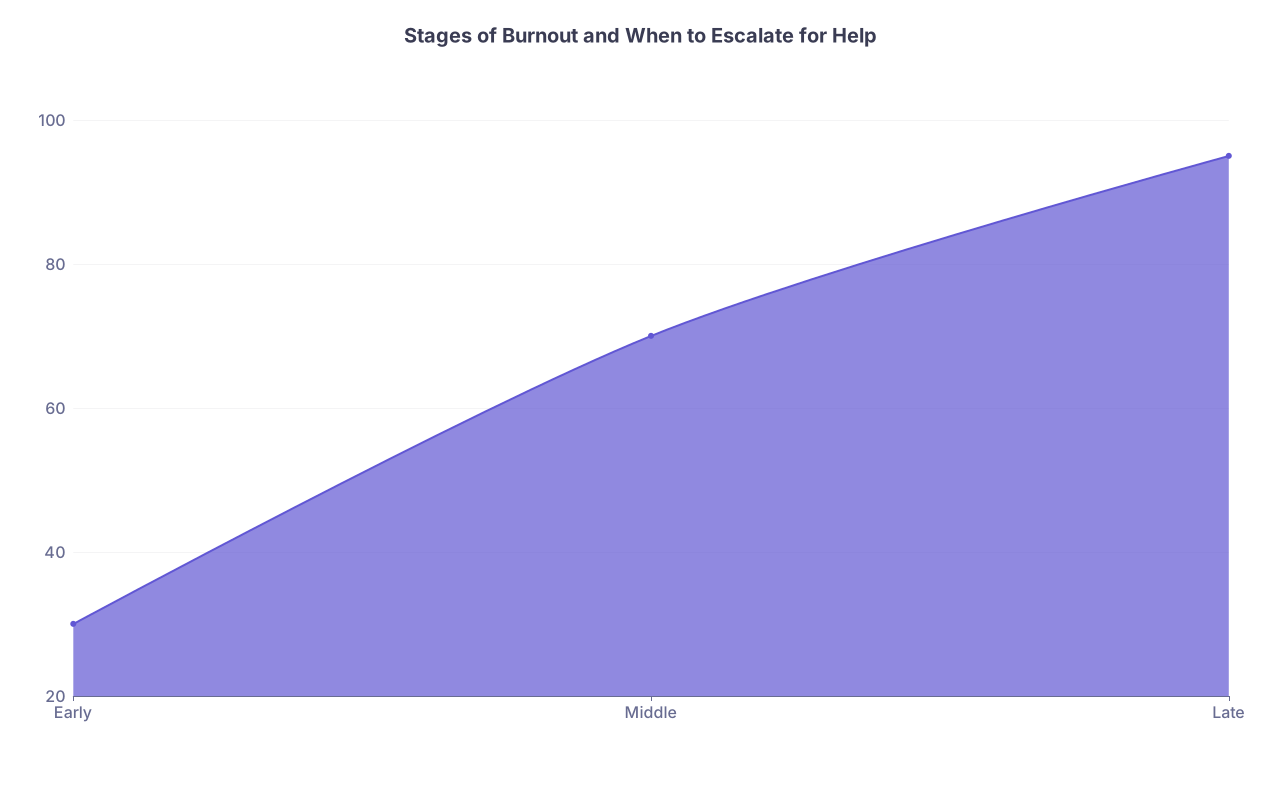
| Category | Value |
|---|---|
| Early | 30 |
| Middle | 70 |
| Late | 95 |
You don’t have to broadcast your worst intrusive thoughts to your PD. You do need to get help somewhere if you’re in that late stage.
Scripts You Can Actually Use
Sometimes the hardest part is “What do I literally say?”
Here are a few options you can tweak:
To a co-resident:
“Hey, can I be real for a second? I feel like I’m hitting a wall and I’m not sure how bad it is. Have you ever felt like that here?”
To a chief:
“I wanted to get your advice. I’ve been more burned out than I’m comfortable with. I’m still getting my work done, but it feels unsustainable. Given how the PD usually responds, do you think it’s worth bringing this up, or are there other ways to adjust things first?”
To your PD:
“I care a lot about being a solid resident here, and that’s why I wanted to meet. The last couple of months I’ve been feeling significantly burned out. I’m still functioning, but I can feel my reserves dropping. I’d like to work on this before it affects my performance—do you have suggestions on schedule adjustments or resources?”
If things are worse:
“I need to be honest—I’m really struggling. I’m worried if I keep going like this, I might make a serious mistake. I don’t want that for my patients or the team. I’d like help figuring out a safe way to step back a bit and get treatment so I can come back stable.”
Is that terrifying to say out loud? Yes.
Is saying nothing and then crashing on service worse? Also yes.
What I’d Actually Do In Your Shoes
If I were where you are—on edge, exhausted, terrified I’ll ruin my career by saying anything—I’d do this, in order:
- Tell one trusted co-resident the truth, not the filtered “I’m tired.”
- Book a confidential appointment with a therapist or physician support line.
(Not because you’re “crazy.” Because it gives you a safe place to say the absolute worst of what’s in your head without it going in your file.) - Talk to a chief or mentor and ask very directly: “What happens here when someone brings up burnout? Is Dr. X usually supportive, or do they hold it against people?”
- Based on that intel, decide:
- If your PD is decent: plan a controlled, professional conversation like the scripts above.
- If your PD is trash: prioritize external support, small schedule hacks via chiefs, possibly institutional wellness resources—not a heart-to-heart confessional with the person who might weaponize it.
- If you’re anywhere near unsafe—self-harm thoughts, serious error risk—move PD/occupational health up the list. I know you’re obsessed with not ruining your career. Being dead or losing your license after a catastrophic error ruins it more.
FAQ (Exactly 6 Questions)
1. Will telling my PD I’m burned out automatically put me on some secret blacklist?
No, not automatically. Some PDs are genuinely supportive and see it as a sign of maturity. A few will judge you more harshly, yes—but usually that happens when things are framed as “I can’t handle anything” rather than “I’m struggling and I want to address this responsibly.” The program culture and the PD’s personality matter more than the mere fact you used the word “burnout.”
2. Can this affect my fellowship chances if my PD knows I struggled?
It can, if they interpret it as “ongoing reliability problem” instead of “temporary, addressed challenge.” But fellowship directors care a lot more about: your clinical performance, letters describing you as reliable, and lack of major professionalism issues. Quietly getting support and course-correcting doesn’t usually show up as a scarlet letter in your application unless it escalates to formal remediation or extended leave.
3. Do I have to report burnout or therapy on future license applications?
Most licensing boards now focus on whether you have a current condition that impairs your ability to practice safely, not whether you ever sought help. Seeing a therapist, especially early, usually keeps you out of serious impairment territory. The far bigger risk for future reporting is documented impairment, major errors, or disciplinary actions—those tend to follow you much more than “I was burned out and got help.”
4. What if my PD has a reputation for being unsympathetic or harsh?
Then I’d be very cautious about what you share and how. Start with peers, chiefs, mentors, and confidential mental health resources. You might still need to loop the PD in if your functioning is really suffering, but go in with a more tightly framed message: focus on concrete issues, what you’re already doing to improve, and specific adjustments you’re requesting, instead of a full emotional download.
5. Can I just push through and handle this on my own without telling anyone?
You can, for a while. That’s what most of us try first. But the pattern I’ve seen too many times is: push through → get more numb/angry/exhausted → make mistakes or implode → now everyone knows, and it’s much uglier. Getting help early doesn’t mean you’re weak; it’s self-preservation and patient safety. White-knuckling everything until you break is what actually wrecks careers.
6. How do I know if what I’m feeling is “normal resident misery” or something I should act on?
Rough rule: if you’re just tired, annoyed, and occasionally fantasize about a vacation—welcome to residency. If you’re dreading every shift, feeling hopeless, crying regularly, zoning out on patient care, having dark thoughts about not wanting to exist, or people around you are worried—this isn’t just “normal.” That’s your sign to stop arguing with yourself about whether it’s “bad enough” and start talking to someone, even if it’s not your PD yet.
Key points to keep in your head:
- Saying nothing and silently deteriorating is usually more dangerous to your career than carefully speaking up early.
- Who you talk to and how you frame the conversation matter more than the simple fact that you said “burnout.”
- Your goal isn’t to prove you’re fine. It’s to stay safe, stay competent, and still have a self left when residency is over.


