

Burnout is common in residency. Inevitable? No. And the longitudinal data flat‑out contradict the fatalistic narrative you hear on the wards.
You have been sold a very specific story: residency = guaranteed burnout, the only variables are severity and timing. That story is seductive because it excuses everything—crushing schedules, bad leadership, toxic cultures. “It’s just residency.” But if you actually read the long‑term cohort data instead of doom‑scrolling anonymous forums, a different picture emerges.
What Longitudinal Studies Actually Show About Burnout Trajectories
Let’s start with the basics: burnout is not a fixed trait. It moves. A lot.
Several major longitudinal studies—following the same residents or early‑career physicians over years—show three consistent patterns:
- Burnout levels fluctuate significantly over time.
- A sizeable minority never meet burnout criteria at all.
- A chunk burn out and then recover, sometimes more than once.
That alone kills the “inevitable and permanent” myth.
Take the classic work by Tait Shanafelt and colleagues who’ve tracked physicians over time at a national level. When they followed physicians longitudinally, roughly a third shifted burnout status between time points—some developed burnout, some improved, some stayed stable. Nothing about that says “inevitable and one‑way.”
In residency‑specific cohorts, the pattern is even clearer. Programs that’ve actually bothered to repeat surveys every 6–12 months see distinct “burnout trajectories” over training:
- A stable low group – consistently low burnout.
- A moderate, fluctuating group – symptoms rise and fall with rotations.
- A high‑risk group – high and often rising burnout.
The stable low group is not tiny. Depending on the study, you’re looking at something like 20–40% of residents who never hit high burnout thresholds across training. Same job. Same hours. Same hospital. Different outcomes.
So no, the data do not support “everyone burns out; it’s just a matter of time.” They support “risk is high, trajectories vary, and change is possible in both directions.”
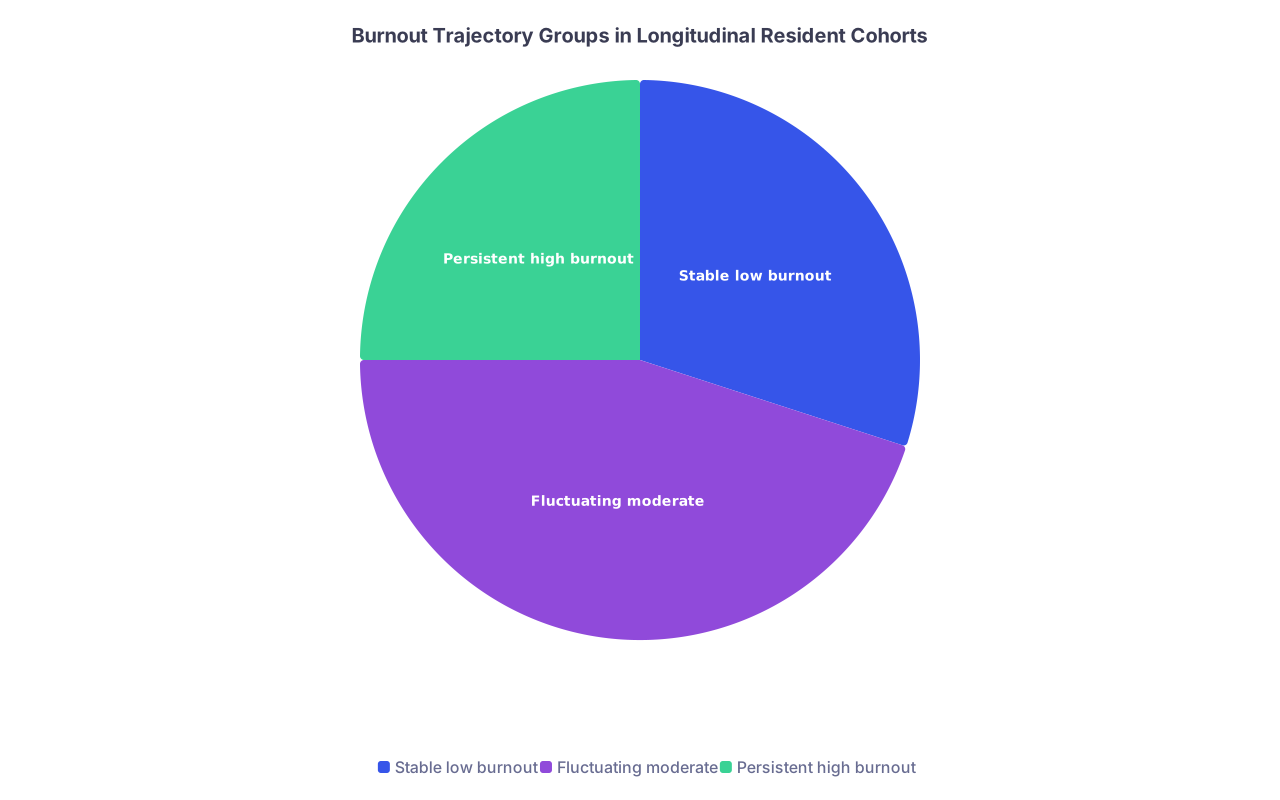
| Category | Value |
|---|---|
| Stable low burnout | 30 |
| Fluctuating moderate | 45 |
| Persistent high burnout | 25 |
Those proportions are approximate, but they’re consistent across multiple specialties and institutions. The point stands: one in three residents in many cohorts does not end up in persistent high burnout.
You are not doomed by the word “resident” on your ID badge.
The Myth of “It’s All Personal Weakness” vs What Predicts Burnout Over Time
The next bad myth: burnout is a personal resilience problem. If you’re tough enough, meditate enough, gratitude‑journal enough, you’ll be fine. And if you’re not? Well, that’s on you.
Longitudinal data again says: wrong target.
When you track residents across years and actually run regression models, the strongest predictors of who ends up on the persistent high‑burnout trajectory are not “grit” scores or personality traits. They’re structural and environmental:
- Workload and hours that violate the spirit (or letter) of duty‑hour rules.
- Chronic sleep deprivation and circadian chaos.
- Perceived lack of control over schedule and clinical decisions.
- Poor supervision and psychological safety.
- Bullying, mistreatment, or discrimination.
- Administrative burden and electronic health record misery.
Do individual factors matter? Sure. People with high baseline anxiety or low social support are more vulnerable. But they’re not the primary levers.
One study following internal medicine residents across training found something very revealing: changes in burnout scores tracked most closely with changes in work conditions. Rotation with humane scheduling, good leaders, and team support? Scores dropped. Next month on a malignant service with a notorious attending? Scores spiked. Same residents. Their “resilience” did not change dramatically in 4 weeks; the environment did.
Here is what the multi‑wave studies quietly prove: if you blame yourself for burning out in an objectively abusive environment, you are misreading the situation.
And conversely—if you think you can white‑knuckle your way through any environment without consequences because you’re “built different,” you’re also wrong. No one outruns sleep deprivation and constant moral injury forever.
Timing Matters: Burnout Peaks and Valleys Over Residency
There’s another pattern that shows up in repeated surveys: burnout isn’t evenly distributed across years. Certain phases of training are simply worse.
Large multicenter cohorts—especially in internal medicine and surgery—find peaks around:
- Early PGY‑2, once the novelty wears off and responsibility ramps up.
- Transitions between inpatient‑heavy years and more specialized roles.
- Periods before board exams or major milestone evaluations.
Intern year does not always show the highest burnout peaks. For many, PGY‑1 is adrenaline, newness, and pure survival. PGY‑2 is when the existential dread sets in: you realize this is not a one‑year sprint but a multi‑year grind.
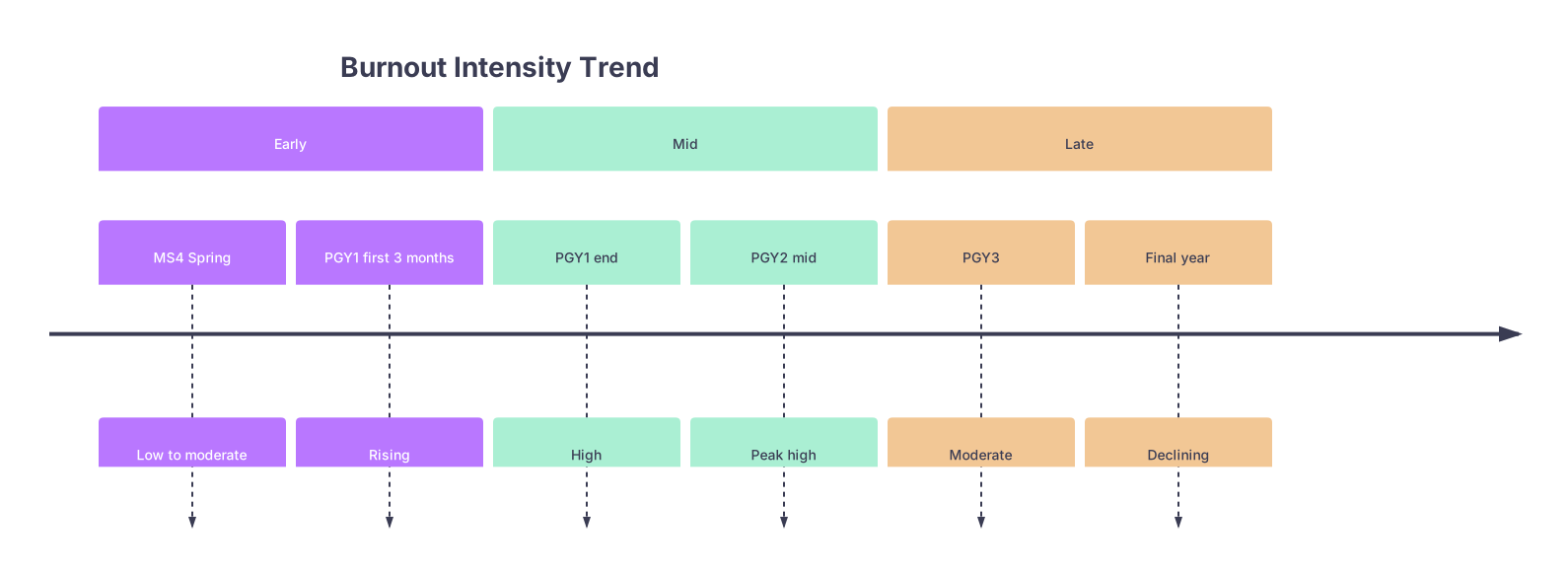
| Period | Event |
|---|---|
| Early - MS4 Spring | Low to moderate |
| Early - PGY1 first 3 months | Rising |
| Mid - PGY1 end | High |
| Mid - PGY2 mid | Peak high |
| Late - PGY3 | Moderate |
| Late - Final year | Declining |
Not everyone follows this curve, but enough do that it shows up in aggregate data. And again, this undercuts the “inevitable” story. If burnout were purely a one‑directional slide, you would not see the consistent late‑residency declines many programs report.
The fact that burnout often drops in senior years—when hours might still be long but autonomy and competence are higher—tells you exactly where to look: misaligned responsibility, lack of control, and constant evaluation pressure, not “residency in general.”
Program‑Level Differences: Same Specialty, Different Outcomes
Here’s the part almost no one tells applicants bluntly enough: program culture and structure change your odds dramatically.
In multi‑institutional longitudinal studies where sites are compared, variations between programs are enormous—even after you adjust for specialty and PGY level. Some internal medicine residencies have burnout rates double those of others. Same specialty. Same ACGME rules. Very different lived reality.
Programs that consistently sit on the lower‑burnout end over time tend to have concrete, boring‑sounding features:
- Real backup systems that are actually used, not just written in a policy binder.
- Attendings and chiefs who systematically protect “golden weekends” and off days.
- Some resident control over rotation scheduling and elective choices.
- Habitual, not performative, attention to psychological safety on rounds.
- Stable ward teams instead of constant reshuffling.
Contrast that with the “sink or swim” programs that treat high burnout as a badge of honor. In longitudinal surveys, those places do not miraculously get better by PGY‑3. They breed the persistent high‑burnout trajectories.
Here is the uncomfortable conclusion: some programs are functionally designed to produce burnout at scale; others are designed, or at least trying, to blunt it. Longitudinal differences between program cohorts make that painfully obvious.
| Program Factor | Longitudinal Burnout Risk Trend |
|---|---|
| Stable teams, predictable call | Lower, often declining by PGY3 |
| Frequent 28+ hour call violations | Higher, often persistent |
| Protected didactics actually used | Lower, fluctuating then falling |
| High mistreatment complaints | Higher, often rising |
| Resident input on schedules | Lower, more stable |
So no, your fate is not just “residency.” It’s this residency, in this environment, run by these people.
Personal Agency: What Longitudinal Data Says About Individual Choices
Now let’s talk about you. Because while system factors dominate, the longitudinal studies do show certain personal behaviors that correlate with lower burnout over time. Not miracle cures. Just small, repeatable things that quietly matter.
Residents who maintain the following through training tend to have flatter, lower burnout curves:
- Regular, non‑medical social contact (friends who are not physicians at all).
- Physical activity at least a couple times per week, even if short.
- A stable sleep window on at least half of their off‑call nights.
- Some form of meaning‑making—religion, philosophy, advocacy, or teaching.
And no, this is not “go to the gym and you’ll be fine.” This is more subtle: people who refuse to let residency completely erase non‑work identity markers are less likely to stay in the persistent high‑burnout group.
I’ve watched this in real time. Two interns on the same malignant rotation. Same hours. Same attending.
One fights—sometimes awkwardly—to protect one weekly dinner with a partner and a 30‑minute run twice a week, even if that means saying, “I need to leave by 7 unless there’s an admission.” They still get crushed. But they maintain tiny islands of control and self outside the hospital.
The other fully abandons any boundary, convinced it’s “not worth the hassle” to push back at all. Guess who ends up spiraling harder by mid‑PGY‑2 on longitudinal surveys.
The message is not “just set boundaries” in some Instagram‑therapy way. It’s this: under heavy structural pressure, micro‑choices about identity and routine compound over years. The data backs that up.
Recovery Is Real: Burnout Is Not a Permanent Identity
Another nasty myth: once you’re burned out, you stay burned out. You’ve crossed some psychological event horizon.
Longitudinal data across residency and early attending years does not support that. People move into and out of burnout states frequently.
In some cohorts, half of the residents who met burnout criteria at one time point no longer did 12 months later. Not because they left medicine, but because something changed—rotation mix, leadership, therapy, meds, boundaries, life circumstances.
One study that followed physicians from residency into early attending years saw a very specific pattern: many who were highly burned out at the end of residency improved significantly 1–2 years after graduation, when they had more control over schedule and practice structure. A smaller group stayed chronically burned out no matter the context—often those in consistently toxic environments or with untreated depression/substance use. Another group, who’d been fine in residency, deteriorated when they landed in abusive first jobs.
The conclusion is annoyingly nuanced:
- Burnout is often a rational response to a broken context.
- Changing the context—sometimes via concrete personal choices, sometimes via moving programs, sometimes by leaving a specific job—can change the burnout trajectory.
- Some people need professional help to break out of entrenched patterns. That is not a moral failure; it is often the only realistic path.
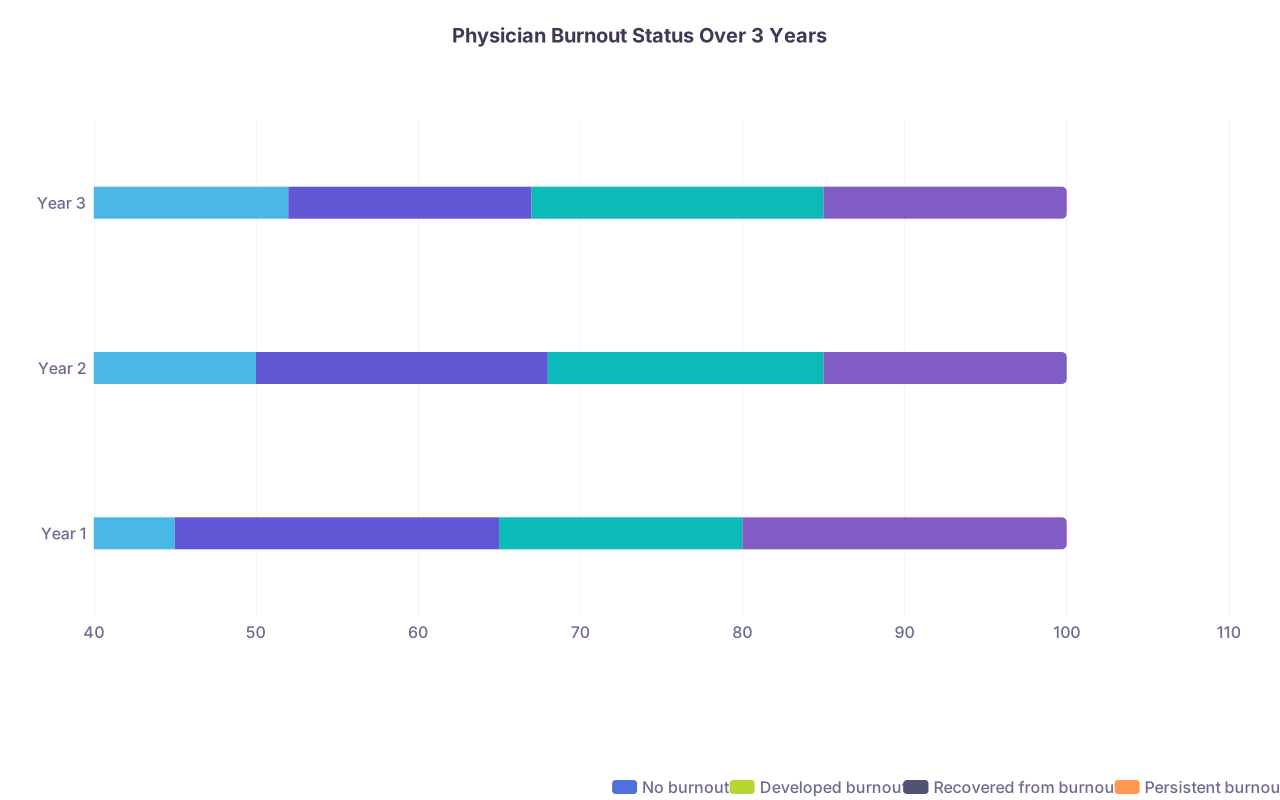
| Category | No burnout | Developed burnout | Recovered from burnout | Persistent burnout |
|---|---|---|---|---|
| Year 1 | 45 | 20 | 15 | 20 |
| Year 2 | 50 | 18 | 17 | 15 |
| Year 3 | 52 | 15 | 18 | 15 |
That “recovered” slice is not a rounding error. Longitudinally, a nontrivial group climbs out.
If you’re fried right now, that matters. You are not fixed in this state, even if it has been months or years.
What This Means for You – Right Now
So where does this leave you, beyond “interesting graphs”?
A few hard truths, backed by the longitudinal evidence, not slogans:
- Burnout risk is high, not universal. You are not guaranteed to burn out, even in a tough program.
- Environment beats individual willpower. If your program is structurally abusive, you cannot “mindset” your way out indefinitely. Document patterns. Use GME channels. Explore transfers if needed. That’s rational, not cowardly.
- Micro‑agency matters within bad systems. Protect small, specific pieces of your non‑work life like they’re part of your treatment plan—because over years, they function that way.
- Burnout is reversible for many. If you’re deep in it, focus less on judging yourself and more on changing one or two conditions you actually control: sleep regularity on off days, one weekly non‑negotiable relationship, one honest conversation with someone who can intervene (PD, therapist, union, ombudsperson).
- Watch the transitions. PGY‑1 to PGY‑2, big rotation jumps, exam prep periods—that’s when trajectories bend. Plan ahead for those, not react after.
And one more: if you catch yourself saying “this is just how medicine is,” remember the inter‑program data. No, this is how your corner of medicine is choosing to be. Other places, with similar patients and payors, have lower burnout, higher support, better outcomes. The variation alone proves change is possible.

Residency will stretch you. It will absolutely exhaust you at times. But inevitability is a lazy story used to justify bad systems and avoid hard decisions. The longitudinal studies are blunt: trajectories differ, environments matter, and people both burn out and recover.
Years from now, you won’t measure your career by your worst call month. You’ll remember which stories you believed about what was “inevitable”—and whether you had the courage to question them.


