

68% of residents report at least one symptom of burnout, yet most still tell themselves, “This is just what residency feels like.”
That disconnect is the problem.
On paper, we’ve “raised awareness” about burnout. In real life, I still hear the same lines in call rooms and sign-out rooms:
“Yeah, I don’t feel anything anymore. That’s just residency.”
“I cry in my car after nights, but everyone does.”
“I’m not burned out, I’m just tired.”
Here’s the uncomfortable reality: a lot of what you’re normalizing as “part of training” are actually textbook symptoms of burnout, depression, or moral injury. And the data back that up more than your co-intern’s bravado.
Let’s cut through the myths and talk about what the evidence actually shows.
Myth #1: “Emotional numbness is just you toughening up”
Emotional exhaustion and depersonalization are literally part of the standard burnout definition. Not “rare complications.” Core features.
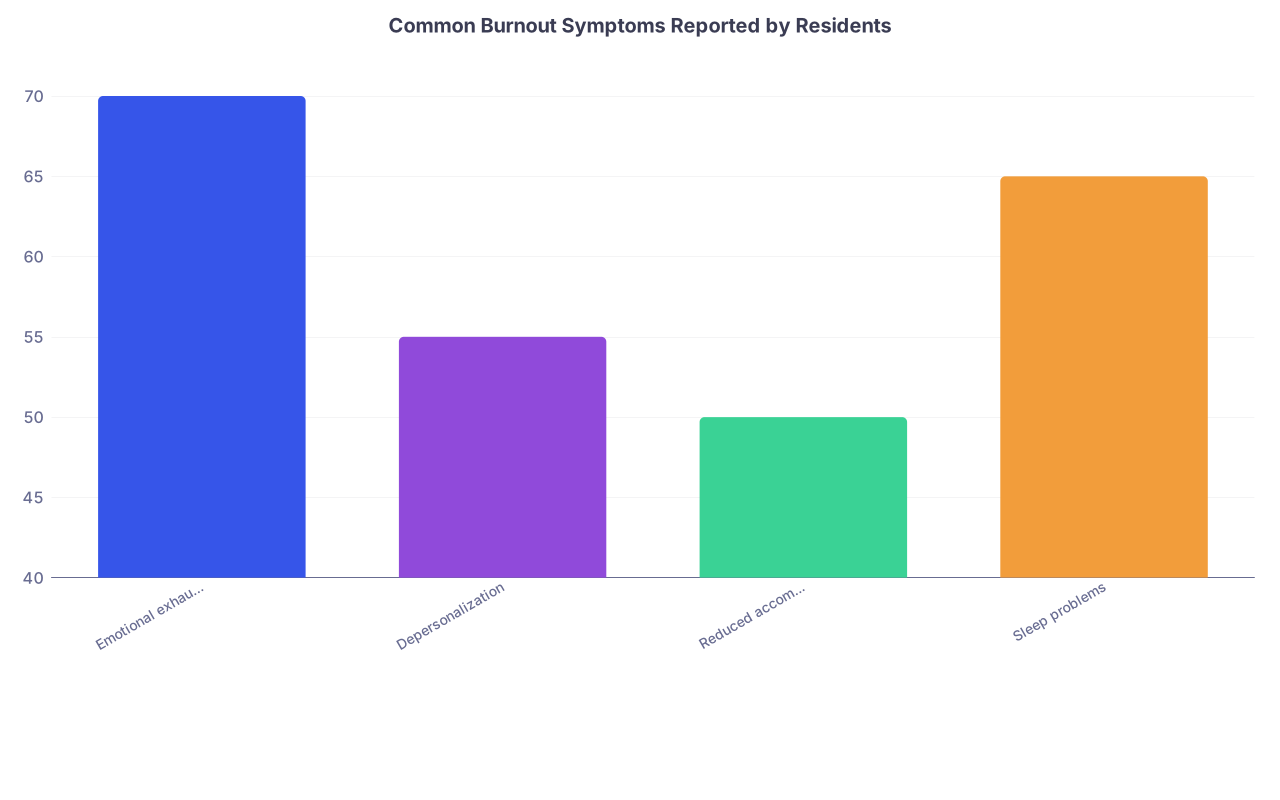
The Maslach Burnout Inventory, the classic tool used in dozens of physician studies, defines burnout around three pillars: emotional exhaustion, depersonalization (that detached, cynical, “robot” feeling), and reduced sense of personal accomplishment.
That “I feel nothing with bad news anymore” you’re noticing? That “I talk about patients like tasks on a checklist because it’s the only way I can function”? Those aren’t signs that you’ve evolved into a superior, hardened clinician. They’re early warning lights.
| Category | Value |
|---|---|
| Emotional exhaustion | 70 |
| Depersonalization | 55 |
| Reduced accomplishment | 50 |
| Sleep problems | 65 |
In multiple large surveys, around 70% of residents endorse emotional exhaustion, and more than half endorse depersonalization. The problem isn’t that numbness exists. The problem is everyone describes it like it’s a character upgrade.
I’ve heard the pride-tinged version: “Intern year used to wreck me emotionally. Second year? I barely feel it.”
But when you push, it’s not resilience. It’s shutdown.
Resilience means you still feel, but you recover. You can be gutted by a bad outcome at 11 am and still show up for the 2 pm family meeting as a human being. Numbness is different. It’s when the emotional volume is turned down on everything: joy, sadness, pride, meaning.
If your “resilience” also came with:
- Losing interest in stuff you used to like outside the hospital
- Not really caring if you did a great job or a mediocre one
- Feeling like days blur together and nothing really matters
that’s not development. That’s burnout creeping in under the banner of “toughening up.”
Myth #2: “Everyone is miserable – that means it’s normal and harmless”
A thing can be common and still be pathological. Hypertension is common. We don’t call it “just adulthood.”
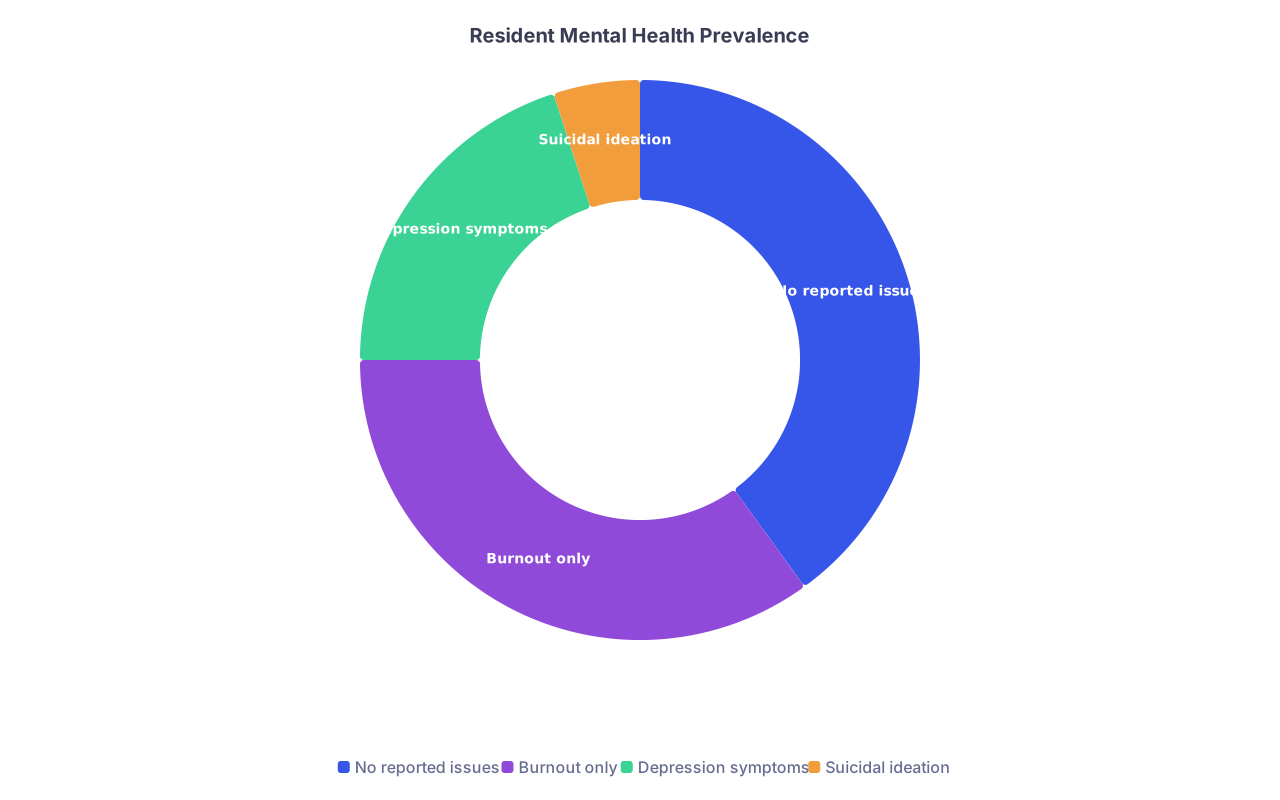
Depression rates in residents? Roughly 25–30% in meta-analyses. Suicidal ideation? Often in the 6–10% range in large cohorts. Burnout? Well over half, depending on specialty and year.
| Category | Value |
|---|---|
| No reported issues | 40 |
| Burnout only | 35 |
| Depression symptoms | 20 |
| Suicidal ideation | 5 |
Now, here’s the kicker: when you ask residents if they think they are burned out, the self-report rate is dramatically lower than when you measure via standardized tools. People undercall it. Consistently.
Why? Because the bar for “burned out” in resident culture is set at “on the verge of quitting or hospitalized.” Anything less than that? Just residency.
So we get this warped logic:
- Everyone around me is exhausted and detached
- Therefore, this must be normal
- Therefore, I don’t need to address it
But the outcomes betray that story. Programs with higher burnout rates also see:
- More self-reported medical errors
- Higher rates of residents leaving or changing specialties
- More substance use and mental health treatment needs
This isn’t just a vibe issue. It affects clinical performance, patient safety, and whether you make it to attending life without hating medicine.
So no, “everyone feels this way” does not make it safe. It makes it a cultural epidemic.
Myth #3: “Burnout is just about working too many hours”
Residents love to blame the 28‑hour call and the 80‑hour workweek. They’re not wrong that hours matter. The evidence does show a dose–response relationship: more hours, higher burnout and depression scores.
But here’s what the data actually show if you look closer:
When researchers control for hours worked, you still see massive differences in burnout based on how those hours are structured and what’s inside them.
Compare:
| Factor | Resident A | Resident B |
|---|---|---|
| Weekly hours | 72 | 72 |
| Control over schedule | Low | Moderate |
| Supervisor support | Poor | Strong |
| Time for documentation | Constantly behind | Protected |
| Feedback | Rare, mostly negative | Regular, constructive |
| Burnout risk | High | Moderate/Low |
Same hours. Different outcomes.
Studies consistently show predictors like:
- Lack of control over schedule or patient load
- Poor leadership and absent or toxic attendings
- Misalignment between your values and what you’re forced to do (hello, moral injury)
- Chaotic systems: constant EMR battles, no staffing, endless scut
These all drive burnout independent of raw hours.
I’ve watched second-year residents on “light” electives still spiral because their attending is a bully, or they’re constantly placed in ethically disgusting situations with no support. Meanwhile, some seniors on busy ICU months are tired but not burned out, because the team is cohesive, the work feels meaningful, and there’s real support.
If your only “burnout plan” is shaving a few hours off the schedule without fixing the garbage system around those hours, you’re rearranging deck chairs on the Titanic.
Myth #4: “If you were really burned out, you couldn’t function like this”
One of the more dangerous myths.
Residents imagine burnout as being unable to get out of bed, missing shifts, or having obvious breakdowns. Then they look at themselves: still rounding, still doing procedures, still getting decent evals. So the conclusion is, “I must be fine.”
But physicians are terrifyingly good at functioning while impaired. That’s the whole culture: push through. Smile on rounds. Write the note. Don’t be the weak link.
Burnout in residents usually looks like:
- You still show up, but you’re on autopilot
- You do what’s required, but with zero internal drive
- You’re quick to snap at nurses or other staff over minor things
- You avoid talking to families more than necessary because you “don’t have it in you”
- You obsess over minor mistakes for days, but big-picture meaning is gone
I’ve seen interns with 90th percentile in-training scores who were also googling “physician suicide rates” between admissions. Objectively “high functioning.” Subjectively hanging by a thread.
Burnout is not binary. It’s a continuum. And if you wait until you literally can’t function to admit there’s a problem, you’ve already overshot by several months.
Myth #5: “You just need better self-care”
Let me be blunt: telling a resident who’s carrying 18 patients, doing 3 admissions, and getting shamed in front of the team that they should “do more self-care” is insulting.
There’s this neat trick institutions pull: rebranding system failure as your personal wellness deficit.
No, you are not burned out because:
- You didn’t journal enough
- You skipped yoga
- You didn’t download yet another mindfulness app
You’re burned out because you’re working in a system that routinely:
– Violates your sleep physiology
– Gives you responsibility without adequate support
– Exposes you to death, suffering, and moral conflict daily
– Buries you in clerical work that has no meaning
– Treats vulnerability like a professionalism violation
Individual-level tactics can help you survive inside that mess. Exercise alters your stress response. Therapy improves coping and perspective. Boundaries outside work protect whatever’s left of your identity.
But the evidence is very clear: system-level interventions have a bigger impact on burnout than asking individuals to be more “resilient.” Schedule redesign, improved staffing, reducing useless documentation, sane paging policies, supportive leadership—these move the needle more than free meditation apps.
So yes, do what you can on your side. But do not internalize the idea that if you’re suffering, it’s because you failed at wellness.
Myth #6: “Feeling numb means you picked the wrong specialty (or medicine is a mistake)”
Burnout messes with how you interpret your entire life story.
You’re exhausted, detached, and nothing feels good. So the brain reaches for a global explanation: “I chose wrong. I hate this specialty. I was never meant to be a doctor.”
Sometimes that’s true. Some residents really are in the wrong field. But often, once the acute burnout is addressed—sleep improves, support increases, workload is less insane—the same resident rediscovers pieces of what they liked.
I’ve watched EM residents who were ready to quit halfway through second year because every shift felt like combat medicine, only to realize later it wasn’t EM they hated; it was doing hallway medicine with no resources and nonstop boarding.
You have to be very careful about making permanent decisions based on a brain that’s running on fumes. A depressed, burned-out brain is a terrible narrator. It tells dramatic, absolute stories:
“I will always feel like this.”
“Medicine has nothing left to offer me.”
“I was stupid to think I could do this.”
If you’re asking “Did I ruin my life choosing this path?” while sleeping 4 hours a night and working 70+ hours a week, I’d treat that as a symptom, not a conclusion.
So what actually helps, beyond slogans?
This isn’t a fairy tale; I’m not going to pretend you can breathe your way out of a toxic rotation. But there are levers you control more than you think—if you stop buying the myths.
First: name things correctly. Stop calling numbness “just residency.” Call it what it is: a sign your coping capacity is being exceeded. That shifts your mindset from “I should tough it out” to “this deserves intervention.”
Second: use real data on yourself. If your program offers validated burnout or depression screeners, take them honestly. If they don’t, you can still use PHQ‑9, GAD‑7, or even informal burnout questions. Seeing a number and a category (“moderately severe depression,” “high burnout”) is often the kick people need to stop minimizing.
Third: recruit allies strategically. Not everyone is safe. Some attendings or PDs will weaponize vulnerability. Others take it seriously. Choose the latter. A senior resident who quietly says, “Yeah, I went to therapy midway through second year and it helped more than anything else” is worth more than five glossy wellness emails.
Fourth: protect some non-negotiable parts of your life. Not all—residency will absolutely steal a chunk of your time and identity. But if everything outside medicine is sacrificed, burnout is inevitable. One standing thing per week that is not optional—lunch with a partner, a pickup game, a choir, whatever—beats a vague intention to “take better care of myself.”
And yes, consider professional help earlier than you think you “deserve” it. Residents wildly underestimate how bad things need to be before they “qualify” for therapy or meds. If you’re wondering if it’s bad enough, it is.
Lastly: understand that pushing for system change is not naïve. It’s survival. Residents who organize around real issues—call schedule fairness, adequate ancillary staff, realistic documentation expectations—aren’t whiny. They’re doing what the literature actually says reduces burnout.

| Step | Description |
|---|---|
| Step 1 | Notice numbness or exhaustion |
| Step 2 | Normalize and ignore |
| Step 3 | Worsening burnout |
| Step 4 | Name it as burnout |
| Step 5 | Screen self honestly |
| Step 6 | Adjust habits and monitor |
| Step 7 | Seek support and treatment |
| Step 8 | Push for system changes |
| Step 9 | Improved function and safety |
| Step 10 | Call it normal? |
| Step 11 | Moderate or high? |
The crucial branch is B. If you stop at “this is just residency,” the rest of the flowchart is dead.
The bottom line
Three things I want you to walk away with:
- Emotional numbness, detachment, and that “dead inside” feeling are not badges of honor. They’re classic burnout—not “just residency.”
- Burnout isn’t only about hours or your personal weakness; it’s heavily driven by system design, culture, and moral injury, and it can exist even when you’re still outwardly “functioning.”
- Treat these symptoms as real clinical problems—use data, get help early, and push for structural change—rather than gaslighting yourself into thinking misery is simply the price of becoming a doctor.


