

“Everyone Is Miserable” and Other Residency Burnout Myths Debunked
Is residency actually as universally soul-crushing as everyone on Reddit, TikTok, and the call room keeps telling you?
Let me be blunt: the narrative that “everyone is burned out, all the time, in every program” is just as wrong — and just as dangerous — as the old-school “suck it up, this is what you signed up for” garbage. Different flavor, same harm.
You do not prevent burnout by catastrophizing it. You prevent it by understanding what’s real, what’s exaggerated, and what’s flat-out myth.
Let’s start where the data actually lives.
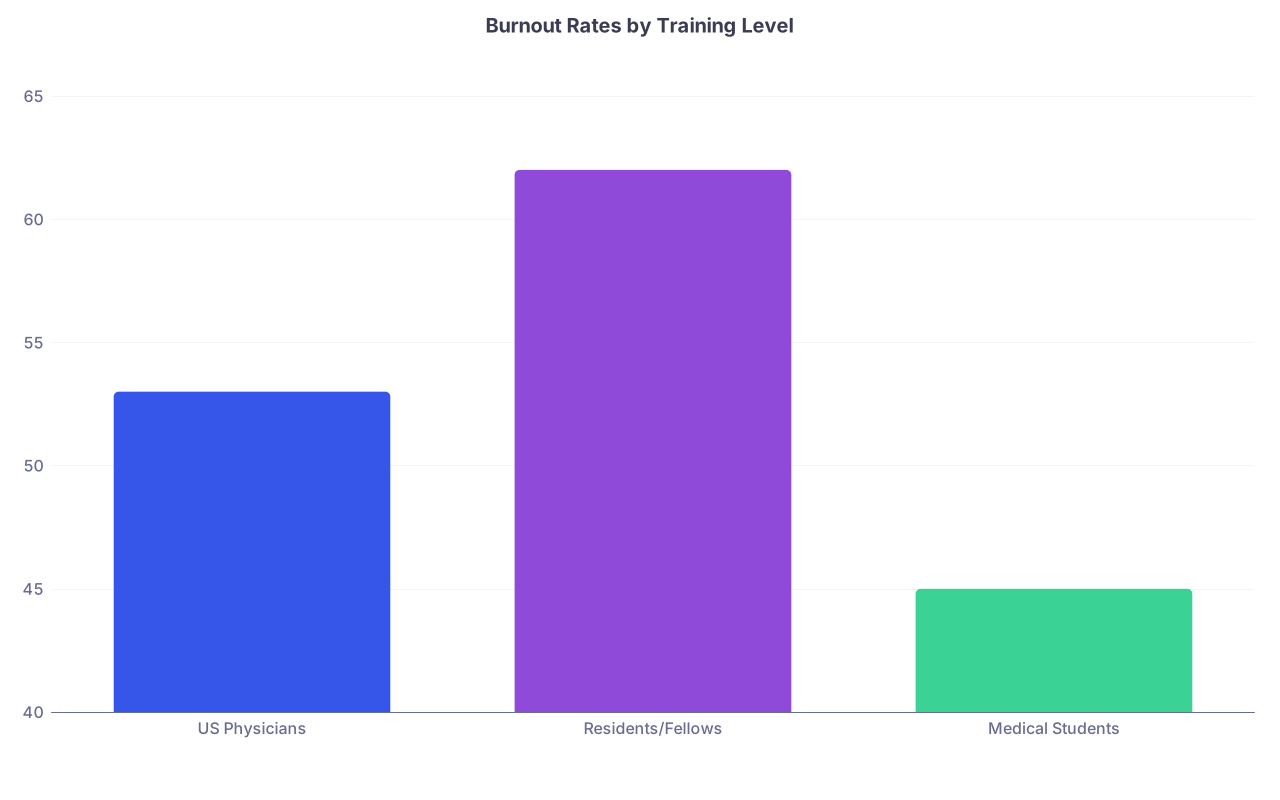
| Category | Value |
|---|---|
| US Physicians | 53 |
| Residents/Fellows | 62 |
| Medical Students | 45 |
Those are ballpark numbers from large national surveys over the past decade: yes, burnout is common in residency. No, it is not universal. And how you think about it — the stories you buy into — absolutely changes your risk.
Time to break some myths.
Myth #1: “Everyone Is Miserable in Residency”
This is the flagship myth. You hear it in M3 work rooms, on premed forums, from that one jaded senior who opens every sentence with “Just wait until you’re an intern…”
Here’s what the data actually shows:
- Roughly 50–70% of residents meet criteria for burnout at some point.
- That means 30–50% do not — even in the same system, same call schedule, same EHR.
- Even among “burned out” residents, the majority still report meaning in work and would choose medicine again.
That last point matters. Burnout is not the same thing as total misery or regret. It’s a syndrome: emotional exhaustion, depersonalization, and reduced sense of accomplishment. People can have significant burnout symptoms and still have good days, solid relationships, and moments of genuine satisfaction.
I’ve watched two interns on the same rotation: same horrendous q4 call, same malignant attending, same broken pager system. One was clearly circling the drain — cynical, checked out, snapping at nurses. The other was tired, frustrated, but still laughing with the team, still teaching students, still going to trivia post-call occasionally. Their circumstances weren’t different. Their experience was.
Not because one was “stronger” or “more resilient.” That’s lazy thinking. The difference was:
- Social support (one had people outside medicine, one didn’t).
- Some control over life outside work (one guarded sleep and exercise like a hawk, one “gave up” early PGY-1).
- Program mentorship: one had a senior who actually intervened when she started slipping; the other had “bro culture” and jokes about “embrace the suck.”
You do not have to be thrilled with life in residency. But “everyone is miserable” is factually wrong — and buying it makes you more likely to slide into the exact misery you fear.
Myth #2: Burnout Is Just About Hours and Call
If long hours alone caused burnout, every surgical resident would spontaneously combust PGY-2 and no ICU fellow would survive. Yet some of the happiest trainees I’ve seen are in “brutal” programs, while some of the most burned out are in supposedly “lifestyle” specialties.
The research is remarkably consistent: work hours matter, but they’re not the main driver. The big predictors are:
- Lack of control and autonomy
- Toxic or disrespectful culture
- Poor supervision or feeling unsupported
- Misalignment with personal values (e.g., billing > patient care)
- Chronic administrative burden (EHR nonsense, pointless clicks)
Long shifts amplify all of this, but they’re not the root cause. A 12-hour day in a collaborative, teaching-focused ICU feels very different from a “9–5” clinic where you’re double-booked, charting at home, and constantly scolded about metrics.
Here’s the contrast in a simple table:
| Factor | Impact on Burnout Risk |
|---|---|
| Lack of control/autonomy | Very high |
| Toxic culture/disrespect | Very high |
| Excess documentation | High |
| Total work hours | Moderate |
| Specialty choice | Lower than you think |
This is why two residents both working 70 hours/week can have completely different burnout trajectories. One feels trusted, learns, gets real feedback, has some say in their schedule. The other feels like a data-entry mule who gets yelled at in the OR and ignored in conference.
The myth that “it’s just the hours” leads to exactly the wrong prevention strategy: you wait for schedules or regulations to save you instead of aggressively shaping the things you can alter — support, micro-control, boundaries, how you talk to yourself.
Myth #3: Burnout Is a Personal Weakness (or a Resilience Problem)
The old-guard myth: “If you’re burned out, you’re not cut out for medicine.” The trendy new myth: “You just need better resilience and mindfulness and yoga.”
Both are blame-shifting, just in different outfits.
Look at what actually works when programs reduce burnout rates in a measurable way. It’s rarely a yoga class. It’s structural change:
- Protected sleep and real control over post-call
- Caps on non-educational scut
- Reliable backup when volumes spike instead of “just pick up more”
- Clear policy against abusive behavior (and enforcement that doesn’t require the intern to be the whistleblower)
The evidence is harshly clear: burnout is primarily a system-level problem with individual-level consequences. Your personality, coping skills, and habits modify your risk, but they do not create it out of thin air.
And the “resilience training” industry? Often a distraction. Residents can be drowning in systemic dysfunction while being handed wellness newsletters and told to practice gratitude. That mismatch actually increases cynicism and burnout.
Here’s a simple way to frame it that lines up with reality:
- System = primary driver of burnout risk.
- Individual = modulator of how high that risk translates into actual collapse.
So no, you’re not burned out because you “cannot hack it” or because you skipped journaling. But also: there are individual strategies that meaningfully change your odds — and pretending it’s all structural leaves you powerless in the short term.
Myth #4: You Can “Gut It Out” and Fix It Later
This might be the most seductive myth for high-achievers.
“I’ll grind through residency, do what it takes, and fix my health/marriage/brain when I’m an attending.”
There’s a problem with that plan: chronic burnout rewires you. It doesn’t politely pause in the background and wait for your fellowship graduation party.
Multiple longitudinal studies show the same pattern:
- Residents with high burnout are much more likely to carry it into early attending life.
- Depressive symptoms, substance use, and relationship problems that start in training often persist even when schedules get better.
- People who repeatedly ignore early warning signs tend to lose the very skills they’d use to fix things later: motivation, energy, ability to experience pleasure.
Let me put it less academic: if you burn yourself into a husk for 3–7 years, there is no “bounce back to baseline” switch afterwards. You do not just sleep for a month and wake up fine.
I’ve watched formerly engaged, curious residents become attendings who:
- Accept every extra shift because they don’t remember who they are without work.
- Stay in toxic jobs because “I survived worse” becomes their identity.
- Feel empty outside the hospital because all their non-medical relationships atrophied while they “gutted it out.”
The data on suicidality in physicians is also not abstract. Elevated relative to the general population, tied tightly to untreated depression, substance misuse, and — yes — burnout. Not because of one bad month, but because years of “I’ll deal with it later” eventually hit the wall.
If your strategy depends on you being a completely different person after graduation, it’s a fantasy, not a plan.
Myth #5: “Wellness” Programs Are Useless Window Dressing
Let me be very clear: a lot of resident “wellness” programming is fluff. Pizza nights labeled as “wellness” are insulting. Forced yoga after 28 hours in-house is a joke.
But the myth “all wellness initiatives are useless” is just as lazy as the programs that toss you a meditation app and call it a day.
Some interventions have measurable, decent effect sizes:
- Formal, confidential mental health services with easy access and no career penalty.
- Protected non-clinical time that actually remains protected.
- Mentorship programs with real matching and expectations, not just a list of names.
- Schedule redesign that reduces fragmentation (e.g., night float systems done well, coherent clinic blocks).
These are “wellness” initiatives even if they’re not branded with pastel posters.
The stuff that does not work, or works minimally:
- One-off resilience workshops.
- Occasional free food framed as a burnout solution.
- Mandatory “wellness” events that cut into your sleep or your only free evening.
When you evaluate your program (or advocate for change), stop asking “Do they have wellness?” and start asking:
- Do we have control over anything?
- Are there mechanisms to respond when residents are in trouble, or do we just whisper in the work room?
- Are duty hours and caps real or just numbers in MedHub?
- Are attendings trained and incentivized to not be abusive?
That distinction between cosmetic and structural wellness is everything.
Myth #6: Talking About Burnout Will Hurt Your Career
I’ve heard residents say this verbatim: “If I tell anyone I’m struggling, I’ll never get a fellowship.” So they stay silent. They hide. Or they vent anonymously online and nowhere else.
Here’s reality:
- National organizations (ACGME, specialty boards) are under intense pressure about physician mental health and safety.
- More programs are being cited — and sometimes losing accreditation — for failing to address resident well-being.
- The legal climate around forcing disclosure of mental health treatment for licensing is shifting; several states have changed questions to focus on impairment, not diagnosis.
Is stigma gone? No. Are there still backward faculty who think struggling = weak? Absolutely. But the tide is not subtle. Many PDs are more afraid of being the program that ignored a struggling resident than the one that helped them.
The trick is being strategic, not silent:
- You don’t need to tell every attending you’re depressed.
- You do need at least one safe, higher-up person (PD, APD, chief) who knows enough to help pull levers: schedule adjustment, coverage, leave, connecting you with confidential care.
- Use formal resources when possible: employee assistance programs, trainee mental health clinics, anonymous hotlines. They exist partly to create some firewall between your care and your evaluators.
The hidden risk is not that you’ll wreck your career by asking for help. It’s that you’ll wreck your life by refusing to.
Myth #7: Preventing Burnout Is About “Balance”
The word “balance” is useless in residency. There is no scenario where you’re working 60–80 hours/week, on nights, with death and disaster around you, and life feels “balanced.” That standard sets you up to feel like a failure even when you’re doing well.
People who weather residency without imploding do something else: they intentionally choose asymmetry.
They decide: for these 3–7 years…
- Work will occupy a massive chunk of life.
- That doesn’t mean everything else dies.
- But it does mean ruthless prioritization of what survives.
I’ve seen this play out like:
- One resident protects a 20-minute daily walk like it’s a code stroke.
- Another drops three hobbies and keeps one non-negotiable thing: weekly dinner with a partner, no phones.
- A third rotates childcare coverage with a co-resident couple and unapologetically says no to “optional” research that’s really just cheap labor.
The research on protective factors backs this up. You don’t need 10 wellness habits. You need 1–3 that are:
- Consistent
- Protected by boundaries you actually enforce
- Rooted in your values, not what “good residents” are supposed to do
So stop chasing “balance.” Aim for deliberate imbalance with a few anchored priorities that keep you human.
Myth #8: “I’ll Definitely Burn Out; It’s Inevitable”
This is the fatalistic cousin of Myth #1. You look at the stats, you read the horror stories, you extrapolate. “If more than half of residents burn out, that’ll be me. Nothing I can do.”
But that’s not how risk works.
Plenty of people walk into high-risk environments and don’t develop the bad outcome. Not by luck. Because risk is a probability, not a sentence — and they stack the probabilities.
The literature consistently finds lower burnout among trainees who:
- Have strong perceived social support (inside or outside medicine)
- Feel some control over schedule or workflow
- Have mentors who acknowledge, not dismiss, systemic dysfunction
- Engage in whatever version of meaning-making works for them (teaching, research, advocacy, religion, etc.)
You can’t fix your hospital’s EHR. You can’t single-handedly prevent malignant behavior. But you’re not powerless:
- You can actively cultivate a non-toxic peer group instead of bonding only through complaining.
- You can pick a mentor deliberately, not wait for someone to assign you one.
- You can define your own lines: how many extra shifts you’ll pick up, how reachable you’ll be post-call, what’s non-negotiable outside of work.
Burnout is common, not guaranteed. Treating it like a foregone conclusion subtly pushes you to stop trying.
Quick Reality Check: What Actually Helps
To make this concrete, here’s what tends to move the needle — based on data and what I’ve seen work on the ground:
| Strategy | Real Impact |
|---|---|
| Schedule redesign, true caps, backup | High |
| Culture change around respect/abuse | High |
| Easy-access confidential mental healthcare | High |
| Real mentorship and advocacy | High |
| Occasional wellness lectures | Low |
| Free food labeled as “wellness” | None |
| Mandatory social events post-call | Negative |
And personally, at the individual level, the residents who stay afloat usually:
- Have at least one non-medical identity they protect (parent, musician, runner, partner, whatever).
- Refuse to glorify martyrdom. They rest when they can, full stop.
- Are selectively disengaged from the nonsense — they’ll jump for a crashing patient, but not for an unnecessarily snarky attending email at 9 pm post-call.
Visual: The Real Burnout Cycle vs Prevention Points

| Step | Description |
|---|---|
| Step 1 | High workload and stress |
| Step 2 | Lack of control and support |
| Step 3 | Emotional exhaustion |
| Step 4 | Depersonalization and cynicism |
| Step 5 | Errors, isolation, worsening health |
| Step 6 | Full burnout and possible crisis |
| Step 7 | Improve supervision and autonomy |
| Step 8 | Protected rest, mental health care |
| Step 9 | Culture change, peer support |
| Step 10 | Formal help, schedule changes |
Notice where the levers are. Not just at the end when everything is on fire.
So What Do You Actually Do With This?
Let’s be clear about a few things:
- Residency is hard, and burnout is common. That’s not a myth.
- The idea that everyone is miserable, that nothing helps, and that you either “tough it out” or wash out — that’s the myth.
- You are neither doomed nor magically safe. You are at risk, with tools.
So here’s the distilled version:
- Stop buying extreme narratives. “Everyone is miserable” and “only weak people burn out” are both lies. Replace them with: “This system creates risk; I’m going to be deliberate about how I move through it.”
- Fight for structure, not slogans. Real prevention is about control, backup, culture, and access to care — not posters and pizza.
- Invest in a few anchors. A mentor, a non-medical identity, one ruthlessly protected habit, and a refusal to ignore early red flags will go farther than any wellness curriculum.
You cannot fix medicine during residency. But you also do not have to be its casualty.


