

Most residents waste their research year and still end up burned out. You do not have to.
You stepped off the wards thinking, “Finally, a breather.”
Now you’re six months into a research year, your brain is mush, your paper is stuck in “revise and resubmit,” and you’re somehow more exhausted than during 80‑hour weeks.
This is not you being weak. This is a predictable trap of the research year: less structure, more pressure, and zero distance from medicine.
Let me walk you through exactly how to reset while you’re off the wards—without blowing up your productivity or your career.
What burnout looks like in a research year (and why it feels weird)
You’re used to the classic clinical burnout: pager going off, no bathroom breaks, constant hallway consults. Research burnout is slipperier. It hides.
Common research‑year burnout patterns I see:
- You open the same draft four days in a row and add one sentence. Maybe.
- You dread emails from your PI more than a 2 a.m. STEMI.
- You say “I’ll catch up on work this weekend” every Friday, then hate yourself on Sunday night.
- You feel guilty any time you’re not “being productive” because “this is my one protected year.”
- Your sleep drifts later and later; you’re running on caffeine, anxiety, and half a bagel.
If two or more of those hit, stop calling it a motivation problem. Call it what it is: burnout.
And burnout in a research year is dangerous because:
- You lose your buffer year to recover from clinical training.
- You go back to the wards more depleted than when you left.
- You train your brain that “free time” = “more pressure,” which poisons future flexibility.
We’re going to fix that.
Step 1: Stabilize your life before you “fix your research”
You cannot reset your brain if your basic life scaffolding is trash. Start there. Not negotiable.
A. Rebuild a predictable weekly skeleton
You need structure. Not a 14‑point habit stack. A skeleton.
Take one sheet of paper. Draw a simple weekly grid. Then fill in only these four categories:
- Sleep window
- Work blocks
- Movement
- True off time
Be concrete. For example:
- Sleep: Midnight–7 a.m. (every day, no heroics)
- Work blocks:
- 9–12: Deep work (writing / stats / analysis)
- 2–5: Shallow work (email, meetings, reading)
- Movement:
- 30–40 minutes, 4 days/week (walk, gym, yoga—doesn’t matter, but scheduled)
- Off time:
- Every evening after 8 p.m.
- One full weekend day with zero work
Now actually put that into Google Calendar. With alerts. Treat those blocks like OR time: protected.
You’ll want to say, “I need more flexibility.” That’s burnout talking. You actually need less decision-making, not more.
B. Fix the three things that quietly wreck your brain
I’ve seen this pattern over and over in research residents:
- You’re eating erratically (coffee for breakfast, DoorDash for dinner… again).
- You’re doomscrolling in bed until 1 a.m.
- You’re never outside in actual daylight.
Here’s the minimum corrective package:
- Daylight rule: Go outside for 10–15 minutes before noon every day. No headphones, just walk. This is not “wellness.” It’s circadian medicine.
- Screen curfew: Set a hard “no email / Slack after 9 p.m.” rule. If your PI has a problem with that on a research year, that’s a red flag, not your failing.
- Simple food upgrade:
Pick one meal per day and make it predictable and reasonably healthy. Example:- Breakfast: Greek yogurt + fruit + handful of nuts
Or - Lunch: Pre-made salad kit + rotisserie chicken
This is about reducing decision fatigue, not becoming a nutrition influencer.
- Breakfast: Greek yogurt + fruit + handful of nuts
You do this for two weeks. No productivity hacks yet. Just stabilizing the system you’re asking to do hard cognitive work.
Step 2: Renegotiate your relationship with research work
Right now, your brain has classified research as:
“High stakes, never done, always behind, nobody’s clear what ‘good enough’ is.”
That combination will fry anyone.
You need to change how the work is packaged in your day.
A. Switch from “project thinking” to “session thinking”
Stop saying:
“I need to finish this paper.”
Start saying:
“I’m doing 2 deep-work sessions today.”
A “session” is:
- 50 minutes of focused work
- 10 minutes of real break
- No phone, no inbox, no Slack
That’s it. Two to three sessions per day, consistently, beats your occasional 7‑hour panic day every time.
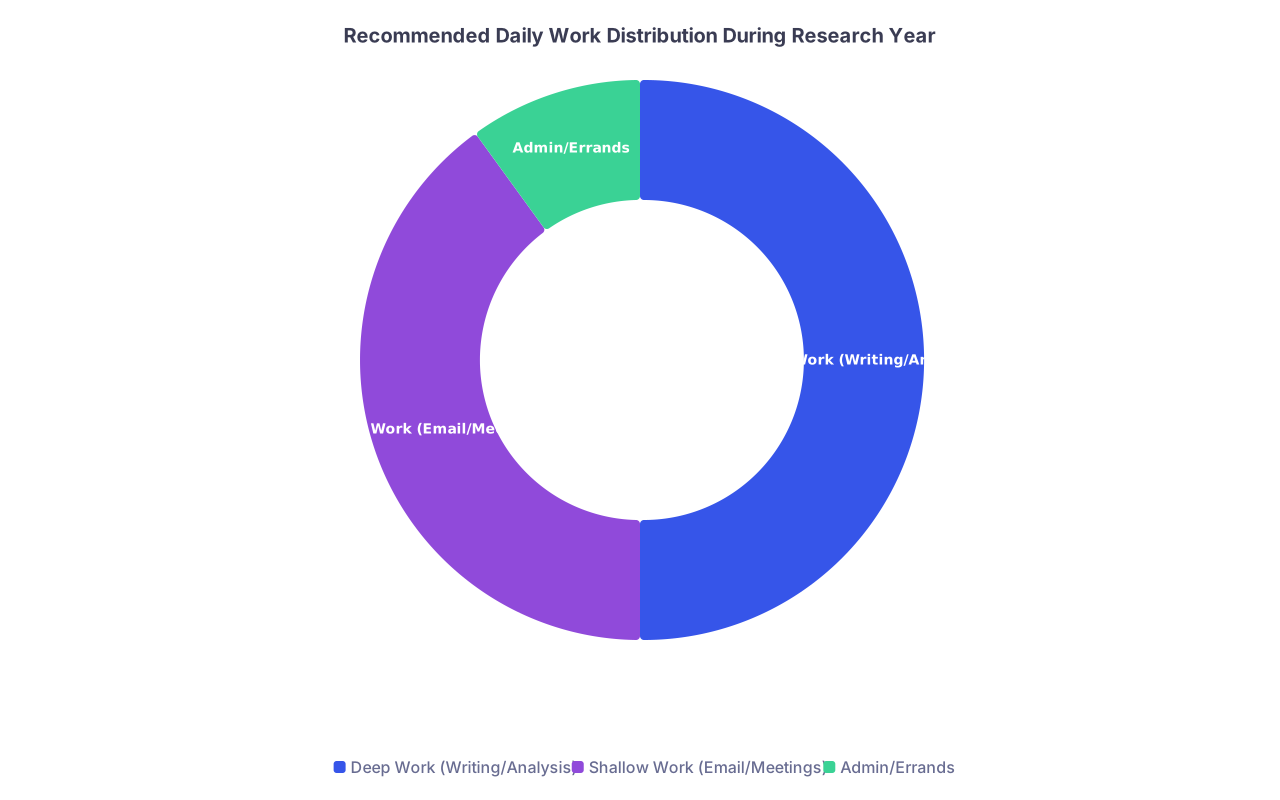
| Category | Value |
|---|---|
| Deep Work (Writing/Analysis) | 150 |
| Shallow Work (Email/Meetings) | 120 |
| Admin/Errands | 30 |
You want to reset? Do this:
For the next 10 weekdays, commit to:
- 2 deep‑work sessions / day
- Scheduled in your calendar
- Done before 1 p.m. whenever possible
After that, you’re “allowed” to call yourself productive even if the afternoon implodes.
B. Define “good enough” with your PI, not in your head
A lot of your stress is coming from invisible expectations.
You think:
- “I should have more abstracts by now.”
- “I’m probably behind my co‑residents.”
- “My PI probably expected this done last month.”
Stop guessing. Have the uncomfortable but necessary 20‑minute conversation.
Script you can literally use:
“I want to make sure I’m working toward the right targets.
For this research year, what would you consider a solid outcome in terms of:
– Abstracts
– Manuscripts submitted
– Presentations
And for this main project, what does ‘on track’ look like over the next 3 months?”
Then shut up and write down what they say. Push for numbers. “One first‑author submission and one co‑author submission by the end of the year” is concrete. “Be productive” is useless.
| Output Type | Solid Year Target | Stretch Target |
|---|---|---|
| First-author papers | 1 | 2 |
| Co-author papers | 1–2 | 3–4 |
| Abstracts | 1–2 | 3 |
Once you have real targets, you can stop inventing impossible ones in your head.
C. Clarify your actual weekly deliverables
Every Friday, spend 10–15 minutes doing this:
- Look at your projects.
- For each project, write one concrete deliverable for next week. Not “work on methods,” but “Draft methods section, 800–1000 words” or “Clean data file and run primary analysis.”
Then slot those into specific deep‑work sessions on your calendar. If you’ve got more deliverables than you have sessions, your problem isn’t discipline; it’s math. You email your PI and say:
“Looking at next week, I can realistically deliver X and Y. Z would likely get pushed. Which is higher priority for you?”
That email does two things:
- Protects you from silently drowning.
- Forces your mentor to reveal what actually matters.
Step 3: Build in real distance from medicine
If your entire research year is medicine, you haven’t actually stepped away from the wards. You’ve just changed your badge.
Your brain needs pockets where you are not a resident, not an aspiring fellow, not “future Dr. X.” Just a human.
A. Add one non-medical identity back into your life
Think in terms of identity labels: “runner,” “pianist,” “gamer,” “aunt who actually shows up,” “person who climbs once a week.”
Pick one that feels either:
- Something you used to be
- Something you’re mildly curious about
Then hard‑schedule it:
- Climbing gym every Tuesday 7–9 p.m.
- Book club every second Thursday
- Pickup soccer Sunday mornings
- Painting class, language course, whatever
Not “when I have time.” On the calendar. Like a clinic block.
This is not indulgent. This is repair. Residents who only take “breaks” by scrolling their phone do not reset; they just go numb.
B. Physically change environments
Working, sleeping, and eating within a 10‑foot radius will ruin you.
Do this:
- Designate one primary work location (home desk, library, office).
- Choose one “light work” location (coffee shop, park bench, med school library lounge).
- Make your bed and couch “no laptop zones” for work.
Even small shifts help. Write methods at your desk. Do article reading at the library. Reply to low‑stakes email at a café.
Your brain starts to associate certain spaces with “being on” and others with “being off,” which makes actual rest easier.
Step 4: Deal with the guilt and comparison spiral
You’re not just tired. You’re also silently beating yourself up.
“I should be doing more.”
“Other people in my program got three publications.”
“If I don’t maximize this year, I’m screwed for fellowship.”
That mental noise is part of the burnout. You’re pouring gasoline on your own nervous system.
A. Reality‑check the “everyone else is crushing it” lie
You’re seeing the outputs, not the process. You see:
- Group emails: “Congratulations to Dr. Y for their new publication in JAMA!”
- Instagram posts from co‑residents at conferences.
- Program newsletters with just the wins.
You do not see:
- The 17 rejections that led to that one acceptance.
- The weeks people spent staring at a blank Stata window.
- The co‑authorship where they did four hours of work and got a line on their CV.
If you can, talk to one or two trusted co‑residents who are also in research years and ask bluntly:
“How are you really feeling about your research year? What’s actually been hard?”
You will find out quickly that you’re not the only one melting down over a stalled manuscript.
B. Shrink your timeframe
Burnout thinking is all about massive time horizons:
- “If I don’t get 3 papers this year, I’ll never match in cards.”
- “This is my one shot to build my CV.”
Pull it back to 2–4 weeks, maximum.
Ask yourself:
- “In the next 4 weeks, what would make me feel reasonably proud of how I used my time?”
- “What’s one bottleneck I could clear that would move any project 30% forward?”
Then ignore everything beyond that. It will still be there. But your brain needs to believe the work is chunkable and survivable.
Step 5: When you’re already deep in burnout
If you’re past “tired” and into “I fantasize about walking out of medicine,” then no, you don’t need another productivity plan. You’re in damage‑control mode.
Here’s what to do in that case.
A. Take a real, declared pause
Not “I’ll secretly do less this week and feel guilty.” A declared pause.
Email to PI, tailored:
“I’ve been pushing hard on the project and I’m hitting a point of cognitive fatigue that’s starting to affect the quality of my work.
Over the next 5–7 days, I’m going to focus on rest, reading, and high‑level thinking rather than pushing forward on new analyses.
After that, I’d like to regroup briefly to prioritize the next steps so I can come back focused and efficient.”
Most decent mentors will accept this. The ones who do not are showing you who they are.
And during that week, your rule is simple:
- No new analyses
- No manuscript drafting
- No late‑night work
You’re allowed some light reading, some brainstorming, but this is rehab, not training camp.
B. Bring in actual support (not just complaining to co‑residents)
If you’re at the point where:
- You’re crying at random times.
- You’ve lost interest in things you used to like.
- You’re having trouble getting out of bed or you’re awake at 3 a.m. most nights.
- You’re thinking “if I got hit by a bus, at least I could rest.”
That is not “normal stress.” That’s your brain waving a huge red flag.
Use your institution:
- GME counseling/psych services
- Employee Assistance Program
- A therapist outside the hospital if you can swing it
Tell them explicitly: “I’m a resident on a research year and I’m burning out hard.”
You’re not the first. They’ve heard this exact story before.
And no, this does not “go on your record” in the way your catastrophizing brain thinks it does. Seeing a therapist in residency is wildly common and rarely career‑limiting. Crashing and burning publicly is far more career‑limiting.
Step 6: Prepare to go back to the wards without destroying your reset
You also have a transition problem: you’re going to be thrown from semi‑flexible research life back into “intern‑plus” chaos.
If you don’t plan this, you’ll lose everything you gained.
A. 6–8 weeks before returning: tighten your schedule
Start shifting from:
- 2 deep‑work sessions + lazy afternoons
Toward:
- Earlier wake time (aim closer to your clinical schedule)
- More predictable mealtimes
- More structured evenings (wind down by 10–10:30 p.m.)
Treat this like re‑conditioning. You’re building back your clinical muscles gently.
B. Decide what you’re going to protect on the wards
You won’t keep everything. But you should protect something.
Pick 2–3 non‑negotiables:
- 1 physical activity slot per week (even if it’s just a 30‑minute walk).
- 1 non‑medical identity activity per week (friend dinner, class, hobby).
- 1 tech boundary (no email after 10 p.m. on post‑call days, for example).
Write these down. Tell a co‑resident you trust. Ask them to call you out if you drop all of them “because I’m too busy.”
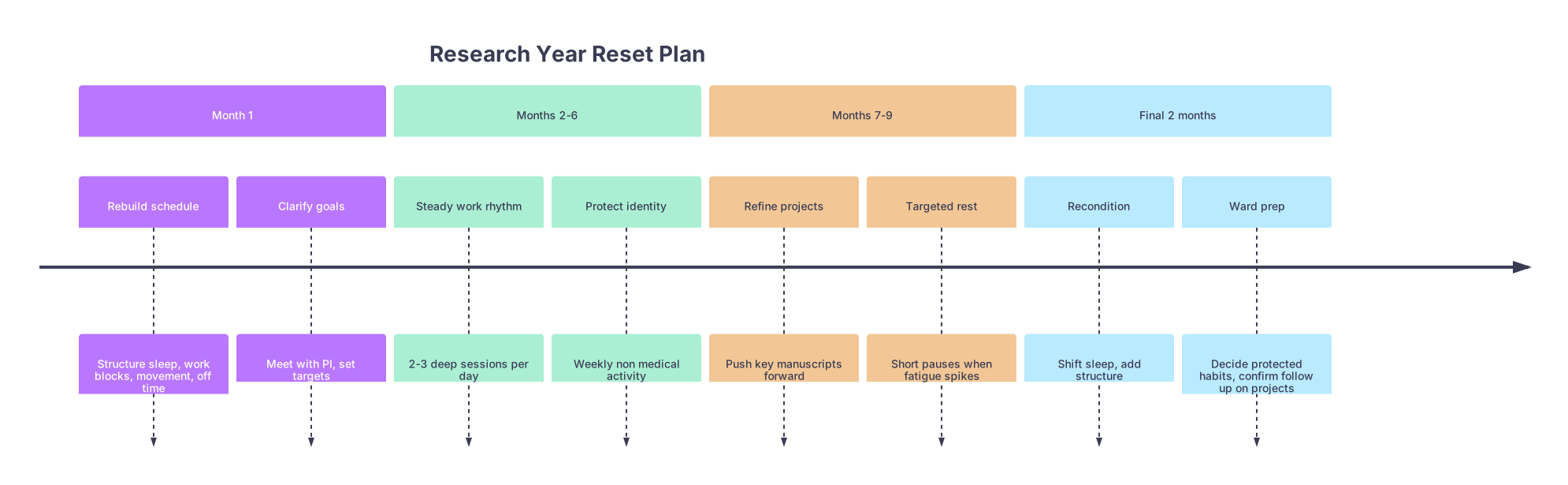
| Period | Event |
|---|---|
| Month 1 - Rebuild schedule | Structure sleep, work blocks, movement, off time |
| Month 1 - Clarify goals | Meet with PI, set targets |
| Months 2-6 - Steady work rhythm | 2-3 deep sessions per day |
| Months 2-6 - Protect identity | Weekly non medical activity |
| Months 7-9 - Refine projects | Push key manuscripts forward |
| Months 7-9 - Targeted rest | Short pauses when fatigue spikes |
| Final 2 months - Recondition | Shift sleep, add structure |
| Final 2 months - Ward prep | Decide protected habits, confirm follow up on projects |
C. Create a “maintenance plan” for your research
Before you go back:
- List every active project.
- For each: next 1–2 concrete steps, and who’s responsible.
- Decide: what can move forward without you vs. what pauses.
Then send one clean, professional email per project team:
“I’m transitioning back to full‑time clinical work on [date].
Before then, I’d like to clarify next steps and my role going forward.
Based on where we are, I see my realistic contributions over the next 6 months as:
– X
– Y
– Z (if time allows)
Does that match your expectations, or would you suggest adjustments?”
This prevents the classic situation where you’re on nights, your PI emails “Any update on the manuscript?” and you want to scream.
Quick reality check: When a reset does not mean quitting
There’s a quiet fear under all of this:
“If I admit I’m burned out, maybe it means I’m not cut out for this.”
No. It means your system exceeded human tolerances. Again.
A good reset year has three outputs:
- A few meaningful academic products, not a graveyard of half‑started projects.
- A clearer sense of what you like and hate about research.
- A nervous system that’s more regulated than when you left the wards.
If you’re not on track for that yet, you still have time. Even if you’re already halfway (or more) through the year.
What you can do today
Do not try to fix everything at once. Pick three actions for the next 24–48 hours:
- Block two 50‑minute deep‑work sessions on your calendar for tomorrow.
- Go outside for 10–15 minutes before noon, no phone, just walk.
- Draft a 3–4 sentence email to your PI to clarify expectations for the rest of the year.
Then open your calendar right now and mark one full day in the next month as “OFF – no research, no clinical.” That day is a line you draw in your own favor.
You reset a research year the same way you survive the wards: with clear boundaries, small consistent actions, and refusing to pretend you’re a machine.
FAQ (exactly 5 questions)
1. How do I know if I need a full break versus just better structure?
If you still have some interest in the work but feel scattered and unproductive, start with structure: fixed work sessions, sleep, movement, and clearer goals. If you feel numb, hopeless, or resentful most of the day and the idea of even a 50‑minute session feels impossible, you likely need a real, declared break (3–7 days) and probably professional support. When basic tasks like showering, answering simple emails, or getting out of bed feel heavy, that’s beyond “needs better time management.”
2. What if my PI is unsupportive or dismissive when I bring up burnout or limits?
Then you treat this like a risk‑management problem. Document your communications. Keep your messages focused on quality of work and clear timelines, not emotions (“to maintain high‑quality analysis, I’ll need two weeks for this step”). Loop in a co‑mentor, program director, or research director if needed. You don’t need your PI to be your therapist; you just need them to be specific about expectations and timelines. If their expectations are truly unsafe or unreasonable, involve GME leadership.
3. I feel behind compared to co‑residents with more publications. Is it too late to catch up?
No. You can make more progress in 4–6 focused months than in a year of scattered panic. Focus on 1–2 high‑yield projects where you can realistically be first or strong co‑author, rather than chasing every opportunity. Ask your mentor which projects have the clearest path to submission in the next 3–6 months and push those. Programs look at coherence and depth, not just raw count. A well‑done first‑author paper often matters more than three superficial middle‑author lines.
4. How much should I actually be working during a research year?
For most residents, 4–5 hours/day of real, focused cognitive work (2–3 deep‑work sessions plus some lighter tasks) is plenty and often the upper limit of what your brain can do consistently. You’re not on shift work; you’re doing high‑level analysis and writing. The problem is not usually that people aren’t working enough hours; it’s that the hours are fragmented, distracted, and soaked in guilt. Aim for consistency, not 10‑hour marathons.
5. What if I realize during this year that I hate research? Did I waste my time?
No. That’s actually a valuable—and expensive—piece of self‑knowledge. You’ve just saved yourself from signing up for a research‑heavy fellowship or academic career that would make you miserable. You can still finish your main obligations (existing projects you committed to) and then pivot toward more clinically focused paths. When you apply for jobs or fellowships, you can frame the year as: “I gained a strong understanding of research methods and realized I’m most energized by direct patient care, so I’m aiming for roles that maximize that.” That’s not failure; that’s refinement.


