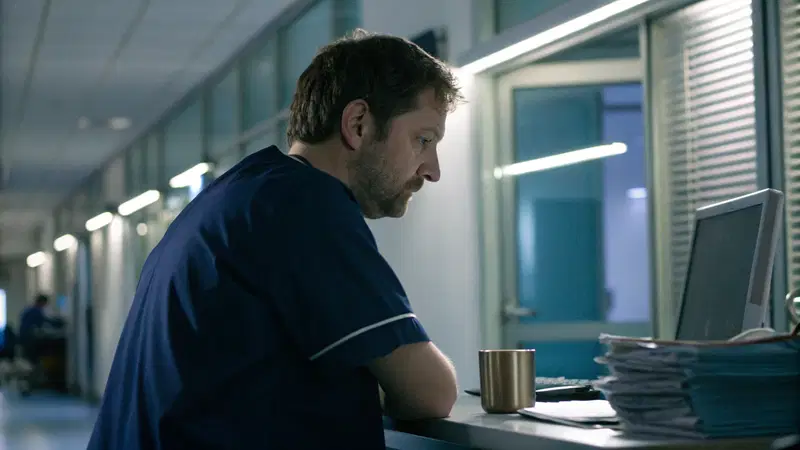
The Moment the Shift Clock Hits End, and the Paperwork Starts
Let me paint the scene nobody puts in the recruitment brochure.
It's 7:04 p.m. Your shift ended four minutes ago, you know this because the schedule says 7 to 7. Your pager does not know this. Bed 14's family just arrived with twenty minutes of questions, cross-cover wants you to re-dose the vanc before you leave, and your senior is waving you toward the workroom because sign-out is "almost done," which, as you've learned, means twenty more minutes. The clock on the wall keeps moving. It doesn't care about your stopwatch, and it never will.
That smear of time between "your shift ended" and "you actually left"? That's extended coverage. In real residency practice, it means the ongoing patient-care tasks you keep performing after your formal shift ends, finishing the sepsis workup, completing a required handoff, placing orders your attending asked for at 6:55. Applicants imagine clean edges to a shift. Residents know better.
Here's the insider premise you need before anything else: programs aren't trying to hide anything from you. I've sat in the meetings. Program directors and coordinators are trying to survive compliance audits, CLER visits, and GMEC scrutiny, and what keeps them up at night is a duty-hour log that can't be defended. Your job is to make yours defensible. Everything below is how.
The Real Rules Behind Counting Extended Coverage: What Programs Actually Use
Forget what the WhatsApp group says. Here's what really happens in the program office.
Your program counts time when you were performing required clinical work that passes two tests. First, it sat inside the program's supervision and assignment structure, meaning the work belonged to your role, your team, your patients, and somebody above you expected it. Second, it's verifiable, you can say what you did, when you started, when you stopped, and who wanted it done. Both tests. Not one.
And here's the behind-the-scenes truth that surprises people: attendings and PDs care far less about how tired you felt than about whether the activity was genuinely clinical duty and whether it can be documented consistently. Fatigue isn't loggable. Tasks are. When a compliance review lands, nobody can measure your exhaustion, they can only read what you wrote down. So the game, if you want to call it that, is writing down the truth in a way that matches the rulebook.
Programs sort this work into buckets, whether they say so out loud or not. Direct patient care: evaluating a decompensating patient, placing orders, calling families, writing notes that are part of active management. Required sign-out and handoff responsibilities, yes, that "almost done" twenty minutes counts, because safe handoff is mandated work. Supervised procedures that run long. And mandatory administrative completion tied to patient care, like the discharge summary required for a disposition or the operative note that must exist before you walk out.
One more secret, and residents never believe me when I say it: charting you finish from your couch can count. If you go home and complete notes that were a required part of your clinical responsibilities, that is still duty under the ACGME definition, all clinical and academic activities related to the program. Programs hate hearing this, because it wrecks their tidy schedules. It's still true. Log it.
Counting Framework, Not Vibes: A Decision Tree for Whether It Counts
Residents decide this by feel. That's the first mistake. Use a decision tree instead, because the tree is what the auditor mentally runs when your entry gets pulled.
The logic is simple. If you performed duty work because a patient needed it or the program required it, it may count. If you were merely waiting for a ride, commuting, catching up on personal email at a workstation, or doing research reading nobody assigned, it won't. The dividing line isn't effort. It's requirement.
Now the gray zones, because this is where people get burned. The "just one more thing" trap: you stay forty-five minutes tidying a list nobody asked you to tidy. Noble. Also probably not countable, because it wasn't required of you. The charting question: finishing documentation that completes an active care plan, orders, assessments, disposition decisions, is different from optional late-night catch-up on notes for stable patients because you like a clean queue. The first is coverage. The second is preference. And covering for a colleague because they looked drowning, without anyone in charge asking you? Log it, but understand it's in the gray until leadership confirms it was an expected coverage need.
The most frequent failure mode I see is counting time that can't be tied to a required task or a supervision expectation. But I'll tell you the second failure mode, because it's just as common and nobody talks about it: underreporting. Residents with a martyr streak leave real, required work off their logs because the culture whispers that logging honestly makes you look weak. PDs know about this culture. The ACGME resident survey literally asks whether you've been pressured to underreport. Both directions of dishonesty are violations. Only one direction is also stealing data your program needs to fix a broken workload.
How the Back Office Thinks: Documentation, Audits, and What Gets Scrutinized
Want to know how your entries actually get read? Let me tell you what happens on the coordinator's side of the screen.
They pull your entries and check three things: consistency, specificity, and alignment. Consistency means your pattern makes sense across weeks, if you logged 7:00 departures all month and then one 11:40 p.m. appears, expect a friendly email. Alignment means your log matches your rotation schedule and sign-out structure. Specificity is where most residents die.
An entry that says "worked late, covered patients" is an audit magnet. It tells the reviewer nothing, and unverifiable entries get questioned, sometimes by the coordinator, sometimes by the GMEC, occasionally by a surveyor. An entry that says "assessed chest pain in bed 9, placed orders under attending direction, completed sign-out" survives everything. Same forty minutes. Radically different paperwork.
On method: same-day entry into whatever system your GME office uses, New Innovations, MedHub, myResidency, take your pick, beats reconstruction every time. Residents who batch-log on Sunday from memory produce fiction, and fiction has tells. The pros keep a running task log: two lines in a notes app when something runs long, or a one-line email to themselves for the timestamp, transferred to the system that night. Thirty seconds of effort. Complete audit armor.
The High-Risk Gray Zones (and How to Handle Them Without Getting Burned)

Three situations generate nearly all the pain. Handle them like this.
Charting after shift end is gray zone number one, and I'll give you the test the back office actually applies: was the documentation a required continuation of an active care plan you owned, or was it catch-up you chose to do because a clean inbox feels good? Writing the note that documents the decision you made at 6:50, with orders riding on it, coverage. Grinding through four stable-patient notes at 8:30 because you hate carrying them, your choice. Dumb rule? Maybe. It's the rule.
Informal cross-coverage is number two, and it's the sneakiest. A overwhelmed intern asks you to stay. You stay, because you're not a monster. But nobody in the chain of command assigned that coverage, which means the program can't verify it was required. Do the work, patients first, always, but confirm quickly with the charge resident or attending that this was an expected coverage need, and log it as such. If it was purely ad-hoc and outside your responsibilities, it may not count the way you hope. Better to know that in real time than in an audit email.
Number three is procedure and consult follow-through. If a clinical decision you made is still unfolding after shift end, the CT result that changes management, the consult callback, frame the continued work as ongoing required coverage, not personal initiative. The difference is a single sentence to your senior: "I'm staying on this until the result lands, per the plan." That sentence moves the work from gray to black-and-white.
Step-by-Step: A Resident-Ready Script and Workflow
Here's the exact workflow I'd hand my own intern. Run it every time the clock hits end and you're not done.
First, at shift end, acknowledge out loud, to yourself and your team, that you're not done. Saying it matters, because it triggers the rest. Second, write down your active tasks right then, not at 10 p.m. Third, tag the supervision source: attending, charge, senior, whoever owns the expectation. Fourth, record start and end times when you close out the work.
The communication script is one sentence. Find your senior, charge, or attending and say: "Before I head out, bed 12 still needs the CT read and disposition. Do you want me to finish this as part of coverage, or hand it to nights?" That's it. That sentence does two things at once: it confirms whether continued work is expected (and therefore duty-eligible), and it creates a witness. Gray zone eliminated.
Your minimum viable documentation, ready to copy and adapt:
7/14, 19:02-19:38, Continued coverage of bed 12: new sepsis workup, cultures and fluids ordered, family updated. Stayed per plan discussed with night senior / attending Dr. A. Sign-out completed 19:20; remained to place orders.
Four elements: date, start-end times, task with clinical content, supervision source. That's a 30-second handoff to an auditor, and it will never get you a follow-up email.
What to Ask (and What Not to Ask) Program Leadership
Here's the insider line on questions: frame them so answering helps the program comply, and you'll get real answers. Frame them as hour-shopping, and you'll get the policy PDF read aloud to you.
"Can you clarify which post-shift tasks our program counts as duty time?" works. "Does late charting for active team plans count, and how should I document it?" works. "What are the required components of our sign-out, so I can make sure the time is captured?" works beautifully, it makes you sound like the solution. "Can I count more to be safe?" does not work. That's not a compliance question; it's a confession in waiting.
What not to do: don't come in hot. No "everyone fudges this, right?" No accusatory framing about what the program gets away with. You want guidance, not a trial transcript, and the moment a PD smells a deposition, the shutters come down. The best programs, I've worked with them, genuinely want clarity. Silence is what scares them. Residents who ask early and document well get remembered fondly come evaluation time, and that's not a coincidence.
Closing Encouragement: You Can Protect Patients and Your Duty-Time Integrity
Stop thinking of this as gaming a system. It's the opposite. You're aligning what you actually did with what you wrote down, so patient care and compliance can coexist in the same hospital at the same hour. That's the whole job.
Run this framework for two weeks and watch what happens: shift transitions stop feeling like a trap. You'll know, in the moment, whether the next thirty minutes count, and you'll have the one sentence ready that settles it. That low-grade anxiety about your log? Gone. Replaced by something better, leverage, because clean documentation is the only lever residents have that actually moves workload.
Last insider reassurance, and I mean it: the good programs want this clarity. They'd rather fix a schedule than cite a violation. Document well, communicate early, and you become the resident they're relieved to have.
The Bottom Line
- Extended coverage counts when it's required clinical or coverage work inside your assigned role and supervision structure, log the task with specifics and start/end times.
- Vague entries are the audit magnet. "Worked late" gets flagged; "assessed chest pain, placed orders under attending direction" gets accepted.
- Run the decision tree, say the one confirming sentence to your senior, and resolve gray zones in real time instead of at audit time.