

You’re on nights in the MICU, post-call brain fog barely clearing, when your sibling texts: “Wedding date is set – Saturday, June 8. Need you there.”
You open Amion. That’s your golden ICU rotation. No elective. No easy swap. Weekend coverage is tight.
Or your partner just told you the planned C‑section date. Your program schedule for that month? Inpatient wards, every other weekend, one of those “no one gets days off” blocks.
Or your parent’s health just tanked and your family is asking, “Can you come home?” And you’re staring at a block schedule that feels concrete, not ink.
That’s the situation this is for: you have a major life event, and your residency schedule is in the way. Not in theory. In cold, hard, published-call-schedule reality.
Let me walk you through what actually works and what usually blows up, step by step.
Step 1: Get Specific About the Conflict (Not Vague)
You cannot walk into a chief’s office with: “My cousin’s getting married sometime in June, can I get that weekend off?” That gets you mentally labeled as not serious.
You need details. Exact ones.
For any event, write down:
- What: “Sibling’s wedding,” “Child’s birth,” “Parent’s major surgery,” “Funeral,” “Religious holiday I always observe,” etc.
- Where: Local vs. cross-country vs. international.
- When: Exact date and time, plus realistic travel window.
- How critical is physical presence: “Must be there in person” vs. “Could join virtually if absolutely necessary.”
Now overlay your rotation/schedule:
- Which rotation are you on?
- Is it an ICU/ED/inpatient heavy service vs. clinic/elective?
- Are you on nights vs. days?
- Are you already scheduled for call/weekend coverage those days?
This matters because your bargaining power is wildly different if you’re trying to leave an elective clinic early vs. bailing on a tiny night float team where you’re one of two residents.
If possible, pull your duty hour requirements and rotation rules too. Some specialties have strict “must complete X weeks ICU” or ACGME minimums. You don’t need to quote chapter and verse, but you do need to know when you’re hitting hard constraints vs just tradition.
Step 2: Rank the Real-Life Importance (For You)
Not all “major life events” are equal, and your program won’t treat them as such either. You should be clear in your own head first.
Top tier, basically non-negotiable if humanly possible:
- Birth of your child (especially if you’re the birthing parent or primary support)
- Major surgery or serious illness of an immediate family member
- Death/funeral of immediate family
- Your own wedding (if anyone tells you to just miss it, that’s a red flag program)
Strongly important but more negotiable:
- Sibling’s wedding
- Religious holidays that are core to your life
- Partner’s graduation, big life milestone, etc.
Nice to have but usually low bargaining power:
- Friend’s wedding
- Bachelor/bachelorette parties
- Reunions, vacations, concerts
I’m not saying your friend’s wedding isn’t meaningful. I’m saying your chiefs and PD will quietly triage them into tiers like this whether they say it out loud or not. Plan your approach accordingly.
Step 3: Time Your Ask Strategically
The earlier you ask, the more likely you win. Late asks cause resentment because someone has to scramble.
Timeline approach:
- As soon as you know the date (wedding, scheduled C‑section, major planned surgery), flag it for yourself.
- If it’s before schedules are built:
- Email chiefs/program coordinator with something like:
“Hey, I wanted to put in a serious request for [event] on [date]. It’s [brief explanation of importance]. If it’s at all possible to avoid call/weekend that day, I’d be really grateful and happy to take extra call another time.”
- Email chiefs/program coordinator with something like:
- If schedules are already made:
- You’re not negotiating with the calendar anymore. You’re working swaps and favors. That’s a different game.
There’s a world of difference between, “You had six months to tell us this” and “This came up last week and we get that you were blindsided.”
Step 4: Check the Rules Before You Ask
Look at your:
- Program handbook (days off rules, vacation request policy, parental leave policy)
- GME/HR policies (bereavement leave, FMLA, parental leave, sick leave)
- Union contract if you’re in a unionized program
You want to know:
- Do you have separate bereavement leave? How many days? For which family members?
- Is there a formal system for requesting “important days off” when building call schedules?
- Does your hospital allow protected time for certain religious holidays?
- For childbirth/parental leave, what’s the lead time and paperwork?
You’re more persuasive if you can say, “I know we have 3 days of bereavement leave for immediate family, and I’d like to use those for my parent’s funeral,” versus “Can I have time off for this?”
Step 5: Try Peer-Level Solutions First (Swaps and Coverage)
Most chiefs and PDs like you more when you show up having already tried to fix it yourself.
Your first move: start quietly looking for swaps or partial coverage.
Ways to do that intelligently:
Targeted asks, not mass spam.
- Look at who’s on your team/rotation block and who’s on adjacent teams.
- Identify people with lighter upcoming weekends/holidays.
- Message them individually:
“Hey, I’m trying to get June 8 off for my sister’s wedding. I can cover one of your weekend calls in [Month X or Y] in exchange. Any chance we can swap [specific shift]?”
Offer something they actually want.
- Cover a holiday they don’t care about (e.g., you take Christmas, they give you Diwali, or vice versa).
- Give them a golden clinic day in exchange for a crummy weekend.
- Offer to take an extra night for them later.
Be specific and organized.
- “I’m on nights 6/3–6/9; if you take my 6/8, I can take your 7/14 cross-cover and your 8/10 night.”
If you get a near-solution—like you’ve got a colleague willing to swap but the chiefs need to approve—that’s a much easier sell:
“Hey chief, X is willing to take my 6/8 shift if I take their 7/20 call. That would let me attend my sibling’s wedding. Would you be ok signing off on this?”
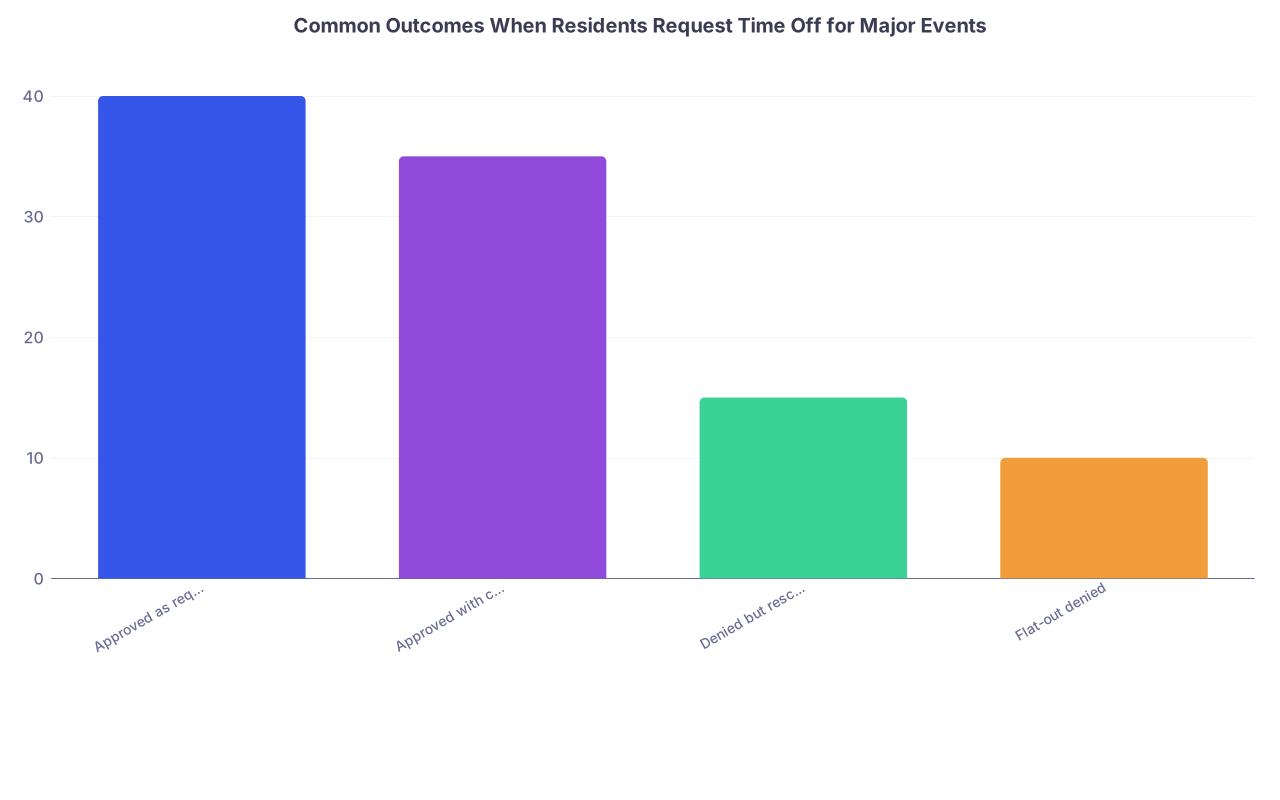
| Category | Value |
|---|---|
| Approved as requested | 40 |
| Approved with compromise | 35 |
| Denied but rescheduled | 15 |
| Flat-out denied | 10 |
Step 6: How to Talk to Your Chiefs and PD (And How Not To)
If swaps alone did not fix it, now you escalate.
General rule: chiefs first, PD second. PD is the nuclear option for real impasses or big-life stuff (childbirth, surgery, serious illness).
How to frame the conversation:
- Be concise and adult.
- Don’t cry in their office if you can avoid it. If you do, fine, but lead with facts.
- Show you’ve already tried to solve it.
Something like:
“Dr. Smith, I wanted to talk about my schedule on June 8. My sister is getting married that day out of state, and it’s extremely important to me to be there. I’m currently scheduled on ICU call that weekend.
I’ve already reached out to several co-residents and one person was willing to swap [give details], but it left us short one night. I wanted to see if there’s any way, with some mix of swaps/extra call later, that I could get that Saturday off.
If there’s a way I can take on more nights or a less desirable weekend in another block to balance things, I’m absolutely willing.”
That’s reasonable, grounded, and signals you’re not just trying to get out of work.
What not to do:
- “I have to go, you just need to fix this.”
- “If you don’t let me go, I’ll call the union/lawyer/ACGME.” (Don’t threaten out of the gate. That’s last resort.)
- “My family says they don’t understand why you won’t let me attend.” (Pulling the “my mom is mad” card is not persuasive.)
For births/serious illness/funerals, you can be more direct:
“I need to let you know my father is in the ICU and they don’t think he’ll make it. I need to go home and be with my family. What’s the best way to handle coverage and paperwork so this is documented correctly?”
That’s not an ask, that’s a statement of reality.
Step 7: Know the Special Categories (Birth, Death, Health, Religion)
These are different from “cool event I’d really like to attend.”
Birth of a Child / Parental Leave
If you’re pregnant or your partner is pregnant, don’t wait until the third trimester to mention it.
- Talk to your PD early. The earlier they know, the more they can cluster heavier rotations away from your due date.
- Ask clearly:
- What’s the parental leave policy?
- Is this FMLA-eligible?
- Will I need to extend residency? How will board requirements be met?
For the birth itself (especially non-scheduled):
- You might have to bail mid-shift. That happens.
- Tell your seniors and chiefs ahead of time: “If I get the call, I’m leaving. I’ll make up the time later.”
- Document everything in email afterward so no one can rewrite history.
Serious Family Illness / Death
Most programs have bereavement leave, but:
- It’s limited (often 2–3 days).
- Applies to immediate family only.
If you need more time:
- You may end up using vacation time or unpaid leave.
- Yes, it’s infuriating to have to burn vacation to attend your parent’s funeral. It’s also how most hospitals are set up.
Be very clear: “I want to use my bereavement leave now. After that, I’m willing to use vacation or unpaid time if needed.”
Religion
If you’re someone who always observes Yom Kippur, Eid, Good Friday, etc.:
- Make that known EARLY in the year. Put it on any “preference” forms.
- Tell the chiefs up front: “These are the days I really do not work if it can be avoided. I’m happy to cover Christmas/New Year in exchange.”
Last-minute religious requests get less sympathy, fair or not.

Step 8: Accept That Compromise Usually Beats “Perfect”
Sometimes you won’t get the full, clean, work-free experience you want. That doesn’t mean you failed.
Common compromises that actually happen:
- You work the day before, catch an evening flight, miss rehearsal dinner but make the ceremony.
- You work post-call but your team lets you leave at 10 a.m. instead of 2 p.m. so you can drive to the event.
- You FaceTime into part of the event but at least physically make the most important piece (e.g., actual ceremony, surgery day).
- You get the day off but have to take a really rough call later to “pay it back.”
Ask yourself: “What is the minimum I need to feel I was truly there?” Often it’s the core event, not every brunch, photo shoot, and reception.
If you communicate that clearly:
“I can live with missing everything except the actual 4–6 p.m. ceremony and early dinner. If I could be off from 2–8 p.m., I’ll make it work,”
your chiefs suddenly have more levers to pull.
Step 9: Protect Your Relationships (Home and Hospital)
The worst part of these conflicts isn’t just the logistics. It’s the emotional fallout.
On the home side:
- Don’t promise what you can’t guarantee.
“I’ll definitely be there” when you know the schedule is shaky is how you blow up trust. - Be transparent with your partner/family: “I’m doing everything I can to get that weekend off. There’s a small chance it won’t work, and I’ll know by [date]. I’m not choosing work over you; I’m trying to stay in good standing so I can finish and we can all move on from this phase.”
On the hospital side:
- Don’t throw colleagues under the bus to save your event.
- Don’t vanish without proper sign-out and coverage—that’s how people get formally written up, and deservedly so.
- When people help you (take your call, swap nights, come in early), repay them. Not just with “thanks,” but with concrete, painful favors later. That’s how reputation is built.

| Step | Description |
|---|---|
| Step 1 | Major life event date known |
| Step 2 | Email chiefs with request and preferences |
| Step 3 | Identify exact conflicting shifts |
| Step 4 | Confirm schedule when released |
| Step 5 | Plan travel and backup |
| Step 6 | Attempt swaps and coverage with co residents |
| Step 7 | Ask chiefs to approve swap |
| Step 8 | Meet with chiefs to discuss options |
| Step 9 | Escalate to PD and GME if needed |
| Step 10 | Negotiate partial compromise |
| Step 11 | Use leave policies or rearrange rotations |
| Step 12 | Document plan and communicate with family |
| Step 13 | Before schedule published |
| Step 14 | Conflict resolved? |
| Step 15 | Full coverage arranged? |
| Step 16 | High priority event - birth, death, major surgery |
Step 10: When They Just Say “No”
Sometimes you’ll hit a wall. “No, we cannot give you that off.” Even after you tried everything.
You then have three choices:
- Accept the no, attend residency, miss the event.
- Push harder within the system (PD, GME office, maybe union).
- Go anyway and face consequences.
Here’s the blunt truth:
- For typical events (friend’s wedding, casual stuff) → Option 1 is usually the adult choice.
- For truly major events (your own wedding, birth of your child, dying parent you may never see again) → I lean heavily toward options 2 or even 3, depending on the program’s rigidity.
If you escalate:
- PD meeting: calm, professional, written summary afterward.
- If still unreasonable and the event is critical:
Talk to GME, faculty mentors, or union reps (if you have them). - Document everything.
If you decide to go anyway for something like a parent’s deathbed, know this:
- You may get written up.
- You may burn goodwill.
- You might not regret it 10 years later, even if you do regret the fallout in the short term.
I’ve seen residents lose short-term standing but keep their self-respect because they chose to be with a dying family member. I’ve also seen people miss those moments and carry that anger for a long time. No PD is living your life for you.
Pick your hill to die on very carefully. But don’t let anyone convince you there are no hills.

Step 11: Plan the Logistics Like a Professional
Once you actually get approval (full or partial), don’t screw it up with sloppy execution.
- Book travel with buffer. Assume sign-out runs late. Assume delays.
- Double-check coverage. Know exactly who is covering what.
- Send a clear sign-out email or note. No loose ends.
“X is following up on results for patient A; B is aware of patient C’s unstable blood pressure trend,” etc. - Set boundaries with family: “I need to be back by Sunday night. That means I leave at 3 p.m. No guilt trips about ducking out early.”
And do not post wild party photos on Instagram if you negotiated a solemn-sounding reason to attend the event. You’d be shocked how fast that circulates back.
| Timing | Likely Response | Why It Matters |
|---|---|---|
| 4–6 months in advance | Most flexible | Schedules still adjustable |
| During schedule build | Often workable | Chiefs can juggle requests |
| Right after schedule out | Possible with swaps | Requires resident-to-resident deals |
| 1–2 weeks before | Low chance | Coverage becomes painful for others |
| Day-of / last minute | Emergency only | Used for births, deaths, true crises |
Step 12: Learn From Each Conflict
Every time you go through one of these, you’re collecting data:
- Who helped you and followed through.
- Which chiefs were reasonable and which were brick walls.
- Which rotations are utterly inflexible.
- How much you personally are willing to bend.
Use that:
- Front-load your life events (vacations, big trips) into electives and outpatient blocks whenever possible.
- Put critical dates into the chief’s hands early in the academic year.
- Build a reputation as someone who shows up, takes call without whining, and says yes sometimes. That buys you favors later when you really need them.
Key Takeaways
- Treat major life events like serious scheduling problems: specific dates, early notice, resident-to-resident swaps first, then structured asks to chiefs/PD.
- Know your categories—births, deaths, serious illness, and core religious observances are different from “nice-to-have” events. Fight harder for the truly major ones.
- Don’t let residency convince you your life is on pause. Protect key moments, pay your debts to colleagues, and accept imperfect compromises without losing sight of what actually matters to you long-term.


