

It’s 2:37 a.m. You’re 21 weeks pregnant, on a 28‑hour call, and you’ve just realized you haven’t peed in six hours. Your N95 feels like a vise, your feet are twice their normal size, and the cross-cover pager won’t shut up. You’re trying to figure out what’s “normal pregnancy discomfort” and what’s “I’m being an idiot and pushing my body too far.”
You’re also thinking: “If I slow down, my co-residents will hate me. If I don’t slow down, my OB is going to yell at me. And the program? They just keep saying, ‘Let us know what you need.’ I don’t even know what I need.”
That’s the situation this is for.
You’re pregnant. You’re in residency. You’re on call. Here’s how to get through this in one piece without setting your career on fire—or ignoring real medical risks.
Step One: Get Clear on What’s Actually Risky vs. Just Miserable
You don’t have time for vague advice like “listen to your body.” You need to know what’s actually unsafe vs. what’s just awful but survivable.
Here’s the blunt version:
Truly concerning in pregnancy during long calls:
- Regular contractions (tightening that’s patterned, painful, or more than 4–6/hour that doesn’t stop with rest/hydration)
- Vaginal bleeding, fluid leakage, or decreased fetal movement later in pregnancy
- Chest pain, shortness of breath at rest, severe headache, visual changes
- Persistent right upper quadrant pain, severe swelling, or sudden weight gain (preeclampsia warnings)
- Feeling close to passing out repeatedly, not just “tired”
- Severe back or pelvic pain making it hard to walk or stand
- Uncontrolled vomiting/dehydration
Miserable but usually manageable with adjustments:
- Fatigue that feels like you’re moving through mud
- Mild swelling of feet/ankles by the end of the call
- Occasional Braxton Hicks that ease with water/rest
- Reflux, low back ache, round ligament pain
- More frequent urination, hunger swings, mild nausea
The line: if the symptom changes your ability to safely function—or doesn’t ease when you pause and hydrate—you treat it like real medical risk, not “I’m just being weak.”
You’re a physician. Start applying the same standard you’d use for a pregnant patient who tells you she’s working 28‑hour manual labor shifts. Because like it or not, that’s what residency is.
Step Two: Have the Hard Conversation Early (Before It’s an Emergency)
Waiting until you almost pass out in the OR is the worst way to negotiate accommodations.
You need two early conversations:
- With your OB/midwife
- With your program leadership (PD or APD, not just chiefs)
With your OB/midwife
Stop being the “perfect resident” in this room. You need brutally honest guidance.
Ask specifically:
- “Given my pregnancy so far, are there any clear limits you recommend on:
- Consecutive hours?
- Overnight calls?
- Lifting/standing (e.g., long OR cases, moving heavy patients)?”
- “What symptoms should make me leave a shift and get evaluated?”
- “If I need a note recommending adjustments, what would you realistically write?”
- “If things stay uncomplicated, is there a gestational age where 24–28‑hour calls are just a bad idea?”
Get it documented in the note. If needed, ask for a letter that says something like:
“Due to pregnancy, this resident should avoid prolonged standing, heavy lifting, and shifts longer than X hours on a regular basis.”
You probably won’t want to use this immediately. But when you need it, you’ll need it fast.
With your program
Do this earlier than you think—late first trimester or early second. Not at 32 weeks when you suddenly cannot see your own feet.
Go in prepared, not apologizing.
You say something like:
“I wanted to let you know I’m pregnant. My due date is __. My OB says at this point I can continue regular duties, but I’d like to be proactive about planning for third trimester and leave. Right now I’m mainly concerned about: [long call, night float, long OR days, exposure to X]. I don’t want to surprise you with last-minute problems—can we talk about realistic options so I can stay safe and still pull my weight?”
Then shut up and let them talk first. See what they offer before you start negotiating.
Common levers they can adjust (even if they act like it’s impossible, I’ve seen all of these done):
- Trading some 28‑hour calls for more shorter shifts
- Front-loading or back-loading heavier rotations
- Avoiding back-to-back calls late second/third trimester
- Switching from call-heavy rotations to clinic-heavy ones closer to due date
- Targeting your maternity leave start date with schedule design
You are not asking to “do nothing.” You are asking for safe redistribution.
Step Three: Micro-Adjustments During a Call That Actually Protect You
Let’s say accommodations are minimal. You’re still on 24–28‑hour calls. What can you do inside that reality?
You’re not going to magically transform your schedule into a spa day. But you can stop doing the dumb stuff that makes things worse.
Non-negotiables each call (yes, non-negotiable)
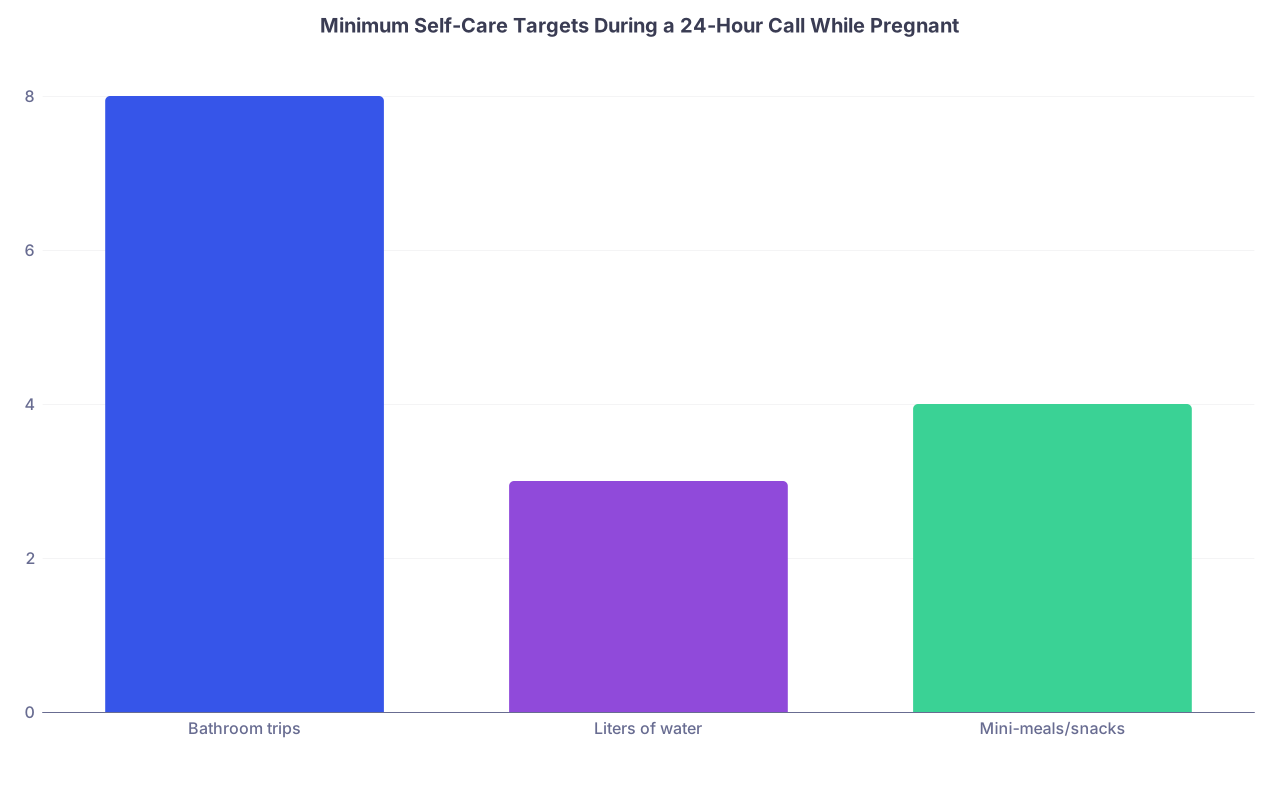
Bathroom breaks every 2–3 hours
If you can round on 20 patients, you can pee. Tell your co-resident, “I’m going to bathroom, I’ll be 2 minutes, then we’ll do admissions.” Say it like a fact, not a request.Actual hydration
Aim to finish a 1L bottle every 4–6 hours minimum. Bring a marked bottle so it’s obvious you’re behind. Keep it at the workstation, not locked in your locker.Sit every 60–90 minutes for at least 3–5 minutes
You can review labs sitting. You can write notes sitting. Standing in hallways for no reason is pointless martyrdom.Food that isn’t just simple sugar
Bring real food. Nuts, cheese, Greek yogurt, sandwiches, hummus, pre-cut fruit/veg. Hospital “snacks” are usually sugar and salt. Those will crush you at 4 a.m.
| Category | Value |
|---|---|
| Bathroom trips | 8 |
| Liters of water | 3 |
| Mini-meals/snacks | 4 |
Things you think you can’t ask for, but you absolutely can
“I need 5 minutes to sit and drink water before we start this case.”
In most ORs, there’s a 10–15 minute shuffle time anyway. Use it.“I need to step out to pee; I’ll be right back.”
Yes, you can briefly scrub out. The world won’t end.“Can someone else take the heavy-lift turn with this 300‑lb patient? I’m pregnant and trying to avoid strain.”
Say it once with eye contact. Most nurses and techs will step in. They’ve seen this.
If your co-resident rolls their eyes, that’s on them. You’re not asking them to do your notes or take your admissions. You’re asking not to physically endanger your pregnancy.
Step Four: Know Your Legal and Policy Backstop (You Have More Protection Than You Think)
Most residents underestimate the leverage pregnancy actually gives them because they’re used to having zero leverage.
Quick reality check: in many places, pregnancy is a protected condition under disability and anti-discrimination laws. No, that doesn’t mean you get out of all hard work. Yes, it does mean your employer has to provide “reasonable accommodation” if requested and medically supported.
Reasonable accommodation in residency has looked like:
- Switching from 28‑hour calls to night float or shorter shifts temporarily
- Providing a call room near a bathroom so you’re not trekking across the building 20 times
- Reducing exposure to specific hazards (chemo, radiation, certain infections) with coverage swaps
- Extra breaks for hydration/food/bathroom—documented and communicated
The critical piece: you usually have to ask and sometimes involve GME/HR, not just your PD.
If your PD says, “We can’t change anything; everyone does the same,” that’s not always accurate. What they mean is, “This is annoying and I don’t want to deal with it.” That’s different from “impossible.”
If you’re hitting a wall:
- Talk to your institution’s GME office directly.
- Ask who handles pregnancy or disability accommodations for residents.
- Bring the OB/midwife note if you have it.
You’re not threatening. You’re saying, “I want to work safely and effectively; I need guidance on how this usually works here.”
| Adjustment Type | Example Change |
|---|---|
| Shift structure | 28-hr call → 2 x 12-hr shifts |
| Rotation timing | ICU moved to early 2nd trimester |
| Physical strain | No heavy lifting or patient transfers |
| Hazard exposure | No chemo/radiation handling |
| Breaks | Protected 10–15 min breaks q4–6 hrs |
Step Five: How to Handle Specific Call Types While Pregnant
Different rotations beat you up in different ways. You probably know this intellectually, but pregnancy changes the calculus.
ICU call
Big problems:
- Constant standing/walking
- Adrenaline surges, skipped meals
- Heavy lifting when turning/transporting patients
What to do:
- At sign-out, explicitly say: “I’m pregnant, so I’m going to avoid lifting/turning heavy patients but can help coordinate and handle procedures, notes, and family updates.”
- Volunteer for the brain work: complex vent adjustments, notes, family meetings. Offload the pure grunt work when you can.
- When you’re doing procedures, demand a step stool, good positioning, and chair when possible. No more hunching over at weird angles at 2 a.m.
Floor call / cross-cover
Big problems:
- Constant pages, no natural break points
- Easy to skip water/food because “just one more thing”
What to do:
- Set a quiet timer on your phone for every 2–3 hours labeled “WATER + BATHROOM.” When it goes off, finish current task, then do it.
- Cluster tasks geographically. Don’t walk the maze 50 times. Rescue your feet.
- Use the call room strategically. 10–15 minutes of horizontal rest at 3 a.m. is better than 0 minutes and bragging rights.
OR call (surgery, OB, anesthesia)
Big problems:
- Long standing in one position
- Lead aprons
- Hot rooms, poor air, N95s
- Not being able to eat/pee for hours
What to do:
- For long cases, ask early: “I’m pregnant—can I plan to swap out for a 5-minute stretch/water/pee break midway through?” Many attendings will say yes if you ask before the case starts.
- Sit during parts of cases where your hands/eyes aren’t needed every second (closing, monitoring, etc.) if the setup allows.
- Avoid lifting and awkward repositioning. You’re there to operate or manage, not to be a human crane.
Night float
Big problems:
- Destruction of sleep architecture
- Harder recovery day-to-day
What to do:
- Between admissions, you must lie down, even if you don’t sleep. Feet up. Lights off. Phone volume on, but face away from charting stations.
- Protect your post-call sleep like it is a procedure. Blackout curtains, phone on DND except for emergencies, sleep mask, ear plugs. This is not “optional wellness”—it’s literal physiologic recovery.

Step Six: What to Say When People Push Back or Minimize
You will get some version of:
- “We all did this. You’ll be fine.”
- “It’s just one more call; can you tough it out?”
- “If we change things for you, we have to change them for everyone.”
- Or the classic: silent judgment and side-eyes.
Here’s how you respond without turning it into a war.
If it’s a peer:
“I’m not asking to do less work. I’m asking not to put my pregnancy at risk. I’ll happily take more [notes/dispo/family calls/clinic time] to balance out not doing [heavy lifts/extra call].”
If it’s an attending:
“I understand the service needs. My OB has recommended I avoid [X], so I’m trying to follow that while still being useful. I’m happy to shift toward [Y tasks] if that helps.”
If it’s leadership minimizing:
“I’m committed to meeting graduation requirements and pulling my weight. I’m also responsible for my health and my baby’s. I’d like to find a specific plan that respects both realities. What have you done for prior pregnant residents?”
You’re not debating whether pregnancy is “hard enough” to deserve accommodation. You’re calmly asserting that:
- This is medical.
- You’re still committed to the program.
- You’re expecting a professional solution.
Step Seven: Red-Line Symptoms and When to Leave a Shift
You need a personal “I leave now, no arguments” list. Decide it before things get blurry at 4 a.m.
Red-line symptoms:
- Contractions every few minutes for more than 30–60 minutes that don’t settle with sitting and hydrating
- Vaginal bleeding, clear fluid leakage, or sudden severe pelvic pressure
- Severe headache with visual changes, RUQ pain, or feeling “just wrong” + elevated BP if you check it
- Repeated near-syncopal episodes or chest pain
If any of that happens:
- Tell your senior or attending:
“I’m having [X concerning symptom]. I need to be evaluated in L&D / ED now. I can’t safely continue this shift.” - Hand off your active tasks briefly: “These are the active issues: [1–2 bullets]. I’ll message you from triage when I know more.”
- Go. Do not stand there arguing about “coverage.” You are the coverage for your own pregnancy.
If they push back (and occasionally, someone will), this is the line:
“If this were a patient describing these symptoms to me, I’d send them to be evaluated immediately. I’m not going to hold myself to a lower standard of care.”
I’ve seen residents avoid care until they’re in real trouble because they didn’t want to be “dramatic.” That’s not noble. It’s reckless.

| Step | Description |
|---|---|
| Step 1 | Feel unwell on call |
| Step 2 | Hydrate, sit 10-15 min |
| Step 3 | Resume with breaks |
| Step 4 | Tell senior + consider going home |
| Step 5 | Page senior/attending |
| Step 6 | Go to L and D or ED for eval |
| Step 7 | Mild or severe? |
| Step 8 | Improves? |
Step Eight: Planning the Last 4–8 Weeks Before Due Date
The endgame is where most people get burned. Suddenly you cannot tolerate what you could at 22 weeks, but your schedule was built assuming you’re a machine.
Ideally, 3rd trimester planning happens around 24–28 weeks. If you’re already past that, fine. Start now.
Targets:
- By 32–34 weeks: no more 24–28‑hour calls
- Last 4 weeks before due date: clinic and shorter shifts if possible, no new ICU/trauma rotations
If leadership balks:
“My OB has recommended I avoid extended shifts past 32–34 weeks because of [contractions, blood pressure, etc.]. Can we shift the remaining heavy calls earlier, or convert some to shorter shifts with extra clinic or admin work?”
And be ready to offer options:
- Take more night float earlier; fewer true 28s later.
- Do more cross-cover but fewer in-house long weekend calls.
- Pick up extra non-call work (QI projects, teaching, clinic) to make up for reduced call load near due date.
This is negotiation. Not begging.
Step Nine: Protecting Your Future Self (Career and Sanity)
The fear under all of this is, “If I ask for what I need, they’ll see me as weak or less committed. It’ll hurt fellowship, letters, everything.”
Here’s the ugly truth: if a PD or faculty member writes you off purely because you stayed safe in pregnancy, that’s not someone you want controlling your future anyway. And most are not that irrational.
You can actively shape the narrative.
During pregnancy:
- Be reliable on the tasks you can do: be on time, answer pages, finish notes.
- Volunteer for intellectually heavy work even when you’re physically limited.
- Don’t complain constantly in front of everyone. Pick one or two trusted people to vent to.
When it comes to letters/future plans:
- Meet with potential letter writers outside of crisis times.
- Say: “During my pregnancy I had some physical limits near the end, but I stayed engaged in patient care and learning. I’d appreciate if your letter could speak to my clinical performance and growth across the whole year.”
I’ve seen stellar LORs for pregnant residents who took appropriate accommodations. I’ve also watched residents try to “power through everything” and end up making terrible errors or going out on emergency leave. Guess which one actually hurt them more.
Step Ten: Remember You’re Not the First (So Stop Doing This Alone)
Almost every program has had pregnant residents before. Many just don’t have a clean system, so each person reinvents the wheel.
If there’s another resident or fellow who’s been pregnant in your program:
- Take them for coffee.
- Ask: “What worked here? What didn’t? Who was actually helpful?”
- Get names: specific attendings, chiefs, admin who made things doable.
Some of the best practical help isn’t official:
- A co-resident who will always swap you out of the heaviest cases.
- A nurse manager who quietly reassigns you away from known violent patients or heavy lifts.
- A chief who engineers the schedule so you’re not publicly “special-cased” but still get what you need.
Lean on that. You do not win any prizes for doing this harder than the last person.
The 2–3 Things To Actually Remember
Pregnancy does not erase your rights as a worker or your judgment as a physician. If you’d pull a pregnant patient off 28‑hour manual shifts, you don’t have to pretend it’s fine for you.
Ask early, not at the edge of collapse. Talk to your OB and your PD in the first half of pregnancy, get clear limits in writing if needed, and negotiate your heaviest rotations and calls around those.
On every single call, protect the basics: pee, hydrate, sit, eat, and draw a hard line at true red-flag symptoms. You can be a good resident and still refuse to sacrifice your health and your baby’s for a pager.


