

You wake up on post‑call day number… who even knows anymore. Your throat is on fire, your head is pounding, and your Apple Watch says you hit a heart rate of 130 just walking to the bathroom. Or maybe it’s not that—maybe you tripped rushing to a code last night and your ankle is now the size of a grapefruit. The schedule, though, doesn’t care. You’re on wards. Or nights. You’ve got cross-cover, continuity clinic, or OR days lined up. And there’s this quiet panic in your chest:
“How do I not screw over my co-residents, not piss off my program, and also… not collapse?”
This is the situation: you’re sick or injured, but duty requirements and residency expectations are still hanging over your head. I’m going to walk you through, step by step, what to do—clinically, politically, and practically.
Step 1: Decide if you’re actually “too sick to work”
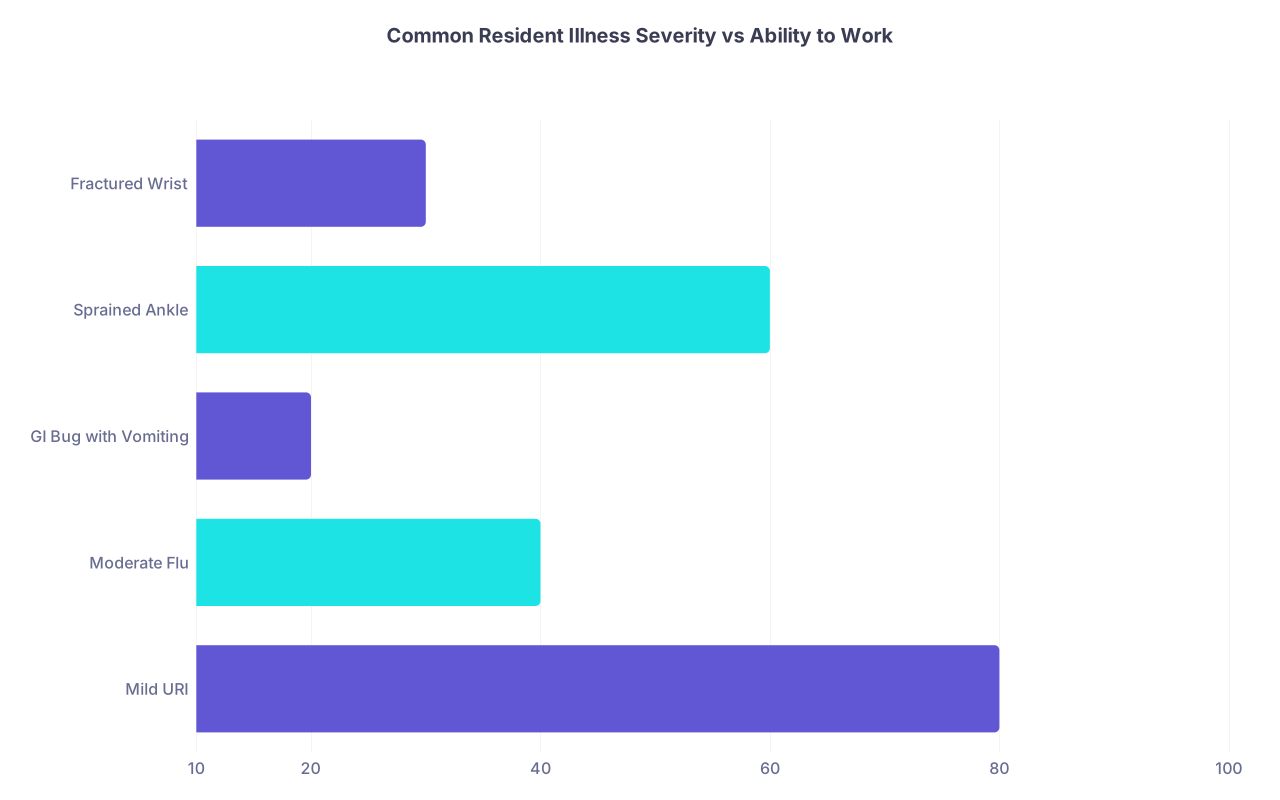
| Category | Value |
|---|---|
| Mild URI | 80 |
| Moderate Flu | 40 |
| GI Bug with Vomiting | 20 |
| Sprained Ankle | 60 |
| Fractured Wrist | 30 |
Most residents use a stupid metric: “Can I physically drag myself in?” That bar is too low. Use a real framework:
Ask yourself three specific questions:
- Am I safe for patients?
- Am I safe for myself?
- Can I reliably complete essential tasks?
Concrete thresholds where you should NOT be working clinically:
- Fever ≥ 100.4°F with systemic symptoms plus direct patient contact, especially on heme/onc, transplant, NICU, or ICU.
- GI illness with active vomiting or frequent diarrhea (you’ll miss pages, procedures, and probably contaminate half the unit).
- Significant respiratory symptoms with uncontrolled coughing and/or shortness of breath at rest.
- New injury where you can’t safely ambulate the unit, scrub, or perform your core tasks (e.g., can’t walk without crutches and your hospital layout is a maze of stairs).
- Any acute condition where you’re dizzy, syncope‑prone, or on meds that slow you down (e.g., opioids after an injury).
Then there’s the gray zone: mild URI, low‑grade sprain, migraine controlled with meds, minor procedure recovery. In those situations, the answer might be:
- You can work, but need accommodations.
- You can work non‑clinical duties only.
- You need a partial day or one shift off.
If you’re debating with yourself for more than 5 minutes and your body is clearly screaming “no,” you probably should not be on the floor. Residents are notoriously bad at judging this. Err a bit on the side of safety.
Step 2: Tell the right people, the right way, and fast
The biggest mistake I see? Residents waiting until an hour before sign‑out to say, “Hey, I think I’m too sick to come in.” That’s how you torch good will.
Who you notify (typical order):
- The chief or scheduling chief (often the key person)
- The senior on your team / night float counterpart
- Program coordinator or PD/APD if it’s serious or prolonged
- Occupational Health or Employee Health for work‑related issues or infections
Use this kind of message (text or call, depending on your program culture):
“Hi [Name], I woke up with [brief description: 102F fever, uncontrollable vomiting, severe ankle swelling after last night’s injury]. I don’t feel safe coming in clinically today. I wanted to let you know as early as possible. I’m going to [contact Occ Health / urgent care] and can send documentation. I’m happy to help remotely where appropriate if cleared.”
Notice what you’re doing there:
- You’re clear you’re not coming in.
- You’re framing it in terms of safety.
- You’re offering documentation.
- You’re offering limited help without being a martyr.
Do not send: “I’m not feeling 100% but I think I could maybe push through? Thoughts?” That dumps the decision on the chief and signals you’ll accept being pressured.
If it’s an injury at work (fall, needle stick, back strain from lifting a patient), say explicitly: “This happened during last night’s shift while doing X. I’m going to Occupational Health.”
Step 3: Get evaluated and documented, not just “rest”

You’re not a hero for self‑diagnosing and then lying in bed hoping it gets better. You need documentation for three reasons:
- Program/HR protection: It shields you from people later questioning your absence.
- Work accommodations: You can get specific restrictions in writing.
- Patient safety: Infection control and fit for duty are real legal concerns.
For illness:
- Go to student/employee health if available.
- If not, an urgent care or PCP visit is fine.
- Ask them to clearly state: “No clinical work until [date]” or “May work with restrictions: no direct patient contact / mask required / no nights for X days.”
For injury:
- If it happened at work: Occupational Health, ASAP. That opens the door for workers’ comp if needed.
- If outside work: still get seen promptly; documentation matters especially for longer restrictions.
Do not downplay to the provider out of pride. Tell them what you actually do: “I walk 10–15k steps a day, lift patients, do procedures, climb stairs between units, and sometimes work 24‑hour calls.” They’re not thinking in residency terms unless you spell it out.
Step 4: Negotiate what you can do without being exploited
There’s a middle ground between “full bore on service” and “disappeared off planet Earth.” That middle ground is where you protect your body but still show reliability.
Here are workable options, depending on your situation and what your PD/cheifs allow:
Remote/admin work:
- Call patients with lab results or imaging updates.
- Do chart review / pre‑round notes from home.
- Work on discharge summaries or clinic follow‑ups.
- Tackle QI, required modules, or delinquent notes.
Modified in‑person role:
- Come in later/leave earlier for a partial shift if safe.
- Help with documentation / orders from a workroom while avoiding direct patient contact if you’re infectious.
- Skip procedures, codes, or heavy lifting if physically limited.
Be specific when you propose this:
“My doctor wrote me for no prolonged standing or heavy lifting for 7 days. I can still do notes, telehealth calls, and order management. Could I cover some of the non-bedside work from home or a desk area, while someone else handles procedures and physical exams?”
Key point: you offer what you can do, but you do not override medical restrictions to seem like a team player. Long‑term, that backfires.
Step 5: Understand how this plays with work hour rules and duty requirements
ACGME rules are a floor, not a ceiling. Most residents bend them until they snap. When you’re sick or injured, that’s exactly when they matter.
Work hour basics (you know this, but let’s frame it in your situation):
- 80 hours/week averaged over 4 weeks.
- 1 day off in 7, averaged over 4 weeks.
- No more than 24 hours of continuous clinical work (plus up to 4 hours for transitions, depending on specialty).
When you’re recovering:
- Do not “make up” hours later like it’s some cosmic balance sheet. That’s not how ACGME works.
- Do not let well‑meaning chiefs schedule you for back‑to‑back heavy rotations “to catch up.”
- If you’re doing remote/admin work during illness, clarify with your program if those hours count as duty hours. Often they do.
If your illness/injury is prolonging:
- You may need formal medical leave rather than just a few sick days.
- That can affect board eligibility and completion dates, but there’s usually flexibility, especially if communicated early.
| Situation | Likely Category | Typical Action |
|---|---|---|
| 1–2 days of viral illness | Sick day | Call out, short coverage adjustment |
| 1–2 weeks off after surgery | Medical leave | Formal HR paperwork, schedule shift |
| 4 weeks with limited lifting only | Work restrictions | Modified duties, avoid certain tasks |
If your PD or chiefs are “forgetting” about duty hours in the scramble to cover your absence, you’re allowed to bring it up bluntly:
“I want to help cover after being out, but this schedule puts me at about 95 hours this week. That’s not safe for anyone. Can we adjust some shifts?”
You’re not being difficult. You’re forcing the system to behave like it pretends it does.
Step 6: Protect your relationships with co‑residents and attendings
This part is political, and yes, it matters.
When you’re out, your teammates are the ones eating your admissions, covering your cross‑cover, and staying late. You can’t fully fix that—but you can manage the fallout.
What helps:
Clear communication:
- Short message in the group chat: “Hey team, I’m out today per Occ Health with [brief issue]. I’m sorry for the extra load—will absolutely step up and help cover when I’m back and cleared.”
Visible effort when you return:
- Don’t ease back in like it’s a vacation comeback unless you’re still limited.
- Offer to take admissions or procedures for someone who covered you, within your actual restrictions.
No oversharing, no melodrama:
- People don’t need your full GI illness play‑by‑play.
- “Had a rough viral thing, got cleared, back now” is enough unless you’re close with them.
If you have that one attending who makes a snide comment—“So you took a little break, huh?”—you do not need to justify your medical condition in detail. A firm, neutral response is enough:
“I was out under the direction of Occupational Health. I’m fully cleared and here to work.”
And then move on. You’re not on trial.
Step 7: Use the system when the culture is toxic
Some programs are good about this. Some are not. If you’re in the second category, you need a different playbook.
Warning signs:
- Chiefs respond to your sick text with: “Everyone’s tired, we still need you to come in.”
- PD or APD hints that sick days will “hurt your reputation.”
- You’re pressured to lie on duty hour logs or call your time off “vacation.”
If this is happening:
Save everything. Screenshots of texts. Emails. Documentation from Occ Health or outside providers.
Loop in more than one person:
- Program coordinator
- PD/APD
- GME office or HR, if needed
Use language that frames it correctly:
- “I’m concerned that I’m being asked to work against medical restrictions.”
- “I’m worried about patient safety and personal safety if I return before I’m cleared.”

| Step | Description |
|---|---|
| Step 1 | Ill or injured |
| Step 2 | Notify chief |
| Step 3 | Follow plan |
| Step 4 | Notify PD or APD |
| Step 5 | Document and continue |
| Step 6 | Contact GME or HR |
| Step 7 | File formal concern if needed |
| Step 8 | Chief response unsafe? |
| Step 9 | Still pressured? |
GME offices exist for exactly this: preventing unsafe practice and abuse. Use them. You’re not “going nuclear” by telling them you were asked to ignore infection control or work on opioids after an injury.
Step 8: Plan your actual recovery like you plan a rotation
Residents are world‑class at ignoring their own recovery. Then they crash halfway back.
If you’ve got a specific timeline (e.g., 1 week on crutches, 4 weeks no lifting), plot it out.
Very concretely:
Sleep:
- Protect at least one full off‑duty block purely for rest early on.
- If you’re post‑call and sick, do not stack life errands that day. Sleep, fluids, light food.
Pain control:
- If you’re on meds that cloud thinking, you should not be on service. Period.
- Switch to non‑sedating options as soon as you realistically can.
Rehab:
- For injuries, actually do the PT exercises. I’ve watched so many residents end up with chronic issues because they “didn’t have time” for PT.
Graded return:
- If you were completely off for surgery or a major illness, ask about a ramp‑up:
- First week back: lighter service (clinic, electives)
- Then heavier rotations
- If you were completely off for surgery or a major illness, ask about a ramp‑up:
Some programs will shrug and say, “The block is the block, sorry.” Others will work with you if you ask early and specifically.
Step 9: When illness or injury is chronic or recurrent
A lot of what I’ve said so far is about acute issues. But some of you are dealing with Crohn’s, migraines, autoimmune disease, mental health crises, pregnancy complications, or post‑op recoveries that aren’t clean.
That’s a different situation, and pretending it’s “just a bad cold” will wreck you.
If you’re in that bucket, you need:
- A real conversation with your PD or APD, not just one‑off sick day texts.
- Formal accommodations if applicable (through HR/Disability services, not just handshake deals).
- Honest assessment of which rotations are going to be high‑risk for flare‑ups and whether schedules can be adjusted.
Examples of reasonable accommodations:
- Avoiding back‑to‑back night float blocks for someone with severe migraines.
- No heavy lifting for someone with a spinal issue.
- Protecting time for regular specialist appointments.
And yes, this might mean your training takes longer. That’s annoying, but it’s not failure. A 4‑year program done safely is better than a 3‑year sprint that leaves you permanently damaged or burned out.
Step 10: What to do the day you go back
The night before you return, don’t just wing it. Do a mini game plan:
- Confirm you’re actually cleared (no half‑healed “I think I’m okay” if you’re still running a fever or can barely walk).
- Send a quick message to your senior/chief:
- “I’m cleared to return tomorrow. Any key updates or sick patients I should read up on tonight?”
- Skim charts if feasible so you’re not starting cold.
- Pack your work bag to match your limitations:
- Brace, inhaler, meds, compression socks, whatever you actually need.
- Extra snacks + hydration if you were recently dehydrated or lost weight.
On the day:
- Meet your team and give a 10‑second version:
- “Was out with X, cleared now, I do have a restriction from Occ Health: [no lifting / no prolonged standing / no call for one week].”
- Don’t volunteer for the exact tasks you’re restricted from “to show you’re tough.” That’s how you end up out even longer.

If you feel yourself crashing halfway through the day—dizziness, chest pain, uncontrollable pain—that’s not “pushing through.” That’s another decision point. Tell your senior. Step back before you end up as their rapid response patient.
A brief word about guilt
You’re going to feel guilty. Almost everyone does. You see your co‑residents drowning and you’re home with a fever or sitting with your leg elevated after an ankle fracture and your brain says, “I’m weak. I should be there.”
Let me be direct: collapsing on service, infecting neutropenic patients, or permanently screwing your back to help one more cross‑cover night is not noble. It’s bad judgment.
Your job is to be a safe, functional physician over decades. Not a martyr for a single rotation.

Three things to carry forward
Safety first, then optics. Decide if you’re safe for patients and yourself. Get evaluated and documented. Then deal with scheduling and politics. Not the other way around.
Clear, early communication buys you goodwill. Tell chiefs and seniors early, state your limitations plainly, and offer what you reasonably can do—without violating restrictions or duty hours.
Recovery is part of being a doctor, not a break from it. Treat your own healing with the same seriousness you’d give a patient. Short‑changing it to look tough will cost you more time and function later.
You’re allowed to be sick or hurt and still be a good resident. The trick is handling it like an adult professional, not like a panicked intern dragging an IV pole behind them down the hallway.


