

The pressure to under-report hours is not “gray area”—it is a patient safety and integrity problem.
If your program’s culture is pushing you to fake your work hours, you are not overreacting. You’re in a situation where your fatigue, your evaluation, and your future reputation are all on the line. I’ve seen residents quietly change 102-hour weeks to “79” because “that’s what everyone does here.” I’ve also seen that blow up on programs—ACGME citations, leadership turnovers, and a lot of residents saying, “We were trying to tell you.”
Let’s walk through what to do, step by step, if you’re in this mess.
1. First Reality Check: Are You Actually Being Pressured?
You’re not crazy to wonder if it’s just you. But there’s a difference between “we trust you to log accurately” and a culture that expects creative math.
Common red flags:
- Chiefs or seniors say things like:
- “Nobody logs more than 80. Just be smart.”
- “We don’t want ACGME breathing down our necks.”
- “Fix your hours—your logs are making us look bad.”
- You get “coached” on how to enter hours:
- “Just shift that post-call time onto tomorrow.”
- “Log 79 every week; it’s easier.”
- Your schedule makes the math impossible:
- You’re physically in the hospital 90+ hours, but magically everyone’s averages are “78–79.”
- Everyone on the rotation jokes that the official schedule is “for ACGME only.”
- You’re criticized for honest reporting:
- Direct pushback after submitting real hours.
- Hints that high hours mean “poor time management.”
If any of that sounds familiar, you’re in a culture that at least tolerates under-reporting. And you need a strategy—because this affects more than your spreadsheet.
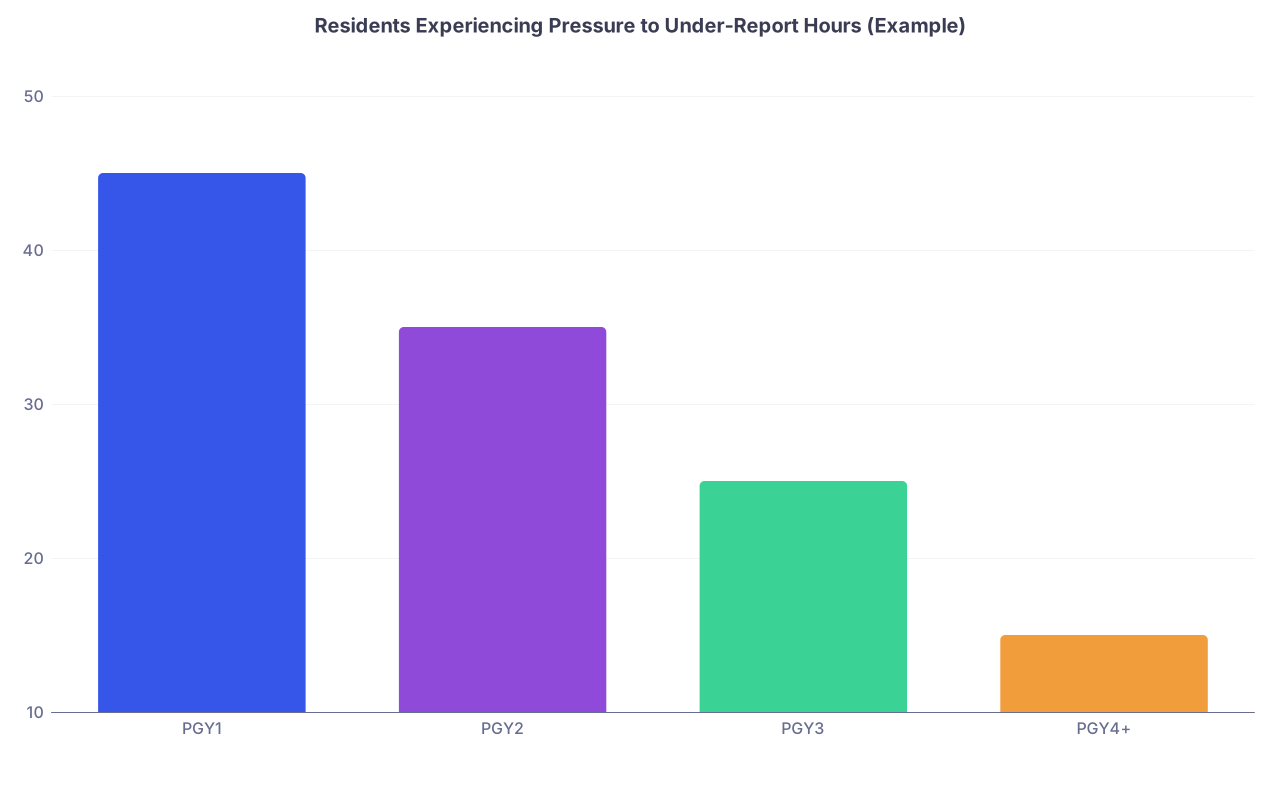
| Category | Value |
|---|---|
| PGY1 | 45 |
| PGY2 | 35 |
| PGY3 | 25 |
| PGY4+ | 15 |
2. Get Clear on the Rules (So You Know Exactly What You’re Defending)
You can’t push back effectively if you’re fuzzy on what the rules actually are. ACGME duty-hour standards (for most specialties) boil down to:
| Rule Type | Typical Limit |
|---|---|
| Weekly hours | 80 hrs/week averaged over 4 weeks |
| Shift length (PGY1) | 16 hrs max (varies by specialty updates) |
| Shift length (upper) | Up to 24 + 4 hrs transition (varies) |
| Days off | 1 day off in 7 (avg over 4 weeks) |
| In-house call | At least 8 hrs between shifts |
Then there’s the second layer: your program’s own written policy. You’ll usually find it in:
- GME handbook
- Program-specific policy manual
- Orientation slides/handouts
- Your hospital intranet
Why this matters: when you push back, you are not “making trouble.” You’re asking the program to follow its own written rules and the ACGME’s. That’s a very different position than “I feel tired and this seems unfair.”
Action items for you:
- Download/print your institution’s duty-hour policy.
- Screenshot or save any official instructions about how to log hours (especially if they contradict ACGME).
- Keep these files somewhere private that you control (personal cloud, local secure folder, not just hospital email).
You’re building your own reference manual before you walk into any conversations.
3. Protect Yourself First: Documentation and Personal Safety
Before you confront anyone, you need to quietly protect yourself. Because if this goes sideways, you’re the easy target—not the system.
Start a private duty-hour log outside the official system:
- Use a simple spreadsheet, note app, or a paper notebook you keep at home.
- For each day:
- Arrival time
- Leave time
- Call status (home vs in-house)
- Location (ED, ICU, floor, clinic)
- Any “I was told to change this later” moments
Don’t obsess over minute-level precision. Just accurate enough to show patterns. The goal: if anyone claims “you’re exaggerating” later, you can calmly produce contemporaneous notes.
Second, keep a conversation log:
- Date, who, and what was said.
- Especially if someone suggests or orders you to under-report:
- “On 1/14, Dr. X told me: ‘You can’t report more than 80; fix your hours.’”
This is not for daily venting. This is evidence. Use neutral language, no sarcasm.
Finally, consider your personal safety in the short term:
- If you are so fatigued you’re unsafe to drive home, document that and arrange a safe ride—even if culture says “tough it out.”
- If you’re making frequent errors or near misses from fatigue, note them (without HIPAA identifiers). That’s exactly the kind of thing ACGME takes seriously.
You can’t fix program culture if you’re running on fumes and terrified all the time. Stabilize your footing first.

4. Decide Your Line: What You Will and Will Not Do
You need a clear internal boundary before you step into the political mess of a residency program.
My blunt recommendation:
- Do not falsify official records. Not duty hours. Not patient documentation. Nothing.
- Do not “round down” 95 to 79 on paper because someone above you is uncomfortable with reality.
- Do not let someone else log your hours “for you.”
You can choose which battles to fight publicly, and when. But once you start cooperating with falsifying data, it becomes much harder to stand up later and say, “This is wrong.” Because your name is already on the fake logs.
Ask yourself:
- Am I willing to honestly report hours, even if it risks awkward conversations or mild retaliation?
- Where do I draw the line between “playing the game” and “I’m lying in a federal/ACGME-related document”?
You don’t have to announce your personal line to everyone. But you need to know it for yourself. Because the ask will come disguised as “help the program.” It nearly always does.
5. How to Handle Direct Pressure in the Moment
Let’s say your chief, PD, or attending leans on you:
“Your hours are too high. Fix them. You’re making the program look bad.”
Here’s how to respond without lighting yourself on fire.
Strategy A: Calm, Policy-Based Pushback
You: “I’ve been logging my actual hours. If we’re consistently over, that might mean our schedule needs adjusting. I’m not comfortable changing numbers that don’t match reality.”
If they push:
You: “I want to follow ACGME policy and our GME handbook. If my documentation is an issue, I’m happy to go over my schedule with you in detail.”
You’re not arguing about feelings. You’re positioning yourself as someone trying to follow written rules.
Strategy B: Clarify in Writing
If someone verbally tells you to change your hours, follow up with a short email:
“Hi Dr. X,
Following up on our conversation today. You mentioned my logged hours look high and suggested I should adjust them. For my documentation, can you clarify how you’d like us to handle logging when actual hours exceed ACGME limits? I want to be sure I’m following both program and ACGME policies.
Thanks,
[Your Name]”
If they’re even halfway smart, they won’t put “please falsify hours” in writing. That’s fine. The fact that you asked in writing helps you later.
Strategy C: Deflect Without Conceding
If you’re cornered and don’t feel safe:
You: “Got it, I’ll review my entries and make sure they’re accurate and match our policies.”
You didn’t agree to under-report. You bought yourself time to regroup and get advice. Then you keep logging accurately while you decide next steps.
6. Use Internal Safety Nets Before You Go Nuclear
Most programs aren’t cartoon villains. They’re scared of citations and trying to keep the machine running. Use the quiet channels first.
Here’s the internal escalation ladder that usually exists:

| Step | Description |
|---|---|
| Step 1 | You notice pressure to under report |
| Step 2 | Talk to co residents |
| Step 3 | Approach chief resident |
| Step 4 | Program director meeting |
| Step 5 | Institutional GME office |
| Step 6 | Anonymous reporting to GME or ombuds |
| Step 7 | ACGME Resident Survey and complaint |
Step 1: Reality Check with Trusted Co-Residents
Ask 1–2 people you trust, not the loudest complainer.
- “How are you logging hours on [X] rotation?”
- “Has anyone ever told you to change your hours?”
You’re looking for patterns, not a group rant.
Step 2: Chief Resident Conversation
If your chiefs are reasonable and not part of the problem:
You: “My actual hours are over 80 on [rotation]. I’ve been logging them accurately, but I’ve gotten feedback they’re ‘too high.’ Can we talk about how the program wants us to handle this?”
A good chief will:
- Admit if a rotation is out of control.
- Help you bring it up to the PD.
- Or at least say, “Keep logging honestly; we’ll back you.”
If your chiefs are the ones pushing under-reporting, skip to the next step.
Step 3: Program Director
In a 1:1:
- Bring your private log.
- Bring specific weeks, not vague statements.
You: “Here’s my schedule from the last month. I’m consistently over 80 hours despite trying to be efficient. I’ve been told my hours ‘look bad’ and should be adjusted. I want to follow policy and also be transparent.”
Watch their reaction closely.
A decent PD will:
- Say explicitly you should log accurately.
- Acknowledge schedule problems.
- Maybe be stressed, but not pressure you to lie.
A bad PD will:
- Say things like “Everyone else manages to be under 80.”
- Minimize your fatigue.
- Make your honesty the problem.
If you hit that wall, you move beyond the program.
Step 4: GME Office / DIO / Ombuds
Every sponsoring institution has a Designated Institutional Official (DIO) and some sort of GME office. Many also have anonymous reporting systems or an ombuds person.
Ways to approach:
- Ask for a confidential meeting with GME staff.
- Use the anonymous hotline/online form if you don’t feel safe being named.
Be specific:
- “Residents are being told to adjust duty hour logs to avoid showing >80 hours.”
- “There is explicit verbal pressure from [role, not necessarily name] to under-report.”
- “Our logged hours don’t match actual schedules.”
GME folks care deeply about one thing: citations that threaten accreditation. Under-reporting is a big red flag for them.

7. Using the ACGME Resident Survey and Formal Complaints
The ACGME Resident Survey is not a joke. Programs fear it more than they fear your group chat.
If your program’s culture is rotten around hours and under-reporting, this is where you tell the truth:
- Answer duty-hour questions honestly.
- Use free-text boxes (if available) to mention:
- “Pressure to under-report duty hours.”
- “Culture of adjusting hours to avoid reporting violations.”
- Encourage your co-residents to do the same—without turning it into a witch hunt. Stick to facts and shared experience.
If things are truly bad and internal mechanisms have failed, you can also:
- Submit a complaint directly to ACGME (doctor-to-ACGME, not anonymous rumor). They do accept resident reports.
- Attach objective evidence if you have it (schedules, de-identified logs that show impossible patterns, etc.).
That’s the nuclear option. Use it if:
- You’ve tried chiefs/PD/GME.
- The culture is clearly entrenched.
- People are being punished for honest reporting.
But do not threaten this lightly. Quietly prepare, then act if needed.
8. Managing the Politics: Minimizing Personal Blowback
You’re not just a whistleblower; you’re also someone who needs:
- Good evaluations
- Strong letters of recommendation
- A fellowship or job later
So you have to be strategic, not impulsive.
Some ways to reduce retaliation risk:
- Don’t rant in writing. Assume every email can be forwarded.
- Keep your language professional: “I’m concerned about duty hour compliance and fatigue” instead of “You’re abusing us.”
- Choose your allies wisely:
- Faculty who are known advocates for resident wellness.
- GME staff who have been around for years.
- Avoid being the only voice. If three residents say the same thing, it’s harder to frame as “one difficult person.”
If you sense evaluations are being weaponized:
- Document changes (sudden negative comments after you raise concerns).
- Keep copies of prior positive feedback.
- Consider talking with GME or an ombuds about potential retaliation.
You’re not paranoid if you’re cautious. Program leadership has power over you. You’re allowed to protect yourself.
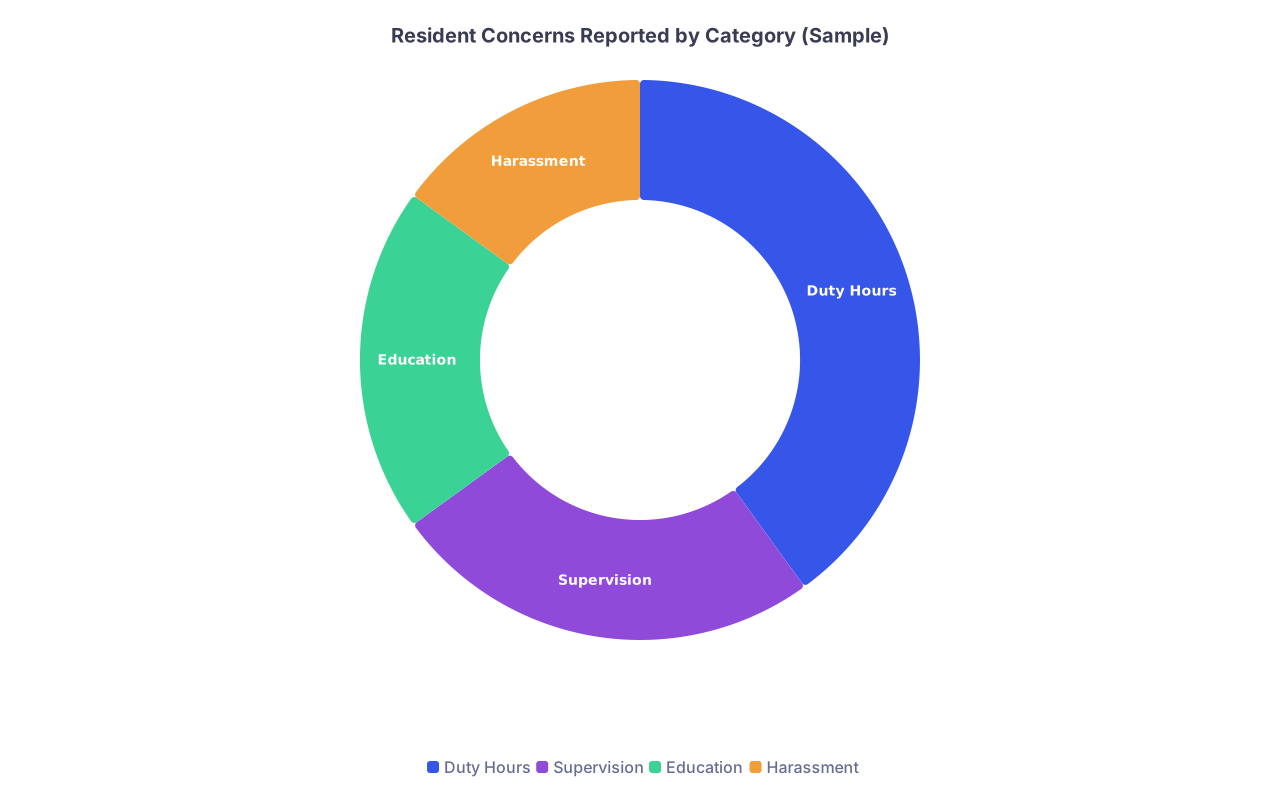
| Category | Value |
|---|---|
| Duty Hours | 40 |
| Supervision | 25 |
| Education | 20 |
| Harassment | 15 |
9. What If You’re Already Complicit?
Common scenario: you’ve already been quietly under-reporting for months because “that’s how it’s done here,” and now you’re uncomfortable.
You have three realistic options:
Stop now and start being accurate.
No dramatic announcement. Just start logging real hours going forward. If questioned, you can say:- “I realized my prior logging didn’t fully reflect my time here, so I’ve started recording more accurately.”
Privately acknowledge it in a safe channel.
In a confidential talk with GME or an ombuds:- “I’ve previously adjusted hours under pressure, but I’m no longer comfortable doing that. Going forward I plan to report accurately.”
Use it to demonstrate pattern, not to self-immolate.
If there’s an investigation later:- “We were encouraged to keep hours under 80, which influenced how I reported. That’s changed now that we’ve raised concerns.”
Don’t spiral into shame. The whole system is designed to make under-reporting feel normal. The important thing is what you do next.
10. When to Get Outside Help (Legal, Union, or Mental Health)
If you’re at the point where:
- You’re scared to go to work.
- You’re being directly threatened for honest reporting.
- You’re exhausted to the point of harming yourself or others.
You need reinforcements.
Options:
Resident union (if you have one):
They live for duty-hour and retaliation cases. Use them.Legal consult (quietly):
Especially if you’ve been disciplined after raising concerns. Just a one-time consult can help you understand your risk and options.Physician mental health support:
Burnout, depression, anxiety—all spike when you feel trapped in an unethical system. Talk to someone outside your program who understands residency (ideal: physician therapist).State medical society or physician advocacy groups:
Some have resident sections that can advise on systemic issues.
If your mental health is collapsing, residency is not more important than your life. Full stop. Stepping away temporarily or permanently is better than driving into a guardrail half-asleep.

11. If You’re a Senior, Chief, or Faculty in This Culture
Quick word if you’re part of the structure now (PGY3+, chief, junior faculty) and you recognize yourself here.
Stop telling them to fix their hours.
Do this instead:
- Tell them in writing: “Log your actual hours. If we’re over, that’s a system issue we need to address.”
- Take over the fight with leadership. Their job is to learn medicine, not to negotiate for basic human limits.
- Use data. Show actual logs and patient safety concerns, not vague “the interns are tired.”
You’re either part of the solution or you’re the person 10 years from now saying, “Yeah, we all did that back then; it was messed up.” Your choice.
FAQ (Exactly 4 Questions)
1. Can my program punish me for honestly reporting my duty hours?
They can try. Retaliation is common in subtle forms—worse evaluations, “not a team player” comments. But formally, they cannot punish you for honest reporting without putting themselves at serious risk with ACGME and GME. If you see a clear pattern of worse treatment after raising duty-hour concerns, document it and bring it to GME or an ombuds. Retaliation for good-faith reporting is itself a major violation.
2. What if my co-residents want me to under-report so we don’t get a citation?
This is the loyalty trap. You’re being asked to choose between short-term “protect the program” and long-term patient safety, your own health, and the truth. You can be clear: “I care about us not getting crushed with citations, but I’m not comfortable lying on official logs. The real problem is the schedule, not our reporting.” You’re not betraying them by being honest—you’re refusing to help keep a broken system hidden.
3. How bad do things have to be before going to ACGME directly?
Use ACGME when internal routes fail or when the culture is clearly entrenched: ongoing pressure to falsify, retaliation for raising concerns, no meaningful changes after you’ve raised the issue with PD and GME. If you do go to ACGME, be specific, organized, and factual. “They make us lie about hours” is less effective than “On X rotation, all residents are scheduled 90–100 hours/week, and we have been told verbally to keep logs under 80.”
4. Could honestly reported high hours hurt my chances for fellowship or jobs later?
Your future fellowship director is not seeing your duty-hour logs. What might hurt you is getting labeled as a “problem resident” if your program leadership is immature and you handle things impulsively. That’s why you stay professional, keep documentation, use proper channels, and avoid unnecessary drama. In most competitive fellowships, people respect residents who care about patient safety and their own limits—especially if they handled a bad situation with maturity.
Key points to carry with you:
- Pressure to under-report hours isn’t a small annoyance; it’s a signal your program has a real culture and safety problem.
- Protect yourself first: document, set your boundary, and use internal channels strategically before going nuclear.
- You are not obligated to lie to protect a system that’s breaking you. Log the truth, act professionally, and remember: your license and your integrity outlast this program.


