

It’s 4:30 a.m. You’re sitting in the call room, staring at your phone. Your mom fell yesterday. Again. Your dad with advancing dementia tried to wander out of the house last week. You’ve got sign-out in 30 minutes and a 28‑hour shift ahead. Your co-resident just swapped away the one day you thought you could take them to a specialist. The attending’s email about “commitment to the team” is still on your screen.
You’re exhausted. You feel guilty at home and guilty at work. And you’re realizing: this isn’t a “bad week.” This is your life for the next few years if you do not put a structure around it.
Let’s get concrete about what to do.
Step 1: Get Uncomfortable-Level Clarity on the Situation
You cannot solve “my parents need help” as a vague cloud. That just sits in your brain and makes you feel like you’re failing at everything. You need specifics.
On your next day off (I know, you want to sleep), sit down and map the reality.
Define exactly what your parents need
Write it out like you’re writing an H&P. Not vibes. Facts.
- ADLs: Can they bathe, dress, transfer, toilet, feed themselves?
- IADLs: Can they manage meds, finances, shopping, cooking, driving?
- Safety: Falls? Wandering? Leaving stove on? Getting lost?
- Medical: How many appointments per month? Labs? PT/OT? Home O2? Dialysis?
- Behavioral/cognitive: Dementia behaviors, sundowning, agitation, paranoia.
- Time-demand: Average hours per week of you needing to be physically there or managing something.
Do not sugarcoat. You’re not filling this out for a long-term care insurance denial. You’re filling it out so you can stop lying to yourself about “it’s just a busy week.”
Map your work constraints like they’re non-negotiable physics
Residency hours aren’t suggestions; they’re gravity. Quantify them.
- Typical weekly schedule: Which days, which shifts, average 24+ calls per month?
- Worst rotations: Which blocks are completely inflexible? ICU? Surgical months?
- “Easier” months: Outpatient, electives, research blocks, nights (depending on you).
- Commute time, pre- and post-call status: When are you truly unavailable?
Put it side by side with your parents’ needs. Now you can see the actual collision points.
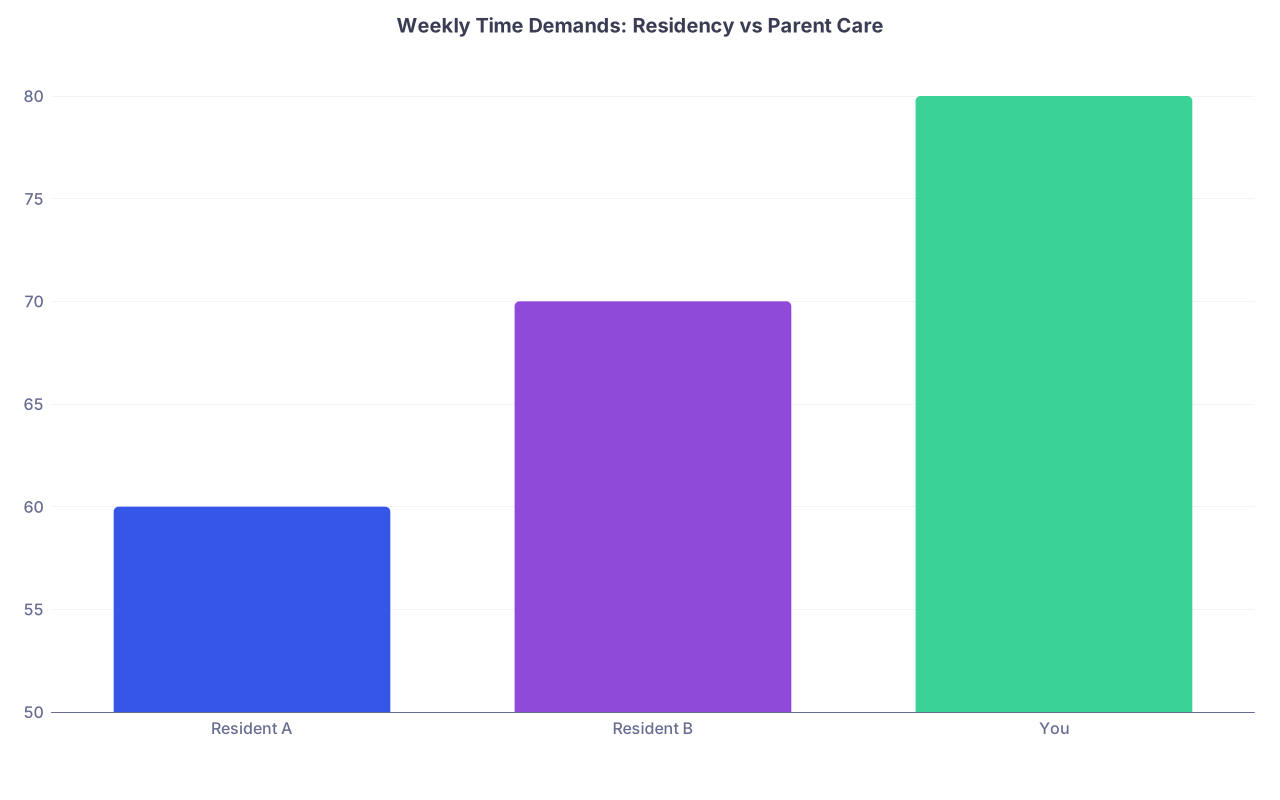
| Category | Value |
|---|---|
| Resident A | 60 |
| Resident B | 70 |
| You | 80 |
That chart is generous for many programs. You’re often more like 80–90 hours + life admin.
If you look at the overlap and think, “There’s no way to do this alone,” good. That’s the correct conclusion. Now we stop pretending you can.
Step 2: Decide Your Non-Negotiables Up Front
Before you talk to anyone—PD, siblings, social workers—you figure out what has to happen and what would just be nice to have.
Examples of non-negotiables:
- “They cannot be left alone overnight.”
- “They must have someone check in at least once daily in person.”
- “They cannot manage medications safely without supervision.”
- “I must be reachable in emergencies, but I cannot leave the hospital for non-emergencies.”
Write 3–5 non-negotiables. That’s it. If your list is 15 items, you’ve created a fantasy, not a plan.
Step 3: Build a Care Team That Isn’t Just You
If your current “care team” is: you, and maybe a sibling who “does what they can when work allows,” that’s not a team. That’s a recipe for burnout and resentment.
You need three categories: family, professionals, and community.
1. Family: Stop the unspoken martyr thing
If you’ve become the default because “you’re the doctor,” I’ve seen how that goes. You get punished for being the one who can interpret labs, so suddenly you’re also the chauffeur, the pharmacy, and the social worker.
You need a blunt family meeting. Probably over Zoom, so everyone shows up.
You say something like:
“I’m working 70–80 hours a week with call. I cannot be the 24/7 point person. Here’s what Mom/Dad actually needs (list). Here’s what I can realistically do each week: X. The rest has to be divided among us and/or paid professionals. Doing nothing is not an option.”
Give people concrete, assignable tasks, not vague roles.
- “You handle all pharmacy refills and med deliveries.”
- “You schedule and take them to appointments on Fridays.”
- “You manage bills and insurance paperwork.”
- “You check in by phone every night at 8 p.m.”
If someone says, “Just tell me what you need,” don’t say “I’ll let you know.” Tell them now and write it down.

2. Professional help: Know your options cold
Here’s where people get stuck because they don’t know what’s even possible. A quick rundown.
| Option | Typical Use Case | Coverage |
|---|---|---|
| Home health | Post-hospital, skilled needs | Medicare |
| Personal care aide | ADL/IADL support at home | Private pay |
| Adult day program | Daytime supervision/activity | Mixed/Private |
| Assisted living | Some help, not full nursing | Mostly private |
| SNF/long-term care | High care needs, 24/7 | Medicare/Medicaid |
You want a social worker in the mix. Start with:
- Hospital social worker (if your parent was recently hospitalized)
- PCP clinic social worker
- Community Aging Agency (Area Agency on Aging / local senior services)
Very specific ask: “I am a resident physician working 70–80 hours. My parents need [X]. I need a realistic menu of options for care support: in-home services, adult day programs, respite, financial assistance. What are three next steps?”
You’re not asking for “information.” You’re asking for next actions.
3. Community resources you probably haven’t tapped
People forget these exist:
- Local senior centers and adult day programs
- Church / mosque / synagogue volunteer groups
- Medical school “geriatrics interest group” or student volunteers (some do friendly visiting)
- Local non-profits that provide rides, meal delivery, or check-ins
Is it perfect? No. Is it more than nothing? Yes.
Step 4: Have the Hard Conversation with Your Program (Strategically)
Do not wait until everything is on fire to talk to your PD. Waiting until you no-show because you were at the ER with your dad is how you get a professionalism write-up on top of your crisis.
Who to talk to and in what order
Ideal sequence:
- Confidential conversation with GME office or resident wellness director (many places have one).
- Then your PD or APD.
- Possibly chief residents for schedule adjustments.
What you actually say
You do not need to overshare medical details. You do need to be very clear this is ongoing, not a one-off.
Script (adapt to your style):
“I want to let you know about a significant ongoing family responsibility that’s impacting my bandwidth. My parents are aging and now need regular assistance with basic daily tasks and medical care. I’m their primary medical decision-maker and one of the main supports.
I’m fully committed to my training, and I’m not asking to work less than my co-residents. But I do need some predictability and help avoiding the most schedule-inflexible blocks lining up with predictable high-care periods. I’ve mapped out a few concrete adjustments that would let me keep meeting my responsibilities both here and at home.”
Then you propose specifics:
- “Can we avoid scheduling me for back-to-back 28‑hour calls on X rotation for the next 3 months?”
- “Could I cluster my clinic days back-to-back instead of scattered, to free up one predictable weekday for parent appointments?”
- “Is there any possibility of an unpaid or FMLA-based short leave during the next lighter block to stabilize things?”

| Step | Description |
|---|---|
| Step 1 | Assess family needs |
| Step 2 | Talk to GME or wellness |
| Step 3 | Meet with PD or APD |
| Step 4 | Discuss schedule adjustments |
| Step 5 | Implement plan and reassess |
Know your formal rights: FMLA and leave
If you’re in the US:
- FMLA (Family and Medical Leave Act) can apply to residents in many institutions.
- It’s not just for having babies. It can be for caring for a seriously ill parent.
- It’s usually unpaid and often extends training. That’s the tradeoff.
Ask GME/hospital HR:
- “Am I FMLA-eligible as a resident?”
- “What’s the minimum leave I can take?”
- “How does this affect my board eligibility and graduation date?”
There’s no heroism in refusing leave, melting down, and then getting put on remediation. I’ve seen that happen. A 4–8 week strategic pause is better than 2 years of barely-functional burnout.
Step 5: Make Your Life Logistically Less Insane
The emotional load is high. Don’t make the logistics equally stupid. Streamline aggressively.
Simplify medical care for your parents
Consolidate like you’d do for a complex patient on discharge rounds.
- One main health system if possible, so all records are in one EMR.
- One PCP who’s actually engaged and understands the caregiving context.
- Ask for: longer appointments, coordination calls, social work support.
Switch all possible things to:
- Mail-order 90‑day meds
- Automatic refills and delivery
- Automatic bill pay
- Patient portal access with proxy rights so you can message asynchronously
Use your resident brain for systems, not just emotion
You’re good at thinking in flows and checklists; do the same here.
Make:
- A “Parent Care” Google Drive/Dropbox folder: med list, advanced directive, insurance info, key phone numbers, last clinic notes.
- A short “one-pager” on your parents: diagnoses, meds, allergies, baseline function, emergency contacts. Give it to any paid caregiver, sibling, or facility.
That way when something goes wrong at 2 a.m., you’re not hunting for their med list between pages.

Step 6: Set Rules for When You Can’t Be the Rescuer
You can’t keep leaving work every time there’s a minor problem at home. You’ll shred your credibility at work and never sleep.
You need a threshold rule. Example:
- Tier 1 (caregiver-level issues): Missed meal, mild agitation, minor med question → handled by caregiver/sibling. You get a text update later.
- Tier 2 (PCP-level issues): New confusion, small fall without injury, med side effects → call PCP or nurse triage. They decide if ER/clinic is needed. You get looped in.
- Tier 3 (ER-level issues): Chest pain, major fall, severe SOB, stroke symptoms → call 911. They go to the ED. You get notified but you don’t abandon a code blue for “My dad might have a UTI.”
Make this explicit. In writing. Share with siblings and caregivers.
You tell them:
“When I’m in the hospital, I often cannot answer the phone or step out quickly. If you call me for non-urgent issues, it can actually delay care. Please follow this plan first, then update me when you can.”
You’re protecting your parents and your career by not trying to be the only point of failure.
Step 7: Plan for the Long Game, Not Just Crisis to Crisis
A lot of residents get trapped in “just get through this month” thinking. You white‑knuckle PGY-2, then PGY-3 hits, your parents decline more, and now you’re fried and looking at fellowship.
Look 12–24 months out with clear eyes.
Ask yourself blunt questions
- If my parents’ care needs double in the next 1–2 years, is my current plan scalable?
- Do I need to reconsider fellowship location based on proximity to them?
- Will I need to adjust my career path (e.g., more outpatient, fewer nights, local vs. big-name far away)?
I’ve watched residents pick an intense surgical fellowship across the country “because it’s the best” while their only caregiver parent is already frail. Two years later, they’re trying to coordinate hospice flights from a call room. It’s brutal.
You don’t owe “prestige” more than you owe basic humanity to yourself and your family.
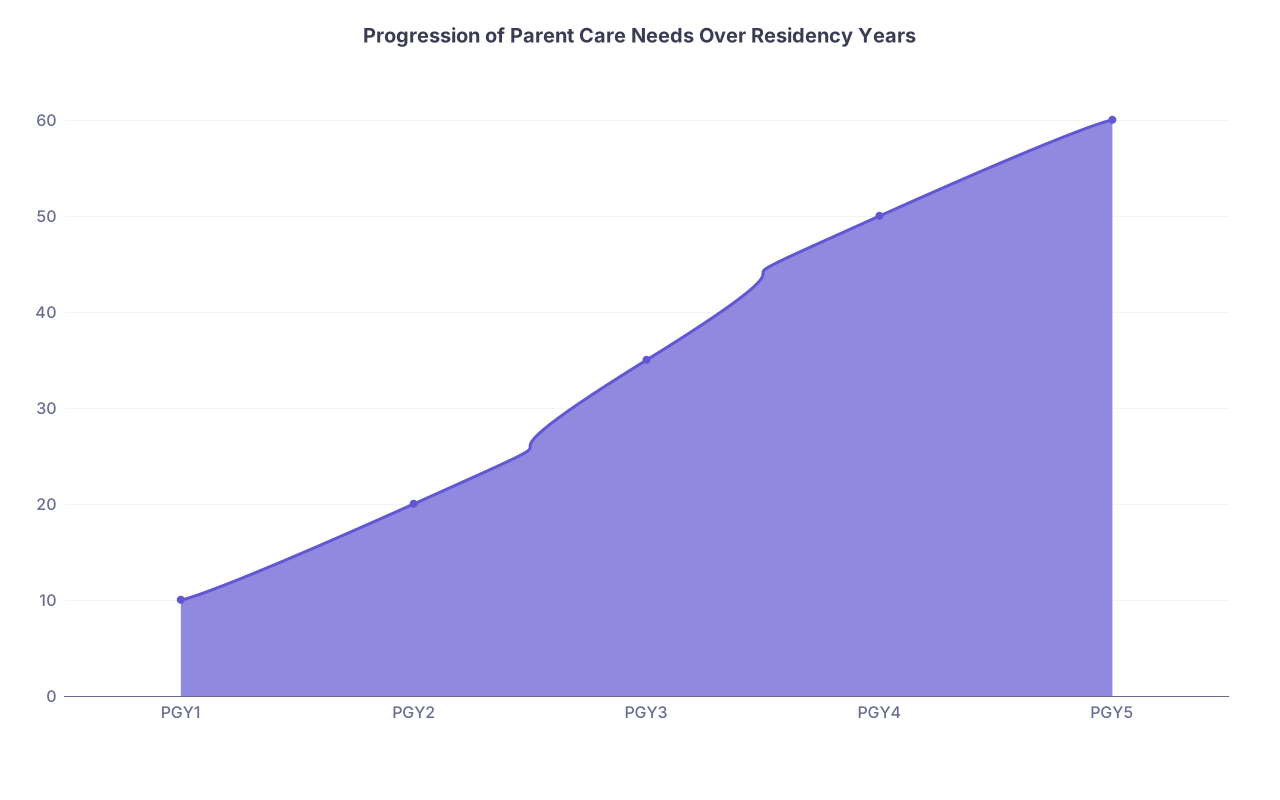
| Category | Value |
|---|---|
| PGY1 | 10 |
| PGY2 | 20 |
| PGY3 | 35 |
| PGY4 | 50 |
| PGY5 | 60 |
That curve is what aging looks like for a lot of people. Plan like the line is going up, not staying flat.
Step 8: Protect Yourself From the Guilt Spiral
You will feel like you’re failing at both roles. That’s basically guaranteed. Two small things that help.
1. Decide what “good enough” looks like
If your internal standard is “I’m always there when they need me” and “I’m always the perfect resident,” you’ve set up a game you cannot win.
Define “good enough” care instead:
- “My parents are safe.”
- “Their basic needs are met.”
- “I’m involved in major decisions and check in regularly.”
- “I’m not destroying my own health to maintain an image of being the perfect child.”
Good enough is allowed. Particularly when you’re already spending your twenties or thirties working unpaid overtime for a hospital.
2. Get external support that isn’t your co-residents
Co-residents are great, but they’re also drowning. You need someone outside that bubble.
Look for:
- Therapist (preferably someone who understands medicine or caregivers)
- Caregiver support groups (many virtual, off-hours)
- Resident wellness groups that aren’t “cookies and yoga in the conference room” but actually talk about things like this
You’re dealing with anticipatory grief, role reversal, and chronic stress. This is textbook stuff for needing help. If a patient told you this story, you’d push them to get support. Apply your own advice to yourself for once.
Quick Example Plans (So You See What This Looks Like in Real Life)
Scenario A: IM PGY-2, mom with early dementia, you’re local
- Non-negotiables: She’s not left alone overnight; meds supervised.
- Family: Brother manages bills and meds; cousin stays 3 nights/week.
- Professional: Hire evening caregiver 4–5 nights/week, adult day program 3 days/week.
- Program: You ask to avoid back-to-back 28‑hour calls for the next 6 months while you stabilize her care; cluster clinic days.
- Your role: Weekly in-person visit post-call or golden weekend; daily 5‑minute FaceTime; major appointment attendance once/month.
Scenario B: Surgery PGY-3, parents 2 hours away, dad with CHF, mom frail
- Reality check: You cannot be primary physical caregiver from that distance with your schedule.
- Non-negotiables: They have in-home support; clear fall and emergency plan.
- Professional: Home health + private aide 3–4 days/week; Meals on Wheels.
- Local backup: Neighbor as emergency contact; church group check-ins.
- Your role: Medical decision-maker, financial help, monthly weekend visit, telehealth presence for key appointments.
Neither of those is ideal. Both are survivable. That’s the point.

FAQ (Exactly 3 Questions)
1. Should I take a leave of absence from residency to care for my parents?
Maybe—but decide like an adult, not from panic. Take a beat, talk to GME, look at FMLA options, and build a provisional care plan first. If a 4–8 week leave lets you set up sustainable systems (caregivers, housing changes, financial planning) and prevents years of constant crisis, it can be absolutely worth extending your training. If the leave would just be you doing full-time caregiving with no long-term solution, you risk derailing your career without actually fixing the structural problem. Short, strategic leave with a clear goal: reasonable. Open-ended “I’ll just figure it out”: usually a trap.
2. What if my program is unsympathetic or subtly punishing about my situation?
Some programs are great; some are quietly toxic. If leadership responds with “Everyone has stuff going on, you just need to manage it,” escalate strategically. Talk to the GME office, institutional ombudsperson, or HR about rights around FMLA and discrimination based on family responsibilities. Document conversations. Loop in a trusted attending who has influence. And start thinking about your exit path—either for fellowship or, if things are truly bad, a transfer. You do not owe total self-destruction to a program that sees you as disposable.
3. How do I handle resentment from siblings who think I should “do more” because I’m the doctor?
You stop trying to argue feelings and instead negotiate responsibilities. Spell out your schedule in concrete terms: “I’m in the hospital 70–80 hours a week, with overnight call. That’s not flexible.” Then move the conversation to tasks: “Here’s the list of what needs doing. Here’s what I can do reliably. What can you commit to? If we still have gaps, we hire help or adjust their living situation.” If someone refuses both responsibility and realistic alternatives, that’s not a you problem. That’s them opting out. You do what you can within sane limits and stop letting their guilt trips override basic math.
If you remember nothing else:
- You cannot be a full-time resident and a full-time caregiver. Accept that and build a team.
- Be explicit—with family, your program, and yourself—about what you can and cannot do.
- Aim for “safe and supported,” not “perfect child.” Your parents need you alive and intact more than they need you at every appointment.


