

You’re on hour 13 of a supposed 12-hour shift. You’ve signed out your patients, closed your notes, and you’re halfway to the elevator when your co-resident says, “Hey, can you just follow up a couple of things for me? I’ve got to run.” You look at the list. It’s not “a couple of things.” It’s another hour of work. And this is the third time this week.
Let’s deal with that situation directly. Because if you do not handle it, you’ll keep absorbing everyone else’s work while your resentment simmers and your burnout accelerates.
Step 1: Get Very Clear On What’s Actually Happening
Start by naming what’s going on. Not in abstract “toxic culture” language. In concrete behavior.
You’re looking for patterns like:
- Same co-resident repeatedly signing out unfinished work that should have been done on their shift
- “Emergencies” that somehow always show up five minutes before they’re supposed to leave
- Them cherry-picking easier tasks and leaving you with the time-consuming, scut-heavy mess
- Them scheduling personal life stuff assuming you’ll just “cover” every time
Write down two weeks of what actually happens. Date, time, what they dumped on you, and why they said they had to go.
You’re not building a legal brief. You’re giving yourself clarity. “Am I overreacting or is this real?” becomes, “On 7 of the last 10 shifts together, I stayed late 45–90 minutes because they left tasks that were clearly theirs.”
Once you have that, the noise in your head gets quieter. You’re not crazy. You’re being used.
Now categorize what they dump:
- True last-minute patient care issues (RRT, new admission, sudden decompensation)
- Work that could have been done earlier in their shift (notes, routine orders, discharge paperwork)
- Pure avoidance (calling consults, family calls, follow-up labs they ignored for hours)
You respond differently to each.
Step 2: Fix the Easy Stuff First – Your Own Boundaries
Before we talk confrontation, fix the part you actually control: you.
Most residents have terrible default boundaries. You were selected for being “a team player.” Translation: You’ve been rewarded your whole life for over-functioning.
You need some rules for yourself:
- A hard time you aim to leave by (barring true emergencies)
- A mental script for what you say when someone tries to push work on you
- A way to triage: what is legitimately your responsibility vs “scope creep”
Example internal rule: “Barring active instability, I’m not starting new non-urgent tasks after 30 minutes into sign-out.”
That gives you something to reference out loud: “I can help with X and Y, but I’m not starting new non-urgent calls after sign-out unless the senior approves.”
Here’s the key: say “no” or “not all of that” in the moment, not later by text, not by stewing all night.
Step 3: Change How You Handle Sign-Out
Most of the dumping happens at sign-out. Not on rounds. Not in the middle of the shift. At the handoff.
So upgrade your sign-out from “casual brain dump” to “structured transaction.”
Minimum structure:
- “Active issues I’m managing right now”
- “Things that must be followed tonight”
- “Things I started and will finish in the morning unless something changes”
When your co-resident starts sliding in half-baked work, slow it down.
You:
“Hang on. Before I agree to take this, what exactly is still pending, and why is it not done yet?”
That question alone exposes a lot of nonsense. Because they now have to say:
- “I didn’t get to the discharge summary” (at 7 p.m. on a patient going home tomorrow)
- “I haven’t called the family yet; can you just do that?” (after a 10-hour day of opportunities)
- “I didn’t order the CT, can you just put it in?” (for someone non-acute)
You then decide on each item:
- True night issue? Fine. It’s yours.
- Daytime work they simply didn’t prioritize? Push back.
Example phrasing that works and doesn’t make you sound like a jerk:
- “That sounds like day work. If it’s not urgent, can you finish it before you head out?”
- “I can follow up results that come back after I sign in, but ordering and arranging it is really on the day team.”
- “If it’s not going to change overnight management, let’s keep that for day hours.”
You’ll feel uncomfortable the first few times. Good. That discomfort is what setting boundaries feels like when you’re used to over-giving.
Step 4: Call It Out Directly (Without Nuclear War)
If this is chronic with the same person, you need a direct 1:1 conversation outside of peak stress.
Not in the middle of sign-out. Not on rounds. Somewhere semi-private:
- After conference, step aside
- Walking between wards
- Quick sit-down in the resident room when pagers are quiet
Use this structure:
- Describe the pattern
- Describe the impact on you
- State what needs to change
- Offer a collaborative way forward
Example:
“Hey, can I talk to you about sign-out? The last few times we’ve worked together, I’ve ended up staying pretty late because there are a bunch of leftover tasks that get handed off right at the end – things like discharge summaries and non-urgent calls. It’s adding an extra 45 minutes to an hour on my shift pretty regularly.
I’m getting underwater on sleep and my own work because of it. I need us to be more intentional about what gets handed over. I’m happy to take true night issues or anything that pops up late, but daytime tasks really need to be wrapped up before sign-out. Can we figure out a better way to divide things so I’m not consistently the one staying late?”
Pause. Let them respond. Don’t fill the silence.
Common responses you may hear:
“Oh, I didn’t realize it was that much extra work.”
Good. Now they know. Re-state expectations.“We’re all busy, I stay late too sometimes.”
Calmly: “I’m sure you do. I’m talking specifically about work you’re handing off to me. I’m not okay with this pattern continuing.”“Well, nights can handle it, that’s part of their job.”
This is where you hold firm: “Yes, nights cover night issues. But consistently offloading unfinished day work onto colleagues isn’t okay. I’m asking you directly to stop doing that with me.”
You’re not at war. You’re just refusing to be their safety net anymore.
Step 5: Use Your Senior and Attendings Strategically
If none of this works (or the behavior is egregious), you bring in backup. But you do it smart.
Don’t go in with “They’re lazy and I’m drowning.” Go in with specifics and with a proposed fix.
Pick the right person:
- On service: your senior or chief resident
- Chronic pattern across rotations: chief residents or APD
- Patient safety issues: attending or program leadership
You:
“I’d like your help with something that’s affecting patient care and work distribution on our team.”
And then calmly:
“I’ve noticed a repeated pattern working with [Name]. On at least 6 of the last 8 shared shifts, they’ve signed out multiple non-urgent, unfinished daytime tasks right at the end of their shift. This has led to me staying 45–90 minutes late each time. I’ve tried addressing it directly with them, asking them to complete day work before sign-out and only hand off true night or emergent issues. The pattern hasn’t changed.
Here are specific examples:
– [Date]: 3 discharge summaries, all could have been started earlier in the day.
– [Date]: multiple non-urgent family calls left for me after sign-out.
– [Date]: routine imaging orders and consult calls signed out as ‘to do.’
I’m concerned about burnout and also about stuff getting rushed at the end of a long shift. I’d like your help in setting clearer expectations for what’s appropriate to hand off at sign-out, and how we can make the workload more balanced.”
Notice what you’re doing there:
- You’re not whining. You’re presenting data.
- You’re anchoring it in patient care and fairness.
- You’re asking for clear expectations, not punishment.
If your senior/attending is decent, they’ll adjust how they supervise sign-out. They might:
- Sit in on sign-outs for a while
- Explicitly say, “Non-urgent day tasks should be done by the day team”
- Re-distribute patients or tasks on particularly heavy lists
If they dismiss you with “That’s just residency,” that tells you something about your culture. We’ll come back to that.
Step 6: Protect Yourself Logistically – And On Paper
While you’re working on the interpersonal side, protect yourself in more boring, bureaucratic ways.
Document your hours accurately. No “rounding down” to look tough.
Use your work hours reporting system honestly. If you’re consistently staying 1–2 hours late because of this pattern, log it. A lot of programs only react when the ACGME clock starts flashing red.
If chief residents see:
- You always on the edge of duty hour violations
- Your co-resident magically always at 55 hours while everyone else is at 75
they start asking questions.
Also, track the big problem days in a simple note for yourself:
- Date
- Shift
- What was handed off
- Approx extra time you stayed
- Any patient safety near-misses
You are not building a federal case. But you are keeping your memory from getting gaslit.
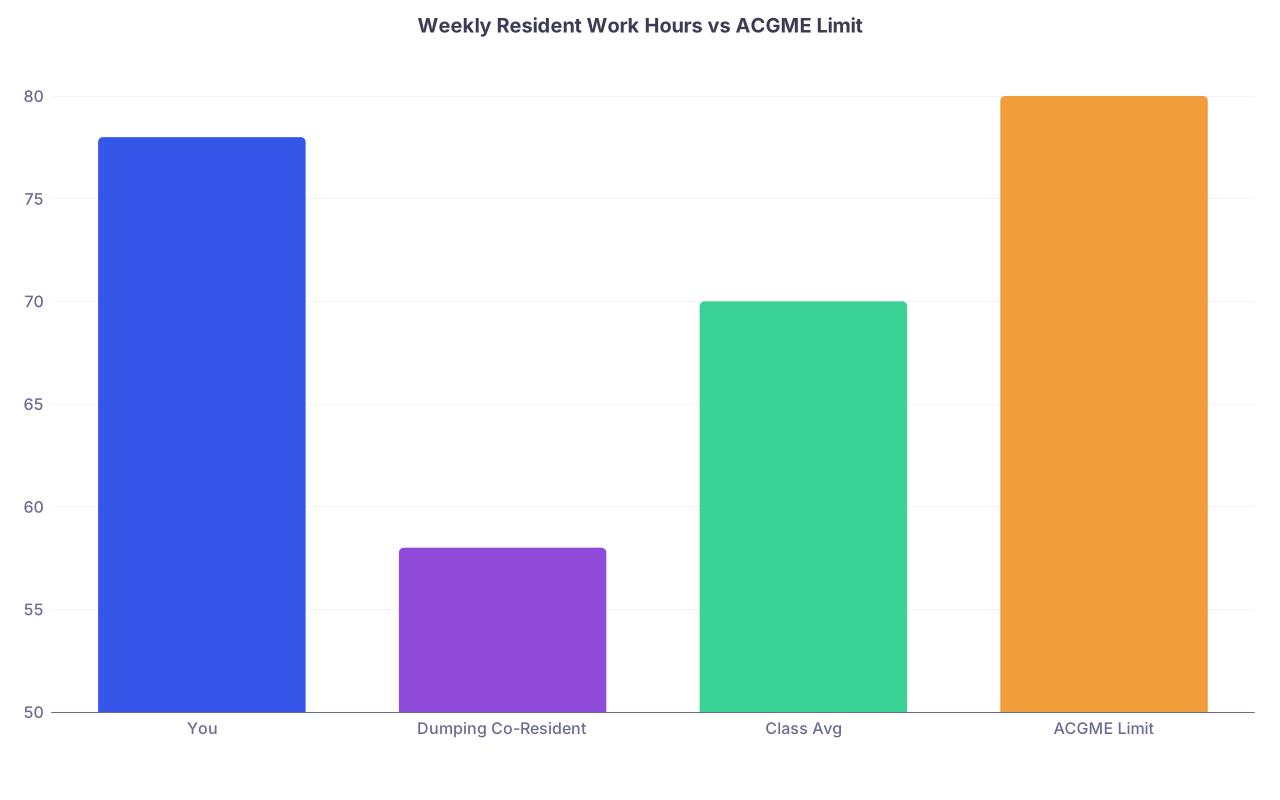
| Category | Value |
|---|---|
| You | 78 |
| Dumping Co-Resident | 58 |
| Class Avg | 70 |
| ACGME Limit | 80 |
If your program leadership ever says, “We haven’t heard about any issues,” you have something concrete to reference.
Step 7: Learn to Say “I Can Do X, Not All of That”
A lot of residents think they have only two options:
- Take everything and suffer
- Say “no” and be labeled unhelpful
There’s a third option: partial yes with clear limits.
Examples:
Co-resident: “Can you follow up these four labs, call the family, and put in this CT order?”
You: “I can follow the labs and call you if anything’s critical. The family update and CT order really should be done on day shift. If it changes overnight management, I’m happy to reassess, but I’m not starting non-urgent new work after sign-out without the senior looping in.”
Or:
“I can take the truly urgent stuff from that list. Which one absolutely needs to be done before you leave, and which can safely wait until tomorrow?”
Force them to triage. Most chronic dumpers are exploiting the fact that you do not make them choose.
One more:
“I’ve already stayed late multiple times this week to pick up extra work. I’m not able to stay late again tonight for non-urgent tasks. I can take new issues that arise during my shift, but I need you to finish that.”
Short, clear, not up for negotiation.
Step 8: Watch For These Red Flags – And Respond Accordingly
Some situations move from “annoying” to “unacceptable” quickly. Red flags:
- They disappear from the floor well before their shift ends and reappear only for sign-out
- They lie: claim something is urgent when it clearly isn’t
- They misrepresent what they’ve done: “I started the discharge” and you open the chart to find a blank note
- They retaliate after you push back: badmouthing you, giving you crappy sign-outs, withholding information
You handle these more aggressively.
If they lie or misrepresent work at sign-out, you say (in front of whoever’s there, calmly):
“I’m opening the chart now and I don’t see that note/consult ordered. I’m not comfortable being told it’s done when it’s not. Let’s be accurate about what’s actually completed.”
If they get defensive, do not match their volume. Just repeat:
“I need accurate information to take safe care of patients. If something isn’t done, just say that.”
If they start to retaliate or trash-talk you, that’s when you involve chiefs or program leadership more directly:
“I attempted to address a workload issue with [Name]. Since then, I’ve noticed X and Y behaviors that feel retaliatory and are affecting team function and patient care. I’d like help resolving this before it escalates.”
You are not there to be their punching bag.
Step 9: When the Culture Is the Problem, Not Just the Person
Sometimes the issue isn’t one co-resident. It’s the entire system.
Signs of that:
- Everyone signs out giant piles of unfinished work; nights are chronically flooded with day tasks
- Seniors/attendings explicitly say things like “Just push it to nights, that’s what they’re there for”
- Residents brag about escaping on time by dumping on cross-cover
- Duty hour complaints are mocked or brushed off
You’re not going to fix that in a week. But you can:
- Find allies who see the same pattern
- Bring data to chiefs/APDs: night admission counts, sign-out lengths, average late stays
- Propose specific system changes (not just “we’re burned out”)
Examples of specific asks:
- “Can we have clearer written guidelines on what’s appropriate to sign out vs what must be completed on day shift?”
- “Can we add a 3 p.m. ‘pre sign-out’ check so seniors can redistribute overflow work before 5 p.m.?”
- “Can we track how much non-urgent day work is handed to nights and address services/attendings with outlier patterns?”

| Step | Description |
|---|---|
| Step 1 | Notice Pattern of Extra Work |
| Step 2 | Track 2 weeks of examples |
| Step 3 | Attempt Direct Conversation |
| Step 4 | Maintain Boundaries |
| Step 5 | Talk to Senior or Chief |
| Step 6 | Adjust Pairing or Coaching |
| Step 7 | Escalate to Program Leadership |
| Step 8 | Propose Specific Changes |
| Step 9 | Improves? |
| Step 10 | Systemic Issue? |
Again, you’re not whining. You’re diagnosing a system failure and proposing interventions.
Step 10: Take Care of the Fallout – Your Mood, Your Reputation, Your Future
Let’s be honest: pushing back has a cost. Sometimes small, sometimes real.
You might get side-eyed as “less flexible” by people who benefited from your overwork. You may feel guilty the first few times you say no. Your anxiety will spike the first time you walk away at a reasonable time while your co-resident lingers to “look good” in front of an attending.
Two things to remember:
- Reasonable people respect clear, fair boundaries. The ones who don’t are often the ones exploiting you.
- Your residency is a marathon. Protecting your bandwidth now is what lets you still care about patients in PGY-3 and beyond.
Also protect your reputation smartly:
- Be early, prepared, and solid on rounds
- Close your own loops reliably
- Be helpful when it’s actually a team emergency
- Be transparent: “I’m leaving on time today because I’ve stayed late multiple days this week to help cover.”
If attendings see you as clinically strong, dependable, and occasionally assertive about your limits, that’s not a bad thing. That’s an adult colleague.
If your program truly punishes you for not being an endless sponge for others’ neglect, that’s data for your future decisions: fellowship, job, how much loyalty you owe this place.
A Quick Reality Check: When You Should Take Extra Work
Not all “dumping” is malicious. Sometimes the right move is to suck it up—for the team, for the patient, or because you’re simply not carrying as much that day.
You stay late without complaint when:
- A patient on your team is critically ill and still actively decompensating
- Your co-resident is legitimately overwhelmed with an admission blast or multiple acutely sick patients
- There was a real, unpredictable surge late in the shift
You don’t moralize those. You just do the work.
But you also don’t let those situations be used as cover for someone who, on a calm day, spent half their shift in the call room, then pretended they’re drowning at 6:55 p.m.
The Point of All This
You’re not in residency to be a receptacle for other people’s avoided responsibility. You’re there to learn medicine, become competent, and yes, to be part of a functioning team.
Sometimes being on that team means staying late. Sometimes it means saying, “No, that’s your job.” The trick is learning which is which—and then having the spine to act on it.
You’ve already done the hard part: noticing that something feels off. Next step is experimenting with one small boundary: a more structured sign-out, a single “I can’t take all of that,” or one direct conversation.
Get that first win, however small. You’ll feel the difference in your shoulders, your sleep, and your patience for patients who actually need you.
And once you get used to protecting your time and energy from a dumping co-resident, you’ll be in a much stronger position for the next set of challenges: advocating for safer workloads, preparing for attending life, and building a career that doesn’t grind you down. But that’s the next phase. For now, start with the next sign-out.


