
Off-campus post-call travel is not a tiny inconvenience. It is one of the cleanest ways a program can create hidden duty-hour violations while pretending everything is fine on paper.
I have seen this pattern repeatedly. A resident finishes call, signs out late, drives 30 to 50 minutes home, grabs maybe a fragment of sleep, then shows up for the next required activity because the schedule says they are technically compliant. That is nonsense. Fatigue does not care whether the lost recovery time happened in a call room, on the interstate, in an Uber, or in your apartment parking lot.
That is the core problem: travel time gets treated as if it exists outside the duty-hour universe, even when it predictably destroys the recovery window that duty-hour rules are supposed to protect. The violation is "hidden" because the program counts departure from the hospital as the end of duty, then quietly ignores the fact that the resident is still in a fatigue-generating, safety-relevant period that makes adequate rest unrealistic.
Post-call off-campus decisions are uniquely risky for three reasons. First, distance matters. A ten-minute walk to nearby housing is not the same as a 45-minute drive on dark roads after a 24-hour stretch. Second, fatigue warps judgment. Residents reliably underestimate how impaired they are after call. Third, scheduling ambiguity makes abuse easy. Was duty over when the pager became quiet? When the last note was signed? When the handoff actually ended? Programs exploit that gray zone all the time, intentionally or not.
This is a residency red-flag issue, not just a personal wellness complaint. If you are a trainee, you should know how to recognize when "that is just how we do it here" is really a compliance problem. If you are a reviewer or auditor, you should know exactly where to look: sign-out timing, geography, transportation assumptions, next-day start times, and whether the program has built any realistic recovery buffer at all. If you are in leadership, you should stop congratulating yourself for nominal compliance while residents are functionally post-call on the highway.
The right lens is simple. Duty-hour rules are about clinical responsibility and fatigue management. Not merely whether a body is standing inside hospital walls. The building is not the point. Safety is.
Duty Hours Fundamentals You Must Get Right (So You Can Spot the Crack in the System)
Duty-hour analysis gets sloppy when people reduce it to badge-swipe math. That is how bad programs hide bad systems.
At the most basic level, duty hours separate time spent in clinical responsibility from time reserved for real recovery. Not performative recovery. Real recovery. Sleep, decompression, and enough interruption-free time to physiologically reset before the next required duty period.
The first concept to get right is what counts as work in substance. Clinical work is not just rounding or admitting patients. It includes sign-out, finishing notes, responding to last-minute issues, closing loops with nursing, clarifying orders, and handling the "one quick thing" that somehow appears every single post-call morning. If the resident cannot reasonably leave because patient care tasks remain, duty has not ended. Period.
The second concept is when duty actually ends. Programs often use a fictional endpoint:
- "Call ended at 6:00 AM"
- "Night float ended at 7:00 AM"
- "Pager handed off at 7:30 AM"
Those timestamps are often administrative placeholders, not real-world endpoints. In actual residency life, handoff runs long, ICU events happen at shift change, discharge questions pop up, and notes still need to be signed. I have watched residents "finish" at 7:00 and leave at 8:05. That hour matters.
The third concept is what rest is supposed to accomplish. Post-call time is not decorative. It exists so the resident can sleep and recover before the next scheduled clinical obligation. If the schedule creates a paper rest window that collapses once commute, delayed departure, food, and basic human function are added back in, then the schedule is broken even if the spreadsheet looks pretty.
That is where the loopholes creep in:
- Travel home is omitted entirely from any fatigue or duty analysis.
- Programs log scheduled shift-end rather than actual handoff completion.
- Residents are told to self-report "approximate" times, which magically drift toward compliance.
- Next-day required activities are labeled "educational" or "brief," as if that makes post-call fatigue irrelevant.
It does not.
Reviewers who know what they are doing rarely depend on logs alone. They infer violations from the whole system. They look at call schedules, sign-out structure, availability of call rooms, local commute patterns, overnight service intensity, and expectations for next-day conferences or clinics. If a resident is routinely leaving late after heavy call and reappearing for duty after a narrow interval, the violation may be obvious even if no one typed the word "travel" into a log.
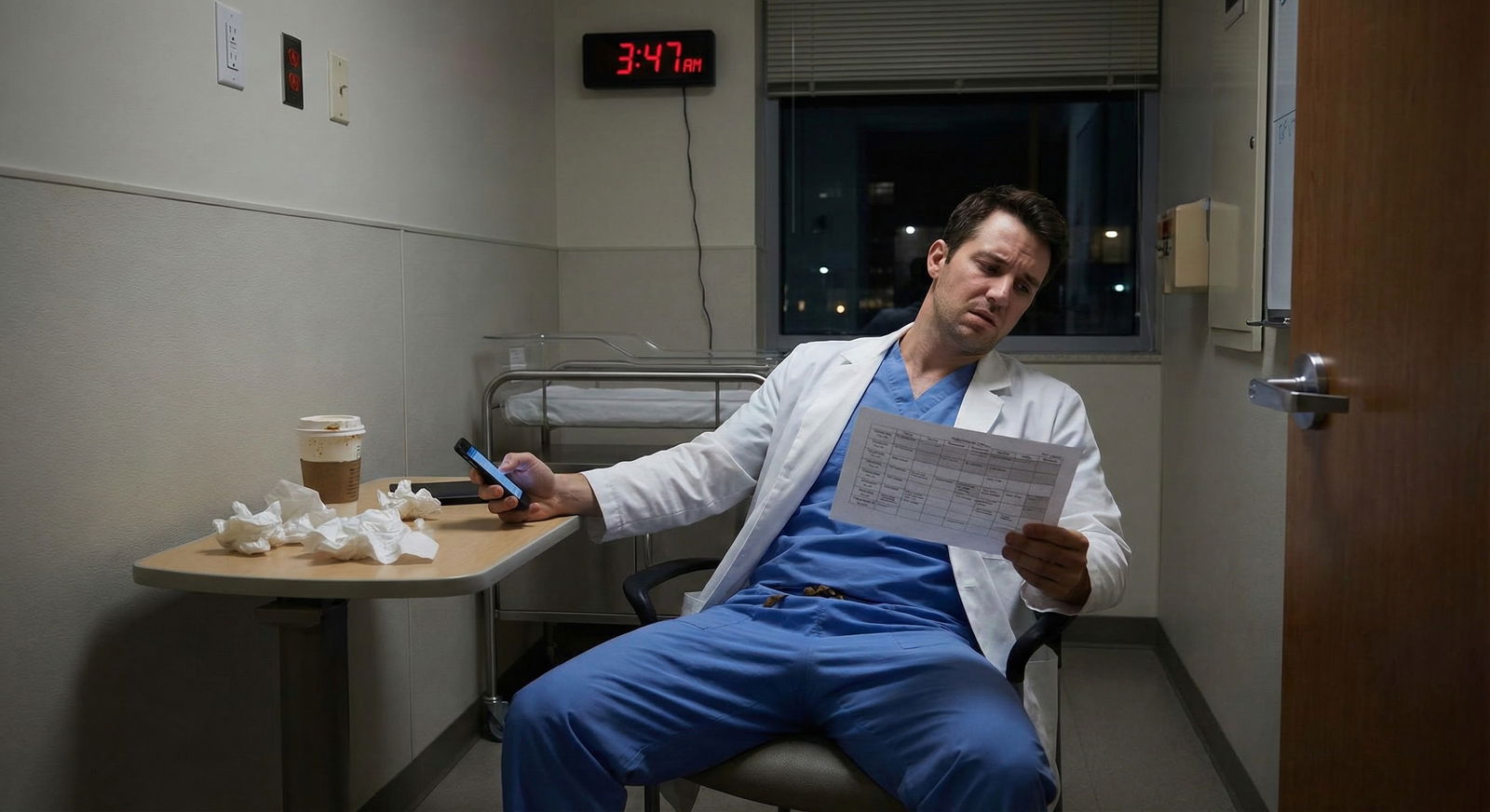
The principle is brutally simple: if the system regularly leaves a resident too fatigued to travel safely or too compressed to recover adequately, the system is violating the purpose of duty-hour protections whether or not it admits it.
Why Off‑Campus Post‑Call Travel Specifically Triggers Hidden Violations
Let me break down the mechanism precisely, because this is where programs hide behind semantics.
Mechanism #1: Travel time is fatigue-generating work in substance, even if not work in paperwork
No, driving home is not the same as staffing a consult. But it is not protected rest either. It is an active, cognitively demanding, risk-laden task performed at the worst possible time: after prolonged wakefulness. Residents do not teleport from handoff to bed. They navigate parking garages, elevators, highways, weather, missed exits, and predawn traffic while physiologically impaired.
That matters because the recovery window starts later than the official schedule claims. A resident who leaves the hospital at 7:40 and gets home at 8:25 has not begun resting at 7:40. That is fantasy.
Mechanism #2: Scheduling mismatch destroys realistic sleep opportunity
This is the classic hidden violation. The next required duty sounds benign on paper, but the available sleep opportunity is absurd once reality is added.
Example. Resident signs out at 7:30 AM after overnight call. Actual departure after notes and loose ends: 7:55. Commute: 40 minutes. Home by 8:35 if traffic cooperates. Brief food, shower, deactivation from "hospital brain," maybe asleep around 9:15. Next mandatory noon conference or early afternoon clinic prep starts the return process by 11:00 or 11:30. That is not meaningful recovery. That is a nap with administrative branding.
Programs love this trick because the hours can appear technically separated. In practice, the resident never got enough uninterrupted sleep.
Mechanism #3: You often do not really finish when the pager quiets
Anyone who has actually worked post-call knows this. Silence from the pager is not the same as release from responsibility.
There is handoff friction. You wait for the day team. The senior wants one last clarification. A nurse asks whether to redraw labs. A consultant calls back late. The EHR inbox still has results to reconcile. An attending asks for a discharge summary correction. These are not edge cases. They are standard residue from overnight work.
That residue shifts the true duty endpoint later and later, while the official schedule remains frozen. The gap between documented end time and actual end time is where hidden violations breed.
Mechanism #4: Distance, weather, and traffic compress the rest window even more
A post-call commute is not just a neutral block of time. It is variable and often hostile.
A 20-minute daytime drive can become a 45-minute winter commute after snow, construction, or morning congestion. Public transit delays are worse. So is walking long distances through unsafe weather because nearby housing is unavailable. Each extra minute is stolen from sleep. More importantly, each extra variable makes the schedule less defensible because the program built no margin for reality.
Programs that recruit residents to expensive cities and then shrug at long commutes are especially culpable here. If local cost of living pushes trainees far from the hospital, leadership does not get to pretend geography is a personal lifestyle choice. Geography becomes a systems issue.
Mechanism #5: Culture normalizes what should be flagged
The most corrosive phrase in residency is: "Everyone does it."
That sentence has excused unsafe driving, fake duty logs, missed meals, skipped lactation breaks, unpaid administrative labor, and wildly unrealistic schedules. Off-campus post-call travel fits neatly into that same culture. If senior residents all drove home exhausted and survived, the system starts treating survival as proof of acceptability. It is not. Near-misses go unreported. Microsleeps at stoplights become jokes. Residents learn to under-document because they do not want to be the one who "causes trouble."
That is how a hidden duty violation becomes institutional folklore instead of a fixable operational problem.
A compliant system accounts for how recovery actually happens. A noncompliant one counts only what is convenient to count.
Exam & Review Patterns: How This Shows Up in Logs, Schedules, and "Inferred" Noncompliance
Auditors and site visitors do not need a resident to confess, "I was too tired and my commute wrecked my rest." They can infer the problem from patterns.
Here is what raises eyebrows fast.
1. Duty logs that ignore geography
If a resident logs departure at 7:00 AM and return for required responsibilities at 1:00 PM, the paper interval looks generous enough to pass casual review. But if the resident lives 45 minutes away and routinely signs out late, the true sleep window is much smaller. Reviewers notice when program assumptions require impossible commute physics.
2. Unrealistic consistency in end times
Every call shift magically ends at exactly the scheduled minute? That usually means residents are reporting schedule templates, not actual practice. Real services vary. Logs with too much neatness often signal underreporting.
3. Blank or absent travel assumptions
Most systems do not explicitly track commute burden, and that is itself a problem. If a program has no idea whether post-call residents travel 5 minutes or 60 minutes, it cannot honestly claim it has assessed fatigue risk.
4. Next-day obligations that are mislabeled as harmless
A "short conference," "brief didactic," or "just come in for sign-out" still forces wakefulness, transit, and cognitive performance. Reviewers know this. Required means required.
5. No call-room or lodging backup
If the program knows post-call residents may be unsafe to drive but the only safety response is "take an Uber if needed," that is not enough. Transportation may reduce crash risk, but it does not restore lost sleep time. Auditors increasingly recognize that.
A simple scenario shows how noncompliance is inferred:
- Overnight call scheduled to end: 7:00 AM
- Typical actual sign-out completion: 7:30 to 7:45 AM
- Resident commute: 35 minutes
- Required educational session: 12:00 PM in person
- Required pre-session arrival/prep: 11:30 AM
That leaves a narrow and fragmented at-home window. Once basic needs are included, meaningful sleep is unrealistic. Even if logs technically avoid a formal violation threshold, the program has created an obviously unsafe and unserious recovery structure.
For trainees and leaders, use this quick red-flag checklist:
- What is the actual handoff completion time, not the scheduled one?
- How far do post-call residents realistically travel?
- Is there on-site call-room or lodging access after call?
- Are next-day duties truly optional, or "optional unless your attending notices"?
- Does the schedule include any built-in recovery buffer for distance and delay?
- Are residents informally coached to log cleaner numbers than reality?
If several of those answers look bad, the program has a systems problem.
The point is not the exact number in every program. The point is feasibility. If the rest window stops being plausible once real travel is inserted, the schedule is defective.
What To Do: Compliance-Safe Solutions That Actually Work in Real Life
This problem is fixable. But only with operational changes. Not speeches. Not wellness emails. Not pizza.
Immediate mitigation for the next rotation
Start by defining the true end of duty. Not pager quiet time. Not scheduled shift end. The real endpoint: handoff completed, urgent documentation finished, patient care responsibility transferred. Residents should document that actual time consistently.
That one change alone exposes a lot of fake compliance.
Then clarify next-day expectations in writing:
- What post-call activities are mandatory?
- Which can be excused automatically?
- Who has authority to release the resident?
- What happens if handoff runs late?
Ambiguity helps the system, not the trainee.
Redesign schedules around effective end times
If post-call departure usually happens 30 to 60 minutes after the nominal shift end, the schedule should reflect that reality. Build earlier wrap-up expectations, stagger handoffs, or reduce overnight carryover tasks so the resident can actually leave when the program says they leave.
Better yet, adjust the next required start time based on the effective recovery window. This is the adult solution. If there is post-call travel, then the recovery block has to begin when the resident can realistically rest, not when the badge leaves the building.
Do not confuse transport with recovery
Programs often offer ride-share reimbursement and congratulate themselves. Useful? Yes. Sufficient? No.
A paid ride home may reduce immediate driving danger, but it does nothing for compressed rest if the resident still must wake up shortly afterward for required duties. Transport fixes safety on the road. It does not fix sleep opportunity.
What actually works:
- available call rooms
- pre-arranged post-call lodging
- permission to sleep on-site before traveling
- removal from early post-call in-person obligations
Time-backed solutions beat transportation-only solutions every time.
Use distance-based policies
One-size-fits-all rules are lazy. A resident living 8 minutes away is in a different risk category from one commuting 50 minutes from an affordable suburb.
Programs should set local thresholds. Example logic:
- If commute exceeds a defined duration after overnight call, call-room or lodging must be offered.
- If severe weather is present, post-call departure planning changes automatically.
- If actual handoff ends beyond a certain time, next-duty expectations are modified.
That is how real systems management works.
Trainee strategy: report with data, not vibes
If you need to raise concerns, do not lead with "I feel tired." That is true, but easy for bad leadership to minimize.
Lead with objective timing:
- scheduled call end
- actual handoff completion
- actual departure time
- commute duration
- time able to begin sleep
- next required activity and start time
- frequency of the pattern
Keep a private log for several weeks. Screenshots, timestamps, calendars. Quietly accurate. Very hard to dismiss.
Then phrase the concern in systems language: "The current post-call structure leaves an insufficient realistic recovery window once actual sign-out and commute time are included. I am requesting review of end-of-duty definitions and post-call scheduling expectations."
That lands much harder than "this feels unfair."
Leadership playbook
If you run a program, audit your own schedule honestly. Follow one resident through a real post-call morning. Not the template. The actual lived sequence. Time the handoff. Time the walk to parking. Time the drive. Ask what obligations remain before sleep is possible.
Then run a rest-window feasibility check:
- Actual duty release time
- Travel time
- Basic transition time
- Earliest realistic sleep onset
- Required next-day activation time
If that chain looks absurd, fix the schedule. Do not ask residents to become more resilient. That is usually code for "we do not want to redesign operations."

Good programs make safe recovery easy. Bad programs make unsafe recovery normal and call it professionalism.
FAQ: Direct Answers for High-Stakes Situations (Busy Residents, Busy Programs)
"I drove carefully, so what is the issue?" Carefulness does not erase fatigue. The issue is not your moral character behind the wheel. The issue is that the system forced a fatigued resident into a risk period and then pretended recovery had already started.
"I was not technically working during the drive." You were not resting either. That is the key distinction. If travel reliably truncates the protected recovery window, the program cannot hide behind a narrow paperwork definition.
"Everyone in this program does it." That is an indictment, not a defense. Widespread normalization is exactly how unsafe scheduling becomes invisible.
"What if a supervisor tells me to go off-campus even though it will compress rest?" Document the timing. Ask a neutral clarifying question in real time: "Just to confirm, with sign-out ending at [time] and travel taking about [duration], am I expected back for [duty] at [time]?" That creates a contemporaneous record without open confrontation.
"What data should I collect if I need to report it?" Collect:
- actual sign-out completion times
- departure times
- commute duration
- next required duty times
- whether call-room or lodging was available
- whether attendance was mandatory
- frequency across multiple shifts
"Who should I contact?" Start with the chief resident or program coordinator if the issue is likely operational and fixable quickly. Escalate to the program director, GME office, or designated institutional official if the pattern is recurrent or if retaliation is a concern.
"How should I phrase the concern?" Keep it concrete: "The current post-call process leaves inadequate feasible recovery time once actual handoff completion and commute duration are included. I am requesting review of scheduling and post-call lodging/call-room policy."
No drama. No editorializing. Just facts that expose the flaw.
The future of residency is not more policy language. It is better systems design. Programs that understand fatigue as a real operational variable will adapt. Programs that keep treating off-campus post-call travel as invisible dead time will keep generating hidden violations, unsafe commutes, and cynical residents who stop trusting the rules. That is the red flag. And now you know exactly how to see it.