
You are three months into the inaugural year of a brand‑new internal medicine residency. The program director just sent an email: “We are revising the night float and call structure effective next block.” Your interns are already exhausted, the chief is drowning in schedule versions labeled “Final_v7_REALLYfinal.xlsx,” and the DIO is muttering about ACGME citations and 80‑hour violations.
This is where early‑stage programs either get serious about duty hours and call design—or they slowly bleed out goodwill, recruitment power, and credibility.
Let me break this down specifically.
1. The Regulatory Box You Actually Live In
New programs love to talk “culture,” “wellness,” and “innovation.” All of that is boxed in by one thing: the ACGME duty hour standards. You do not get to be creative outside that frame.
Here is the short version of the actual box for most core residencies (IM, peds, surgery, OB, etc.):
| Rule Type | Requirement (ACGME Standard) |
|---|---|
| Weekly hours | ≤ 80 hours/week, averaged over 4 weeks |
| Shift length | ≤ 24 hours continuous + up to 4 hours transition |
| Day off | 1 day in 7 free, averaged over 4 weeks |
| Short break | 10 hours between shifts (goal; may be violated) |
| Long break | 14 hours after 24-hour call when possible |
That is the skeleton. Early‑stage programs get into trouble because they:
- Build a schedule that theoretically meets rules but collapses with any sick call.
- Underestimate documentation and signout time (residents regularly stay 1–2 hours late).
- Run too “lean” on staffing, so every census bump pushes them over 80 hours.
If you are starting fresh, assume:
- Residents will stay 1–1.5 hours beyond scheduled time on busy inpatient rotations.
- One resident per block will have some unplanned absence (COVID, pregnancy, family emergency).
- At least one rotation per year will run hotter than you think (an “easy” community month turns into a boarding disaster).
Design for reality, not brochure fantasy.
2. Call Structures: What Actually Works in Young Programs
Early-stage programs usually oscillate between three models:
- Traditional 24‑hour call
- Night float systems
- Hybrid or “cross‑cover + admit” mixes
Each has strengths and predictable failure modes in a new program.
2.1 Traditional 24‑Hour Call: High Risk for New Programs
I have seen several new IM and surgery programs try to look “serious” by installing old‑school Q4 or Q5 24‑hour call on wards or ICU. Almost all of them modified or abandoned it by year 3.
Why it backfires in early-stage programs:
- Your systems are immature. Orders, consult workflows, paging patterns, EHR order sets—none of it is optimized, so a “24‑hour” call day quietly becomes 26–28 hours.
- Faculty are learning too. Attendings in a new teaching program often do not know how to structure pre‑rounds, rounds, and teaching without bloating the day.
- Your resident numbers are thin. One sick call, one maternity leave, and suddenly that “q5” becomes “q3–4” for someone.
Standard mistakes:
- Putting a single intern on 24‑hour in-house call with no in-house senior.
- Expecting full post‑call days off while still maintaining heavy clinic requirements.
- Ignoring the fact that “post‑call” still includes 2–3 hours of dispo, notes, and signouts.
If you insist on any 24‑hour model in a new program, the minimally sane version on inpatient wards looks like:
- Senior + intern in house, 24+4 max.
- True protected post‑call day (out by noon, no clinic, no meetings, no “quick” education sessions).
- Max 1 in 3 frequency, more realistically 1 in 4 or 5.
- Separate float or jeopardy pool explicitly to absorb sick calls without collapsing compliance.
Most early programs do not have the resident volume to support this responsibly. Which is why many move to some variant of night float.
3. Night Float: The Default for Early Programs (If You Do It Right)
Night float feels “modern” and resident‑friendly. It can be. It can also become a hidden 90‑hour disaster if the structure is lazy.
There are three things to get right:
- Hours and caps
- Role clarity (admitting vs cross‑cover)
- Off‑service and clinic protection
3.1 Common Night Float Structures
For a brand‑new IM or peds program with ~8–12 residents per class, the common patterns:
- 6 nights per week, Sunday–Friday, with Saturday off.
- 5 nights per week, Sunday–Thursday, with full weekends off but heavier days.
- 2‑week or 4‑week blocks, sometimes split between interns and seniors.
A clean early‑stage structure might look like:
- One intern NF: cross‑cover + limited admissions (e.g., 4–6).
- One senior NF: supervises, handles complex admits, runs codes, backs up cross‑cover.
You pair that with:
- A hard admission cap per night (per ACGME but also per sanity).
- A clear rule: which services do they admit to (wards, obs, ICU?) and who they cross‑cover (just ward teams or subspecialty floors too).
Where new programs screw this up:
- They give night float all admissions plus cross‑cover for half the hospital.
- They do not align resident caps with bed availability and hospitalist/APP coverage.
- They forget that “6p–7a” is never 13 hours. It is 14–15 with signout, code debriefs, and EHR cleanup.
3.2 Hour Math: The Part People Lie to Themselves About
Let’s say your NF is scheduled:
- 6 nights/week, 6p–7a = 13 hours scheduled.
- Residents usually stay till 7:30 or 8a = 13.5–14 hours real.
Now:
13.5 hours × 6 nights = 81 hours. That is already a violation before any required pre‑shift education, meetings, or inevitable “just stay an extra hour” for a sick patient.
The truly functional early-stage programs I have seen do this instead:
- 5 nights/week, 7p–7a, with mandated out‑by‑8a.
- Or 6 nights/week but 10–11 hour scheduled nights, use a short “swing” shift to offload early admissions.
You can either be precise with math up front or you can spend year 2 replying to ACGME citations with embarrassed PDFs of your schedules.
4. Float Systems: The Most Abused Tool in New Programs
“Float” is the magic word new PDs use when they want flexibility without committing to structure.
Bad idea.
You need to distinguish three different float concepts:
- Night float – fixed nocturnal admitting/cross‑cover.
- Day float – in-house day coverage for admissions/discharges.
- Jeopardy/pool – flexible backup for sick calls, surges, and odd tasks.
Throwing all of that under “float” and using those residents as your plug‑and‑play patches is how you burn them out and blow duty hours.
4.1 Day Float: Done Right vs Done Wrong
Day float, when designed well, can be the best friend of your ward teams and your duty hour ledger.
Purpose of a proper day float:
- Offload late discharges and complex dispositions.
- Take overflow admissions outside core team caps.
- Protect post‑call residents from getting stuck until 6 p.m.
A sane early-stage model:
- One resident (often senior) on day float per block.
- Working hours: 7a–5p or 8a–5p, strictly enforced.
- Predefined task list: handle handoff admits from the ED, facilitate discharges, respond to cross‑cover pages on specific services after 4 p.m.
Where it goes off the rails:
- That float is constantly “borrowed” to cover clinic, ICU, or procedural areas.
- They are routinely staying past 7 p.m. and somehow nobody is counting that.
- There is no clear census/cap at which float can say “no” and escalate.
Use day float as a surgical tool, not duct tape.
4.2 Jeopardy / Backup: Non‑Negotiable for New Programs
Early programs tend to under‑staff jeopardy because:
- “We only have 8 residents per class, we cannot afford someone to sit idle.”
- Administration is allergic to any FTE that is not “fully utilized.”
Reality: if you do not have a clearly defined jeopardy or backup system, you will violate duty hours the first time you have a cluster of illnesses, pregnancies, or FMLA.
Minimal acceptable structure:
- One resident per class level (PGY‑1 and PGY‑2/3) designated as jeopardy in any given 2‑ or 4‑week block.
- Their primary rotation that block is either a lighter elective, ambulatory month, or research. Something that can absorb sudden absences.
- Hard rule: activation criteria (e.g., ward resident >78 hours/week, ICU census >X, NF out sick, etc.).
New programs that treat jeopardy as an afterthought end up doing informal “you owe me one” coverage trades. That kind of backroom deal‑making usually hides duty hour overages until ACGME comes to visit.
5. Early‑Stage Reality: Thin Numbers, High Variability
Let us talk about the unique physics of a new program.
You do not have senior depth. You do not have mid‑level residents who know how to protect themselves. Faculty are new to teaching workflows. Hospital systems are adjusting to resident presence. Everything is unstable.
That means a few things.
5.1 Census Volatility Is Brutal
Year 1 and 2, you have wildly variable:
- Admission volumes (ED patterns change once residents appear).
- Boarding times.
- Consultant response times (surgeons, GI, etc., have not built teaching-friendly patterns yet).
I have seen early programs model ward workloads using historical hospitalist data—and then be shocked when resident teams are swamped. Of course they are. Hospitalists did not:
- Pre‑round on 12 patients with interns.
- Teach at the bedside.
- Sit in noon conference.
- Dictate academic‑style notes with more thoroughness.
If your historical average ward census is 14–16 per hospitalist, your comfortable residency cap is often closer to 10–12 per team initially, sometimes lower. Early programs regularly over‑admit to resident teams, then push them into 80+ hour weeks with all the teaching overhead.
5.2 Bad Signouts and Inefficient Systems Inflate Hours
In the first 1–2 years:
- Signout is usually bloated, repetitive, and disorganized.
- EHR templates are half‑built.
- No one knows the fastest way to get imaging, transport, or labs done.
This is why you must bake “overhead” into your scheduling assumptions.
If your perfect spreadsheet says interns should average 60–65 hours on wards, reality in a new program is often 70–75 unless you have very aggressive optimization and faculty training.
Then you add call or night float. You are at 80 before you blink.
6. Concrete Models That Actually Work for New Programs
Let me give you some reasonably safe starting templates. These are not theoretical; they are close to what I have seen work by year 2–3 in successful new IM‑style programs.
6.1 Inpatient Ward Structure (PGY‑1 Heavy, Limited Seniors)
Assumptions:
- Class size ~10 residents per year.
- 2 ward teams, each: 1 senior + 2 interns.
- Dedicated NF pair (1 intern, 1 senior) most blocks.
Core daytime:
- Ward interns: 6 days/week, one golden weekend every 4 weeks.
- Work hours: ~6:30a–5:30p typical.
- Seniors: similar but more variable for admissions and teaching.
Nights:
- NF block: Sunday–Thursday, 7p–7a, Friday/Saturday nights split by separate “short call” or moonlighter.
- Caps: each NF resident no more than 8 new admissions/night, total hospital cap enforced.
Float:
- One PGY‑2 on day float: helps discharges, late ED admits, and post‑call cleanups, 5 days/week.
- One PGY‑1 jeopardy per block, usually on ambulatory.
Duty hour control points:
- Out‑by‑noon policy for post‑call residents that is actually enforced.
- NF residents have one full weekend off and a day off midweek during that block.
6.2 ICU Structure for Early‑Stage Programs
ICU is where new programs often push residents too hard. Critical care feels “serious,” and hospital administration wants residents there for coverage. Residents then do 70–80 hour weeks in ICU alone.
A safer early model:
- 1 senior + 1 intern (or 2 juniors), but with strong APP or fellow coverage.
- 12‑hour shifts rather than 24‑hour call for residents in many settings.
Example:
- Days: 7a–7p, Nights: 7p–7a.
- Residents do 5 shifts/week max.
- One resident designated “swing” for 10a–10p three times a week to smooth admissions if ED volume is high.
If you insist on 24‑hour ICU call early on, you will need:
- Very strict caps (e.g., no more than 8–10 patients per resident).
- A hard ceiling on call frequency (q4 or less).
- Explicit faculty hands‑on support, especially evenings.
New programs that treat ICU as a place to “stretch” residents to show toughness usually just end up with a queue of people looking for transfers out.
7. Monitoring, Feedback, and Fixing the Schedule in Real Time
Talk is cheap. The only way you know if your duty hours and call design are working is data. Not the pretend “click this box to submit duty hours” kind. Real.
You want three streams:
- Actual logged hours.
- Real‑time violation triggers.
- Qualitative feedback that is not a complaint circus.
7.1 Hour Data and Violation Patterns
Most programs use New Innovations, MedHub, or some Frankenstein homegrown solution. Residents under‑report—everyone knows that. So you remove friction:
- Require logging once per week, not daily nagging.
- Have a chief resident or coordinator quickly scan for near‑violations (not just actual ones).
Typical early‑stage patterns:
- 80‑hour average exceeded first on ICU and wards with busy ED admitting.
- “1 day off in 7” violated by poorly planned float/jeopardy cover.
- 10‑hour turnaround broken after night float when residents get pulled into mandatory conferences or clinics.
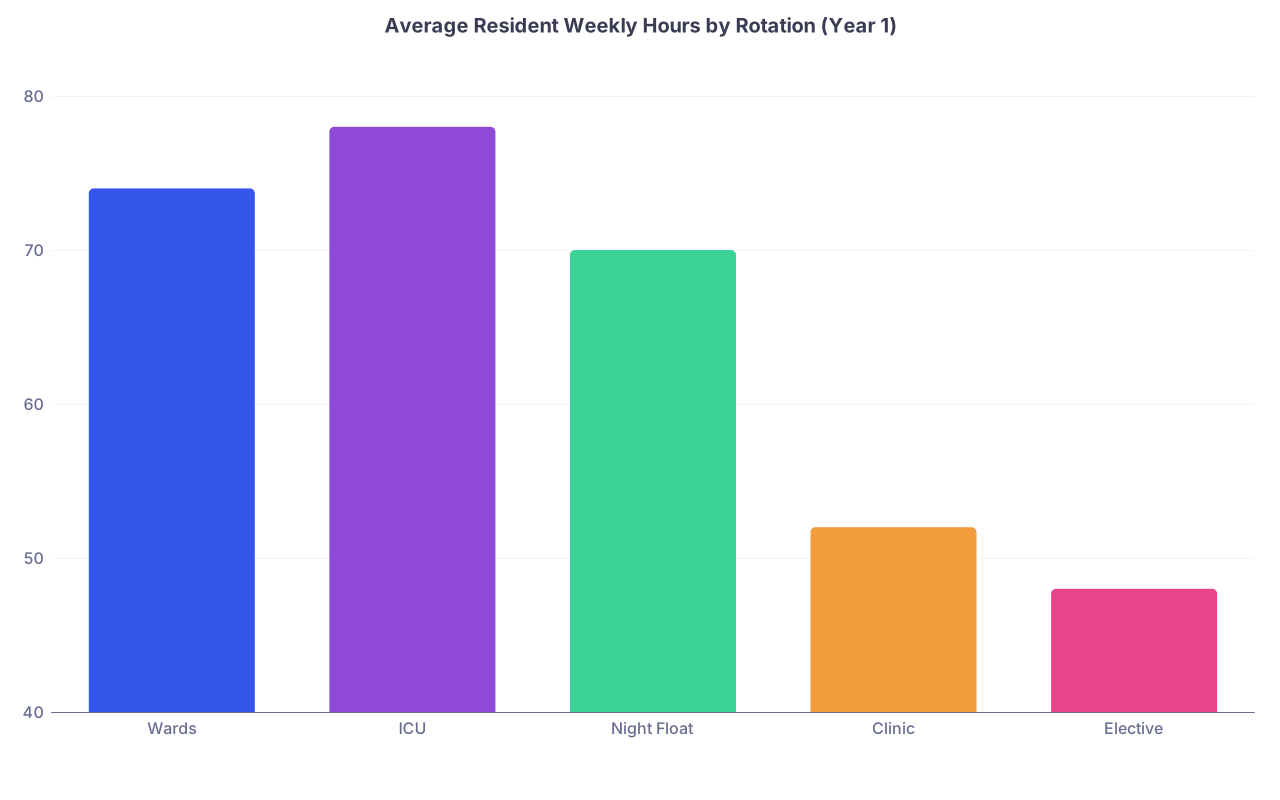
A simple visualization helps. For example, by block:
| Category | Value |
|---|---|
| Wards | 74 |
| ICU | 78 |
| Night Float | 70 |
| Clinic | 52 |
| Elective | 48 |
If you see ICU at 78, you do not need a committee. You cut a shift, add an APP, or lower caps. Immediately.
7.2 Short, Structured Debriefs
Do not ask open‑ended “how is call going?” in town halls. You will get noise.
Instead, at the end of each block, have residents completing:
- 3 fixed questions, scored 1–5:
- “Average number of hours worked per week felt… [1=reasonable, 5=unsafe].”
- “Post‑call recovery time felt… [1=adequate, 5=inadequate].”
- “Night coverage allowed safe patient care… [1=yes, 5=no].”
- One free‑text “what specific change would improve this rotation’s schedule?”
Patterns matter more than single comments. If three consecutive blocks say “NF intern is drowning from 11p–3a,” you do not argue, you change the model: either add a swing resident or offload late ED admits to hospitalists.
8. The Politics: Administration, Faculty, and Residents
New programs sit in political crossfire:
- Hospital admin wants maximum coverage from minimal FTE.
- Faculty want robust teams for teaching and research.
- Residents want safe hours and time to learn, not just grind.
Call structure and float systems are where all three collide.
Here is the blunt reality:
- If you consistently violate duty hours, you will get cited.
- If you schedule residents to be human Band‑Aids for every hospital gap, they will leave or poison your reputation.
- If you protect residents reasonably and communicate your boundaries, hospital leadership eventually learns to adjust other staffing (APPs, nocturnists, etc.).
You must be willing, as leadership, to say no to:
- “Let’s just add another resident cross‑cover at night; cheaper than another nocturnist.”
- “Can float cover clinic, ICU, and the ED hold area depending on the day?”
- “Can residents stay an extra 2 hours daily for this new quality project?”
In a mature program, residents themselves sometimes push back. In a brand new program, they often do not. They are grateful to be there and terrified of retaliation. That means you have to be the one to guard the line.
9. Future Directions: Where Early Programs Can Actually Innovate
Everyone claims to be “innovative.” Most just rename traditional structures. But there is real room to experiment if you respect core limits.
A few areas where I have seen early‑stage programs do smart things:
9.1 Data‑Driven Dynamic Scheduling
Instead of static “NF every block,” one program built:
- Quarterly review of ED admission patterns, ICU trends, and bed occupancy.
- Seasonal adjustment of NF staffing: heavier in winter respiratory surge months, lighter in summer.
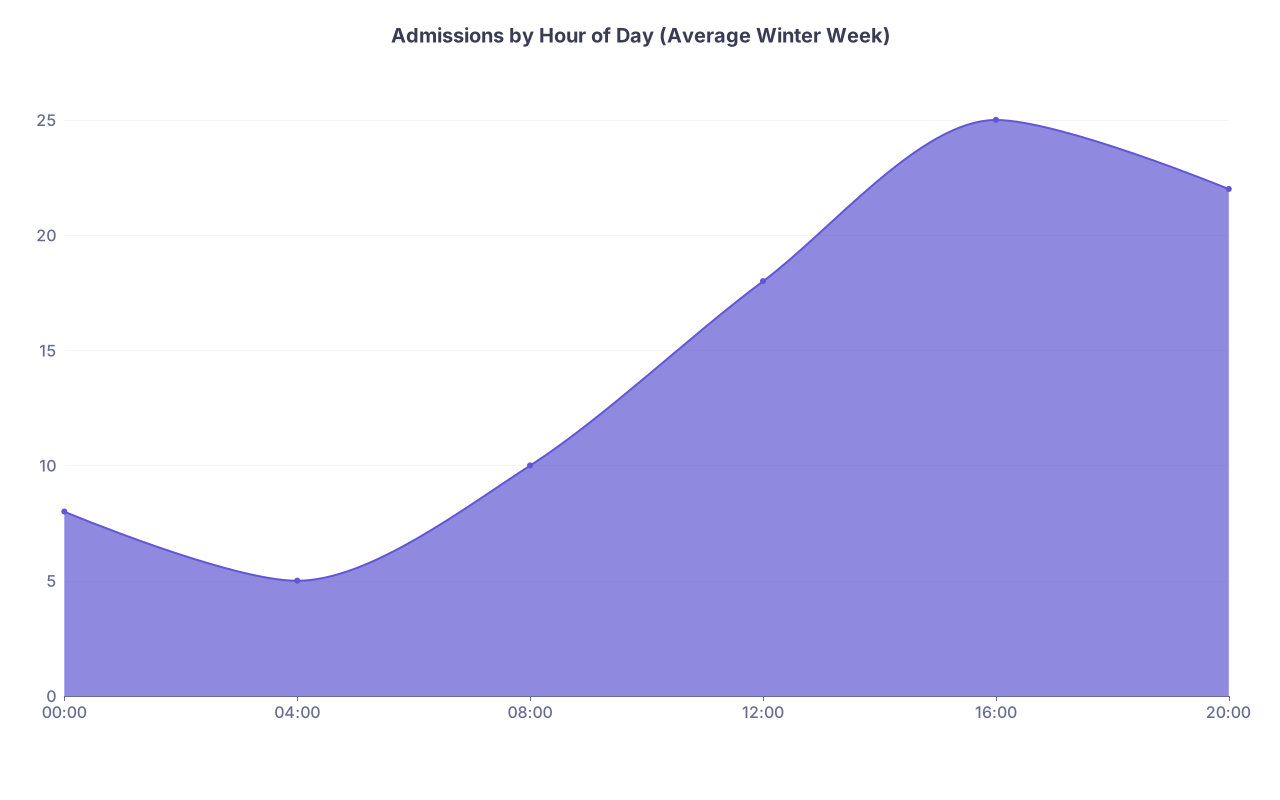
They also built a simple area chart of admission volume over time and shifted swing shifts to match peak admits:
| Category | Value |
|---|---|
| 00:00 | 8 |
| 04:00 | 5 |
| 08:00 | 10 |
| 12:00 | 18 |
| 16:00 | 25 |
| 20:00 | 22 |
They placed a 3p–11p swing covering the 16:00–22:00 spike, which cut NF overload and reduced 80‑hour weeks.
9.2 Protected “Deep Work” Time on Lighter Rotations
On clinic or elective months, rather than letting residents be free labor for every gap, some programs:
- Built explicit “buffer hours” mid‑day where residents cannot be scheduled into cross‑cover or float.
- Used that time for scholarly work, board prep, or focused QI projects.
That does not directly change call, but it changes how exploited residents feel. Which heavily influences how they perceive heavy rotations.
9.3 Smarter Use of Non‑Resident Coverage
Early programs often forget they are not required to use residents for every in‑house task.
Some systems:
- Use APPs for night cross‑cover on subspecialty floors, leaving residents to cover core medicine/surgical units.
- Use nocturnists to absorb non‑educational admissions (e.g., straightforward obs chest pain) so that NF residents focus on higher educational value cases.
The early years are the best chance you will ever have to shape those relationships before “we’ve always done it this way” calcifies.
FAQ (Exactly 6 Questions)
1. Our new program is being pushed to use 24‑hour call to “match other academic centers.” Is that a dealbreaker?
Not automatically, but it is a yellow flag. In a brand‑new program with limited residents and immature systems, 24‑hour call is high risk for hidden violations and burnout. If leadership cannot articulate caps, post‑call protection, and how they will monitor actual hours in real time, I would be wary. A transparent, data‑driven 24‑hour system can be safe; a vague one is usually not.
2. How many nights in a row is reasonable for night float in an early-stage program?
For most residents, 5 nights in a row (Sunday–Thursday) is the upper limit of what feels sustainable if the workload is moderate. Six can work if nights are capped and there is a true weekly day off, but it pushes against the 80‑hour ceiling very quickly. In year 1–2, err toward 5 with strong swing or hospitalist support rather than trying to cover the entire week with one tired NF pair.
3. Do all new programs need a formal jeopardy system, or can we “share” coverage across teams?
You need a formal jeopardy system. Informal coverage sharing almost always leads to under‑reported hours and inequity. In small programs, jeopardy residents can be placed on ambulatory or elective rotations where short‑term absence is tolerable, but there must be a named person, clear activation criteria, and a tracking system. Otherwise, your “helping out” culture becomes exploitation quickly.
4. What is a red flag in a new program’s schedule from a resident applicant perspective?
A few big ones: no explicit day off policy (or vague language about “approximately one day off a week”), unclear call frequency (“variable based on service needs”), heavy use of the word “flexible” around float/jeopardy without specifics, and any hint that residents cover multiple physically distant sites overnight without backup. Also, if the PD cannot answer “How do you monitor duty hours and what have you changed based on that data?” with specifics, that is not a good sign.
5. Is it realistic for early‑stage programs to fully comply with duty hours, or does everyone “stretch” a bit?
Full compliance is realistic if you design for it and adjust aggressively. What is not realistic is designing razor‑thin schedules that only work if nobody gets sick, no census spikes happen, and everyone leaves on time. High‑functioning new programs accept that residents will sometimes stay late for patient care but build buffers (float, caps, extra support) so the average still meets standards. Chronic stretch is laziness, not inevitability.
6. How often should a new program formally review and revise duty hour and call structures?
In the first two years: every 3–4 blocks. That means roughly quarterly. You do not wait for an annual retreat. You look at logged hours, rotation evaluations, and simple metrics like average census per team and admissions per night. When a pattern appears—ICU at 78 hours weekly, NF overwhelmed on certain days—you change the schedule, not just send a reminder email. After a few cycles, things stabilize and you can move to semi‑annual reviews.
Key takeaways:
- Early‑stage programs live or die by how honestly they design around ACGME limits and real‑world inefficiency, not fantasy schedules.
- Night float, day float, and jeopardy are powerful tools only if roles, caps, and backup rules are explicit and respected.
- The first 2–3 years are your only real chance to hard‑wire sane duty hours and call structures before bad habits become untouchable tradition.