
The way people talk about ACGME “initial accreditation” vs “continued accreditation” is often misleading—and occasionally flat-out wrong.
You are not just picking a badge on a website. You’re picking how much risk you’re willing to tolerate in residency.
Let me walk you through what it actually means for you as an applicant or new resident, cutting through the marketing fluff programs love to use.
1. Quick Plain-English Definitions
Let’s start with what these labels really are, without the ACGME legalese.
Initial Accreditation:
The program is new (or newly restructured) and the ACGME has said, “You’re allowed to start training residents, but we’re still watching you closely.” Think of this as “provisional but valid.”Continued Accreditation:
The program has been around long enough, passed a few reviews, and the ACGME is saying, “You’re established and meeting ongoing standards.” This is the normal steady-state for most programs.
Both types are fully ACGME accredited. That means:
- You can sit for your specialty board exams as long as the program remains accredited while you’re there.
- You are officially considered a resident in an accredited training program.
Where they differ is:
- Predictability
- Oversight level
- Maturity of curriculum, culture, and systems
That’s what actually affects your day-to-day life.
2. What “Initial Accreditation” Really Looks Like From the Inside
Here’s what you’re actually signing up for in a program with initial accreditation.
The Upsides (Yes, there are real ones)
You’re often getting:
Senior leadership attention
Hospital execs hate program failure. New programs usually have the CMO, DIO, and chairs staring straight at them. Money and resources can flow faster at the beginning.Room to shape the program
Early residents end up co-writing handbooks, proposing new rotations, helping design schedules, and sometimes picking new faculty. I’ve seen PGY-2s basically design an entire ambulatory block from scratch.Potential for rapid growth and reputation building
Some now “big name” community programs were tiny unknowns 10–15 years ago. Their first few classes got great case volume, close attending supervision, and lots of leadership roles.Less entrenched toxic culture
New programs rarely have that “this is how we’ve always done it” attitude. There’s no 15-year-old malignant tradition to fight.
But let’s not sugarcoat it.
The Downsides (These matter more than people admit)
Common realities in new/initial programs:
Systems are half-built
Clinic templates are a mess. Call schedules are revised three times a month. Rotations get canceled last-minute. You’ll hear: “We’re still working that out” a lot.Faculty and leadership turnover risk
Sometimes the founding PD burns out or leaves after 2–3 years. ACGME notices, but you feel the chaos long before they do.Accreditation risk if they misstep
If the Clinical Competency Committee (CCC) is disorganized, evaluations are late, case logs are low, or the program underperforms on ACGME surveys or board pass rates, they can get warnings or worse.You are the test run
Your class is the pilot project. That sounds exciting, but it also means you may be the first one discovering all the gaps: didactics, EMR defaults, consult workflows, on-call structure.
Here’s the key: initial accreditation is not “unsafe” by default. But it is less predictable. You’re betting on potential and leadership, not history and track record.
3. What “Continued Accreditation” Actually Means For You
“Continued accreditation” is what most people think of when they picture an ACGME program.
On the ground, that usually translates to:
Stable rotations and schedules
The block schedule is set. Rotations have existed for years. Clinic workflows are established. You’re not inventing basic processes.Known track record with boards and jobs
You can ask:- “What’s your board pass rate for the last 5 years?”
- “Where did graduates match for fellowship?”
- “Where do grads get jobs?” And you’ll get real data, not hypotheticals.
More predictable culture
Residents can tell you if the program is chill, intense, research-heavy, service-heavy, or just dysfunctional. There is history.Accreditation risk usually lower—but not zero
Programs with continued accreditation can still get significant citations, adverse actions, or even probation if they slip. I’ve seen long-standing programs get hammered after years of neglect.
In short: with continued accreditation, you’re trading some of the “build-your-own-program” energy for stability and known outcomes.
4. What Happens If Accreditation Status Changes While You’re There?
This is what applicants really worry about, and rightly so.
Common scenarios
Initial → Continued Accreditation
Best case. Program does well, ACGME is satisfied, status upgrades.
Your experience: basically no disruption. Maybe more applicants in later years, program becomes more competitive.Initial Accreditation → Withdrawn / Closed
This is rare, but everyone thinks about it.If this happens:
- The sponsoring institution and ACGME work to place current residents in other programs.
- You do not just get dumped on the street. But transfers can mean:
- Moving cities
- Losing a year if credit doesn’t fully transfer
- Joining a program with a different vibe than what you signed up for
Continued Accreditation → Probation / Warning
Possible causes:- Terrible ACGME survey results
- Board pass rates dropping
- Chronic duty hour violations
- Missing key educational requirements
For you:
- Day-to-day, sometimes nothing dramatic changes immediately.
- But it affects program reputation, recruitment, and morale, and forces leadership to scramble.
The one thing that usually protects you
As long as your program is ACGME-accredited while you are there, your time counts toward board eligibility. If a program closes, the system tries hard to place you somewhere else so your training remains valid.
But nobody can promise zero disruption.
5. How To Decide: Is an Initial-Accreditation Program Safe For You?
You’re not deciding whether initial accreditation is “good” or “bad.” You’re deciding whether the particular new program in front of you is a smart bet.
Here’s how I’d reality-check any new program before ranking it.
1. Look at the sponsor and context
Ask yourself:
Is this a brand-new teaching hospital with no educational infrastructure?
Higher risk.Or a large academic or long-standing community hospital finally adding your specialty?
Lower risk. If they’ve run IM, EM, or surgery for 20 years, they know how to do GME.
| Factor | Lower Risk Example | Higher Risk Example |
|---|---|---|
| Hospital type | Large academic or major community | Small standalone hospital |
| Existing residencies | Multiple successful ACGME programs | None or one very new program |
| GME office | Established DIO and staff | Minimal or newly formed |
| Case volume | Historically high for that specialty | Borderline or just meeting minimums |
| Fellowship network | Long-standing related fellowships | No subspecialty presence |
2. Scrutinize the program director and faculty
You want:
- A PD with prior academic or leadership experience, not someone doing it as a side hobby.
- Faculty who’ve trained at solid places and actually like teaching.
- A PD who can answer your detailed questions without hand-waving.
Red flag phrases I’ve heard from shaky new programs:
- “We’ll probably figure that out once the first class arrives.”
- “We don’t have that rotation yet, but it should be coming.”
- “We haven’t decided how we’re doing didactics exactly.”
Compare that to a strong new program:
- “Here’s our didactic schedule template.”
- “This is the call structure we’re piloting; we’ll adjust based on your feedback.”
- “Here’s our 3-year block schedule and which sites you’ll be at.”
3. Ask direct questions during interviews
You should be asking:
- “Why did the hospital decide to start this residency now?”
- “What metrics are you tracking in year one and two to make sure the program succeeds?”
- “What is your plan if ACGME gives you major citations?”
- “How many core faculty do you have right now and what are their FTEs?”
- “What concrete protections are in place if volumes or staffing change?”
And specifically for your own sanity:
- “How will residents be involved in shaping the program—but not carrying its administrative weight?”
If the answer to every problem is “the residents will help fix it,” that’s code for “you’ll be unpaid middle management on top of training.”
6. How Accreditation Status Affects Your Future: Boards, Jobs, and Fellowships
This is where the myths really spin out of control.
Board eligibility
- Being at an initially accredited program is fine as long as the program stays ACGME-accredited through your training.
- If accreditation is lost and can’t be salvaged, the transfer plan matters. Program leadership should be able to explain what they’d do in that scenario.
Fellowship applications
Fellowship PDs look less at “initial vs continued” and more at:
- Your letters
- Your clinical performance
- Your research or scholarly work
- Your case log and procedural experience
What can hurt you from a shaky new program is not the label itself, but:
- Weak mentorship
- Missing key rotations
- Chaotic schedules that leave you with poor evaluations or low case volume
- No one with connections to call on your behalf
Job prospects
Most employers care about:
- ACGME accreditation (yes/no)
- Board certification (yes/no)
- Your references and reputation
They’re not digging through old ACGME PDFs to see if your program started as “initial” in 2022.
7. Simple Decision Framework: When Should You Be Cautious?
If you want a blunt filter, use this.
You should be extra cautious ranking a program with only initial accreditation highly if:
- It’s the hospital’s first and only residency.
- Leadership can’t clearly explain their curriculum, rotation sites, and long-term vision.
- There’s no transparent plan for board prep, research, or remediation.
- They dodge your questions about backup plans if accreditation issues arise.
You can be reasonably comfortable with an initial-accreditation program if:
- The institution already runs multiple strong residencies or fellowships.
- The PD has a clear, detailed plan and seems to understand ACGME requirements cold.
- You meet current residents from other programs there who seem supported and not miserable.
- You’d actually like the city and hospital even if things turn out “average” instead of “amazing.”
And remember: a mediocre, long-standing program with “continued accreditation” can still be a miserable place to train. Status is one variable, not the whole story.
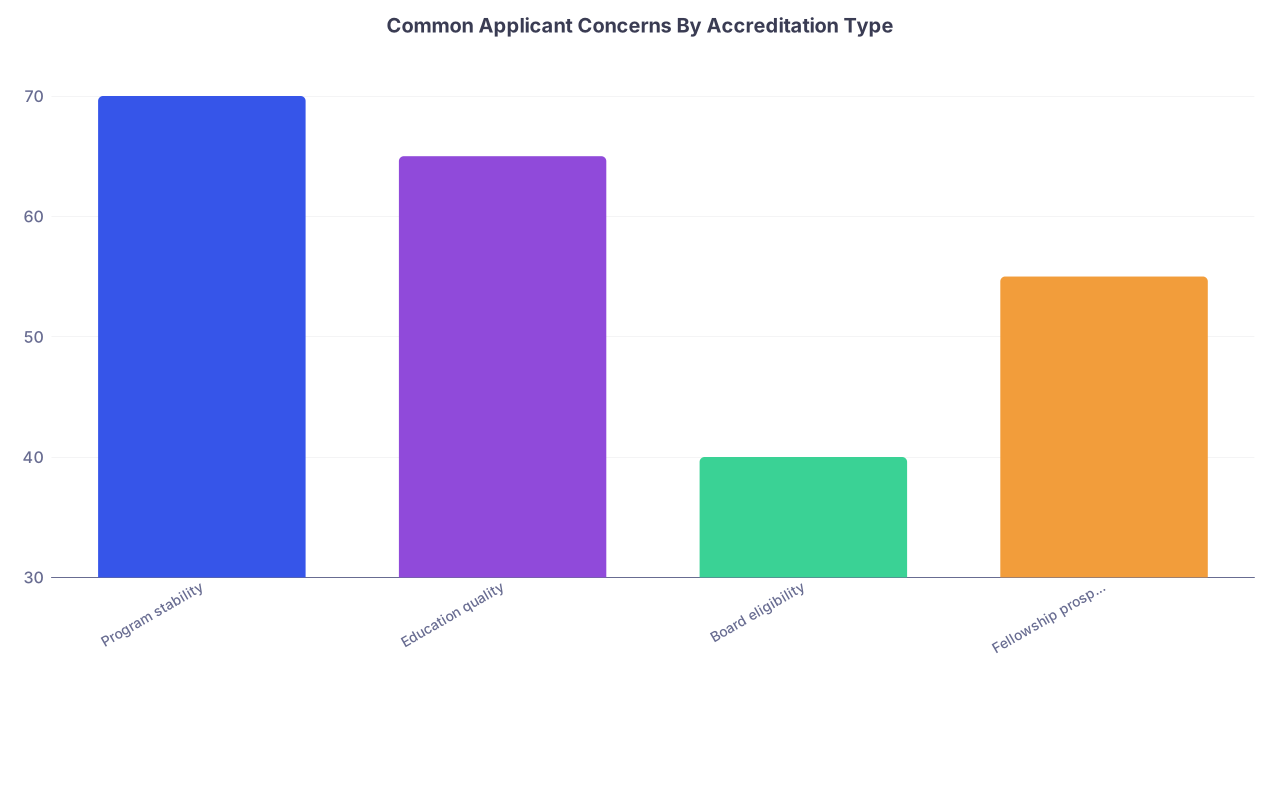
| Category | Value |
|---|---|
| Program stability | 70 |
| Education quality | 65 |
| Board eligibility | 40 |
| Fellowship prospects | 55 |

| Step | Description |
|---|---|
| Step 1 | See Initial Accreditation |
| Step 2 | Review PD and faculty track record |
| Step 3 | High caution - ask hard questions |
| Step 4 | Reasonable risk if fit is good |
| Step 5 | Rank lower or avoid |
| Step 6 | Existing GME at hospital |
| Step 7 | Curriculum defined? |

8. Bottom Line: What “Initial” vs “Continued” Means For You
Strip it down:
- Both initial and continued accreditation are valid ACGME statuses.
- Initial accreditation means: new, under closer scrutiny, more moving parts. More upside and more risk.
- Continued accreditation means: established, track record, and generally more predictable.
What matters more than the label:
- Who is running the program
- The hospital’s existing educational culture
- How clearly they can explain rotations, didactics, support, and contingency plans
If you’re risk-averse, have specific fellowship goals, or need stability for family reasons, you’ll likely lean harder toward well-established, continued-accreditation programs.
If you’re flexible, comfortable with some chaos, and excited by building something new—and the leadership looks good—an initially accredited program can be a solid bet.

FAQ: Initial vs Continued Accreditation
Does “initial accreditation” mean I can’t sit for my boards?
No. As long as the program is ACGME-accredited during your training, your time counts for board eligibility. The risk is if the program loses accreditation and cannot place you elsewhere, but that’s uncommon and usually managed with transfers.Is a residency with continued accreditation always better than one with initial accreditation?
No. A weak, stagnant program with continued accreditation may give you worse training than a well-designed, energetic new program. You have to judge the specific program: leadership, resources, case volume, and culture.How can I tell if a new, initially accredited program is “safe enough” to rank?
Look at the sponsoring hospital’s GME history, the PD’s experience, how detailed their curriculum is, and how honestly they answer questions about challenges and contingency plans. If everything is vague, that’s a bad sign.Will fellowship directors care that my program was initially accredited when I trained there?
What they really care about: your letters, competence, scholarly work, and reputation. They’re not typically rejecting people because the program was in initial status, especially if it’s attached to a strong institution with other established programs.Could a continued-accreditation program lose its status while I’m there?
Yes. Any program can get serious citations or probation if quality drops. But programs with a long, positive track record are generally lower risk. During interviews, ask directly if they’ve had recent ACGME concerns and how they addressed them.
Key takeaway 1: Initial vs continued accreditation are both legitimate; the label doesn’t decide your future—leadership, culture, and case volume do.
Key takeaway 2: New programs offer influence and opportunity but come with real instability risk. Ask specific, uncomfortable questions before you trust them with your training.