
Last week a new intern called me from an empty workroom at 2 a.m. “We did one central line this month,” she said. “My senior keeps saying, ‘The volume will come,’ but what if it doesn’t? What if I finish residency having watched everything and done nothing?”
If you’re looking at a shiny new residency program and your stomach drops at the thought of being the “guinea pig class” with no procedures, no volume, and a bunch of promises—yeah, I get it. This is exactly the nightmare scenario that lives in the back of my head too.
Let’s talk about what actually happens if your new program doesn’t have the procedures or case volume you need—and what you can do before and after you match there.
First: How Bad Could It Really Be?
Let me be blunt: low volume isn’t some cute little inconvenience. It can mess with:
- Your competence
- Your confidence
- Your future job or fellowship chances
- Your board pass rate and credentialing
You already know that. That’s why you’re reading this.
Here’s the ugly version your brain is probably running on a loop:
- You match to a brand‑new IM/EM/Anesthesia/Surgery program
- Hospital census is low, attendings are new, referrals are thin
- PGY‑3 rolls around and you’ve done like 5 intubations, 3 central lines, 1 chest tube, and 0 sick cases solo
- You graduate technically board‑eligible but practically terrified
- Jobs/fellowships side‑eye your log: “Why so few cases?”
- You start your first attending job and feel like an impostor with a name badge
Is that possible? Yes. I’ve watched versions of that play out.
But here’s the part nobody tells you when you’re spiraling at 1 a.m.:
Most new programs cannot survive long‑term if they truly starve residents of volume. ACGME and the sponsoring institution have skin in the game. If they don’t fix it, they risk probation, closure, reputation damage, and wasted money.
The real question isn’t “What if the volume is low?” The real question is “What if the volume is low… and leadership doesn’t care or can’t fix it?”
That’s the scenario you have to screen for.
How To Tell If “We’ll Build Volume” Is Real Or Just Vibes
You’re going to hear lines like:
- “We’re growing.”
- “Volume is increasing.”
- “We’re building partnerships.”
- “We’re committed to resident education.”
Cool. None of that means anything without evidence.
Here’s what I’d actually ask and look for.
1. Hard numbers, not hand‑waving
Ask them, straight up:
- Average daily census (medicine, surgery, ICU, ED volume per day)
- Annual ED visits
- Annual OR cases
- Number of key procedures last academic year (intubations, central lines, LPs, chest tubes, deliveries, etc.)
- Number of residents per year and how they project that will change
Then look at this kind of thing:
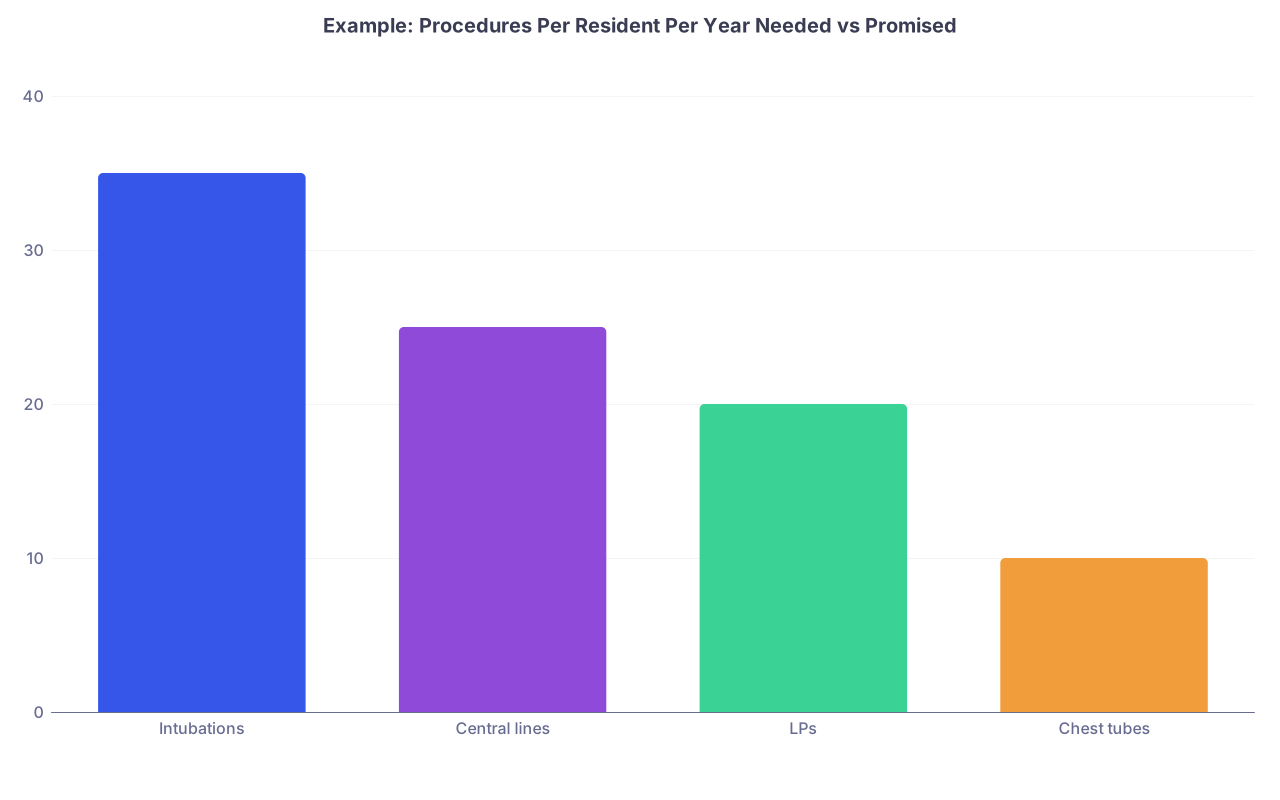
| Category | Value |
|---|---|
| Intubations | 35 |
| Central lines | 25 |
| LPs | 20 |
| Chest tubes | 10 |
If they can’t give you any concrete numbers? That’s a red flag. A new program will have limited data, sure, but they should at least have hospital‑level numbers and some basic projections.
2. Where do the cases actually come from?
New programs like to say, “We’re starting a trauma service,” or “We’re expanding cardiology.”
You want details, not dreams:
- “Which surgeons/trauma/ICU attendings are already on staff?”
- “Do you have 24/7 anesthesia/IR/OB coverage right now?”
- “What’s your transfer‑out rate for sick patients?” (If everyone gets shipped out, guess who doesn’t get the procedures? You.)
- “Are residents the primary operators or just observers when consultants are involved?”
If you hear, “Well, we’re planning to recruit X and Y” with zero signed hires, that’s hope, not a plan.
3. Concrete affiliation agreements
Volume often comes from affiliations: trauma centers, children’s hospitals, cancer centers, VA, etc.
You want to know:
- “Are there signed agreements in place for residents to rotate there?”
- “Have residents already rotated there this year?”
- “Is the rotation ACGME‑approved as part of our curriculum?”
If they say things like “We’re in talks with…” and nothing is signed, your procedure experience just became a negotiation in progress.
4. What’s written in the curriculum vs. what’s aspirational
Ask to see the actual rotation schedule for each PGY year.
Then check:
- How many ICU months?
- How many ED / OR / L&D months?
- Any away rotations built in for high‑volume experiences (trauma, peds, etc.)?
- Are core procedures listed as graduation requirements with tracking?
You want to see that someone has sat down and mapped, “Okay, residents need X encounters and Y procedures, so we’ve built Z rotations to make that happen.”
Because “We’ll make sure you get what you need” without a schedule is code for “We’ll figure it out on your back.”
What If I Already Matched To The New Program And Volume Is Low?
This is the true “oh sh*t” moment: you already matched, you show up, and it’s… thin.
Low census. Consultants take every interesting case. Procedures go to attendings or CRNAs or IR. You’re on call, bored, and guilty for being bored.
Now what?
Step 1: Get brutally honest data
Don’t just “feel” like volume is low. Prove it.
Start tracking for a month or two:
- Patients per shift / per day
- Procedures you could have done but weren’t allowed to
- Procedures you did do
- How often patients are transferred out instead of managed in‑house
Then compare what you’re seeing to what’s promised in your curriculum or what’s expected for your specialty.
For perspective, here’s a very rough (and simplified) feel of what “adequate” might look like in high‑procedural fields by graduation:
| Specialty | Intubations | Central Lines | LPs | Chest Tubes |
|---|---|---|---|---|
| EM | 35–50 | 25–40 | 20+ | 10–20 |
| Anesthesia | 150+ | 40+ | few | 10+ |
| Critical Care (fellow) | 50+ | 60+ | 20+ | 15+ |
These are ballparks, not official numbers. But if your log at the end of PGY‑2 is like 2 intubations and 1 central line in EM? That’s a serious problem.
Step 2: Use the system before you nuke anything
You have more levers than you think:
- Program Director (PD)
- Clinical Competency Committee (CCC)
- Program Evaluation Committee (PEC)
- Your GME office / DIO (Designated Institutional Official)
This is where you don’t just go and say “Volume feels low.” You go with:
- “Our ICU admits about X patients/day, residents are doing Y procedures/month.”
- “Our logs by PGY‑year look like this.”
- “Compared to typical ACGME expectations and procedure minimums for privileging, we’re behind.”
And then you ask very plainly:
- “What is the concrete plan to increase resident procedural exposure this year and next?”
- “Can we add rotations at [nearby trauma center / VA / children’s hospital]?”
- “Can we change workflow so residents do all lines/LPs unless contraindicated?”
If leadership responds with urgency and specifics—extra rotations, new agreements, changing protocols so residents are first‑up for procedures—that’s hard work, but salvageable.
If they respond with defensiveness, gaslighting (“You’ll be fine, you’re just anxious”), or vague future talk? That’s when my stomach drops.
Step 3: Aggressive self‑advocacy (without being That Resident)
There’s a line between advocating and annoying. But if your competency is on the line, I’d push.
Things I’ve seen residents do that worked:
- Asking seniors/attendings at sign‑out: “Are there any anticipated LPs/lines/intubations? I’d like to be the one called.”
- Leaving your number with ED/ICU charge nurse: “Please page me for procedures even if I’m not technically on that team tonight, if workload allows.”
- Volunteering for higher‑acuity rotations, nights, ICU blocks where more happens
- Swapping some elective time for high‑volume rotations at affiliated sites
This shouldn’t have to be necessary. But in thin programs, the squeaky wheel really does get more procedures.
Worst‑Case: Transferring Programs or Extending Training
This is the nuclear scenario you’re secretly Googling at 3 a.m.
“What if this program just never gets better? Am I stuck? Will anyone take me?”
Transferring is possible. It’s not easy. It’s not guaranteed. But I’ve watched residents do it.
Realistically, programs are more open to taking a transfer when:
- You’re in a stable specialty (IM, FM, Peds, Psych) vs hyper‑competitive ones
- You’re early (PGY‑1 or PGY‑2, not late PGY‑3 with tons of gaps)
- You have a clean record and strong evaluations
- Your PD is willing to support the transfer (or at least not sabotage it)
And the reason matters. Saying “your program sucks” will backfire. But documenting:
- “Our ICU has no overnight intensivist; all critical patients are transferred out.”
- “Our ED volume is X/year with Y residents; there are barely any resuscitations.”
- “Here are my actual procedure logs vs. what’s expected in this specialty.”
That lands differently. It shows you’re trying to become a safe physician, not just complaining.
Some residents also choose to:
- Do an extra year (chief year, extra fellowship time) somewhere with higher volume
- Seek out fellowships known for procedural intensity (critical care, EM fellowships, etc.) to “make up” for it
Is that ideal? No. It’s patching a problem that shouldn’t exist. But it’s a path.
Big Picture: What Future You Actually Needs
Your brain is stuck on one question: “What if I don’t get enough procedures?”
Zoom out. What do you actually need out of residency?
- Enough reps on core procedures to be safe on day one as an attending
- Enough variety and complexity of cases to recognize what can kill people and how to stop it
- Enough clinical volume that pattern‑recognition becomes instinct, not guesswork
- Enough supervision that you don’t just do stuff—you learn to do it right
A new program can technically check those boxes. But only if:
- The hospital already has real volume (they’re not just starting a hospital from scratch and a residency)
- There are real, signed affiliations with higher‑acuity centers
- Leadership is obsessed with making sure residents hit their milestones, not just filling service gaps
- Early classes are transparently monitored and supported, not sacrificed
If their entire selling point is, “You’ll get in on the ground floor and have leadership opportunities,” but they dodge questions about case logs, sick patients, or transfers—be suspicious.
Shiny leadership titles don’t save you when you can’t intubate.
How To Grill A New Program (Without Sounding Like A Jerk)
You’re allowed to ask hard questions. You should.
If you’re on interview day or a second look, you can say:
- “I know you’re a new program. Can you share concrete data on your current patient volume and how many procedures residents have logged so far this year?”
- “How do you ensure residents—not fellows, not APPs—are the primary operators for core procedures?”
- “Do you have any residents rotating at other institutions for higher acuity or specialized exposure? Are those rotation agreements already in place?”
- “If the projected volume doesn’t materialize in the next 1–2 years, what’s Plan B for resident training?”
Then watch not just what they say, but how they say it.
If they seem relieved you asked and start rattling off specifics? That’s a good sign.
If the room gets awkward and they pivot to generic mission‑statement fluff? That’s your answer.
Here’s the mental flowchart I wish someone had shown me before I ever ranked a new program:

| Step | Description |
|---|---|
| Step 1 | Considering new program |
| Step 2 | Ask for concrete volume and procedure data |
| Step 3 | Check affiliations and rotations |
| Step 4 | High risk - rank lower or avoid |
| Step 5 | Ask about resident role in procedures |
| Step 6 | Reasonable risk - consider ranking |
| Step 7 | Data specific and adequate? |
| Step 8 | Affiliations signed and active? |
| Step 9 | Residents primary operators? |
One Harsh Truth And One Reassuring One
Harsh truth: If you choose a brand‑new program, you are taking on some risk. No clever wording changes that. You won’t fully know how the volume and culture shake out until you’re already there.
Reassuring truth: You’re not powerless, and you’re not the first person to worry about this. ACGME, the GME office, and even future recruitment for that program depend on you not graduating dangerously under‑trained. That gives you leverage.
If you remember nothing else, remember this:
- Don’t believe “we’re growing” without numbers, affiliations, and a real rotation map.
- If you end up in a low‑volume situation, document it, push through formal channels, and aggressively seek out procedures—you’re protecting your future patients, not just yourself.
- Transferring or supplementing training is possible; it’s not ideal, but you’re not trapped on a burning ship with no exits.
You’re allowed to be anxious about this. Honestly, if you weren’t worried about your training, that would worry me more.