
The shiny new residency program everyone’s hyping might be built on your exhaustion.
That’s the fear, right? That “exciting new program” is just code for: fewer protections, more call, no culture, no alumni, and you become cheap labor to help a hospital plug coverage gaps it never staffed properly.
You’re not crazy for thinking this. I’ve heard PDs say out loud in meetings: “Once we get residents, we can stop paying so much for nocturnists.” Translation: residents become the budget line item that makes admin smile and interns cry.
Let’s break this down like someone whose sleep and sanity are actually on the line.
What “New Program” Actually Means (Behind the Marketing)
New residency ≠ one thing. There are flavors:
- Brand-new hospital + brand-new residency
- Long-standing hospital that just got GME funding
- Community hospital “partnering” with a big name university (often mostly on paper)
- Existing institution that’s expanding a single specialty (e.g., first time adding surgery)
The anxiety spiral goes something like this:
- “No senior residents to protect me”
- “No proven track record with duty hours”
- “No one to say, ‘this place is toxic, don’t come here’”
- “They just want residents to cut staffing costs”
Sometimes that’s dramatic. Sometimes it’s exactly what happens.
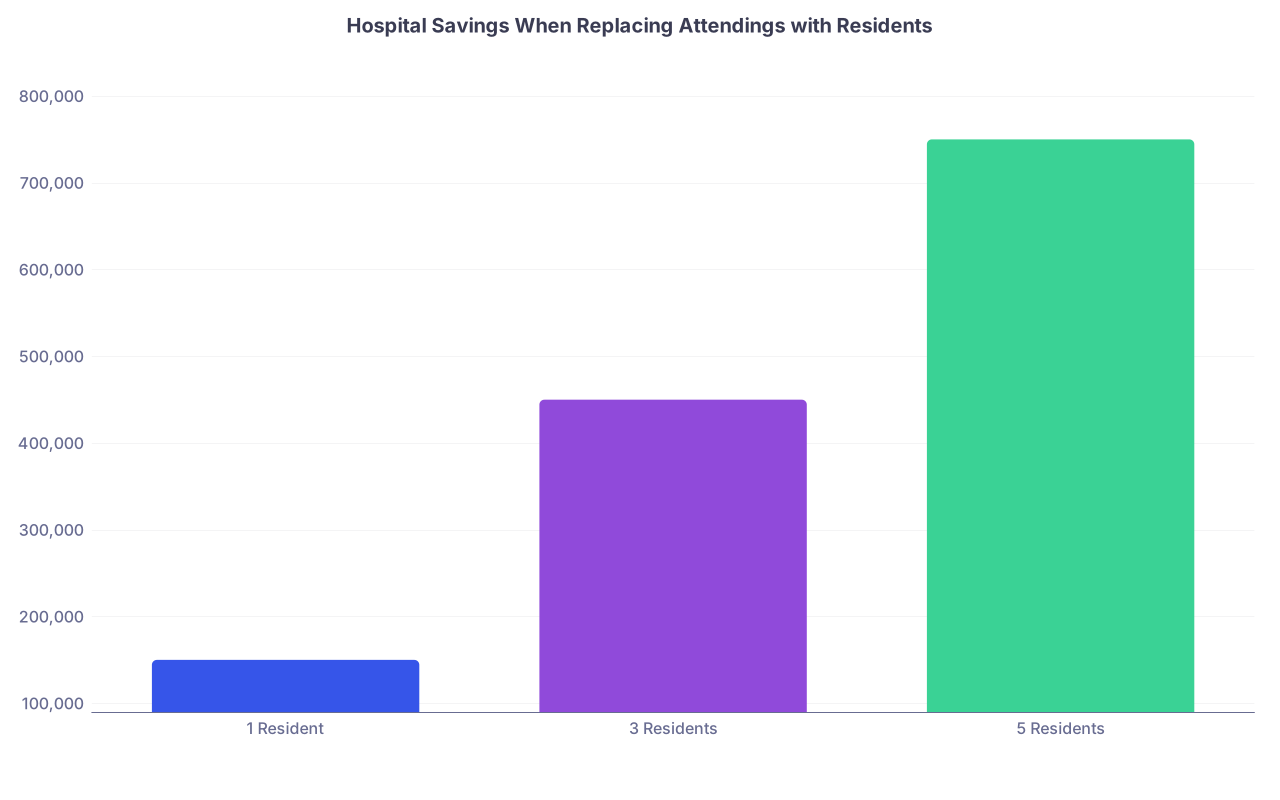
Here’s the ugly financial reality that makes all of this feel worse:
| Category | Value |
|---|---|
| 1 Resident | 150000 |
| 3 Residents | 450000 |
| 5 Residents | 750000 |
That’s why you feel like “cheap labor.” Because on admin spreadsheets, you are.
The question isn’t “Will I be used as cheap labor?” The question is “How do I tell if this specific new program is going to treat me like cheap labor and burn me out?”
The Red Flags That Scream: “We Just Want Your Labor”
This is where I get a little harsh, because too many people gloss over this stuff.
If you’re looking at a shiny new residency and you see a bunch of these, your alarm bells should be going off.
1. Coverage Depends on Residents From Day 1
If residents are being plugged into core 24/7 coverage immediately, that’s scary.
Bad signs:
- “You’ll be our first night float intern class.”
- “We’re so excited, we can finally stop using locums.”
- “Right now attendings take home call, but with residents we’ll move to in-house coverage.”
That last one sounds fine until you realize “in-house coverage” might be…you. Alone. At 3am. In a hospital that’s never had a resident step foot in it.
2. Vague or Evasive Duty Hour Answers
Ask, “How do you monitor and enforce duty hours?”
If they say:
- “We follow ACGME rules, of course” with no specifics
- “Honestly, we’re more like a family so we just help each other out”
- “We’re still working out the exact schedule, but trust us, it’ll be balanced”
That’s not okay. A new program should be OVER-prepared here, not winging it.
You want to hear:
- Exact shift structure
- Where residents physically document hours
- Who reviews and acts on violations
No details = you’re the pilot test animal.
3. No Clear Ancillary Support
If you’re thinking: “Wait, am I also the phlebotomist, transporter, social worker, and unit clerk?” you might be right.
Ask bluntly:
- “Who draws STAT labs at night?”
- “Do nurses put in all their own orders?”
- “Who handles discharge paperwork logistics?”
- “Do residents transport their own patients to imaging overnight?”
If the answer is “residents” to 3 or more of those, your day just became a 14-hour shift squeezed into 12, and then you still document until midnight.
The Green Flags That Say: “We Actually Care About Not Destroying You”
Let me balance the doom a bit. There really are good new programs. The problem is they don’t just say the right things. They show them.
Green flags I’d take seriously:
1. Overstaffing Early Rather Than Understaffing
If they’ve kept full attending/hospitalist coverage even with residents coming in, that’s huge.
Examples of good signs:
- “Attendings will still be in-house 24/7 for the first few years.”
- “Hospitalists will continue to see their own full census; residents are supernumerary initially.”
- “We intentionally capped resident census lower the first two years.”
That means they’re prioritizing education over staffing savings. Rare, but it exists.
2. Honest Acknowledgment of Being New
Counterintuitively, “We’re new and expect to get some things wrong, here’s how we’ll adapt and protect you” is safer than “We’re perfect.”
Look for:
- A clear process to anonymously report problems
- Actual examples of changes they’ve already made from resident feedback (even if it’s just from prelims/rotators)
- A PD who says “If call is unsafe, I cancel it. I’ve done it before.”
If everyone is endlessly positive and no one can name a single thing they’re actively working to improve? That’s suspicious.
How Overworked Is “Normal” vs “Exploitative”?
Let me be brutally honest: you will be tired in residency. Even in great programs. You will have days where you are, in fact, doing cheap labor work—because that’s how US healthcare is set up right now.
But there’s a difference between hard and unsafe.
Here’s a simplified way to think about it:
| Scenario | “Hard but Reasonable” | “Exploitative and Unsafe” |
|---|---|---|
| Hours | 55–65 avg with true days off | 75+ weekly, bad hour logging |
| Night call | Predictable schedule, backup attending | Constant short-notice changes, no backup |
| Support | Nurses/RTs/consults responsive | Residents handle everything non-physician too |
| Culture | PD cares when you’re drowning | “Everyone went through this, suck it up” |
| Education | Protected didactics mostly honored | Teaching constantly canceled for staffing |
If you’re starting to worry your future program is creeping into the right-hand column—listen to that.
Questions You Have to Ask New Programs (Even If It Feels Awkward)
You can’t just rely on vibes. You need data. Ask uncomfortable questions. If they get weird about it, you’ve learned something important.
Here’s what I’d actually say out loud on interview day or in a follow-up email:
- “What concrete staffing changes are being made because residents are joining? Any roles being reduced or cut?”
- “Can you walk me through a typical call shift—minute by minute—for an intern on their busiest rotation?”
- “How are duty hours logged? Who reviews them? Have you ever changed schedules because of violations?”
- “What’s the highest patient census an intern or senior would carry here? Is that a hard cap or flexible?”
- “If I feel unsafe with my workload in a moment—who do I call right then?”
Then watch not just what they say, but how fast and detailed their answer is.
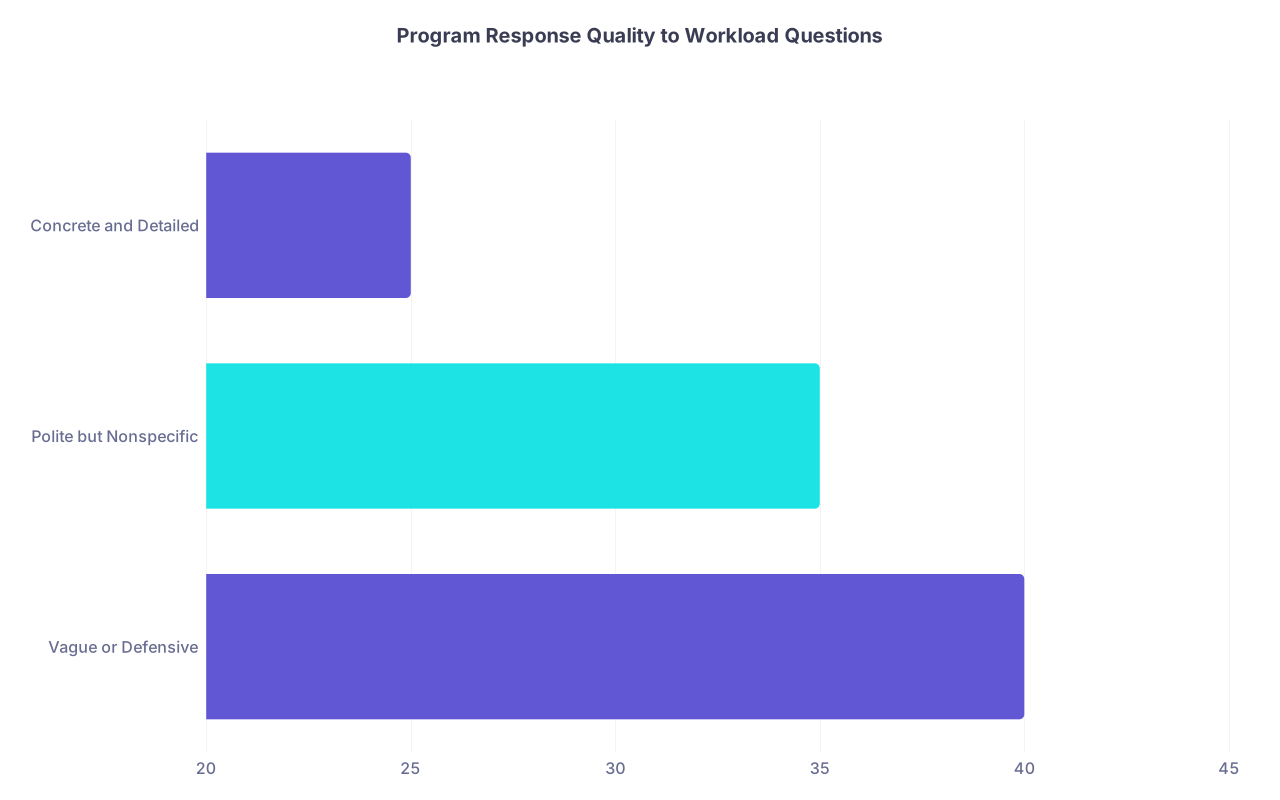
If it helps to visualize what a solid vs shaky answer pattern looks like:
| Category | Value |
|---|---|
| Vague or Defensive | 40 |
| Polite but Nonspecific | 35 |
| Concrete and Detailed | 25 |
Way too many new programs live in those first two bars.
The “Future of Medicine” Spin vs Your Reality at 2am
New residencies love to market themselves as “innovative,” “future-facing,” “team-based care,” “AI-driven,” whatever buzzword is trending this year.
You know what none of that helps with?
- Being the only person physically in-house covering 30+ patients
- No senior above you to ask, “Is this sepsis or just dehydration?”
- A PD who’s stretched across 12 committees and can’t fix your schedule
- A hospital that’s never integrated learners and treats you like an annoyance or a workhorse
Future of medicine is cute. You need:
- Safe staffing
- Real supervision
- A program that won’t shrug when you’re wrecked by February of intern year
If they’re talking about “transformational care models” but can’t tell you how many patients you’ll cross-cover at night, something’s off.
Reality Check: Why People Still Choose New Programs (And Aren’t Always Miserable)
Here’s where your anxious brain is probably going, “So I just shouldn’t rank any new programs?” Not that simple.
Some people actively choose new programs and do just fine, because they’re getting:
- Faster leadership opportunities (chief roles, committees, QI projects)
- More flexibility building rotations/electives from scratch
- Closer relationships with attendings (fewer total residents)
- A chance to help design a culture that isn’t already toxic and crusted over
If you’re the kind of person who:
- Speaks up when something is unfair
- Can tolerate ambiguity
- Doesn’t need everything perfectly paved ahead of you
…then a well-designed new program can work. Not stress-free. But not inherently a death sentence.
Just don’t confuse “new” with “automatically progressive” or “obviously terrible.” It’s neither. It’s a risk profile. You have to decide how much risk you can live with.
How to Protect Yourself if You Do Match at a New Program
Let’s say you end up there. Maybe you liked the city. Maybe it was your only offer. Maybe you took a chance.
You’re still not powerless.

| Step | Description |
|---|---|
| Step 1 | Start Intern Year |
| Step 2 | Track Your Hours Honestly |
| Step 3 | Identify Unsafe Patterns |
| Step 4 | Talk to Senior or Chief |
| Step 5 | Monitor and Reassess |
| Step 6 | Escalate to PD |
| Step 7 | Contact GME or Ombudsperson |
| Step 8 | Problem Fixed? |
| Step 9 | Still Unsafe? |
Stuff you can do from day 1:
- Log your duty hours accurately. Stop “rounding down to be a team player.” That only proves to GME that everything’s fine when it’s not.
- Keep a private record (dates, shifts, census, near misses). This isn’t to be dramatic. It’s to have receipts when you say, “This is unsafe.”
- Find allies—nurses, respiratory therapists, a few attendings who clearly care. They see patterns you don’t. They can often back you up when you raise concerns.
- Use your class. If all interns are drowning, go as a group. It’s a lot harder for leadership to gaslight a united front.
And if it ever crosses from “this is really hard” into “this is genuinely dangerous” territory (unsafe ratios, no backup, constant near misses) you are allowed to escalate. GME office. Institutional DIO. Even ACGME if you absolutely have to. You’re not “being dramatic.” You’re protecting patients and yourself.
Quick Comparison: New vs Established Programs
This might help your decision-making brain calm down a little:
| Factor | New Program | Established Program |
|---|---|---|
| Policies | Often untested, evolving | Stable but sometimes rigid |
| Workload | Can be unpredictable | More predictable patterns |
| Culture | Blank slate, can be great or awful | Known reputation (good or bad) |
| Mentorship | Fewer upper levels, closer to attendings | More residents, more peer support |
| Risk of Overwork | Highly variable, depends on leadership | Also real, but easier to research |
You’re not avoiding risk by choosing an older program. You’re just choosing a different type of risk. Overwork is everywhere. Transparency is what you’re hunting for.
What You Can Do Today
You don’t have to fix the whole system tonight. But you can get a little less blind about this specific fear.
Here’s a concrete thing you can do right now:
Open your rank list (or your list of programs you’re considering applying to) and mark every new or recently accredited program. For each one, write down three questions about workload, staffing, and support that you haven’t heard a clear answer to yet. Then: email the coordinator or PD and ask them directly.
Their answers—and how they answer—will tell you more than any glossy brochure ever will.
FAQ (Exactly 5 Questions)
1. Are new residency programs always more exploitative than established ones?
No. I’ve seen some older programs abuse the “we’re prestigious” card to overwork residents just as badly. The difference is: with older programs, there’s usually a paper trail—reviews on Reddit/SDN, alumni you can talk to, known reputations. With new programs, you don’t have that, so your margin for error is smaller. You’re relying almost entirely on what they show you and how honest they are.
2. How can I tell if a new program is just trying to save money with residents?
Look for structural signs. If they openly talk about cutting locums, reducing nocturnist shifts, or changing hospitalist coverage “because residents are coming,” that’s a red flag. Ask what concrete roles or staffing patterns are changing with the launch of the residency. If they can’t (or won’t) answer plainly, assume cost savings are a driving motivator and you’re part of that calculus.
3. Is it risky to rank a brand-new program highly?
Yes, there’s real risk. You’re betting on leadership you don’t know, policies that haven’t been stress-tested, and a culture that doesn’t exist yet. Some people are okay with that because of location, specialty, or the chance to shape a program. If the thought of being the first to go through all the growing pains keeps you up at night, you probably don’t want it in your top few ranks unless the alternative is not matching.
4. What if I only get interviews at newer or less established programs?
That doesn’t automatically mean you’re doomed. It means you need to be more aggressive about gathering info. Ask blunt questions about hours, patient load, backup, and safety. Request to talk to current prelims, TYs, or even med students who rotated there. Pay attention to how seriously they take your concerns. If you match there and it’s rough, you still have options: escalating issues, using GME resources, and in rare extreme cases, exploring transfer.
5. Will speaking up about workload as a resident hurt my career?
Program culture matters a lot here. In healthy programs, raising safety concerns (with data, calmly) is seen as professionalism. In toxic ones, yeah, they might label you as “not a team player.” That’s why it’s safer to speak up as a group, involve chiefs, and frame it around patient safety. Long term, quietly enduring unsafe conditions and burning out helps no one—least of all your career. You can’t be a great physician if you’re completely broken by training.
Now: open your program list, circle every “new” or “recently accredited” residency, and draft one uncomfortable but honest email question about workload for each. Don’t overthink the wording—just send the first version that clearly asks what you actually want to know.