
The way most applicants interpret ACGME status on new residency programs is dangerously simplistic. And that is how people end up ranking programs that should never have made their list.
You are not just matching to a hospital. You are matching to a legal and regulatory framework that controls your ability to graduate, sit for boards, and get a job. Misreading ACGME language is how smart, well-meaning applicants end up stuck in unstable programs, scrambling two years later.
Let’s walk through the big mistakes I keep seeing and how to avoid them.
Mistake #1: Treating “ACGME Accredited” as a Binary Yes/No
The first mistake is assuming “ACGME accredited” is one simple box: checked or not checked. That is wrong, especially for new programs.
ACGME status is not a light switch. It is a progression.
For new programs, you will typically see:
- Initial Accreditation
- Initial Accreditation with Warning
- Continued Accreditation
- Continued Accreditation with Warning
- Probationary Accreditation (less common but serious)
- Withdrawn status (voluntary or involuntary)
The trap: applicants see “Accreditation: Initial” and think, “Great, it is accredited. Good enough.” They do not ask what that actually means for them as residents.
Here is the blunt truth:
“Initial Accreditation” means the program is still on probationary footing. The ACGME thinks it might be a good program, based on a plan and some early structure, but it has not yet proven that it can train residents from start to finish successfully.
You need to distinguish between eligible for Match and proven training environment.
| Status Label | What It Really Signals |
|---|---|
| Initial Accreditation | New, unproven, under close ACGME scrutiny |
| Initial Accreditation with Warning | Early serious concerns already identified |
| Continued Accreditation | Established, has passed early milestones |
| Continued Accreditation with Warning | Ongoing significant problems under review |
| Probationary Accreditation | High-risk, may lose accreditation |
If you treat all “accredited” labels as equivalent, you are playing games with your future certification and employability. Some programs are hanging on by threads while still technically “accredited.”
Do not make that mistake.
Mistake #2: Confusing ACGME Accreditation with Board Eligibility
The second mistake is subtle and potentially catastrophic: assuming that any ACGME-accredited program automatically leads to board eligibility in your specialty.
Often true. Not always.
Some boards, particularly in rapidly evolving or niche fields, have their own requirements and timelines regarding:
- Minimum duration of accreditation
- Whether the program’s accreditation must cover your entire training period
- Whether the first few cohorts from a brand new program have special review or exceptions
I have seen applicants match into brand new subspecialty programs assuming, “If ACGME approved it, I am golden.” Then, they discover mid-fellowship that the board’s policies on new programs lag behind or require certain conditions.
You must check three separate things:
- ACGME status of the program
- ABMS or specialty board policies for that discipline on new programs
- Whether every year of your projected training will fall under approved accreditation
If a program only just received Initial Accreditation and has no graduates yet, ask bluntly:
- “Are your trainees board-eligible upon graduation?”
- “Has the specialty board explicitly confirmed eligibility for early cohorts?”
- “Have any residents/fellows from this institution in other new programs had trouble with board eligibility?”
If they hedge or “expect” it to be fine without showing you anything concrete, that is a major red flag.
Do not assume. Ask for specifics.
Mistake #3: Ignoring the Timeline and Expiration of Initial Accreditation
Another big error: applicants do not understand that Initial Accreditation is time-limited and contingent on performance.
New residency programs start with Initial Accreditation, typically followed by a site visit and decision about moving to Continued Accreditation. That does not happen overnight.
Here is the risky scenario I have actually seen:
- You match to a program with Initial Accreditation.
- You are PGY-1. The program hits serious issues: staffing, case volume, faculty turnover.
- At the next ACGME review, the program fails to move forward or gets a Warning.
- ACGME later withdraws accreditation or does not renew.
- You are now a PGY-2 or PGY-3 in a collapsing program, scrambling for a transfer.
The mistake is believing: “If they are in the Match, ACGME must be confident in them.”
No. ACGME is confident enough to let them try. That is all.
You need to ask each new program:
- “When was Initial Accreditation granted?”
- “When is your next ACGME site visit or review?”
- “Have you already had any site visits or citations?”
- “Have you been told when you might transition to Continued Accreditation?”
If the program director cannot clearly explain their own accreditation timeline, or if the answers are vague (“sometime in the next year or two”), you are assuming risk they are not acknowledging.

| Step | Description |
|---|---|
| Step 1 | Program applies |
| Step 2 | Initial Accreditation |
| Step 3 | First resident cohort starts |
| Step 4 | ACGME site visit |
| Step 5 | Continued Accreditation |
| Step 6 | Warning or Probation |
| Step 7 | Accreditation withdrawn |
| Step 8 | Meets standards |
| Step 9 | Problems fixed |
If you join at the wrong point on that timeline without understanding it, you might be caught between G and I.
Mistake #4: Overtrusting Marketing Language Over ACGME Documents
Hospitals and GME offices love optimistic phrasing. You will see:
- “ACGME-approved”
- “Accredited for X positions”
- “Awaiting ACGME review, expected approval soon”
- “On track for full accreditation”
Applicants often treat this as equivalent to the actual ACGME status. That is careless.
The ACGME does not use marketing language. It uses specific status terms on its public database and official letters. Those are what matter.
You should:
- Look up the program on ACGME’s public program search yourself.
- Confirm the exact status term: “Initial Accreditation,” “Initial Accreditation with Warning,” etc.
- Check whether there are any public citations or notes.
Program websites are often out of date. I have seen sites claiming “new ACGME-accredited program” when the ACGME status had already shifted to Warning.
If a program uses phrases like “ACGME-ready” or “in the process of obtaining ACGME approval,” but you cannot find them on the ACGME website, treat that as non-accredited. Until it is listed, it does not exist in the way that matters for your future.
Mistake #5: Not Asking About the Sponsoring Institution’s Track Record
Another error: applicants focus only on the program and ignore the sponsoring institution.
ACGME accreditation is not just about a single residency. It is also about the GME structure of the entire institution.
A very common situation with new programs:
- Large hospital system wants more residents.
- They already sponsor one or two established programs (for example, Internal Medicine and Family Medicine).
- They now add new specialties: EM, Psych, Surgery, etc.
If the institution has a strong GME office and good track record, your risk drops. If their existing programs are under Warning or have recurring citations, your risk explodes.
You need to ask:
- “What other ACGME-accredited programs exist at this institution?”
- “What is their current accreditation status?”
- “Has the institution ever had a program lose accreditation or be put on probation?”
Then quietly verify that against the ACGME listings.
If the sponsoring institution has multiple programs with Warning or probationary status, do not assume yours will be the magical exception. The same leadership, same infrastructure, same culture will be involved.
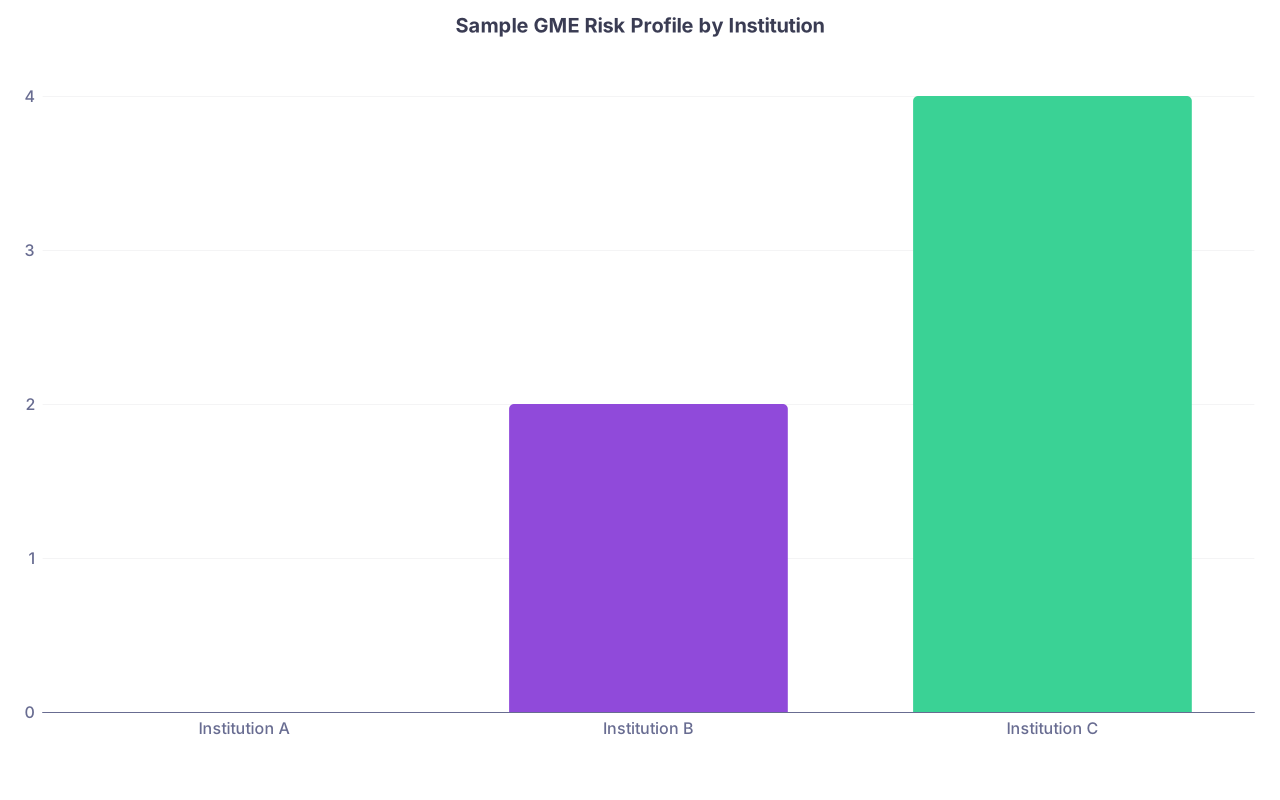
| Category | Value |
|---|---|
| Institution A | 0 |
| Institution B | 2 |
| Institution C | 4 |
In this simple example, Institution A has zero programs with warnings or probation, B has two, C has four. Guess where you would rather be the first or second cohort in a new residency.
Mistake #6: Ignoring “Initial Accreditation with Warning” as a Red Flag
“Initial Accreditation with Warning” is not just a slightly worse version of Initial Accreditation.
It means:
The program is very new and the ACGME has already found significant problems.
Many applicants assume this is just bureaucratic language. They think, “Every new program has some kinks, they’re just being honest.”
No. Warning status means problems serious enough that the ACGME felt compelled to formally flag them.
Common underlying reasons:
- Insufficient faculty or unstable leadership
- Inadequate patient volume or case mix
- Systemic problems with duty hours, supervision, or education
- Major gaps in evaluation, feedback, or curriculum
These are the exact issues that destroy your training, your quality of life, and sometimes your ability to graduate on time.
If you see “with Warning” attached to any accreditation status and you are the one assuming the risk as a new resident, you should:
- Ask what the specific citations or deficiencies are.
- Ask for the action plan and timeline to correct them.
- Ask how these issues are experienced by current residents day to day.
If leadership cannot speak about those issues clearly and transparently, they are either hiding problems or do not understand them. Both are bad.
Mistake #7: Believing “By the Time I Graduate, It Will Be Fine”
This is the magical thinking mistake.
Applicants tell themselves:
- “Yes, it is Initial Accreditation now, but by the time I am PGY-3 they will be Continued.”
- “Sure, they have Warning status, but they will fix it. I will be graduating later; it won’t affect me.”
- “They are waiting for a site visit. It always goes through.”
No. That is not how you protect yourself.
You are gambling that:
- The program leadership is competent.
- The institution will allocate enough resources.
- The ACGME will be satisfied quickly.
- No new major issues appear.
I have seen programs promise, “We expect Continued Accreditation after the next visit,” and then get hit with new citations or extended Warning. Meanwhile, residents are stuck in limbo, trying to explain to future employers why their training program’s accreditation looked shaky.
The correct mental model:
ACGME status as of Match Day and during your training is what matters. Not what people hope it will be.
Ask the program director directly:
- “If, worst case, the program remains in Initial Accreditation or Warning for my entire training, will I still be board-eligible?”
- “Has your DIO (Designated Institutional Official) put that in writing for current residents?”
If they cannot answer clearly, stop assuming the future will magically fix it.
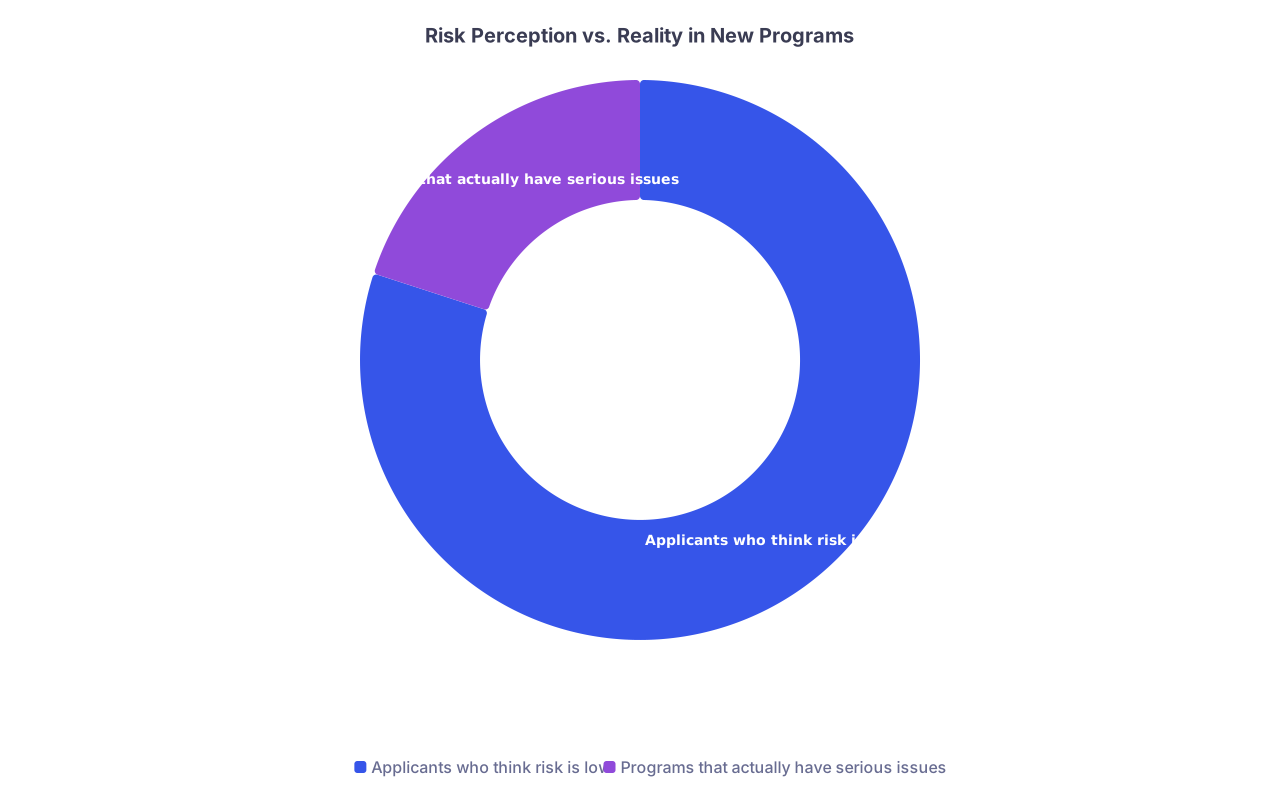
| Category | Value |
|---|---|
| Applicants who think risk is low | 80 |
| Programs that actually have serious issues | 20 |
Most applicants think 100% of accredited programs are “safe enough.” A non-trivial minority are not.
Mistake #8: Failing to Distinguish Core vs. Subspecialty Program Risk
Not all new ACGME programs carry the same level of risk.
New Internal Medicine or Pediatrics residency in a large teaching hospital with decades of training experience? Different than a brand new, stand-alone fellowship in a niche field at a community site that has never run any GME program.
The mistake is treating all “new” programs as comparable.
Think about:
Core residencies (IM, FM, Psych, EM, Surgery, etc.)
Often anchor programs with broader institutional support, more scrutiny, and more residents.Subspecialty fellowships (Cardiology, GI, Heme/Onc, Pain, etc.)
Sometimes piggyback off strong core programs. Sometimes created faster, with less robust administrative infrastructure.Completely new GME institutions
A hospital that never had residents before and suddenly launches multiple programs at once. High logistical risk.
As an applicant, your radar should be sharper if:
- The hospital has no other residents in any specialty.
- The department leadership is new to the institution and the program is new.
- There is heavy reliance on visiting faculty, locums, or moonlighters to cover core teaching.
I am not saying “never rank a new program.” I am saying: the less institutional GME experience behind it, the more serious your due diligence must be.
Mistake #9: Not Talking to the First and Second Cohorts (Or Realizing There Aren’t Any)
This one is painful because it is so preventable.
Applicants often rely on:
- The program director’s vision speech
- The glossy recruitment slides
- One or two carefully selected resident ambassadors
But for new programs, especially in the first 3–5 years, the real story is in the early cohorts.
You want to know:
- How much of what was promised actually materialized (rotations, faculty, clinics, electives).
- How often schedules change mid-year because they are still patching holes.
- Whether residents feel safe bringing concerns to leadership.
- Whether anyone has left the program or transferred out.
If there are PGY-2 or PGY-3 residents and the program refuses to let you speak to them privately, that is not a scheduling issue. That is avoidance.
If you are applying to the very first cohort, treat that as a high-risk, high-uncertainty choice. You will be the test case. There is no track record, no prior classes to learn from.
You should demand much more clarity on ACGME status, institutional backing, and long-term plans if you are considering being part of Year 1.

Mistake #10: Ignoring How ACGME Status Affects Transfers and Plan B
Nobody applies thinking, “I will need to transfer.” Yet residents at new programs do transfer. Or try to.
When a program runs into serious ACGME trouble, residents often scramble to find spots elsewhere. If you are at a brand new program with Initial Accreditation and minimal relationships with other institutions, your transfer options may be far worse than those of residents at long-established programs.
The mistake is never asking:
“If this does not work out, how hard will it be for me to move?”
When you consider a new program, ask:
- “Do you have any partnerships or affiliations with other teaching hospitals?”
- “Have any residents in other programs here ever transferred out successfully?”
- “If ACGME issues arose, how would the institution support residents seeking transfer?”
If the institution has no track record and no clear answers, then you are accepting higher downside risk if something breaks.
Mistake #11: Assuming Growth Phase Chaos Is Just “Normal”
Every new program has growing pains: workflows, conference schedules, clinic flow, call structure. That part is normal.
What is not normal is chronic instability disguised as “growth.”
Warning signs that the chaos is not just a phase:
- Program director turnover in the first few years.
- Major rotation changes every few months, not just yearly refinements.
- Faculty leaving faster than they are being replaced.
- Residents frequently covering service gaps because attendings are insufficient.
ACGME inspectors look for these patterns. If they see enough, status can stagnate at Initial, drop to Warning, or worse.
You cannot fix institutional chaos by being “flexible.” You will just be exhausted and undertrained.

When you interview, do not just ask what they plan to build. Ask what has actually been stable for the past 12–24 months.
Mistake #12: Not Verifying ACGME Status Yourself Before Ranking
The last, laziest mistake: relying solely on what programs tell you during interview season without independently checking.
ACGME program status can change between the time they design their recruiting slides and when you submit your rank list.
You should:
- Go to the official ACGME public program search.
- Look up every single program before you certify your rank list.
- Confirm the current status and any public notes.
- Compare that to what you were told during interviews.
If there is a mismatch:
- Ask the program about it directly.
- Watch how they respond. Transparent explanation? Or deflection?
You are about to give them several years of your life and your future board eligibility. Spending 30 minutes verifying ACGME status is not overkill. It is baseline self-protection.

Quick Comparison: Safer vs. Riskier New Program Profiles
| Feature | Safer Pattern | Riskier Pattern |
|---|---|---|
| Institution GME history | Multiple stable programs, Continued status | New GME sponsor or many programs with warnings |
| Program ACGME status | Initial, clear path/timeline to Continued | Initial with Warning, vague plans |
| Leadership | Experienced PD, stable faculty core | New PD, high turnover, many unfilled positions |
| Early cohorts | Present, accessible, mostly satisfied | Absent, restricted access, or obvious distress |
| Board eligibility clarity | Explicit, documented, board-confirmed | Hand-wavy reassurances without documentation |
If a program looks like the right-hand column in more than one row, you are entering high-risk territory.
The Takeaway
Interpret ACGME status like your future depends on it. Because it does.
Three points to keep front and center:
- “Accredited” is not enough. You must know which ACGME status, what it implies, and where the program stands in its accreditation timeline.
- Hope is not a safety plan. Do not rely on what programs “expect” or “plan” to happen with accreditation. Base your decisions on current status, documented board eligibility, and institutional track record.
- Verify everything. Check ACGME’s own data, talk to early cohorts, and interrogate any Warning or Initial status like you are cross-examining a witness. If a program cannot give you straight answers, believe that. Not the brochure.