
The worst ranking mistakes happen when people treat new residency programs like lottery tickets instead of calculated risks.
You cannot do that. Not in this match climate. Not with your years of work on the line.
Here’s the month‑by‑month reality check and action plan for when (and how) to prioritize new programs in your rank list—so you’re not guessing when you certify.
Big Picture: How New Programs Actually Match
Before we go month‑by‑month, you need a mental model.
New programs tend to fall into three rough categories:
| Type | Risk Level | Typical Applicant Fit |
|---|---|---|
| Brand-new program | High | Broader range, more unknowns |
| Expansion site of known program | Moderate | Good for mid-range applicants |
| Re-opened / restructured after closure | Very High | Only if you fully understand history |
Key truths I’ve seen play out:
- New programs do often rank applicants aggressively “up the list” because they need to fill.
- But they’re not charity. They still care about board scores, professionalism, and sanity.
- Their infrastructure can be amazingly fresh and flexible… or a total construction zone.
- Communication quality before March usually predicts your early training experience.
Your job from August through March is to convert “new and shiny” into “specific and defendable”: Why exactly is this program high, middle, or low on your list?
Now let’s walk the calendar.
August–September (Pre‑Application): Decide Your Risk Tolerance
At this point you should be honest about how badly you need “extra chances.”
You don’t have ERAS submitted yet. You’re planning.
Step 1: Reality-check your competitiveness
In late August or early September, take one evening and be brutally direct with yourself:
- Step 1/Level 1 (if applicable) and Step 2/Level 2 scores
- Class rank / AOA / Gold Humanism
- Number and quality of letters
- Red flags: remediation, LOA, exam failures
Then categorize yourself for your chosen specialty:
- Stronger than average
- Average / slightly below
- Below / red flag
Why this matters:
- Stronger applicants can afford to be more picky about new programs.
- Below-average applicants have to strategically embrace new programs to increase match probability.
Step 2: Decide your “new program exposure” target
By early September, you should have a rough ratio in mind:
- Strong applicants: maybe 10–25% of your interview targets can be new programs.
- Average applicants: 20–40%.
- Struggling applicants or in hyper‑competitive fields (derm, ortho, plastics): you may intentionally chase any accredited new program that looks remotely stable.
Write this down. Literally.
“I am comfortable having up to X% of my final rank list be new or expansion programs.”
That’s your anchor for later when recency bias and interview charm try to hijack you.
October (Applications Out, Waiting Mode): Build Your New Program Watchlist
At this point you should be building a structured list of new programs instead of just hearing about them on Reddit.
Use one spreadsheet tab for “New / Newish Programs” with these columns:
- Program name + ACGME ID
- Type (brand‑new, expansion site, recently re-opened)
- Sponsoring institution (especially for community sites)
- First match year
- Planned complement (how many residents per year)
- Key selling points (from website/social)
- Initial concerns / red flags
Where to find them (early in the season)
- ACGME program search filtered by accreditation date.
- Specialty society lists—many showcase new programs.
- Program websites that say things like “inaugural class” or “now recruiting first class.”
Your goal in October is not to rank anything. Your goal is to know who’s new before the interview invites start rolling in, so you’re not blindsided.
November (Interviews Begin): Start Grading the Infrastructure
This is when new programs will try to sell you the dream. Fancy slide decks. “Build something from the ground up.” “You’ll have a voice.”
At this point you should start separating marketing from infrastructure.
During or right after each interview, capture specific data on new programs:
Leadership stability
- How long has the PD been at this institution?
- Is the PD internally known and respected, or imported last month?
- Do they have a long‑term chair / service chief backing them?
Accreditation and oversight
- Is it already ACGME accredited with a full 10‑year cycle?
- Is it initial accreditation with short cycle? Any site visit comments mentioned?
- Who is the sponsoring institution, especially if the clinical site is small?
Clinical volume reality
- Ask residents: “Are there ever days you’re scrambling to find cases or patients?”
- For surgery-heavy specialties: “How many cases did PGY‑2s log last year?”
Resident support
- Is there a GME office that actually exists and does something?
- Housing, wellness, benefits: are they standard for the region or clearly bargain-basement?
Right after the interview day, score each category 1–5. Don’t overthink. Gut reaction while memory is fresh.
December (Mid‑Interview Season): Build a Preliminary Tier System
By early December, you’ve probably had a mix of established and new program interviews.
At this point you should build your first pass tier list, not a rank list:
- Tier 1: Dream / excellent fit
- Tier 2: Solid / would be happy
- Tier 3: Acceptable / would go if needed
- Tier 4: Only if nothing else
Now, look at where the new programs landed.
If >50% of your Tier 1 spots are new programs, pause. That’s usually too aggressive unless:
- You’re a very strong applicant who only interviewed at a few elite legacy places plus some very promising new ones.
- Or the “new” ones are expansion sites of nationally respected institutions with serious backing.
You want balance:
- Strong applicant: most Tier 1 should still be established programs.
- Average applicant: Tier 1 & 2 can have a healthy mix.
- Struggling applicant: it’s fine if a larger share of Tier 2/3 are new—just be sure you’re not ignoring obvious safety options.
January (Late Interviews): Deep-Dive on the Shortlist
By January, the shine of interview season wears off, and patterns become obvious.
This is where you should intentionally re‑interview the program in your head, especially if it’s new and you’re tempted to rank it high.
Week 1–2 of January: Independent fact‑checking
For each new program that might land in your top half:
- Look up hospital financials or local news. Any talk of service line closures, mergers, bankruptcies?
- Check if any residents or faculty have quietly left mid‑year (ask respectfully, especially on second looks).
- See if the program has already expanded faster than planned (sometimes a bad sign—they’re plugging service gaps with residents).
Red flags I’ve personally seen:
- Program couldn’t get enough attending supervision, so residents were yanked to other hospitals constantly.
- Didactics “planned” but not actually happening because “we’re still building the curriculum.”
- Ownership changed (e.g., hospital bought by a for‑profit chain) right after ACGME accreditation. Chaos.
Week 3–4 of January: Compare new vs established head‑to‑head
Take one evening and do this exercise:
For each promising new program, compare it directly to the established program immediately below it in your mental rank order on:
- Case volume / patient complexity
- Fellowship or job placement trajectories they’re aiming for
- Geography and cost of living
- Culture: did residents and faculty feel aligned?
Write a simple line under each:
“I would choose Program A over Program B because ______.”
If you can’t fill that blank with something specific (not just “vibe”), that’s a warning that recency or flattery is driving your thinking.
Early February: Draft Rank List v1 (and Check Your Exposure)
Rank order lists usually open around this time.
At this point you should create Rank List v1 within 48 hours of the system opening—nothing final, just a concrete starting point.
Steps:
Drag programs into your honest preference order ignoring whether they’re new or old.
Tag each one in your spreadsheet:
- E = Established (>5–7 years of graduates)
- N1 = Brand-new (no graduates yet)
- N2 = New-ish (1–3 classes, maybe first grads)
- R = Re-opened / restructured after past issues
Now count:
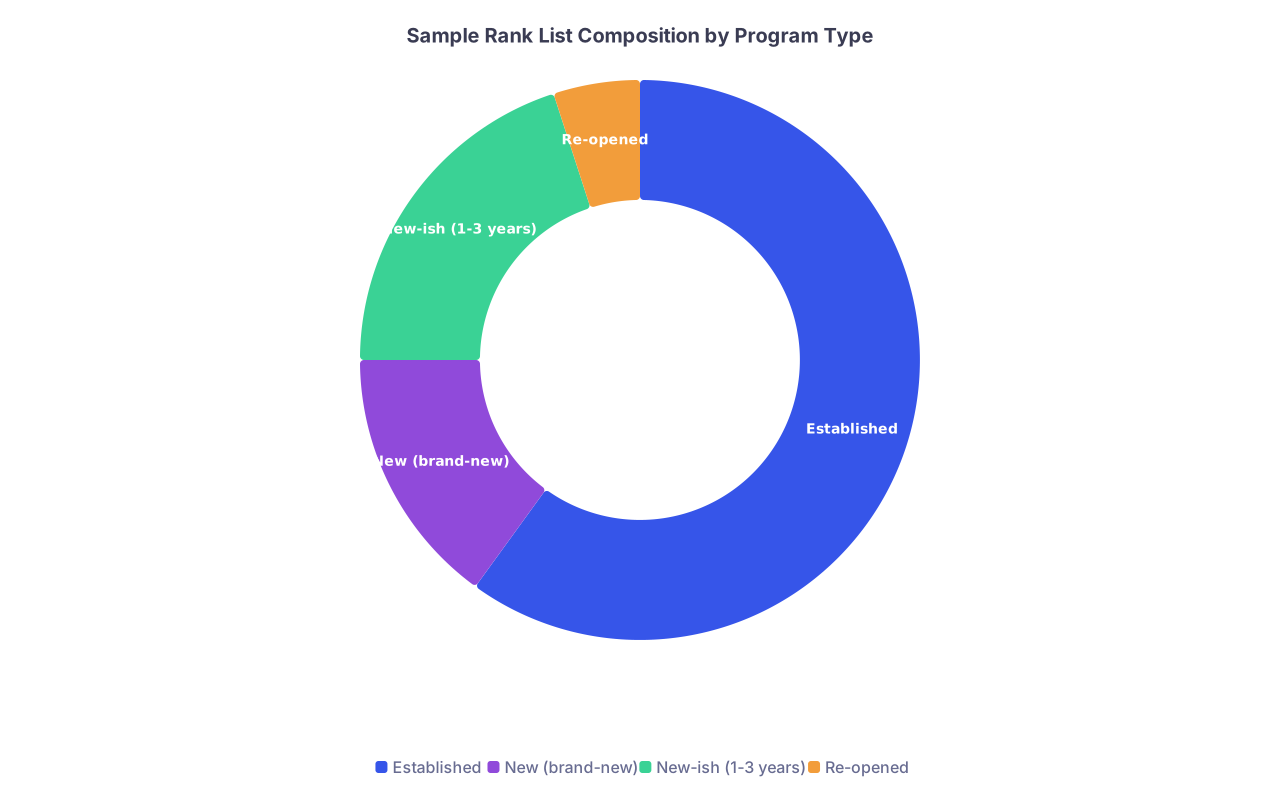
| Category | Value |
|---|---|
| Established | 60 |
| New (brand-new) | 15 |
| New-ish (1-3 years) | 20 |
| Re-opened | 5 |
If your upper half of the list (say, top 10–12) is:
50% N1 or R: high risk. Time to reconsider.
- 30–50% N1/N2: moderate, usually fine if your overall number of ranks is strong.
- Mostly established with a sprinkling of new: generally conservative and safe.
Ask yourself:
“If the match hits my #1–#5, would I be surprised or scared by where I land?”
If the honest answer is “Yeah, a little,” then you’ve given new programs too much priority.
Mid–Late February: Second Looks and Final Reordering
This is when you’ll feel the most pressure. PD emails. Resident messages. Maybe a second-look visit.
At this point you should use second looks to verify your top 5–8 choices, especially any new programs in that group.
How to use second looks for new programs
On a second look (virtual or in-person) for a new program, you want to see:
- Is the chaos level going down, not up?
- Are workflows and rotations more defined than they seemed in November?
- Do residents sound tired-but-hopeful… or defeated-and-trapped?
Ask these questions directly to residents, away from leadership:
- “What did they promise on interview day that hasn’t actually materialized?”
- “How often are you pulled to cover gaps in staffing?”
- “If you could go back a year, would you still rank this program where you did?”
If you consistently hear “We’re still figuring that out” to infrastructure questions in late February—curriculum, mentorship, evaluation systems—that’s a bad sign.
Final prioritization rules (that I actually recommend)
By the last week of February, before you certify, use these rules of thumb:
Expansion sites of strong institutions
It’s usually reasonable to rank these nearly as high as the main campus if:- Leadership overlaps
- Rotations and curriculum are shared
- Brand name on your diploma/GME certificate is the same
Brand‑new, standalone community programs
I would rarely put these above well‑run, mid‑tier established programs unless:- You have strong personal reasons (family, geography).
- Leadership blew you away and has a track record at other programs.
- Clinical volume is clearly robust (not aspirational).
Re‑opened or majorly restructured programs after issues
Only rank these in your upper half if you have:- Clear explanation of prior closure or probation.
- Evidence of new leadership and real changes, not cosmetic fixes.
- Direct, uncoached resident honesty that things are steadily improving.
If any new program feels like a “maybe it’ll work out” gamble, it belongs mid‑list or lower, not in your top 3.
Early March (Rank Certification Week): Sanity Check and Commit
This is your last chance to avoid emotional ranking.
At this point you should freeze the data and ignore new outreach. Seriously—PD “interest” emails don’t change your actual fit.
72 hours before rank deadline
Run a final structured sanity check:
Look at your top 5.
- How many are established? How many are new?
- If you matched to #5, would you be proud to train there? Or rationalizing?
Look at each new program in your top half and answer, in writing:
- “Three concrete reasons this program belongs above the one below it.”
- “What specific risk am I accepting by putting it here?”
- “What will I gain if it works as promised?”
Confirm your earlier “exposure target.”
- If you said back in September you were comfortable with 25% new programs, and now you’re at 60%, what changed?
If the only answer is “they seemed really excited about me,” that’s not enough.
- If you said back in September you were comfortable with 25% new programs, and now you’re at 60%, what changed?
24 hours before deadline
Stop tinkering. Minor swaps driven by anxiety almost never improve your list.
One last filter I use with residents:
If this brand‑new program were five years old with a solid track record, would you still rank it here?
If the answer is “yes,” you’re probably fine. If the answer is “only because it’s close to my partner / cheap city / they loved me,” consider dropping it a few spots below stable alternatives.
Then certify. And walk away.
After the Match (March–April): Learn from the Outcome
This part is unsexy but critical if you’re early in medical training and just reading ahead, or planning for a different specialty later.
At this point you should do a post‑match autopsy—whether you matched at a new or established program.
If you matched at a new program:
- Track what you got right.
- Notice where you under‑ or over‑estimated risk.
- Document early pain points (systems not in place, limited support) and benefits (early responsibility, close PD contact).
If you matched at an established program but ranked new ones high:
- Ask yourself whether you would have been okay starting in a startup‑like environment.
- Decide now how much risk you’ll tolerate for fellowship rankings later.
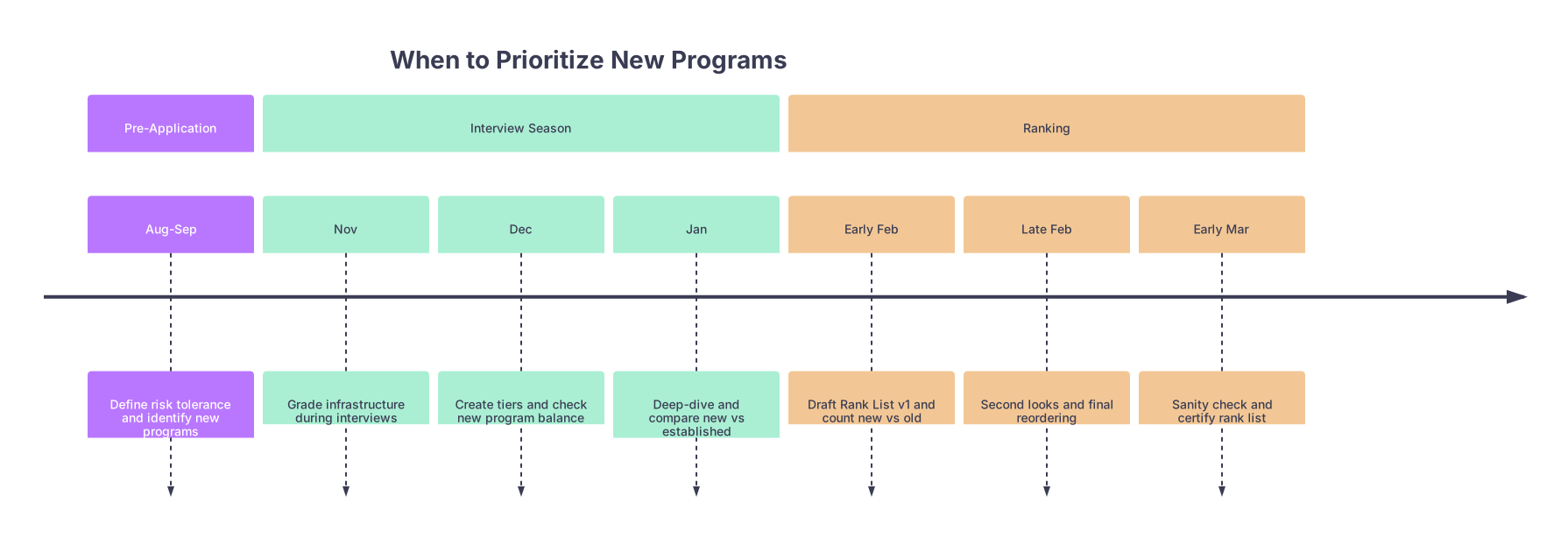
| Period | Event |
|---|---|
| Pre-Application - Aug-Sep | Define risk tolerance and identify new programs |
| Interview Season - Nov | Grade infrastructure during interviews |
| Interview Season - Dec | Create tiers and check new program balance |
| Interview Season - Jan | Deep-dive and compare new vs established |
| Ranking - Early Feb | Draft Rank List v1 and count new vs old |
| Ranking - Late Feb | Second looks and final reordering |
| Ranking - Early Mar | Sanity check and certify rank list |
Quick Month‑by‑Month Snapshot
Use this as your mental checklist:
| Month | Main Task | New Program Focus |
|---|---|---|
| Aug–Sep | Assess competitiveness | Set risk tolerance % |
| Oct | Build program list | Flag new/accredited in last 5 years |
| Nov | Start interviews | Score infrastructure and leadership |
| Dec | Tier programs | Check how many new programs in top tiers |
| Jan | Deep comparisons | Fact-check and direct head-to-heads |
| Early Feb | Draft v1 list | Measure new vs established balance |
| Late Feb | Second looks | Verify or drop questionable new sites |
| Early Mar | Finalize | Sanity check top 5–10 and certify |

Do one thing today: open a spreadsheet and make a column titled “New / Expansion / Established.” Start listing every program you’re considering. Tag the type. That 10‑minute move will force you to treat new programs as a calculated strategy instead of a blind gamble when rank week hits.