
It is late January. You are on Thalamus, looking at interview invites, and one of the emails catches your eye: “Exciting Opportunity at a New Residency Program!”
There is no alumni list. No historical board pass rates. No established reputation. The website has three stock photos, a paragraph of buzzwords (“innovative,” “cutting-edge,” “future of medicine”), and a PDF with the block schedule that looks like it was thrown together last week.
You are not crazy for being suspicious. But you also cannot just reflexively say “no” to every new program. Geography, family, visa needs, or specialty competitiveness might push you toward considering them seriously.
So here is the problem: when there is no track record, how do you actually do due diligence? How do you decide whether this shiny new program is an opportunity or a landmine?
I am going to walk you through a concrete, step‑by‑step way to build your own due diligence dossier on a new residency program. Think of it as an internal file you build so that by the time you rank, you are not guessing. You are making an informed, ruthless decision.
Step 1: Define What “Good Enough” Looks Like For You
Before you judge a new program, you need your own standards. Otherwise you will either:
- Talk yourself into something dangerous because you "need to match at all costs"
- Or dismiss everything new because it does not feel safe
You need a checklist of non-negotiables and nice-to-haves. Write it down. Literally.
A. Non‑negotiables (for any residency, but especially new ones)
At minimum, for a new program to be acceptable, I would set these as hard lines:
- ACGME accreditation status is current
- Not “initial application.” Not “pending.”
- They should have an ACGME program number and “Initial Accreditation” at least.
- Stable sponsoring institution
- Large health system or established community hospital.
- History of hosting students and/or other residency programs.
- Clearly defined clinical volume
- Enough patients to train you, not just fill call schedules.
- Real teaching structure
- Named PD, APD(s), core faculty with at least some education track record.
- Transparent duty hours, supervision, and support
- How they will protect you from being used as cheap labor.
If any of those are missing or evasive—you should be extremely cautious.
B. Personal priorities
Then your personal filters. Examples:
- Need to be in a certain city/region?
- Need solid fellowship prospects?
- Need visa support (J‑1/H‑1B)?
- Want academic over community (or vice versa)?
- Tolerance for “building mode” chaos on a scale of 1–10?
Write these out in a simple scoring grid you will use for every new program you consider. You are going to need it later.
Step 2: Do a Hard Background Check on the Institution
Forget glossy websites. Start with the hospital and system, not the program.
A. What you are trying to figure out
You want answers to:
- Is this hospital financially stable?
- Do they already train anyone (students, residents, fellows)?
- What is the clinical volume like?
- Are they just now discovering “residents are cheap labor”?
Here is a structured way to do it.
B. Quick external intel checklist
Use this as your first‑pass scan.
| Item | What to Look For |
|---|---|
| GME Presence | Other residencies/fellowships already in place |
| Financial Stability | No recent bankruptcies or major layoffs |
| Clinical Volume | ED volume, admissions, subspecialty services |
| Academic Links | Affiliation with a med school or major system |
| Reputation | Reviews from nurses, staff, med students |
1. GME ecosystem
- Go to the hospital’s GME page.
- Look for other residencies (IM, FM, EM, surgery, etc.).
- Look for fellowships (even one or two is a good sign).
Stronger if:
- They already run multiple residencies with full accreditation.
- They have had students rotating there from a known medical school for years.
Red flag if:
- This is their first foray into GME.
- Or they had a program that closed / lost accreditation.
2. Financial and structural stability
Search:
- “[Hospital name] financial problems,” “bankruptcy,” “mass layoffs,” “closure”
- Local news sources are gold here.
Watch for:
- Mergers with chaos.
- Large recent layoffs.
- Units closing.
- Major lawsuit headlines around patient safety.
You do not want your program’s second year to coincide with the hospital slashing budgets.
3. Clinical volume and complexity
Check:
- ED visits per year (often on hospital fact sheets).
- Number of beds (esp. ICU, step-down).
- Key services: ICU, cardiology, GI, neurosurgery, OB, etc.
- Presence of subspecialty clinics.
Low volume hospital + new residency = recipe for weak training and service bloat.
Step 3: Dissect the Program Leadership and Faculty
New program = no alumni. But faculty and PDs do have track records. That is where you dig.
A. Program Director due diligence protocol
This is non-optional. You learn a lot by dissecting the PD's background.
- Search the PD by name:
- PubMed, Google Scholar, Doximity, LinkedIn, health system bio.
- Look for:
- Prior role in GME: APD, clerkship director, site director.
- How long at previous institutions.
- Any major leadership roles (Q&I, curriculum development).
- Check if:
- They previously worked at a strong teaching institution.
- They have evidence of being an educator, not just a clinician.
Better:
- PD previously APD at a known program for 5+ years.
- Multiple education‑focused awards or committees.
- Involved with national organizations (ACP, AAFP, ACGME committees, etc.).
Risky:
- PD has essentially no prior GME leadership.
- Recently relocated with minimal local roots.
- More administrative/business background than educational.
B. Core faculty: actually count and classify
Go beyond the faculty list on the website.
- How many true “core” faculty are there?
- What is their FTE (full-time equivalent) devoted to the residency?
- Do they span all key rotations (wards, ICU, clinic, subspecialties)?
If a new IM program claims 6 core faculty for 12 residents per year in a busy hospital, that is thin. Expect burnout. Expect you doing service with little teaching.
Step 4: Analyze the Structure: Schedules, Clinics, Curriculum
This is where most applicants are too superficial. They see a pretty block schedule chart and stop. Do not.
You are trying to answer: Will this structure actually train me, or just exhaust me?
A. Block schedule autopsy
Pull up the block schedule. Go block by block. Ask:
- How much ward time vs. ICU vs. electives?
- Is there a dedicated continuity clinic structure?
- Any obvious service black holes? (e.g., “Hospitalist Service A/B/C” with no teaching time listed)
- How do night float and cross-coverage work?
Example red flags:
- PGY‑1: 9+ months of wards/ICU with almost no ambulatory.
- Electives crammed in PGY‑3 only.
- “Procedural service” vague and not tied to supervision.
B. Continuity clinic and ambulatory training
Continuity clinic should not be an afterthought.
Ask:
- How many half‑days per week on average?
- Same clinic preceptor most weeks or random?
- Patient panel assigned and tracked?
- EMR used in clinic (same as hospital or different)?
If they cannot articulate how you will build and own a panel over time, the ambulatory side will be weak. This matters a lot for primary care and IM/FM.
C. Didactics that are more than “Wednesday noon conference”
Every new program claims to have “robust didactics.” You want the specifics:
- Daily morning report?
- Noon conference protected?
- Structured board review cycles?
- Simulation? Ultrasound curriculum? QI curriculum?
If their answer is “We plan to develop…” with no specifics—assume it does not exist yet.
Step 5: Quantify Risk with a New Program Risk Matrix
You need a way to turn your impressions into actual decisions. A simple risk scoring system forces clarity.
Here is a basic matrix you can use.
| Domain | Low Risk (2 pts) | Medium Risk (1 pt) | High Risk (0 pts) |
|---|---|---|---|
| GME Ecosystem | Multiple existing programs | 1–2 small programs | First GME program |
| PD Background | Prior APD / strong educator | Some GME exposure | No GME history |
| Clinical Volume | High, well-documented | Adequate but unclear | Low/unknown |
| Didactics | Detailed, structured | General claims | Vague “we will build” |
| Stability | Strong system, no turmoil | Minor changes | Financial/legal issues |
Add up the points out of 10:
- 8–10: Reasonable to rank if it fits your goals.
- 5–7: Caution. Needs strong geographic/personal justification.
- 0–4: High risk. Rank only if you are absolutely desperate to match somewhere.
Is this crude? Yes. That is the point. It prevents you from fantasy‑level optimism.
Step 6: Use the Interview Day as an Investigation, Not a Sales Tour
When there are no alumni, current residents (if any) and how the team talks are your best real-time data source. You are not there to be impressed. You are there to collect evidence.
A. What you observe, not just what they say
Watch for:
- Body language of current residents. Forced smiles? Glazed eyes?
- How faculty talk about service vs. education.
- Whether they are honest about being new, or spin everything.
Three phrases that should make you pause:
- “We are still figuring that out.” (said about core structures like call, clinic, supervision)
- “The residents help us shape the program as we go.” (code for “we are building the plane during flight”)
- “Residents are integral to our hospital operations.” (be careful—often means service pressure)
B. Questions to ask residents (if there are any)
You need to go straight to the pain points.
Ask:
- “What has been the hardest part about being in a new program?”
- “What have you asked for that you did not get?”
- “Have you ever felt unsafe clinically or unsupervised?”
- “How often do you get genuine teaching on busy services?”
- “How did the program respond the last time something went seriously wrong?”
You are not looking for perfection. You are looking for:
- Responsiveness: did leadership actually fix things?
- Transparency: do residents feel safe speaking up?
- Pattern recognition: repeated complaints about the same issue.
C. If there are no residents yet
Now you are evaluating pure potential plus institutional track record.
Then the questions go harder at leadership:
- “What concrete metrics are you using in year 1 to monitor resident workload and safety?”
- “How are you preventing residents from being pulled into pure service needs?”
- “Who is your external mentor program or institutional sponsor on the GME side?” (e.g., link to a mature program in another site or system)
- “What exactly will you have in place by July 1 of the first year—curriculum, evaluation tools, wellness resources?”
If they cannot answer in specifics (not buzzwords), that is telling.
Step 7: External Signals: NRMP, ACGME, and the Grapevine
You are not the first person to wonder about this program. Use that.
A. ACGME and public records
Check the ACGME ADS public listing:
- Confirm program ID and accreditation status.
- Look at sponsoring institution’s other programs and their status.
If a sponsor has multiple “warning” or “probation” statuses—understand that culture bleeds across programs.
B. NRMP behavior
Patterns to watch (from friends, forums, etc.):
- Did the program suddenly appear this year?
- Are they offering unusually many positions for a brand‑new program?
- Are they doing SOAP heavy in year one or two?
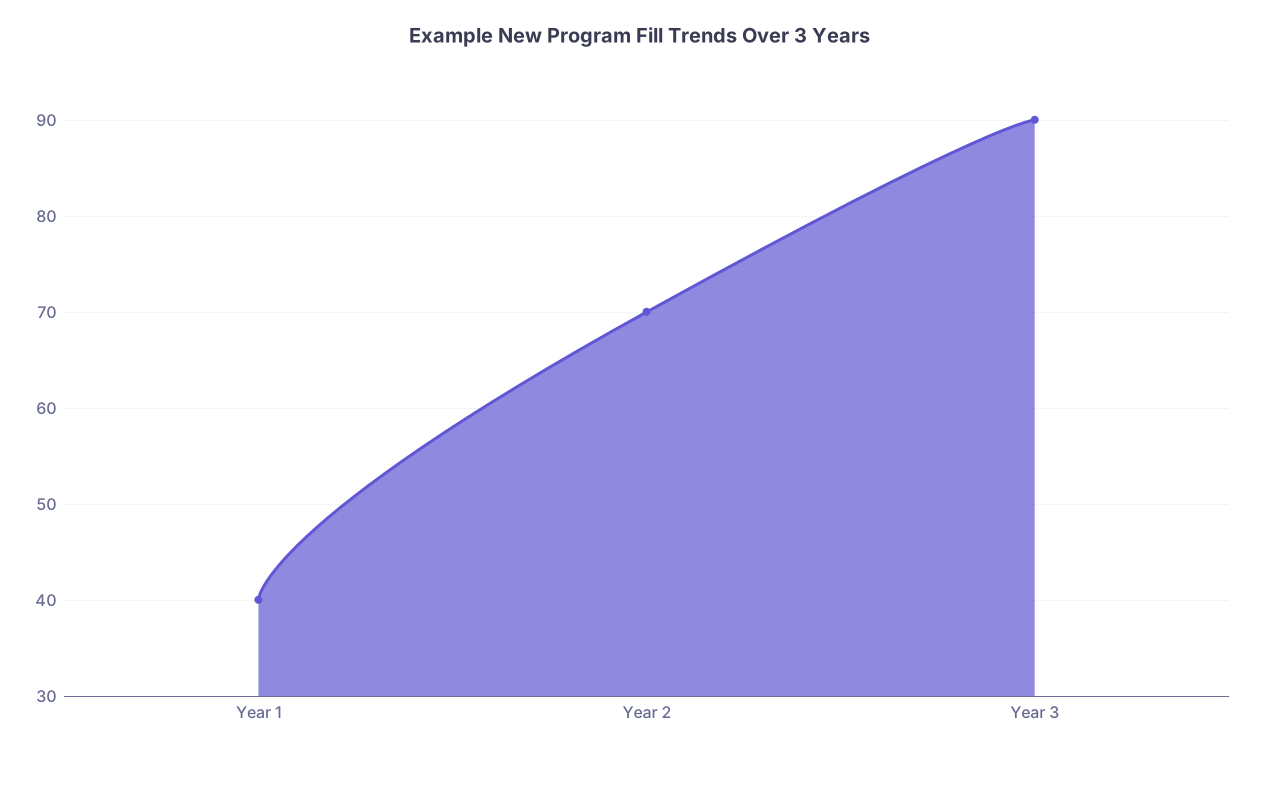
| Category | Value |
|---|---|
| Year 1 | 40 |
| Year 2 | 70 |
| Year 3 | 90 |
A program that fills 40% of spots in year one, 70% in year two, and slowly climbs may just be new and unknown.
A program that repeatedly dumps positions into SOAP because people figure them out—different story.
C. Unofficial sources (with filters)
Yes, forums (Reddit, SDN), but treat them as smoke detectors, not final truth.
You are looking for repeat patterns:
- Multiple independent reports of “unsafe,” “no supervision,” “pure scut.”
- Students describing away rotations as chaotic.
- Nursing staff reviews saying the hospital is chronically understaffed and disorganized.
You are not making decisions based on one angry post. But you do not ignore five similar ones.
Step 8: Build a Structured Dossier Document
Enough mental juggling. You need everything in one place. Treat this like a legit report.
Your “Due Diligence Dossier” for each new program should have:
Cover summary (1 page max)
- Yes/No/Maybe rating.
- Risk score (from the 0–10 system above).
- 3 reasons to rank.
- 3 reasons to avoid.
Institution profile
- GME ecosystem snapshot.
- Clinical volume and key services.
- Financial / reputation notes.
Program leadership & faculty
- PD bio + education history.
- Number and quality of core faculty.
- Any notable mentors or external affiliations.
Curriculum & schedule
- Block schedule annotated with your comments.
- Call schedule details.
- Clinic structure overview.
Red flags & unknowns
- List of unanswered questions.
- Things that felt vague or hand‑wavy.
Your personal fit & constraints
- Geographic/family/visa issues.
- How it ranks against your personal priorities.
If you are applying to several new programs, comparing dossiers side by side will clarify things brutally fast.
Step 9: Decide How Aggressively to Rank New Programs
You are not evaluating in a vacuum. You have a list with old and new programs. Here is a simple framework.
A. You have multiple solid offers from established programs
In that case:
- New programs need to be exceptional in geography, lifestyle, or unique opportunities to justify ranking them above stable, accredited programs with good track records.
- A new program with a great PD and strong health system might deserve a mid‑list spot.
- But I would not put an untested program first over a known, decent (even if not fancy) program.
B. You are borderline for your specialty or have very few interviews
If your priority is “any match > no match”:
- You may safely include moderate‑risk new programs (score 5–7) high enough to realistically match.
- For true high‑risk programs (score 0–4), you still need a line you will not cross. If you genuinely believe training there would be unsafe or leave you poorly prepared, rank them low or not at all. Matching into a disaster can be as bad as not matching.
C. Smart ranking posture
You do not need to tell them where you will rank them. Do not get pulled into guilt or flattery. Your job is to protect your future license and sanity.
Step 10: How to Use “New” to Your Advantage (When It Is Worth It)
Not all new programs are traps. Some are genuine opportunities, especially if:
- Backed by a major academic center extending into a new site.
- Led by a strong PD with a track record and something to prove.
- Heavily resourced early on to attract good applicants.
Advantages you can actually get:
- Faster leadership roles (chief, committees, QI leads).
- Ability to shape curriculum and culture from day one.
- Closer contact with faculty because there are fewer layers.
- Early fellowship pathways if linked to a parent institution.
But you only play that game if the basic safety and educational structure is already solid. You are not there to build their program for them while they bill encounters off your back.
Quick Visual: Your New Program Review Workflow

| Step | Description |
|---|---|
| Step 1 | Identify New Program |
| Step 2 | Check ACGME Status |
| Step 3 | Hospital and GME Ecosystem Check |
| Step 4 | PD and Faculty Background Review |
| Step 5 | Curriculum and Schedule Analysis |
| Step 6 | Interview Day Investigation |
| Step 7 | Assign Risk Score |
| Step 8 | Build Dossier Document |
| Step 9 | Integrate Into Rank List |
Common Failure Patterns I Have Seen
I have watched people ignore all of this and then regret it. Patterns repeat:
- Matching at a brand‑new community program where hospital admin overrules PD constantly. Residents become service cogs. PD burns out and leaves in year 2.
- A hospital rushing to create GME to fill staffing gaps. Training quality is an afterthought. Residents cover multiple services, documentation burdens skyrocket, didactics collapse.
- Programs with glossy websites but zero thought put into continuity clinic or longitudinal education. Graduates struggle with board exams and real‑world practice.
Most of that was visible before ranking, if you knew what to look for.
You know what to look for now.
Example Dossier Snapshot: How It Might Look

For one hypothetical new IM program:
- GME Ecosystem: 4 other residencies, 2 fellowships — Low risk (2).
- PD Background: Former APD at mid‑tier academic IM for 7 years — Low risk (2).
- Clinical Volume: 550‑bed hospital, busy ED, full subspecialties — Low risk (2).
- Didactics: Documented weekly schedule, protected time, board review outlined — Low risk (2).
- Stability: Recent merger but no layoffs, system growing — Medium risk (1).
Total: 9/10.
If that program is in a city you like and fits your goals? It should absolutely be in the serious part of your rank list.
Second hypothetical new IM program:
- GME Ecosystem: First and only residency — High risk (0).
- PD Background: Clinician with no prior GME roles — High risk (0).
- Clinical Volume: 150‑bed hospital, limited subspecialties — High risk (0).
- Didactics: “We plan to implement weekly lectures” — High risk (0).
- Stability: Local newspaper articles about financial strain and unit closures — High risk (0).
Total: 0/10.
If you are ranking that anywhere above dead last, you are gambling with your career.
Brief Summary: What You Actually Need To Do
- Stop treating new programs as black boxes. Treat them as due‑diligence projects.
- Build a structured dossier and risk score for each new program instead of going on vibes or desperation.
- Use the institution’s and PD’s track record as your proxy for alumni, then verify with schedule, clinic, didactics, and interview‑day reality.
Do this properly and “new program” stops being a total mystery and becomes a manageable, calculated decision.
FAQ (Exactly 4 Questions)
1. Are new residency programs automatically worse than established ones?
No. Some new programs are extremely strong out of the gate, especially when they are:
- Satellite sites of major academic centers
- Led by experienced PDs/APDs with serious educational backgrounds
- Backed by hospitals that have hosted students and other trainees for years
They lack alumni data, which adds risk. But they are not automatically inferior. The dossier approach helps you separate the promising from the dangerous.
2. Should I ever rank a high‑risk new program if I am very worried about not matching?
You need a personal red line. If a program scores extremely low, shows signs of unsafe training, or seems like pure service labor, I would treat it as “only if the alternative is leaving medicine.” An unmanageable, unsafe residency can lead to burnout, remediation, or leaving anyway. In practice, I advise most people to avoid the truly worst programs even if they are anxious about matching.
3. Can I trust what the PD and faculty tell me on interview day about future plans?
Partially, but not fully. Intentions are often good. Execution is the problem. That is why you push for specifics:
- Written schedules
- Defined didactic plans
- Documented clinic structures
- Clear policies on duty hours and supervision
If everything is “we are planning to” without documents or details, assume much of it will not be fully ready for you.
4. How much weight should I give geography and family needs when evaluating new programs?
A lot—but never enough to ignore clear danger signs. If you must be in a particular city or region, a moderately risky new program backed by a strong system may make sense. A clearly chaotic, under‑resourced program should give you pause even in the perfect location. Use your dossier to see whether you are trading some comfort and stability, or gambling your training entirely.