
The biggest mistake residents make in early-stage programs is this: they just complain instead of negotiating for real resources.
If you’re in a brand-new or early-stage residency, you are both trainee and unpaid consultant. Whether you like it or not, you’re helping build the program. So you can either suffer in silence or treat this like what it is: a startup that actually affects patient care and your career.
Here’s how to advocate for missing resources without getting labeled “difficult,” and actually get things changed.
Step 1: Get brutally specific about what’s missing
Vague complaints die in committee. Specific, documented problems get action.
Do not go to leadership with, “We don’t have enough support” or “Our program is disorganized.” That’s noise.
You need concrete gaps. Think in categories:
- Education resources
- Clinical support and staffing
- Infrastructure and tech
- Safety and workflow
- Career development
Start with a quick, ugly brain dump. Then turn it into a clean list.
Examples of concrete missing resources:
- No protected didactic time (pages and admissions during conference every week)
- No ultrasound machine for bedside procedures on nights
- No access to UpToDate or similar reference on workstations
- No meaningful feedback structure—no mid-rotation feedback, no schedule
- No simulation training for codes/procedures despite residents running codes
- No coverage when residents are sick; unsafe ratios on nights
Do a fast 1-week “resource log” with your co-residents:
- Every time you think “I can’t do this safely / effectively because X is missing,” write it down.
- Note time, setting, patient risk, and what you had to do instead.
Then clean it up into a list of 5–10 priority items. Not 40. If you bring everything, nothing changes.
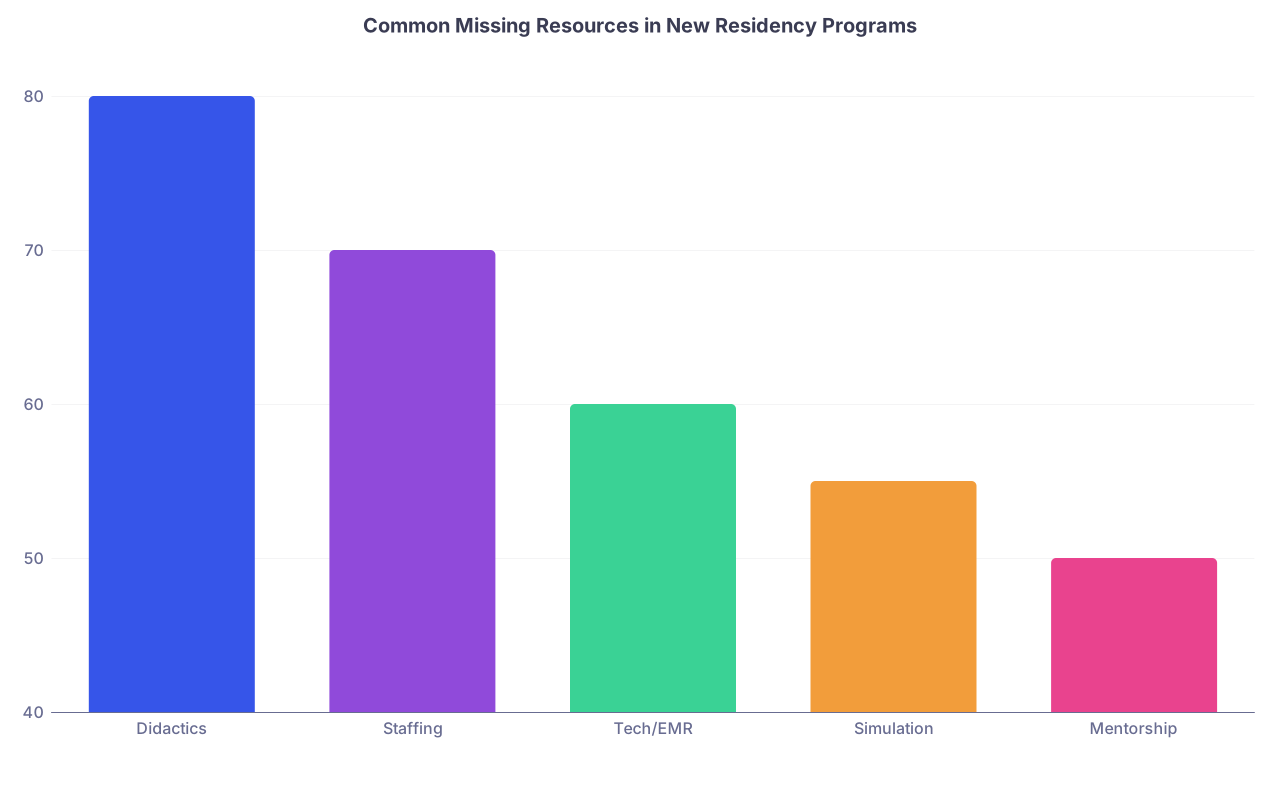
| Category | Value |
|---|---|
| Didactics | 80 |
| Staffing | 70 |
| Tech/EMR | 60 |
| Simulation | 55 |
| Mentorship | 50 |
(Values as approximate percent of early-stage programs I’ve seen with issues in that area.)
Step 2: Sort issues by safety, education, and annoyance
You do not advocate for snacks and a resident lounge the same way you advocate for code blue training.
Rank each missing resource in three buckets:
Patient safety critical
- Lack of cross-cover notes; nobody knows plans at night
- Residents expected to do procedures without supervision or training
- No reliable way to escalate care overnight
Core educational quality
- No structured didactics or journal club
- No specialty exposure promised in recruiting
- No attending feedback on notes or clinical reasoning
Quality-of-life / efficiency
- Parking nightmares, no call room, no workspace
- No templates, order sets, or basic EMR tools
- Scheduling chaos (switches by text, no system, no backup)
Safety goes first. Then true educational deficits. Then workflow and quality-of-life.
When you bring issues to leadership, you want to be able to say things like:
- “Here are 3 patient-safety issues that keep showing up.”
- “Here are 2 core education gaps that are out of alignment with what was described on interview day.”
- “Here are some operational improvements that would dramatically reduce burnout.”
That framing matters. It signals you know how to triage.
Step 3: Learn who actually has power (and who just talks a lot)
In early programs, titles can be misleading. The loudest person in resident meetings is often not the one who can fix anything.
You want to map the real power structure:
- Program Director (PD) – controls curriculum, evaluations, a lot of the culture
- Associate PDs – often handle schedules, didactics, rotations
- Program Coordinator – controls logistics, communication, can make your life easy or miserable
- Department Chair – controls money and faculty time allocation
- GME Office / DIO – cares about ACGME compliance and institutional risk
- Chief Residents (if they exist) – can influence faculty, buffer resident concerns
Ask around quietly: “When something actually changes here—who made it happen?” That answer tells you where to go.

| Step | Description |
|---|---|
| Step 1 | Identify Missing Resource |
| Step 2 | Discuss with Co Residents |
| Step 3 | Talk to Chief Resident |
| Step 4 | Program Director |
| Step 5 | GME Office or DIO |
| Step 6 | Program Leadership Meeting |
| Step 7 | Track Follow Up |
| Step 8 | Safety Critical? |
You typically start with:
- Chiefs (if you trust them)
- Then PD / APD
- Only then GME / DIO if it’s safety or serious non-compliance
Skipping straight to the top for non-safety issues is how you get labeled as “difficult.” Use escalation like a surgeon uses a scalpel, not a sledgehammer.
Step 4: Turn complaints into proposals
Nobody in leadership wants to be handed 10 problems and no solutions. They’re already overwhelmed. You’ll get more traction if you show up with at least a rough plan.
For each high-priority resource, answer three questions:
- What exactly is missing? (One sentence)
- What is the impact? (Safety, education, or burnout – with a concrete example)
- What is a realistic, low-friction solution?
A bad pitch:
“We need way more didactics. It’s ridiculous.”
A good pitch:
“Right now, Wednesday didactics are routinely interrupted by pages and admissions. Last week, 4 out of 6 interns left conference to handle cross-coverage issues. We’re missing the equivalent of 50–60% of our protected teaching. Could we trial a 90-minute weekly no-page block with a covering hospitalist or night float handling non-urgent pages during that time for 2 months, then reassess?”
One more example:
- Missing resource: Ultrasound for bedside procedures on nights
- Impact: “Interns are placing lines and doing paracenteses without ultrasound when the day machine is locked in radiology. I had to decline a tap on a cirrhotic patient because we didn’t have safe access. Nurses are aware and frustrated.”
- Proposal: “Could we reassign one older machine to be stored on the night float unit with a simple sign-out log? If that’s not possible, could we pilot a shared machine with ICU with a check-out system?”
You are not expected to solve hospital politics. But a concrete, modest ask is harder to ignore than a vague rant.
Step 5: Build a resident coalition without fueling a mutiny
You’ll get further if you’re not a solo voice.
But you also don’t want to become the center of a resident uprising that leadership sees as a threat instead of a partner.
Do this cleanly:
- Quietly ask 5–10 co-residents to list their top 3 missing resources.
- Look for overlap. If 7 people list “no real feedback” and only 1 lists “no Peloton in the lounge,” you know where to focus.
- Confirm you have backing: “If I bring these 3 issues forward, are you comfortable adding your name as supporting the request?”
You don’t need 100% consensus. You need a clear majority on a few focused items.
What you avoid:
- Group venting sessions that don’t produce a list or a plan
- Angry emails or texts that could be screenshotted out of context
- Statements like “everyone thinks the program is failing” (leadership will find the one person who doesn’t and dismiss the rest)
You want: “Eight of the twelve PGY-1s and PGY-2s listed these same three issues as their top concerns, and we put together some possible solutions we’d like to discuss with you.”
That’s organized. Not rebellious.
Step 6: Document issues like you’re building an ACGME file
New programs are terrified of one thing: accreditation problems.
You can use that—carefully.
Create a simple shared document (Google doc, OneNote, whatever):
Columns like:
- Date
- Issue (short)
- Category: Safety / Education / Workflow
- Brief description
- Immediate workaround used
- Impact on patient or education (1–2 lines)
| Date | Issue | Category | Impact Summary |
|---|---|---|---|
| 07/12/2026 | No cross-cover info | Safety | Delay in care, repeated calls |
| 07/13/2026 | No didactic protec. | Education | Left 45 min early for admission |
| 07/15/2026 | No US at night | Safety | Procedure deferred, transfer |
You don’t weaponize this on day one. But when you meet with PD/GME, you can say:
“We’ve been tracking these issues over the last 6 weeks so we don’t rely on anecdotes. Here’s the pattern we’re seeing.”
Patterns move people. And if things ever genuinely go off the rails, this log also protects you when ACGME or GME comes calling.
Step 7: Choose your communication channel strategically
How you bring this up matters almost as much as what you bring up.
Here’s a straightforward approach that works:
- Email request for a meeting – short, calm, non-accusatory.
- Attach or link: 1-page summary of 3–5 key issues + proposed solutions.
- In-person or Zoom meeting – this is where you humanize it, give examples, and negotiate.
- Post-meeting recap email – “So we’re on the same page, here’s what we discussed and next steps…”
Sample email to PD:
Subject: Request to discuss resident resource priorities
Dr. Smith,
A few of us from the first two classes have been keeping track of recurring issues that affect patient safety and our core education. We put together a short document highlighting three areas we think are most urgent, along with some possible solutions.
Could we schedule 30 minutes in the next few weeks to review these and get your perspective on what is realistic in the short and medium term?
We all want this program to succeed long term and want to make sure we’re bringing things to you in a constructive way.
Best,
[Your Name], PGY-1
Notice the tone: collaborative, not hostile. Focused, not panicked.
Step 8: In the meeting – how to talk so people actually listen
In the room (or on Zoom), your goals are:
- Frame this as shared problem-solving.
- Highlight safety and education first.
- Show that you’ve prioritized and you understand constraints.
- Get concrete commitments or at least a realistic timeline.
Rough outline you can use:
Start with alignment:
“We appreciate the work you’ve put into starting this program. We know a lot is still being built, and we want to help make it stronger.”Present your top 3–5 issues, briefly:
“We compiled resident feedback and tracked issues over 6 weeks. These are the most consistent problems we’re seeing, in order of impact.”For each: problem → impact → proposal. Keep it short.
“Night coverage has no clear escalation structure—several times we’ve had delays in getting attendings involved for unstable patients. Our proposal is to create a simple escalation algorithm and have it printed on the unit and added to the orientation packet.”Ask for their perspective:
“From your side, what are the main barriers to addressing this?”Negotiate for something concrete:
“Would it be reasonable to trial this for two months and then reassess?”
“Could we have a decision by [date] on whether we can get access to [resource]?”
You’re aiming for commitments, not just sympathy. “We hear you” is not a win. “We’ll do X by Y date” is.
Step 9: Escalate smartly if leadership stalls or gaslights
Sometimes leadership will do one of three annoying things:
- Minimize: “All new programs go through this; it’ll settle down.”
- Deflect: “This is really a hospital issue, not a program issue.”
- Blame: “Residents are just more demanding these days.”
If the issues are minor, you can live with some of that. If they’re safety or core education, you cannot.
Your next-tier options:
- GME Office / DIO – frame it as “we need help building structures,” not “our PD is terrible.”
- Anonymous survey comments – program and GME do read them, especially in new programs. Be specific, calm, and factual.
- ACGME Resident/Fellow Survey – do not waste this with vague venting. This is leverage. If things are truly unsafe or non-compliant, that will show up here.
If you need to escalate to GME:
“We’ve discussed these safety and education issues with our PD and presented specific proposals. Some progress has been made, but we’re still seeing recurrent problems like [X, Y, Z] that we feel we can’t fix at the program level. We’d appreciate your guidance on how to ensure the program meets ACGME expectations for supervision, didactics, and patient safety.”
Notice: still professional, still collaborative, but firm.
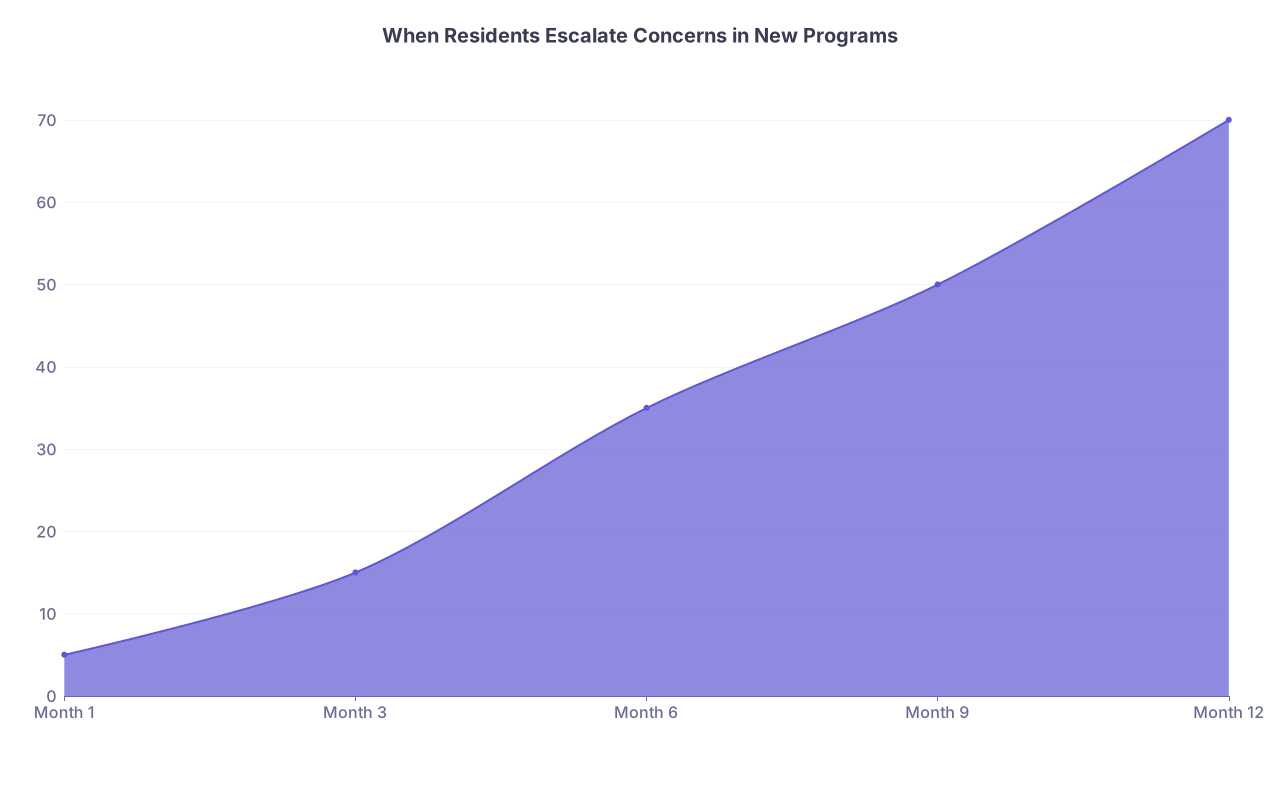
| Category | Value |
|---|---|
| Month 1 | 5 |
| Month 3 | 15 |
| Month 6 | 35 |
| Month 9 | 50 |
| Month 12 | 70 |
The longer leadership ignores real problems, the more likely people go above them. You’re not alone.
Step 10: Protect your own career while pushing for change
Here’s the part people won’t say out loud: you can be right and still get burned if you’re careless.
So you do three things:
Stay obsessively professional on record.
Emails, surveys, official meetings—no sarcasm, no personal attacks, no dramatic language.Avoid being the single face of all discontent.
Rotate who talks in meetings. Use “we” more than “I” when presenting group concerns.Keep your own file.
Save copies of: schedules, duty hour logs, major issue logs, and any formal complaints or responses. If the program implodes later or ACGME investigates, you want clean documentation of what you did and when.
And mentally, accept this: you may not see all the benefits of what you’re building. Early classes rarely do. But you still fight for enough resources so your training is safe, accredited, and competitive when you apply for jobs or fellowships.
FAQs
1. How soon is “too soon” to start advocating in a brand-new residency?
If it’s safety, you speak up immediately—day one if needed. For education and workflow issues, give it 1–2 months to see what’s growing pains versus systemic problems. Around the 3-month mark, patterns are real. That’s when a structured, documented approach has the most credibility: you can say, “We’ve watched this for a quarter of the year, and it’s consistent.”
2. Won’t I get a reputation as a troublemaker if I push for change?
Only if you’re sloppy about it. People labeled as troublemakers usually do one of three things: they complain without data, attack individuals instead of systems, or go nuclear (GME, ACGME) before trying reasonable internal steps. If you’re specific, calm, data-driven, and collaborative, you’re far more likely to be seen as a future chief or leader than a problem.
3. What if most co-residents are too scared to speak up with me?
You do not need a revolution. You need a small, consistent group. Even 3–4 residents aligned on the same top 3 issues is enough. You can still reference “multiple residents across both classes” without exaggerating. Some people will free-ride on your advocacy. That’s reality. Don’t wait for unanimity; wait for enough data and a few allies.
4. When is it time to involve ACGME directly?
That’s the nuclear option. You go there if: (a) there are ongoing, clear safety issues or severe non-compliance (no supervision, no didactics, duty hour abuse), and (b) you’ve tried internal channels—PD, GME—and nothing meaningful changes. At that point, you document everything, keep your communication factual and unemotional, and understand that it may trigger a site visit or focused review. Do not threaten it casually.
5. What if leadership promises changes but never follows through?
Then you shift from conversation to receipts. After every meeting, send a brief recap email: “To summarize, we agreed to X, Y, Z by [timeframe]. We appreciate your willingness to work on this.” When the deadline passes, follow up once: “Just checking on the status of X we discussed.” After a couple of these cycles with minimal movement—especially for safety or core education issues—you have strong justification to escalate to GME with a clear timeline of unfulfilled commitments.
Key points: Focus on specific, documented problems—not vibes. Tie your asks to safety and core education, bring concrete proposals, and escalate strategically only when needed. You’re not just surviving a new program; you’re helping shape it.