
The scariest part of a new residency program isn’t the curriculum. It’s the question no one wants to say out loud: what if this brand‑new program loses accreditation while I’m stuck in it?
You’re not crazy for worrying about this. I worry about it too. Every time someone says, “We’re a newer program, but we’re very committed to education,” my brain translates it to, “So… how likely is it that the ACGME might pull the plug?”
Let’s walk through what actually happens if a new residency loses accreditation while you’re a resident there, what that means for your board eligibility, and how much this can realistically wreck your career (spoiler: it feels apocalyptic, but it usually isn’t).
First: What “Losing Accreditation” Really Means (Not Just Rumors)
People toss around “losing accreditation” like it’s one giant red stamp of doom. It’s not that simple.
ACGME accreditation status usually moves in stages. Roughly:
| Status | What It Means |
|---|---|
| Initial | New program, under close review |
| Continued | Stable, meets standards |
| Probationary | Serious concerns, fix or else |
| Withdrawn | Accreditation lost / ending |
The nightmare you’re imagining is that last one: accreditation withdrawn or denied continuation.
Here’s the part people forget: when ACGME pulls accreditation, they almost always set an effective date in the future. Programs don’t usually disappear overnight with residents still on the schedule.
There are three broad patterns I’ve seen:
- The program loses accreditation but is allowed to teach out current residents (no new residents, you finish there).
- The program loses accreditation and can’t teach out, so residents have to transfer out to other programs.
- The program doesn’t fully lose accreditation but gets hammered with probation and everyone panics for 6–24 months.
You’re worried about scenario 2. The “ACGME rug pull” where you’re suddenly homeless as a PGY‑2 in a program that no longer exists.
Let’s attack that head on.
Worst-Case Scenario: Accreditation Gone, You’re Mid-Residency
Picture this: You’re PGY‑2 in a new IM program at a community hospital. Things have felt… off.
Faculty turnover. PD resigns, new PD looks stressed 24/7. Rumors that “the ACGME is coming again.” Then one day there’s an emergency meeting. You get the dreaded line:
“The ACGME has decided not to continue accreditation. The program will close on X date.”
Your brain immediately jumps to:
- Will I still be board eligible?
- Will anyone take me?
- Is my entire career over because I trusted a shiny new program?
Here’s the reality, bluntly:
The system actually has some safety nets.
ACGME knows that residents are not responsible for their hospital’s failure. When a program closes unexpectedly, there is usually a coordinated process to find you another spot.Your time isn’t “wasted time.”
The rotations and years you’ve already done in an ACGME-accredited program count. ABIM, ABFM, ABS, etc., don’t say, “Oh, your PGY‑1 was at a doomed program, so it doesn’t count.” They care whether it was accredited during the time you trained there. Not what happened later.You’ll likely be able to finish somewhere.
Will it be smooth? No. Will it be anxiety‑free? Definitely not. Will it probably be possible? Yes.
The big fear is: “What if no program takes me and I’m stuck as the half‑trained person no one wants?”
That’s the nightmare scenario your brain spins up at 2 a.m. In real life, when programs close, surrounding institutions usually step up. Not out of pure kindness, but because:
- They get trained residents with experience.
- They can expand their complement or fill vacancies.
- There’s institutional pressure and regional coordination.
Is it guaranteed you’ll land exactly where you want, in your preferred city, same prestige level? No. But total exile from medicine because your program closed is incredibly rare.
Will I Still Be Board Eligible If My Program Closes?
This is the part that keeps most of us up at night.
Am I going to do three miserable years and then be told: “Sorry, you don’t qualify to sit for boards because your program died halfway through”?
Here’s how it actually works, using internal medicine as an example (but the idea is similar in most specialties):
- The ABIM requires X years of training in an ACGME-accredited program.
- They look at where you trained during those years.
- If you transfer midstream, you don’t reset to zero; your previous time counts as long as it was in an accredited program at the time.
So if your new program loses accreditation:
- The time you already spent there, while it was accredited, still counts.
- The years you complete at the new program also count.
- ACGME and your specialty board generally cooperate to not punish residents for administrative failures out of their control.
Where it can get messy:
- If the program is never fully accredited (e.g., initial accreditation denied after you start) and you were essentially training in something the boards don’t recognize the way you thought.
- Or if there’s a long dispute and things stay in limbo.
But straight‑up: a sudden closure doesn’t usually mean “board ineligibility for life.” That’s the catastrophe story our brains love to write. It’s not how the system is designed.
How Transfers Usually Work When a Program Closes
Let’s talk logistics, because that’s where anxiety lives.
If your program is closing and cannot teach you out, there’s usually a structured process:
Official notification
You’ll get an email/meeting where they announce the closure and the effective date. PDs and GME leadership are required to inform you and help with relocation planning. They’re not allowed to just ghost you and hope it works out.ACGME and RRC involvement
They’ll communicate with other programs in your specialty and region. Programs get notified that residents are displaced and need positions.Residency “match” round 2, but off-cycle and messy
You basically enter a chaotic transfer market:- Some programs have open spots (residents who left, programs expanding).
- Some can apply for temporary increases in resident complement to absorb you.
- You’ll send a mini‑application package: letters, evaluations, CV, maybe a quick interview.
Credit for previous training
The new program reviews what you’ve already done. If you’ve completed, say, 18 months of IM, they usually don’t make you restart as PGY‑1. They slot you as PGY‑2 or advanced PGY‑2 with some tailored make‑up rotations.
Is it perfect? No. It’s rushed. You might have to move states. You might get less choice. But you are not thrown into a void with no options.
How Much Will a Program Closure Stain My Record?
Another awful thought: “Am I going to look damaged forever because my first program fell apart?”
You’re scared future PDs or employers will secretly judge you for being from a “failed” program.
Here’s what actually tends to happen:
- Everyone in medicine knows program closures are institutional problems, not resident problems.
- If anything, it can be framed as: you survived chaos, adapted, and still finished.
- Most people who’ve been in academics long enough have seen at least one shaky program; they’re more sympathetic than you think.
Down the road, someone might ask in an interview, “What happened with your first program?” You’ll say something like:
“It was a new program that ran into major institutional issues and lost accreditation. I transferred to X, where I completed training. It was stressful, but I learned to advocate for myself and prioritize my education.”
That’s it. It becomes one paragraph in your story. Not your obituary.
Red Flags Before a New Program Implodes
Now, the anxious part of you wants prevention. “How do I avoid ending up in a program that could realistically lose accreditation while I’m there?”
Here are patterns I’ve seen in shaky new programs:
Constant leadership turnover
PDs cycling every 12–18 months. APDs quitting quietly. Chiefs leaving mid-year. People don’t bail on healthy places at that rate.Opaque communication about ACGME visits
You ask, “How did the last ACGME site visit go?” and get vague answers like, “We’re always improving!” without details. That’s… not a great sign.Residents doing a lot of scut with no backup
New programs are busy. But if residents are essentially functioning as cheap labor with minimal didactics, supervision, or feedback, that’s exactly the kind of thing that leads to citations.Chronic understaffing and unsafe workloads
It’s not just burnout. ACGME looks at duty hours, supervision, patient safety, documentation time, education time. If everyone’s barely hanging on, that gets noticed.“We’re new, so we’re still building that” for everything
It’s fine if they’re still polishing a research infrastructure. It’s not fine if they’re still “building” basics like a structured didactic curriculum, evaluation system, or clear policies.
If you already matched and are seeing these signs? You’re not doomed, but you should:
- Document duty hour violations and unsafe situations.
- Talk to your PD or chief (if safe to do so) about systemic issues.
- Quietly keep your CV updated. Maybe keep an eye on open positions in other programs just in case.
Paranoid? Maybe. But after what I’ve seen, I’d rather be a little paranoid than blindsided.
What If the Program Can “Teach Out” Current Residents?
Best‑case bad scenario: the ACGME says, “No more new residents, but you can graduate your current ones.”
In that case:
- Your training path might not change much.
- Your accreditation status during training remains valid.
- Your board eligibility should be fine, assuming the specialty board accepts the program’s teach‑out period (which they usually do).
Your real risk in this scenario isn’t formal; it’s educational quality.
Programs that are closing can get very weird:
- Faculty leave.
- Morale tanks.
- The hospital may invest less in education.
- Rotations that used to work suddenly fall apart.
If that happens, you still have options:
- Ask to do away rotations or outside electives that strengthen your experience.
- Look into transferring anyway, if the closure is early in your training.
- Keep records of rotations, evaluations, procedure logs—anything that backs up your competence when you apply for jobs or fellowships later.
You’re not trapped. You just have to be more strategic.
The Hard Truth: You Can’t Eliminate All Risk
Here’s the part you probably don’t want to hear, but need to:
There is no residency program, new or old, that is 100% risk‑free.
I’ve seen:
- Established “name” programs get hammered with probation.
- Fancy university programs lose key rotations and scramble.
- Big systems merge, close hospitals, and toss residents into chaos.
New programs are higher risk. Not infinite risk.
So this becomes a trade‑off problem:
- Does the program have strong institutional backing (big health system, stable funding, committed DIO)?
- Does leadership look competent, present, and responsive?
- Are residents actually learning—or just surviving?
Your job isn’t to eliminate risk. It’s to avoid obviously unstable situations and know that, if the worst does happen, there’s a path forward that doesn’t end your career.
A Quick Visual: How Often Programs Actually Close
Most programs, even new ones, do not close while residents are in them. But your brain won’t believe me until it sees something concrete, so here’s a simplified snapshot of why this fear is bigger in our heads than in the stats.
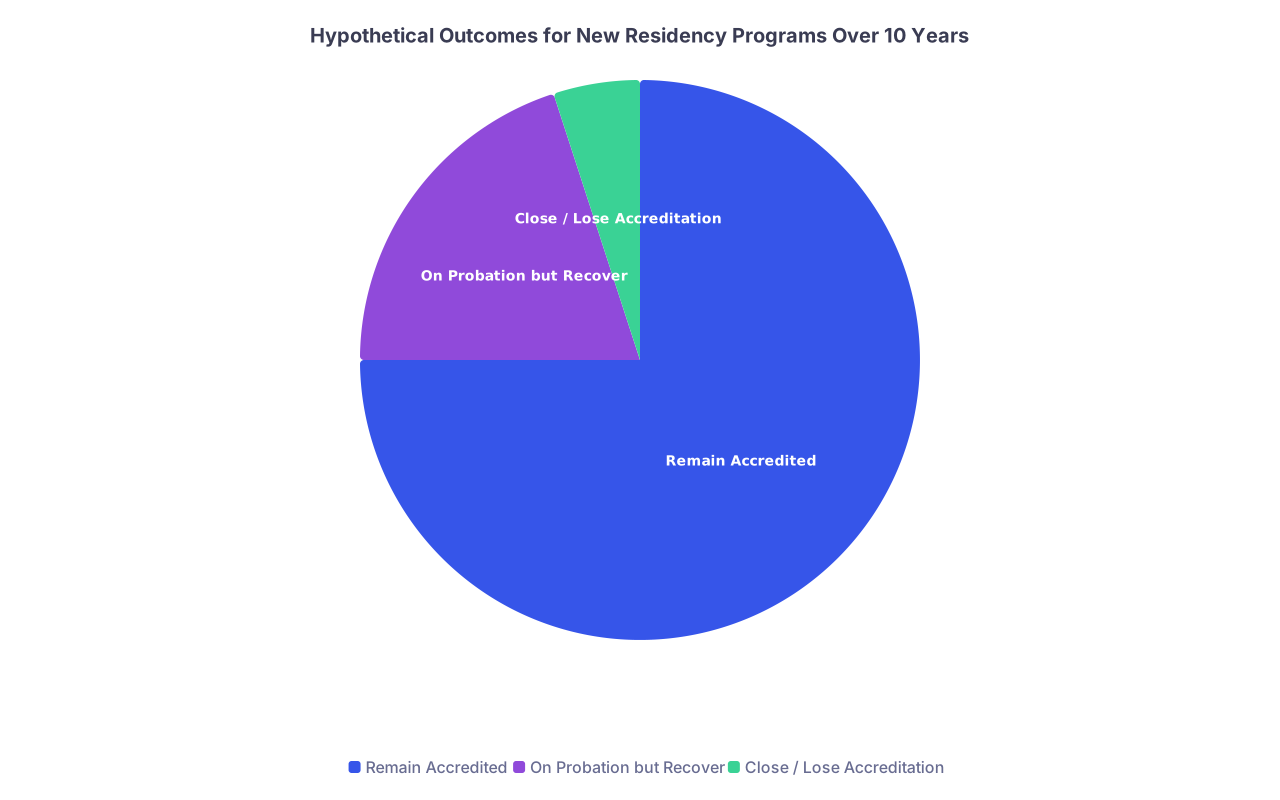
| Category | Value |
|---|---|
| Remain Accredited | 75 |
| On Probation but Recover | 20 |
| Close / Lose Accreditation | 5 |
Even if the exact percentages vary by specialty and year, the general reality holds: most new programs survive, some wobble then stabilize, and a small fraction actually close.
You’re obsessing over that 5%. Because that’s how anxious brains work. Mine too.
If You’re Applying Now: One Practical Step
You’re probably thinking: “Okay, cool, but what do I do with all this?”
Next time you interview at a new program, ask very direct questions:
- “What was most recent ACGME feedback, and what changes came from it?”
- “Have you had any citations? How are you addressing them?”
- “What specific support does the institution give to ensure this program is stable long term?”
- “If ACGME ever raised serious concerns, how would that be communicated to residents?”
Watch their body language. Listen for specifics. “We’re committed to excellence” is meaningless. “We had concerns about supervision in the ICU and responded by adding X, Y, Z concrete changes” is much better.
And if you truly get a bad gut feeling about a place? Believe it. Ranking a slightly less shiny but more stable program higher is not cowardly. It’s rational self‑preservation.

FAQ: Six Brutal Questions You’re Probably Still Asking
1. If my program loses accreditation, can I still become board certified?
Yes, if:
- The time you already completed was in an accredited program at that time, and
- You finish the required total training years in other accredited programs (or in that program’s approved teach‑out period).
Boards and ACGME generally do not punish residents for institutional problems. You may have to do some paperwork, get letters documenting your training, and coordinate between programs, but it’s not “game over.”
2. Could I be forced to repeat a year if I transfer?
It’s possible, but not automatic.
If your previous program’s training doesn’t line up well with the new program’s requirements—missing key rotations, procedural experience, or continuity clinic—your new PD might say, “We want you to redo some PGY‑1 or PGY‑2 rotations.” That could feel like repeating a year.
But most PDs don’t want to waste your time or money. They’ll usually:
- Give you credit for as much as they can, and
- Patch gaps with targeted rotations rather than full‑year repeats, if feasible.
3. Will fellowship programs think less of me if I came from a closed or troubled residency?
They might ask about it. But they’re usually more concerned with:
- Your clinical skills and evaluations
- Your letters of recommendation
- Your board scores and research, if relevant
- How you talk about the situation
If you sound bitter and chaotic, that’s a problem. If you sound grounded and honest—“It was messy, but I learned A, B, and C”—most people will respect that. Plenty of fellows out there have non‑linear training stories.
4. Could I lose my visa status (if I’m IMG on J‑1 or H‑1B) if the program closes?
This is where things get scarier.
If you’re on a visa:
- Abrupt program closure can put you on a tight timeline to find a new position and transfer your visa sponsorship.
- ECFMG (for J‑1) or your immigration attorney and hospital HR become critical.
People have successfully navigated this, but the stakes are higher and the margin for error is smaller. If you’re an IMG in a new program, you should be extra cautious about institutional stability and have a basic understanding of what would happen to your status if the program folded.
5. What if I realize my new program is a mess—can I try to transfer before it loses accreditation?
Yes. It’s hard, but yes.
You don’t have to wait for ACGME to drop the hammer to say, “This isn’t working for me educationally. I want out.”
That usually means:
- Quietly networking with other programs.
- Reaching out to PDs where there might be open spots.
- Being honest but professional about why you’re leaving: focus on education and fit, not trash‑talk.
Transfers are more common than people admit. They’re just not talked about openly because everyone’s embarrassed. You don’t need to be.
6. What’s one thing I should do today if I’m already in a new program and low‑key worried?
Start building your paper trail and network:
- Make sure your evaluations, procedure logs, and duty hours are accurate and saved.
- Keep an updated CV.
- Cultivate at least 2–3 faculty who know your work well and would vouch for you if you ever needed to transfer.
You don’t have to act like the program is doomed. Just quietly prepare for the 5% scenario so that, if it happens, you’re not starting from zero.
Open a blank document right now and write down three things: your current program’s strengths, its biggest red flags, and one concrete question you’ll ask your PD or senior residents this week about accreditation or stability. Start there.