
You are not crazy for worrying that a brand‑new residency program might tank your fellowship chances. That fear is rational. But the way most of us picture it—in flames, everything ruined, fellowship doors slammed forever—that part is exaggerated.
Let’s unpack that without sugarcoating it.
The Core Fear: “If I Go to a New Program, I’ll Never Match a Good Fellowship”
I know the loop in your head, because I’ve heard versions of it over and over:
- “No name recognition = no interview invitations.”
- “No alumni in fellowships = no one to vouch for me.”
- “No established fellowship match list = I’m the guinea pig.”
- “Committees will just skip my application because they don’t know my program.”
Underneath all that is one terror: what if this one decision (choosing a new residency) permanently shrinks my career options?
Let me be blunt: a brand‑new, unproven residency does make your fellowship path steeper in some ways. But it’s not the same as “game over.” It’s more like: “you have to be visibly strong on paper and more proactive than average.”
Let’s talk about what changes, what doesn’t, and what you can realistically do about it.
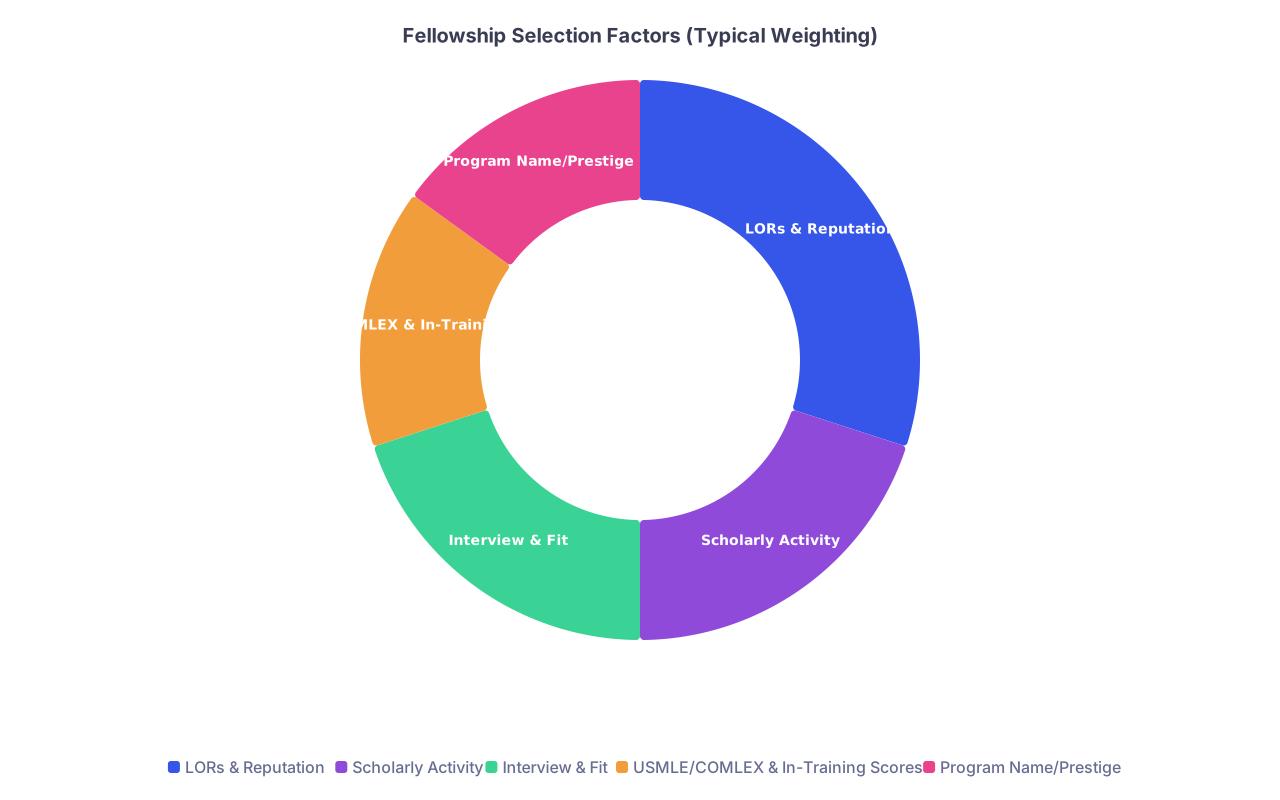
| Category | Value |
|---|---|
| LORs & Reputation | 30 |
| Scholarly Activity | 20 |
| Interview & Fit | 20 |
| USMLE/COMLEX & In-Training Scores | 15 |
| Program Name/Prestige | 15 |
What Fellowship PDs Actually Care About (Not the Fantasy Version)
People talk like fellowship directors only care about big-name institutions. That’s lazy thinking.
When I’ve listened to faculty and PDs talk about fellowship selection behind closed doors, they talk about:
- “Can this person function as a junior attending?”
- “Do we trust their letters?”
- “Is their clinical training solid or do we have to un-teach bad habits?”
- “Are they serious about this field or just running from general practice?”
- “Will they be a problem?” (yes, this is actually said)
Program name is shorthand. It’s a fast way to guess the answers when they don’t know you. But it’s not the only tool.
Here’s what consistently matters more than the age of your residency:
- Strong, specific letters from people the field respects
- Real scholarly activity (not just your name in the middle of a 20‑author case report you never read)
- Concrete evidence of commitment to the specialty (rotations, electives, presentations, QI)
- Not being a red flag in professionalism or evaluations
- Interview performance and fit
Where does “new program vs established” land? Honestly: it’s part of the context, not the verdict.
A new IM resident applying for cardiology with:
- Great ITE scores
- Two strong letters from recognized cardiologists
- A poster at ACC and a small retrospective study
- A clearly articulated story of why cards and what they’ve done for it
…will get more serious consideration than a mediocre applicant from a famous but lukewarm program.
Fellowship PDs will absolutely accept people from “no‑name” or newer places if they can clearly see:
“This person will be safe, competent, and productive in my fellowship.”

How Being at a New Residency Actually Changes Your Fellowship Odds
Let’s be honest about where new programs hurt you and where they surprisingly don’t.
Where New Programs Do Make It Harder
No historical match list to lean on
When you’re at a place like BIDMC or Mayo, you can say “Our last 5 class members went to XYZ fellowships.” New programs can’t. That does two things:- PDs don’t have built-in trust in your program’s output.
- You don’t get the psychological comfort of a proven pipeline.
Weaker alumni network
At older programs, alumni are everywhere—fellows, attendings, PDs. They can pull your app out of the pile with a single email:
“Hey, this resident is strong. Worth a look.”
At a new program, you might have literally zero alumni in your target fellowships.Less “brand shorthand”
Top‑30 name on ERAS? People infer a floor of competence.
New community‑based program? They might assume you’re untested until you prove otherwise.Early growing pains
New programs often have:- Chaotic scheduling the first few years
- Inconsistent evaluation systems
- Faculty still figuring out how to mentor for fellowship This can make it harder to build a clean, impressive application without chasing things yourself.
None of that is imaginary. It all affects fellowship prospects.
Where It Doesn’t Hurt as Much as Your Brain Thinks
Clinical exposure can still be strong
Many new programs are created within systems that already had solid clinical volume—just no residents. You might be at a big tertiary center that only recently built a residency. Fellowship PDs know this is happening across the country.Certain fellowships care far more about you than your badge
Community GI, heme/onc at mid‑tier universities, many pulm/crit programs, peds subspecialties at non-elite places—they’ll read your application if your metrics and letters are solid.The first few “star” graduates can overperform
Early cohorts at new programs sometimes get more attention than you think, because:- Faculty are very invested in making them succeed
- PDs are eager to prove “We can match competitive fellowships” I’ve seen brand‑new IM programs send their first grad to a university cards or GI spot precisely because they poured everything into that one candidate.
USMLE/COMLEX, ITE scores, and research travel
A 250+ Step 2CK or high COMLEX, strong in‑training scores, and real research in the target field still travel well. A fellowship PD can look at those and say, “Okay, this person is at least academically capable, regardless of program age.”
| Factor | New Residency Program | Established Program |
|---|---|---|
| Name recognition | Low, variable | Moderate to high, depending on institution |
| Alumni network | Minimal or none | Broad, often across many fellowships |
| Faculty invested in you | Often very high (small cohorts) | Variable, more residents to divide attention |
| Built-in research pipeline | Usually limited at first | Often established labs, ongoing projects |
| Match list history | None or 1–2 years | Many years, easier to “sell” to fellowships |
What Fellowship PDs Might Secretly Worry About With New Programs
Your nightmare: “They’ll take one look at my new program and toss my app.”
Their actual thoughts are more like:
- “Will this resident be undertrained clinically?”
- “Have they actually seen sick patients at volume, or are they sheltered?”
- “Can I trust their letters if I don’t know their faculty?”
- “Does their eval system inflate everyone to ‘outstanding’ because it’s a new program?”
- “Why are they interested in my field? Can they articulate it or are they just running from general practice?”
So your job, if you do pick (or are already stuck in) a new program, is to attack those doubts head-on in how you build your CV and present yourself.
The question stops being:
“Is my program new?”
and becomes:
“Given that my program is new, how do I make myself obviously safe and obviously serious about this field?”

| Step | Description |
|---|---|
| Step 1 | Start PGY1 at New Program |
| Step 2 | Identify Target Fellowship |
| Step 3 | Find Mentors in That Field |
| Step 4 | Join Research or QI Projects |
| Step 5 | Seek Away Electives or Visiting Rotations |
| Step 6 | Prepare for Strong Letters |
| Step 7 | Apply Early and Broad |
| Step 8 | Secure Fellowship Interviews |
Concrete Moves to Protect Your Fellowship Prospects at a New Program
Here’s where the anxiety can actually be useful. You’re already catastrophizing. Fine. Use that energy.
1. Pick Your Target (Even If It Changes Later)
By mid‑PGY1, you should have a working hypothesis:
- “Likely cards”
- “Probably heme/onc”
- “Maybe pulm/crit or hospitalist—undecided”
This doesn’t lock you in forever. But if you don’t narrow it at all, you can’t position yourself, and people at new programs who “just see what happens” often wake up in PGY3 with a generic CV and no angle.
2. Build External Validation
Because your program doesn’t have a long track record, you need evidence that travels well outside your hospital:
- Present at national conferences in that field (ACC, ACG, ATS, ASH, etc.)
- Get your name on a manuscript, abstract, or at least a serious poster with someone known in the specialty
- Do an away elective / visiting rotation at a fellowship‑heavy institution in your target field, if your program and life can tolerate it
That away month, if you perform well, can be the difference between your app being “risky unknown from New Program X” vs “Oh, Dr. Smith at Our Institution wrote them a strong letter.”
3. Letters That Actually Mean Something
From a new program, your letters matter more. Not just that they’re positive. But that they’re:
- From people in that specialty, preferably in academic settings
- Detailed, with behavior‑based comments: “I watched them independently manage complex X, followed by proactive reading and follow‑up”
- From at least one person with a name or institution that fellowship PDs recognize
You probably need:
- 1–2 letters from your home institution faculty in the specialty
- 1 letter from an away rotation / collaborator at a more established program, if at all possible
- A PD letter that makes it clear your training is robust despite being new
4. Dominate the Controllables
You can’t change that your program started in 2023 or whatever. You can change:
- Your ITE/ABSITE/other in‑training scores
- Whether you show up early and prepared on subspecialty rotations
- Whether you volunteer for QI projects that touch your field
- Whether faculty think of you as “reliable and hungry” vs “fine, I guess”
From a new program, “fine, I guess” kills you. You need at least a few people willing to say, on the record and privately: “This one is special, worth a chance.”
5. Apply Broadly and Strategically
Yes, you may need to apply to more programs than the average resident from a top‑tier institution. Because you’re not just selling you, you’re also selling “my program is new but legit.”
That means:
- Casting a wider geographic net
- Being realistic about tier—mix of strong mid‑tier academic, some higher‑tier long‑shot, and solid community fellowships
- Using every connection you can: mentors emailing PDs, conference networking, faculty who trained elsewhere reaching out
None of this is fair. But it’s reality. And it’s survivable.

The Worst-Case Scenarios You’re Scared Of (And What Actually Happens)
Your brain probably cycles through a few horror stories:
Horror Story 1: “No one will interview me.”
Real risk? Low if you:
- Have a coherent CV
- Apply broadly
- Have at least one recognizable letter
You might get fewer interview offers than someone identical at a top‑name program, yes. But going from “fewer” to “none” usually takes more than just “new program”—it takes poor scores, weak letters, or a scattered application.
Horror Story 2: “I’ll only match a ‘bad’ fellowship.”
Let’s be honest: there are fellowships that are less academic, more service‑heavy, or in locations you don’t want. You might be more likely to end up in one of those if you:
- Want a very competitive field (cards, GI, heme/onc at top centers)
- Have average stats and average research
- Come from a new, unknown program
But “only match bad” is still better than “never train in the field you wanted.” And more importantly, your first fellowship job doesn’t freeze your entire career path forever. People move, they do additional training, they join better groups later, they change jobs.
Horror Story 3: “If I don’t match from this new program, I’m ruined.”
Some people don’t match fellowship from top programs either. It’s not only a “new program” thing.
If you don’t match:
- You can work as a hospitalist or generalist for a year and reapply
- You can beef up your CV—research, new letters, maybe another away rotation
- You can shift fields (e.g., from cards to pulm/crit or hospital medicine leadership)
Does it hurt? Yes. Is it career-deleting? No.
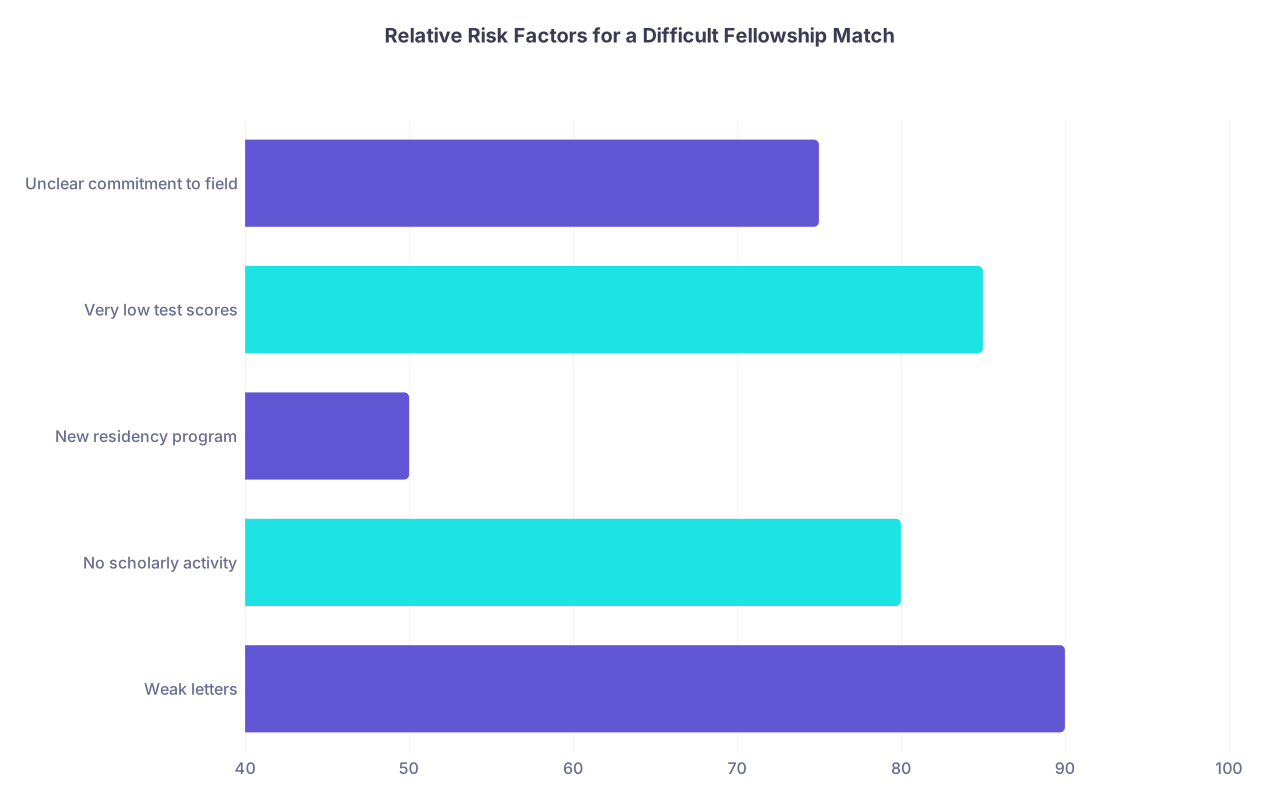
| Category | Value |
|---|---|
| Weak letters | 90 |
| No scholarly activity | 80 |
| New residency program | 50 |
| Very low test scores | 85 |
| Unclear commitment to field | 75 |
Signs a New Program Will Protect Your Fellowship Prospects (vs One That Won’t)
Not all new programs are created equal. You’re right to be suspicious. Some are clearly built with an academic/fellowship pipeline in mind. Others are band‑aids for staffing.
You should be on high alert if:
- There are no subspecialists on staff in your interested field
- The program director shrugs when you ask about fellowship outcomes and says things like “Most people just do primary care/hospitalist” with no plan for those who don’t
- No one is doing research, QI, or presenting at national conferences—like, at all
- They can’t outline any plan for away rotations or scholarship support
- They get defensive when you ask about fellowship match projections (“We’re new, we don’t know yet” with zero follow‑up like “but here’s what we’re building”)
On the other hand, a new program is much safer if:
- It’s in a system that already has strong fellowships in your field, even if not at your exact hospital
- There are faculty who trained at reputable places and still have contacts there
- They can say, “Our first class hasn’t graduated yet, but three people are seriously aiming for X, and here’s the mentorship and projects lined up”
- The PD lights up (in a good way) when you ask about fellowship and talks specifics: conferences, letters, data, connections
If they look at you blankly when you say “fellowship,” alarm bells.

Final Reality Check: Your Anxiety Isn’t Lying, It’s Just Loud
You’re right to be cautious about new programs. Some are fantastic and will absolutely get their grads into fellowships. Some are barely holding it together and will leave you doing damage control.
Here’s the uncomfortable truth:
- A new residency makes your fellowship path more dependent on you and less on institutional inertia.
- You lose the automatic credibility of a decades‑old name and alumni network.
- You gain potentially more attention from faculty desperate to build a match record, if you’re proactive and clearly strong.
If you’re the kind of person who’s anxious enough to read an article like this and think several years ahead, that already puts you ahead of half your peers. As long as you don’t let the anxiety paralyze you.
So, one concrete next step:
Today, sit down and write one page with three headings: (1) Target fellowship(s), (2) People I can ask about fellowship outcomes at my program (or interview sites), and (3) Specific things I could do in PGY1–2 to be competitive from a new program. Then, email one actual human (PD, APD, mentor, or resident) with two direct questions about fellowship from that list.
Not hypothetical. Not “someday.”
Open your email, send that message, and force this fear into a real conversation instead of a 3 a.m. spiral in your head.