The biggest myth about new residency programs is that you can “launch in a year” if everyone just works hard enough. Wrong. If you try to compress this, you will either miss accreditation, fail recruitment, or burn out your founding faculty before PGY‑1 orientation.
Here’s the real pace: three to five years from “we should start a program” to your first graduating class walking across the stage.
You’re building an institution, not an event. So you need a map.
Below is a year‑by‑year (and sometimes quarter‑by‑quarter) timeline from vague idea → ACGME accreditation → recruitment → graduation of your first class. I’ll assume a core residency (IM, FM, Peds, Psych, etc.) using the ACGME single accreditation system and NRMP Match, but the skeleton is the same for most specialties.
Year 0: Concept to Green Light (6–12 months before serious ACGME work)
At this point you should be deciding whether you can and should do this at all, not writing curriculum.
Main goals this year:
- Decide specialty and program size.
- Confirm institutional commitment (money + FTEs, not “verbal support”).
- Roughly map finances and clinical capacity.
Quarter 1 (Exploration)
At this point you should:
- Form a small exploratory group:
- Potential PD candidate (if you have one in mind).
- DIO / GME office lead.
- CMO or equivalent.
- Finance rep.
- Decide which specialty actually fits your hospital:
- Where do you have protected clinical volume? (e.g., 60,000 ED visits/year for EM, strong inpatient census for IM).
- Where do you have a credible faculty core? Board‑certified, clinically respected, not already maxed out.
- Do a quick and dirty market scan:
- How many programs in your region?
- Existing pipeline issues (hard to recruit? long‑term vacancies?).
- Potential feeder medical schools and DO schools.
Quarter 2 (Feasibility & Commitment)
Now you move from “idea” to “proposal.”
At this point you should:
- Build a pro forma (3–5 year):
- Resident salaries and benefits.
- Faculty FTE buy‑down for education time.
- Program admin (coordinator, maybe assistant).
- ACGME and NRMP fees.
- Call rooms, conference space, simulation, IT.
- Identify a Program Director candidate:
- Meets ACGME requirements (years out of training, board‑certified, scholarly activity).
- Has at least 0.3–0.5 FTE available for PD role (more if multiple sites).
- Present to hospital leadership / board:
- Clear ask: “We need X dollars and Y faculty FTE over Z years.”
- Define benefits: recruitment, coverage, academic branding, pipeline.
By the end of Year 0, you should have:
- Formal institutional sign‑off.
- A draft timeline for:
- ACGME application submission.
- Desired first Match year.
- First resident start date.
If you do not have those, you’re not ready for Year 1.
Year 1: ACGME Application Build and Submission
This is your application year. The PD and DIO run the show.
Core goals:
- Hire/confirm PD and program coordinator.
- Complete program design and ACGME application.
- Secure necessary agreements and resources.
Quarter 1: Leadership and Structure
At this point you should:
- Formalize PD appointment with contract, FTE, and protected time.
- Hire an experienced program coordinator (preferably someone who’s worked in GME before; learning both GME and this program from scratch is a recipe for chaos).
- Map your governance:
- CCC (Clinical Competency Committee).
- PEC (Program Evaluation Committee).
- Faculty roster with roles (site leads, block directors, etc.).
- Confirm sponsoring institution and teaching sites:
- Sponsoring GME office processes.
- Letters of support from each participating site.
Quarter 2: Curriculum, Rotations, and Resources
At this point you should be building the spine of the program.
- Design the block schedule for all PGY years:
- Required rotations with durations.
- Elective structure.
- Continuity clinic model (for primary care specialties).
- Align with ACGME requirements:
- Minimum clinical experiences and procedures.
- Duty hours compliance and call schedule model.
- Secure educational resources:
- Dedicated resident conference space.
- Didactic schedule (protected time).
- Simulation access.
- Library and online resources.
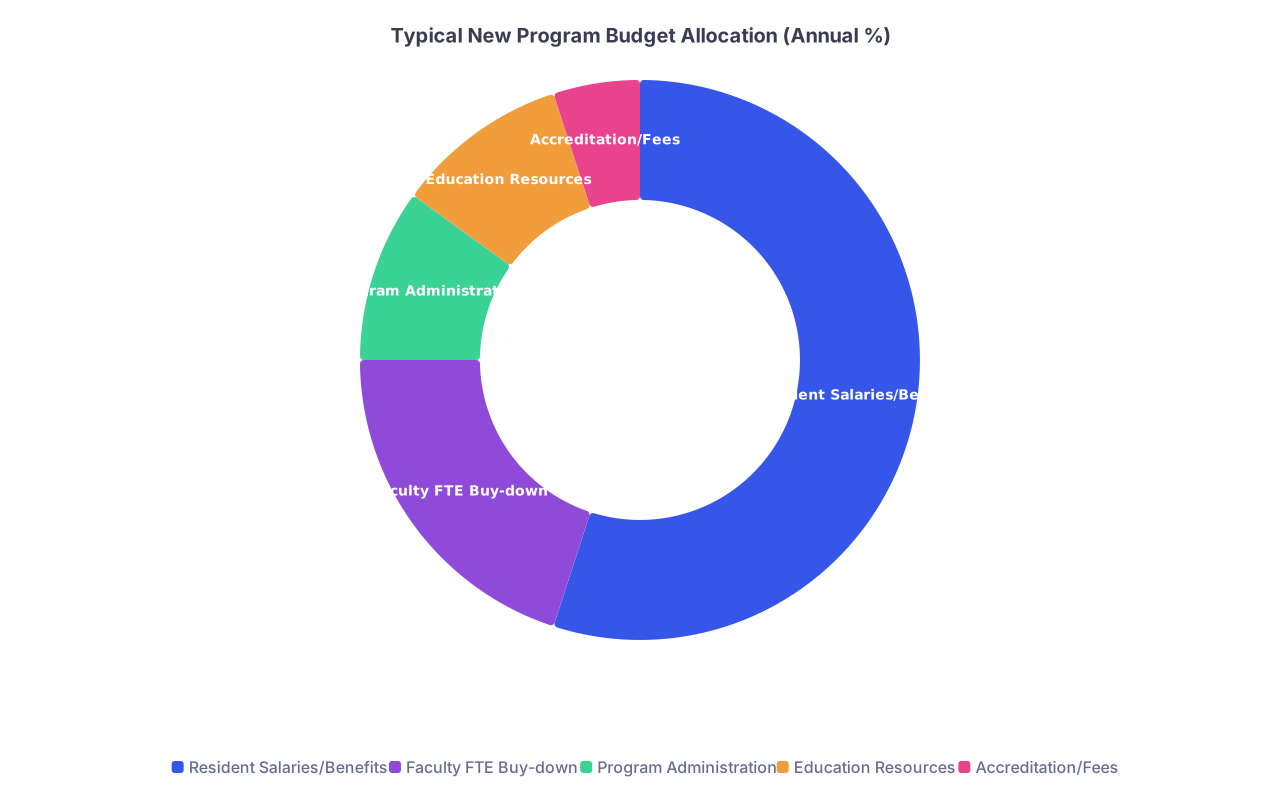
| Category | Value |
|---|---|
| Resident Salaries/Benefits | 55 |
| Faculty FTE Buy-down | 20 |
| Program Administration | 10 |
| Education Resources | 10 |
| Accreditation/Fees | 5 |
Quarter 3: ACGME Application Drafting
Now you’re in the weeds of ADS (ACGME’s system).
At this point you should:
- Write the Program AIMS and narrative sections:
- Clear, specific, and consistent with institutional mission.
- Finalize faculty CVs and scholarly activity documentation.
- Build evaluation tools:
- Milestones‑aligned rotation evaluations.
- 360 tools where required.
- Lock in policies:
- Duty hours.
- Supervision and handoff.
- Fatigue mitigation.
- Moonlighting.
- Wellness and mistreatment reporting.
Do not underestimate this quarter. I’ve watched programs stall six months here because faculty “will get their CV updated soon.” They rarely do without hard deadlines.
Quarter 4: Internal Review and Submission
At this point you should:
- Undergo an internal GMEC review:
- Many institutions require a mock review before ACGME submission.
- Fix any identified gaps promptly.
- Finalize all agreements:
- Affiliation agreements with outside sites.
- Call pay or other resident‑related contracts where relevant.
- Submit the ACGME application by the internal deadline aligned with your desired start year.
Remember: ACGME timing is not infinitely flexible. If you want to participate in a given Match year, you need Initial Accreditation in time to register with NRMP and ERAS. Miss that, and you lose an entire cycle.
Year 2: Accreditation Decision and First Recruitment
This year splits into two tracks: waiting for ACGME and preparing to recruit.
Quarter 1: ACGME Review and Site Visit (if required)
At this point you should be:
- Responding quickly to ACGME requests for clarification.
- Preparing for a site visit or virtual review:
- PD, DIO, key faculty prepped.
- Documents organized and consistent with the application.
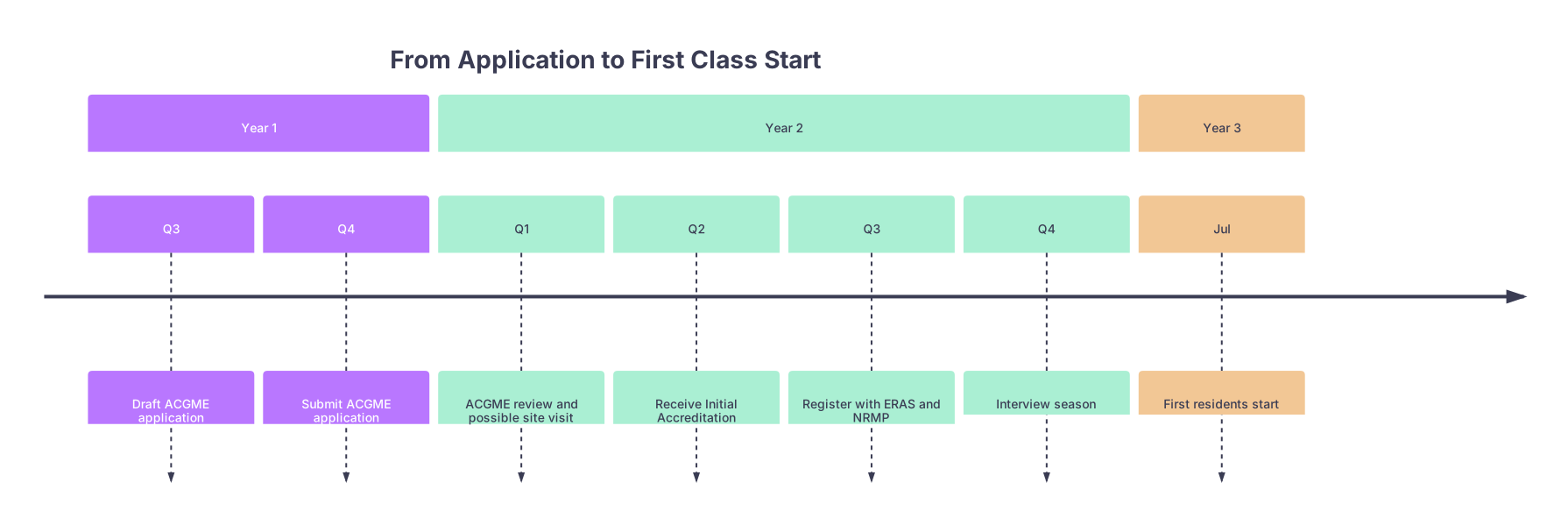
| Period | Event |
|---|---|
| Year 1 - Q3 | Draft ACGME application |
| Year 1 - Q4 | Submit ACGME application |
| Year 2 - Q1 | ACGME review and possible site visit |
| Year 2 - Q2 | Receive Initial Accreditation |
| Year 2 - Q3 | Register with ERAS and NRMP |
| Year 2 - Q4 | Interview season |
| Year 3 - Jul | First residents start |
Quarter 2: Initial Accreditation & Match Setup
Best case: you receive Initial Accreditation this quarter.
At this point you should:
- Register the program with NRMP and ERAS.
- Finalize:
- Number of positions for each PGY level.
- Any off‑cycle or non‑Match positions (if allowed/strategic).
- Build your recruitment profile:
- Website with honest, detailed info (do not oversell).
- Clear description of being a new program, with what that means for applicants.
- Faculty bios, educational philosophy, rotation plan.
If accreditation is delayed, you may have to skip a Match cycle. That’s not failure; that’s reality. Starting with a rushed class under half‑baked infrastructure is worse.
Quarter 3–4: Recruitment and Interviews
This is where many new programs underestimate the work.
At this point you should:
- Set selection criteria:
- USMLE/COMLEX thresholds (if any).
- Visa sponsorship policies.
- How you value couples match, second careers, etc.
- Build your interview day:
- Who interviews (faculty, PD, maybe chief or near‑peer residents from other programs if no residents yet).
- Virtual vs in‑person strategy.
- Plan for lower initial application volume:
- New programs often need to over‑invite early to fill interview days.
- Aggressive, prompt communication matters.
| Program Type | Apps per Position | Interviews per Position | Historical Fill Risk |
|---|---|---|---|
| New Community | 60–100 | 10–14 | Moderate |
| New University | 80–150 | 10–12 | Low–Moderate |
| Established Comm. | 120–250 | 8–12 | Low |
| Established Univ. | 200–600 | 8–10 | Very Low |
During interview season you should:
- Keep turnaround fast:
- Reply to applications and send invites within days, not weeks.
- Track acceptance rates for interview invites.
- Begin sketching your rank list strategy early:
- Prioritize residents who can handle ambiguity and growth, not just scores.
Year 3: First Class Onboarding and PGY‑1 Year
At this point you’ve matched your first class. Now the real work starts.
Pre‑July (Spring–Early Summer): Orientation Build
You should:
Finalize onboarding workflows:
- HR, employee health, background checks.
- Licensure, NPI, DEA (if applicable).
Plan orientation (1–4 weeks depending on program):
- EMR training.
- Hospital systems.
- Basic procedures, ACLS/BLS, PALS/NRP as needed.
- Culture and expectations.
Stress‑test:
- Call schedules.
- Coverage models when residents are post‑call.
- Supervision chains (who backs up nights, weekends).
PGY‑1 Year: Quarter by Quarter
Q1 (July–September): Survival and Micro‑Adjustments
At this point you should:
- Monitor duty hours weekly for violations.
- Round frequently on:
- Resident experiences.
- Faculty supervision quality.
- Hold monthly PD–resident check‑ins:
- Psychological safety.
- Early signs of burnout or misalignment.
Make small schedule fixes quickly. Rotations that look good on paper sometimes implode in reality.
Q2–Q3 (October–March): Systems Mature
Now:
- Launch CCC and Milestones assessments.
- Start program evaluation cycles:
- Mid‑year PEC review.
- Address glaring issues (a toxic rotation, poor teaching, workflow disasters).
- Support residents who want to present at local or regional conferences.
Q4 (April–June): Planning for PGY‑2 Year
At this point you should:
- Finalize the PGY‑2 schedule.
- Decide early if any PGY‑1s are at risk of not being promoted:
- Clear documentation and remediation plans.
- Prepare for the next recruitment cycle:
- Your first class are now ambassadors; get their honest take integrated into your pitch.
Year 4: Expansion and Second/Third Classes
Your first class is PGY‑2. Program culture is forming—for better or worse.
Program-Level Focus
At this point you should:
- Fine‑tune rotation loads:
- Reduce bottlenecks and overstuffed services.
- Shift residents away from low‑yield scut environments.
- Build or expand scholarly activity pathways:
- QI projects attached to hospital priorities.
- Research for residents aiming at fellowships.
- Strengthen faculty development:
- Feedback training.
- Assessment calibration for Milestones.
Recruitment 2.0
Your sales pitch changes now.
You should:
- Feature current resident voices:
- Website testimonials (unedited is best).
- Residents present on interview day.
- Showcase outcomes:
- Board prep structure.
- Early fellowships or job commitments (if any PGY‑3s in combined tracks or advanced entries).
- Adjust your rank strategy based on year‑1 outcomes:
- If you had professionalism issues, tweak what you screen for.
- If residents want more procedural exposure, recruit people who thrive on that.
Year 5: First Class Graduation
This is the year you’ve been walking toward the whole time.
Your first class is PGY‑3 (or PGY‑4/5 depending on specialty). They’re your proof of concept.
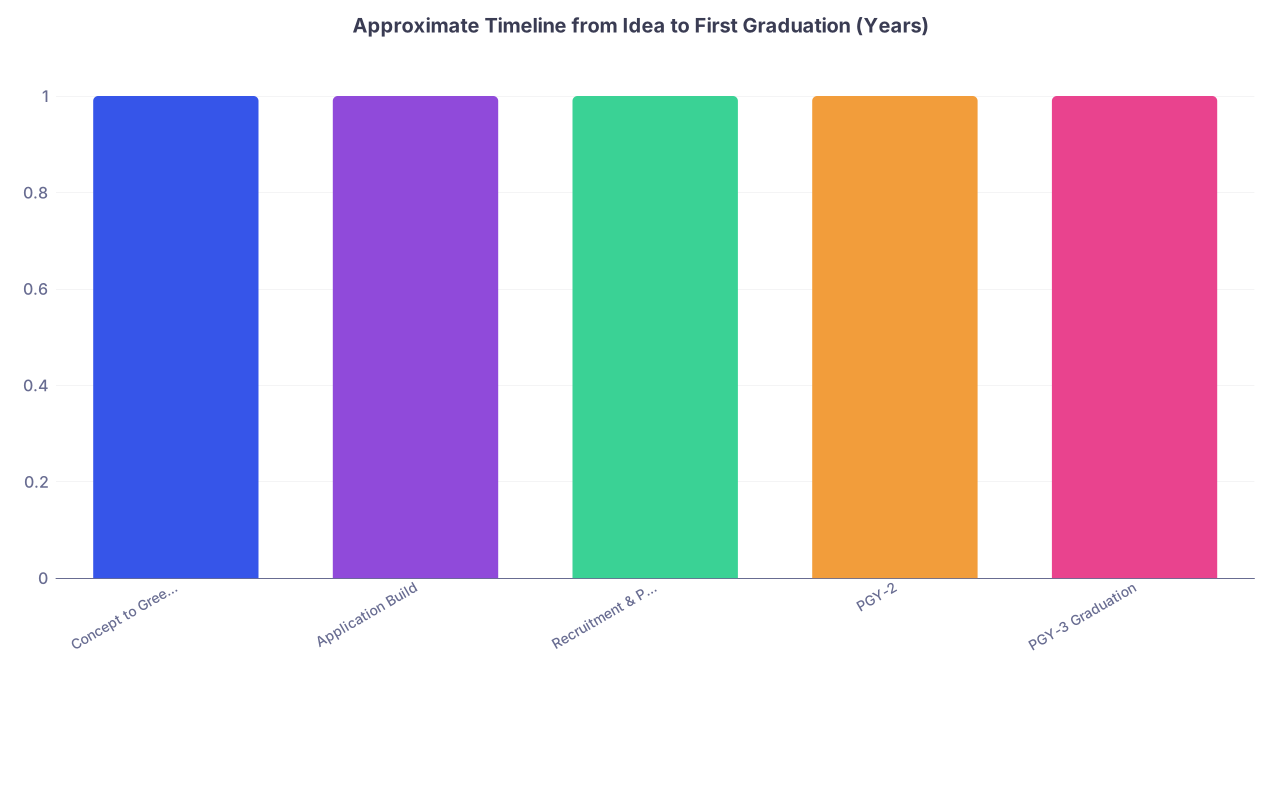
| Category | Value |
|---|---|
| Concept to Green Light | 1 |
| Application Build | 1 |
| Recruitment & PGY-1 | 1 |
| PGY-2 | 1 |
| PGY-3 Graduation | 1 |
Early Year 5 (July–December): Outcomes and External Perception
At this point you should:
- Track board eligibility:
- Ensure graduates will meet all case/procedure/clinic requirements.
- Support fellowship and job applications:
- Letters that specifically highlight adaptability (new program grads often have strong leadership narratives).
- Prepare for ACGME continued accreditation reviews:
- Use your first three years of data (surveys, Milestones, board pass rates once available).
Late Year 5 (January–June): Graduation and Reflection
You should:
- Plan a real graduation ceremony:
- This isn’t fluff. It sends a message internally and externally that the program is here to stay.
- Conduct a deep retrospective with your first class:
- What worked.
- What failed.
- What they want preserved for future residents.
By the time they graduate, you’re no longer a “new program.” You’re a young program with measurable outcomes. That changes both your internal politics and your external reputation.
Putting It All Together: A Compressed Roadmap
If you want a high‑level checklist from “proposed program” to first graduation:
Year 0 (6–12 months)
At this point you should:
- Decide specialty and class size.
- Confirm institutional dollars and leadership backing.
- Identify PD candidate and core faculty interest.
Year 1
- Hire PD and coordinator.
- Design curriculum, rotations, evaluations, and policies.
- Submit ACGME application after internal review.
Year 2
- Achieve Initial Accreditation.
- Register with NRMP/ERAS.
- Build and run your first recruitment and interview season.
- Match your first class.
Year 3
- Onboard and orient PGY‑1s.
- Monitor duty hours, culture, and supervision closely.
- Launch CCC/PEC and start serious quality improvement.
Year 4
- Mature PGY‑2/PGY‑1 structure.
- Stabilize rotations and workload.
- Enhance research/QI and refine recruitment with real resident voices.
Year 5
- Support PGY‑3 outcomes: jobs, fellowships, board eligibility.
- Graduate first class.
- Leverage their success to solidify accreditation and reputation.
Final Takeaways
- You are not building a schedule; you are building a multi‑year institution. Treat the timeline like a long game or you will fail in the middle years.
- The most fragile periods are Year 1 application build and Year 3 PGY‑1 launch; if you’re going to over‑invest effort anywhere, it’s there.
- A first graduating class that’s proud to say “I trained there” is your ultimate metric. Everything in this timeline is aimed at earning that sentence.