
It’s 7:30 p.m. You’re on a late call shift, and your PD pulls you aside in the workroom: “We’re thinking about starting a new residency in [insert specialty]. Don’t mention this broadly yet.”
You nod, say “that’s exciting,” and go back to your notes. But your brain is buzzing:
Who actually decides to start a residency? Why this specialty? Why now? And how the hell does a place that can barely staff the wards suddenly become a “training site”?
Let me walk you through what actually happens. Not the clean, brochure version. The version PDs and chairs talk about behind closed doors.
Step 1: It Starts With Money, Not Education
Let’s kill the fantasy up front. New residency programs do not start because someone woke up and said, “We must train the next generation.”
They start because of one of three drivers. Always:
- The hospital needs cheap, semi-skilled labor (residents).
- The department needs prestige and leverage (and often, more faculty FTEs).
- The system sees a strategic or financial opportunity in GME expansion.
Occasionally all three.
What actually triggers the first conversation is usually a non-clinical leader. A CFO, a system VP for Growth, or a CEO who just came back from a conference where another hospital bragged about “tripling their GME footprint” and capturing more GME funding.
I’ve been in that room. It sounds like this:
- CFO: “How much does a resident cost us versus an APP?”
- DIO: “Well, we get about X in CMS GME funds per resident per year…”
- Chair: “If we had residents, we could open another team and stop paying so much for locums.”
No one is talking about ABMS boards or teaching philosophies yet. They’re talking about FTEs, coverage, and federal dollars.
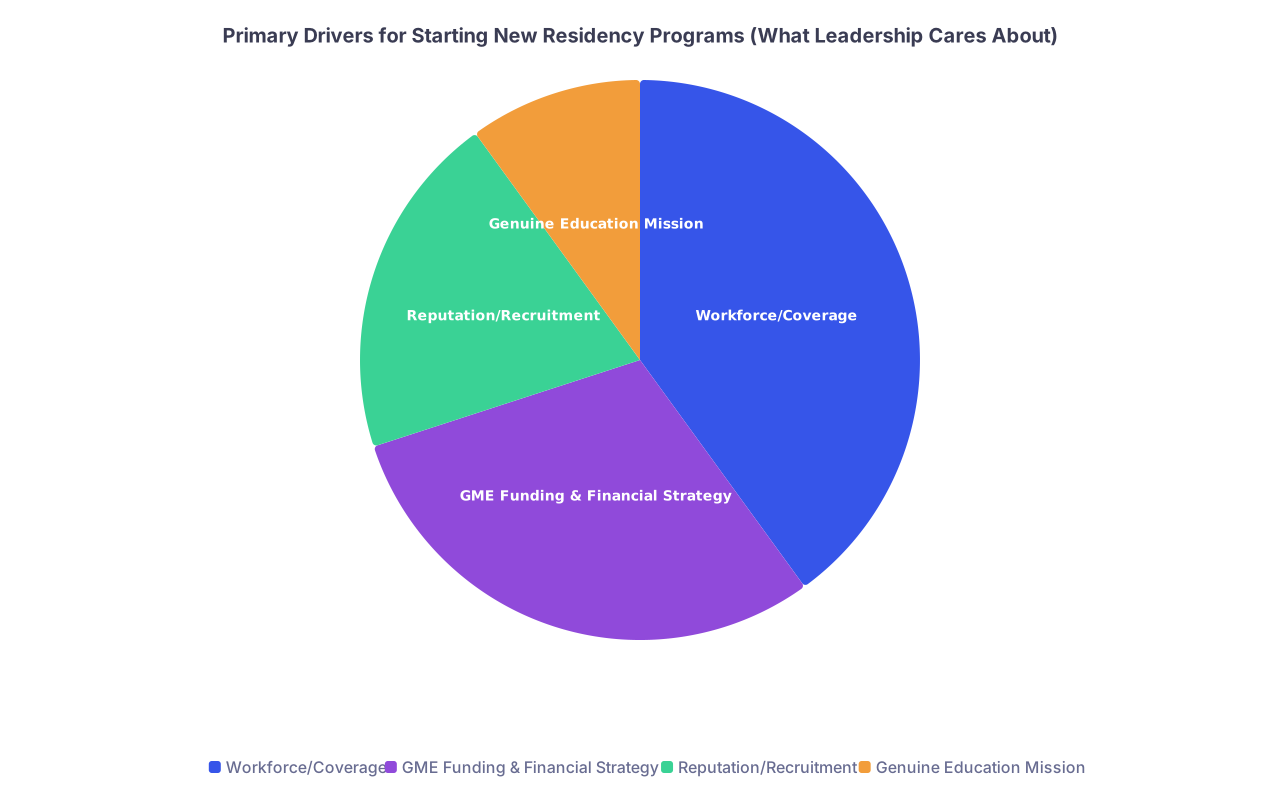
| Category | Value |
|---|---|
| Workforce/Coverage | 40 |
| GME Funding & Financial Strategy | 30 |
| Reputation/Recruitment | 20 |
| Genuine Education Mission | 10 |
If you think I’m being cynical, ask any DIO off the record:
“Would you have got approval for that new residency if it didn’t come with CMS dollars and cheaper coverage?”
Watch the face. You’ll get your answer.
Step 2: The Internal Politics – Who Wants It, Who Fights It
Once the idea is floated, the internal politics start.
Here’s who has real power in that decision:
- The CEO or system-level leadership
- The DIO (Designated Institutional Official)
- The specialty chair and a couple key senior faculty
- Sometimes the CFO or finance VP
Residents? Medical students? Community docs? They’re window dressing for later.
There’s usually a tug-of-war between these camps:
- Administration – wants the program for coverage and financial upside
- Department – wants prestige, faculty lines, and sometimes academic clout
- Existing programs – worried about cannibalizing teaching cases and faculty time
- DIO/GME office – worried about ACGME compliance and institutional risk
I watched a mid-size hospital try to launch a general surgery residency while medicine, OB, and EM already existed. Medicine’s PD said quietly in a GME meeting:
“If you start surgery with our current OR throughput and periop resources, you’re going to create a compliance nightmare. And you’ll cannibalize our ICU teaching.”
He wasn’t wrong. But the chair of surgery had the CEO’s ear. Guess who won.
The real conversation is usually some version of:
- “Can we meet the ACGME minimums on paper?”
- “Will this make or cost us net money?”
- “Who’s going to scream the loudest if we do this?”
You’d be amazed how often the last question is decisive.
Step 3: Selling the Dream – The Pitch Deck Phase
Once someone with power decides “we should explore this,” the chair and future PD go into pitch mode.
There’s always a deck. Always. It usually includes:
- Workforce need: “Our region has a severe shortage of X specialists”
- Recruitment angle: “Residents will help us recruit and retain faculty”
- Financials: GME funding projection, replacement of locums, APP offset
- Prestige: “This will elevate us to a true academic medical center” (my personal favorite line)
- ACGME checklist-lite: “We have adequate patient volume and diversity…”

Hidden underneath that, there are two less-public calculations:
- PD Ambition – Someone wants to be a program director or department power broker. Creating a new residency is a career launchpad. PD titles translate into regional and national committee work.
- Chair Leverage – Chairs use new residencies as bargaining chips: more faculty, new services, capital support. “We can’t train residents if we don’t have X.”
A good chair plays this hard. “If you want that residency application submitted this year, I need approval for three new faculty and a dedicated ultrasound machine.” Seen it. More than once.
Step 4: The ACGME Game – Meeting Standards vs. Looking Like You Meet Them
This is where the public story and the private story split.
Public story:
“We are meticulously building an outstanding educational environment that meets all ACGME requirements.”
Private story:
“We need to map our current chaos onto ACGME bullets and make it look coherent.”
You’ll see phrases like:
- “Robust didactic curriculum” – translation: we’ll schedule some noon conferences and journal clubs and hope people show up.
- “Adequate supervision at all times” – translation: please, God, let our attendings remember to log into the EMR when they staff.
- “Sufficient patient volume and case mix” – translation: can we cobble together enough encounters from three sites to hit the numbers?
Here’s how leadership and future PDs think through this, whether they admit it or not:

| Step | Description |
|---|---|
| Step 1 | Idea for New Residency |
| Step 2 | Delay or Cancel |
| Step 3 | Build ACGME Application Story |
| Step 4 | Assign PD and Core Faculty |
| Step 5 | Submit to ACGME |
| Step 6 | Enough Volume on Paper |
| Step 7 | Can We Fund Faculty and Admin |
| Step 8 | GME Office Will Support |
The ACGME application is part real planning, part narrative spin. Anyone who’s done a couple site visits knows the dance.
A few of the “quiet tricks” programs use:
- Padding clinic numbers by counting every trivial encounter to meet continuity clinic minimums.
- Borrowing rotations from affiliated sites that are already overextended.
- Overpromising didactics beyond what the bandwidth of faculty truly allows.
Do all programs do this? No. Do many stretch the “optimistic interpretation” of their readiness? Absolutely.
Step 5: Faculty Reality – Who’s Actually Going to Teach?
This part almost always gets underestimated.
To get approval, the chair and PD promise “engaged faculty” and “protected time.” To their credit, some do deliver. But here’s what usually happens:
- A few true educators carry the developmental load.
- A bunch of clinically overloaded attendings get “voluntold” to precept or supervise.
- A small subset quickly burns out when they realize teaching residents is not “free labor,” it’s work.

The PD is stuck in the middle:
- Administration: “We approved your program, where are the residents to cover this new service?”
- Faculty: “We’re drowning, and now you gave us interns?”
- ACGME: “Show us your faculty development plan and evidence of regular feedback and evaluation.”
So the PD builds a frantic structure: noon conferences, eval systems, CCC meetings, PEC meetings, faculty development workshops. Layered on top of people already stretched clinically.
The insider truth: the first 2–3 years of a new program are held together by a small number of overcommitted faculty who believe in education enough to do two jobs for the salary of one. If those people leave, the program wobbles. Hard.
Step 6: Residents as Coverage vs. Residents as Learners
Here’s the most important internal tension in almost every new program:
Is this a training program that also helps coverage,
or a coverage solution justified as a training program?
That distinction is everything.
I’ve seen places where leadership literally said in a meeting:
“If we get an intern class of 10, we can close the night float locums contract.”
Nobody said, “Do we have the case mix to support 10 interns without turning them into scut factories?” That question came later—usually from the site visitor.
| Dimension | What Applicants Expect | What Some Hospitals Really Want |
|---|---|---|
| Primary Role | Learners | Workforce coverage |
| Schedule Design | Education-driven | Service-driven |
| Faculty Time | Protected and invested | Minimal, squeezed between RVUs |
| Rotations | Thoughtful curriculum | Patchwork of coverage gaps |
| Long-term Goal | Train competent physicians | Stabilize staffing and finances |
The programs that succeed long term are the ones where the PD has enough political capital to say “no” to pure service expansion masquerading as education. The PD who can look a COO in the eye and say:
“I’m not putting PGY-1s on that service without appropriate supervision and educational value. We will not survive our first ACGME visit if we do that.”
PDs who cannot or will not do this? Their programs get a reputation fast—on the trail, on Reddit, through alumni. Residents always find out.
Step 7: The ACGME Site Visit – Performance Theater
By the time the ACGME comes for the initial accreditation visit, everyone is playing a role.
Leadership scripts their lines:
- “We are deeply committed to GME.”
- “We have invested significantly in educational infrastructure.”
- “Residents are viewed as learners first.”
Residents (if they’re already there as a trial year or prelims on site) get a quiet briefing:
- “Be honest, but remember they are evaluating us as much as you.”
- “If you have concerns, frame them as opportunities for growth.”
Faculty are told to “just describe what you do day to day,” which is code for: don’t free-associate about coverage gaps.

The site visitor is not stupid. They’ve heard every line. They look for:
- Does the story leadership tells match what residents say in private?
- Is there any actual protected time or is it all fiction?
- Do rotation descriptions match reality?
- Is the institution using residents to plug unsafe service holes?
That last one is where programs get burned.
I’ve sat in follow-up debriefs. The comments are blunt:
- “Residents report frequent violations of duty hours during ICU months.”
- “Faculty describe supervision as ‘available by phone,’ which does not meet expectations.”
- “The described didactic series has not occurred in the last three months.”
When that happens early in a program’s life, they may get initial accreditation with a warning. If it keeps happening, they get a reputation in ACGME circles and on the applicant trail.
Step 8: The First 3–5 Years – Growing Pains and Power Shifts
The first few years of a new residency can look wildly different from what was promised.
Common patterns:
- Overexpansion of class size once leadership sees the “coverage benefit.”
- Faculty turnover when people who never wanted to teach realize residency means constant evaluation, meetings, and remediation work.
- Curriculum chaos as rotations that looked good on paper fall apart in real life.
There’s also a quieter shift: once a program is established and fills reliably, it becomes political capital.
- PDs gain more leverage: “We match well; you need us.”
- Residents become entangled in hospital politics: committees, patient safety projects, “representative” roles that sometimes are more optics than impact.
- Departments start using the residency brand in their marketing.
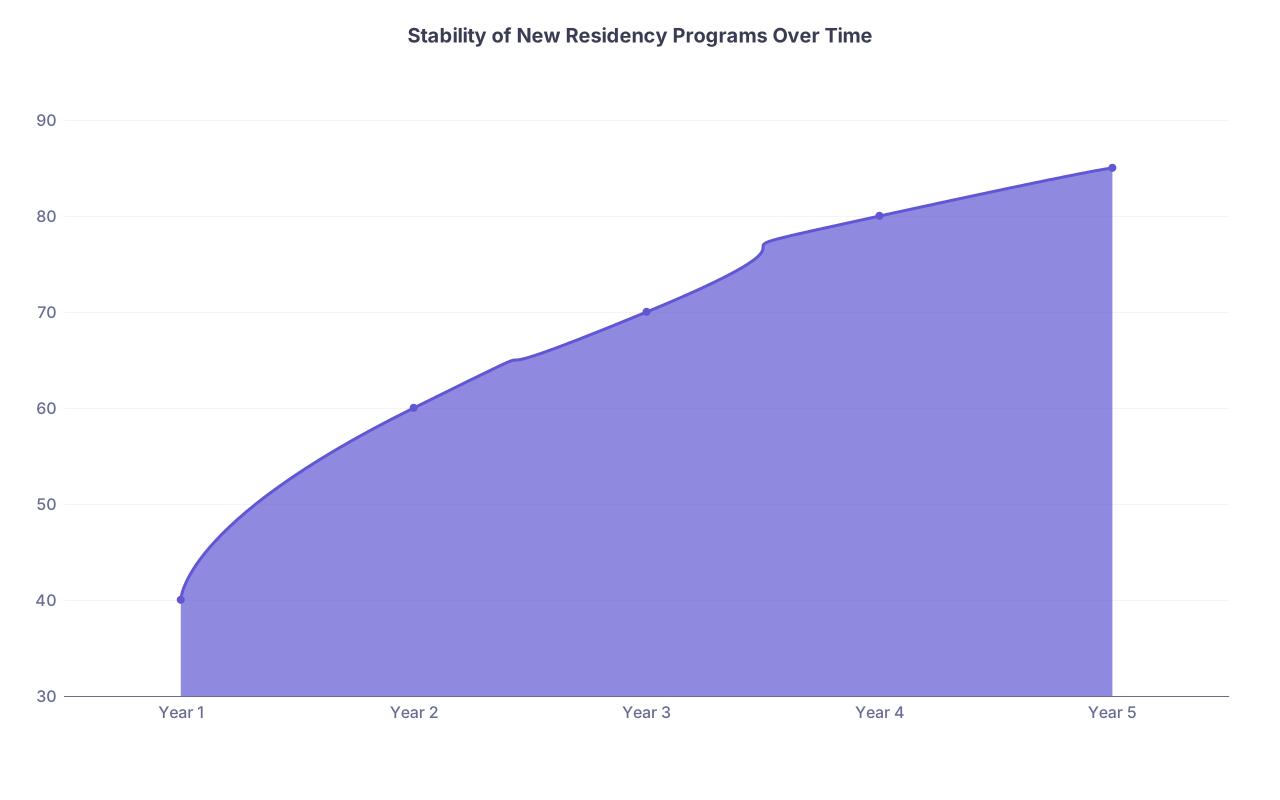
| Category | Value |
|---|---|
| Year 1 | 40 |
| Year 2 | 60 |
| Year 3 | 70 |
| Year 4 | 80 |
| Year 5 | 85 |
That line is what I’ve seen subjectively: around year 3–4, good programs stabilize and start to look like what they advertised. Bad programs ossify into “we’ve always done it this way” dysfunction.
If you’re a resident joining a brand-new program, year 1–2 is when you have disproportionate influence. You’re the one writing the unofficial manual. Your complaints and suggestions carry more weight than you realize—if leadership is actually serious about building something real.
So What Does This Mean For You?
If you’re looking at or already in a new program, here’s how to read the tea leaves like an insider instead of a brochure-reader.
Look past the buzzwords and ask:
- Does the PD have visible backing from the chair and DIO, or are they out on a limb?
- When you ask about coverage vs education, do they give a real answer or a press release?
- Are faculty excited and present, or resentful and “too busy”?
- When you talk to current residents or fellows on site (even if different specialties), do you hear “they care and they’re fixing things”—or “yeah, they’re using you all for coverage”?
And one blunt metric: if leadership keeps talking about “GME expansion” like it’s a growth line on a business chart, but cannot tell you concretely how they protect teaching time, you’re walking into a coverage-first environment.
FAQ – Straight Answers
1. Is it risky to join a brand-new residency program?
There’s always risk. You won’t have alumni, a track record with boards, or proven fellowship pipelines. But not all new programs are equal. If the PD is strong, the chair is visibly invested, and the hospital has an established GME culture in other specialties, the risk is manageable. The real red flag is a hospital with zero GME history “suddenly” launching multiple programs at once because a consultant told them to chase GME dollars.
2. How can I tell if a new program is mostly about coverage?
Listen for how they talk about residents. If the conversation keeps drifting back to “helping with night coverage,” “expanding services,” or “building capacity,” and you hear almost nothing detailed about mentoring, scholarly activity, or individualized development, you have your answer. Also ask about duty hours and backup coverage plans. Coverage-first programs hand-wave those.
3. Do ACGME and site visitors actually shut down bad new programs?
Yes, but it’s slower and more bureaucratic than you’d like. ACGME can give warnings, require progress reports, limit expansion, or in worst cases, withdraw accreditation. However, they almost always try to protect current residents—so they’ll often allow existing residents to finish while blocking new classes. That’s why you sometimes see programs “not taking applicants this cycle” with vague explanations.
4. Why do some PDs push for new programs if they’re so hard to build?
Because being a founding PD is powerful. It’s a legacy project, a national role, a way to shape a department. Some are genuinely mission-driven and willing to suffer through the early chaos to build something great. Others want the title and underestimate the grind. From the outside, you can usually tell which is which by how concretely they talk about resident experience versus how much they talk about growth and prestige.
Key takeaways: New residency programs are built on politics and money first, education second. The quality of your experience hinges on whether your PD and chair are willing—and empowered—to push back when coverage demands threaten training. If you learn to see through the brochure and hear the real priorities in the room, you’ll know which “new” programs are worth betting your career on.