
Hospitals don’t open new residency programs because they suddenly “care about education.” They open them for money, manpower, and market share—and your training quality is often an afterthought.
Let me pull the curtain back on what actually drives this rush to create new residencies, and what it means for you if you end up in one.
Why Hospitals Are Suddenly Obsessed with New Residency Programs
Ten years ago, adding a new residency program was a slow, cautious move. Now you’ve got mid-tier community hospitals trying to open Internal Medicine, Family Medicine, EM, Surgery, Psych, and even subspecialty fellowships in one breath.
This isn’t random. It’s driven by a very specific calculus in the C-suite.
The Money and Manpower Equation
Here’s the part no one phrases honestly on the website.
Residents are not just learners. They’re subsidized labor.
Medicare and other payors fund a significant chunk of graduate medical education (GME). Once a hospital secures those GME dollars and fills their “cap” of funded positions, they get a reliable revenue stream tied directly to having residents on the ground.
Residents then do work that would otherwise require hiring more NPs, PAs, hospitalists, or more hours from attendings. Residents are cheaper. They stay late. They don’t bill individually. And they’re obligated to be there as part of training.
I’ve sat in a room where a CFO literally said, “We’ll use residents instead of expanding the nocturnist coverage.” That is the thinking.
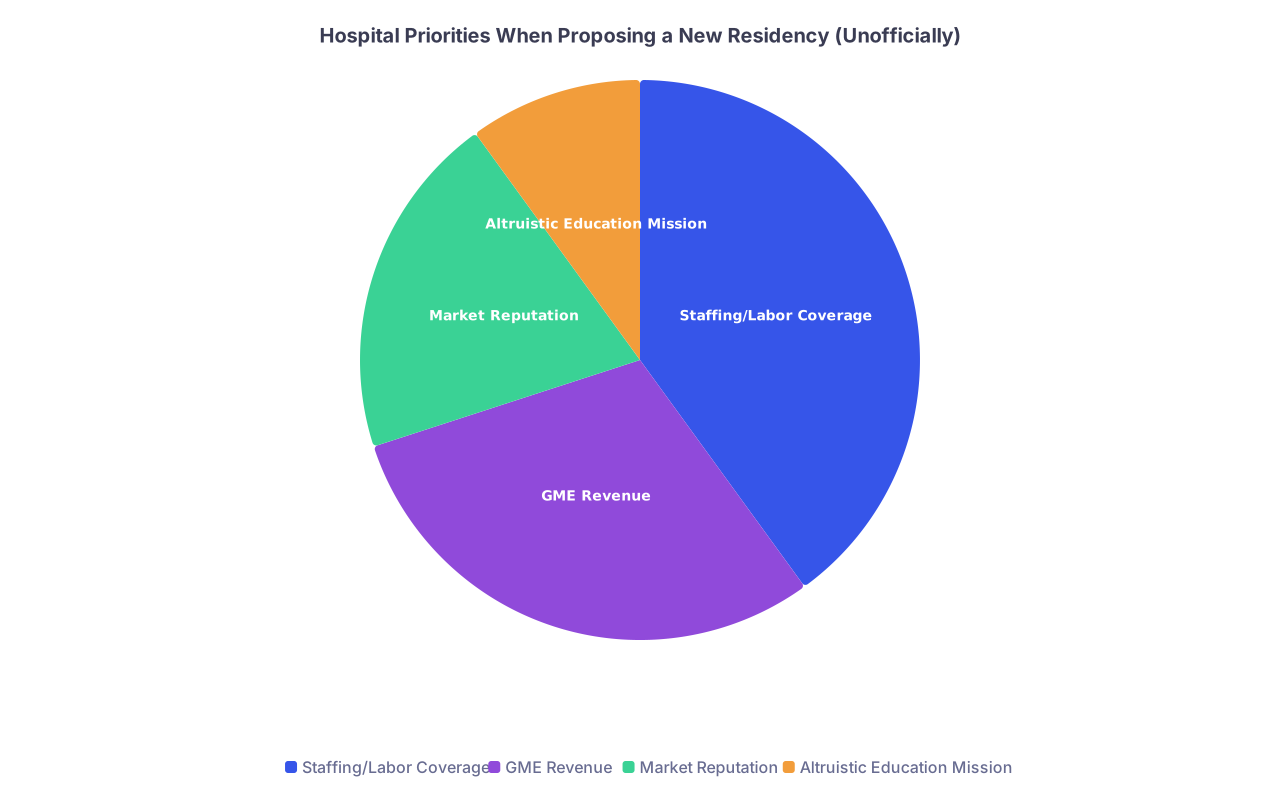
| Category | Value |
|---|---|
| Staffing/Labor Coverage | 40 |
| GME Revenue | 30 |
| Market Reputation | 20 |
| Altruistic Education Mission | 10 |
On paper, the hospital pitches it as:
- “A commitment to education”
- “Serving the community”
- “Investing in the future of medicine”
In the actual internal deck that goes to the executive board, the slides are more like:
- Cost savings from resident FTEs replacing APPs or additional hospitalists
- GME funding projections over 5–10 years
- Increased admissions capacity and throughput
- Referral capture from “being an academic center” in name
The education piece? That’s slide 9, after the financials.
Market Share and the “Academic” Badge
Hospitals want the “teaching hospital” label. It attracts:
- More complex cases
- Referrals from smaller hospitals
- Specialists who like teaching (and sometimes just like the prestige)
- Medical students, which in turn feeds residency recruitment
Being seen as an “academic center” helps them negotiate with insurance, attract faculty, and build service lines—oncology, cardiology, transplant, whatever they’re trying to grow.
You end up being another line in their marketing brochure: A thriving internal medicine residency with 36 residents.
They know applicants are desperate for spots. They know the Match data. They know there’s a growing gap between number of applicants and PGY‑1 positions in competitive specialties.
So they open programs because they can fill them.
The Birth of a New Residency: What Really Happens
Let me outline what actually happens when a hospital “decides” to create a new residency.
It doesn’t start with, “Do we have enough top-notch educators?” It starts with, “Can we staff this with our current attendings and not go broke?”

| Step | Description |
|---|---|
| Step 1 | Hospital Executive Idea |
| Step 2 | Financial Projections |
| Step 3 | Find Program Director |
| Step 4 | Design Curriculum |
| Step 5 | Initial ACGME Application |
| Step 6 | Site Visit and Approval |
| Step 7 | First Resident Class Starts |
| Step 8 | Rapid Growth and Expansion |
| Step 9 | ACGME Citations or Warning |
| Step 10 | Stabilize or Struggle |
Step 1: The Numbers Come First
The C-suite asks GME leadership or a consultant:
“How many residents can we support?”
Translation: “How many can we bill for and use as coverage without blowing up our budget?”
They run scenarios:
- X residents in internal medicine → Y extra admissions per day
- Residents covering nights → saved cost on additional nocturnists
- Residents in ED → more throughput, less locums
No one is asking, initially, “Will we be able to give them strong procedural training?” The first question is always: “Is it financially viable?”
Step 2: Scrambling for a Program Director
They then try to find a Program Director who:
- Has at least some prior GME or academic experience
- Is willing to take on a ton of administrative work
- Will accept a modest stipend and “protected time” that often isn’t really protected
I’ve watched well-meaning attendings get tapped for PD with a pitch like:
“You’d be amazing at this. You care about teaching. We’ll give you 0.3 FTE protected and a stipend.”
What they get:
- 0.3 FTE on paper
- Still carrying a full or near-full clinical load
- Writing ACGME documents at midnight
- Designing didactics from scratch
- Recruiting faculty who are already overworked
That chaos bleeds into your training.
Step 3: ACGME Application and the “Good Enough” Threshold
ACGME wants structure, faculty, educational resources, and patient volume. But there’s a catch: they don’t demand the program be outstanding on day one. Just adequate.
The hospital doesn’t need a Johns Hopkins-level operation. They just need to clear that “good enough to get initial accreditation” bar. And some places do the absolute minimum.
Common shortcuts I’ve seen:
- Calling every hospitalist “core faculty” to hit faculty numbers
- Using existing QI projects as “scholarly activity” without depth
- Slapping together a didactic schedule that looks decent on paper but has no actual buy-in
You don’t see that on the website. You see, “Robust didactics and diverse patient population.”
How Being in a New Program Actually Changes Your Training
This is the part that affects your day-to-day life at 2 a.m. on call.
New programs are not doomed. Some are excellent from day one. But there are predictable pain points that almost every brand-new program struggles with—and you will feel them.

1. You Are the Beta Tester
You’re not joining a polished machine. You’re stress-testing a prototype.
Rotations get shuffled mid-year. Policies change weekly. Call structures are re-written after residents complain—or after something goes wrong.
I’ve seen:
- A PGY‑1 schedule flipped three times in 6 months because the service was unsafe
- A clinic continuity site switched mid-year because the original practice couldn’t handle residents
- Night float systems created on the fly because the initial model burned everyone out
If you’re early in a program, you’re co-writing the handbook as you go. Great if you like building. Terrible if you wanted predictability.
2. Faculty Still Think Like Private Attendings, Not Educators
Most new programs launch in hospitals where the culture has been “get the work done” for years. Teaching is add-on, not core identity.
So on day one of the residency, they don’t magically become academic attendings.
What you actually get:
- Attendings who’ve never run a true teaching service
- People who present as “core faculty” but still prioritize RVUs above all else
- Variable feedback—some excellent teachers, some barely aware of ACGME milestones
That’s not fatal. But it means there’s a steep learning curve for your supervisors too. You’re learning medicine while they’re learning how to train you.
3. “Service vs Education” Skews Hard Toward Service Initially
Let’s be honest: a lot of early-year residents in new programs do scut that used to be done by NPs, PAs, or junior attendings.
Orders. Discharges. Paperwork. Admissions stacked one after another because “we have residents now.”
When a new program opens:
- Volume tends to go up—ER starts admitting more
- Consultants expect faster notes and more detailed workups
- The hospital leans into residents as throughput engines
Unless your PD actively fights this, your educational experience can get swallowed by service. You’re working, but not always learning at the depth you should.
4. Reputation and Fellowship Prospects: The Uncomfortable Truth
Here’s what most PDs won’t say out loud: early graduates from brand-new programs sometimes get side‑eyed in the fellowship and job market. Not always. But it happens.
Program directors at big-name fellowships think in terms of risk. A brand-new residency with no track record? That’s risk to them.
They ask themselves:
- “Have I seen graduates from this place before?”
- “Do I know what kind of training they actually get?”
- “Do I know anyone faculty-wise I trust at that institution?”
If the answer is no, you’re relying heavily on:
- Your Step 2/3 scores
- Your letters (which must be from respected attendings or known researchers)
- Your own hustle in research and networking
You can absolutely match strong fellowships from new programs. I’ve seen people from brand-new community FM or IM programs match GI, Cards, even Heme-Onc. But they had to over-perform to counter the program’s lack of name recognition.
The Upsides No One Tells You About
Now here’s the twist. New programs are not all doom and exploitation. If you know what you’re walking into, there are serious advantages.
| Factor | New Program | Established Program |
|---|---|---|
| Flexibility | High – you can shape policies | Low – rigid, entrenched systems |
| Faculty Access | Often high – small cohorts | Variable – sometimes diluted by size |
| Name Recognition | Low to moderate | Usually higher |
| Structure and Stability | Often shaky for first 3–5 years | Generally stable |
| Innovation Potential | High – easier to try new ideas | Lower – bureaucracy and tradition |
You Get Access and Influence You’d Never Have at a Big Name
In a new program, you can:
- Walk into the PD’s office and actually have a say in call schedules or rotation design
- Start a new rotation (for example, a dedicated ultrasound month) and see it adopted
- Be the first to hold leadership roles—chief, QI leads, curriculum committee
At a massive, 40‑year‑old university program, you’re resident #108 of 180. They’re not flipping the structure because you’re unhappy. In a 12‑resident new IM program, they might.
Leadership and Ownership Come Faster
Hospitals want these programs to succeed. Accreditation status is on the line. Surveys are on the line. Future expansion is on the line.
So when a resident steps up to:
- Run morbidity and mortality
- Lead QI projects
- Coordinate didactics
- Represent the program to med students
They get recognized quickly. I’ve seen PGY‑2s at new programs walking into GME meetings and speaking directly with the CMO. Try doing that as a PGY‑2 at an entrenched academic behemoth.
You Can Carve Out a Niche
Want to be “the ultrasound person,” “the palliative care lead,” “the QI guru,” “the EMR optimization resident”? In a new place with empty niches, it’s wide open.
That niche then becomes:
- Lines on your CV
- Letters from attendings who saw you build something from scratch
- A talking point in every interview you do for fellowship or jobs
How to Evaluate a New Residency Program Like an Insider
You cannot just look at “ACGME accredited” and call it a day. That’s the bare minimum. You need to interrogate how and why the program exists.
Here’s how seasoned attendings quietly judge new programs—and how you should too.

1. Ask About Origin Story Directly
On interview day, ask the PD or core faculty:
“Why did the hospital decide to start this residency, and how did the process unfold?”
Listen for:
- A story grounded in education, mentorship, and mission
vs - A vague answer about “growth” and “opportunity” with no specifics
If they can articulate:
- The educational gaps they wanted to fix
- The clinical strengths they built around
- How they staffed and protected faculty time
That’s a decent sign.
If you get corporate buzzwords, be skeptical.
2. Probe Faculty Bandwidth and Stability
Questions that actually reveal something:
- “How much protected time do core faculty really get for teaching?”
- “Have many of your attendings worked with residents before?”
- “How long have the PD and APDs been here, and what’s their plan for the next 5 years?”
Red flags:
- PD is brand-new to the hospital and hasn’t worked there long
- High turnover—core faculty leaving after 1–2 years already
- Vague answers about protected time: “We’re working on that.”
3. Look at Volume, Not Hype
New programs love to flaunt “diverse pathology” and “busy services.” Ask surgical programs:
- “Average number of cases per resident by graduation?”
- “Case logs of graduating chiefs?”
- “Overlap with fellows—who gets the key cases?”
For IM/EM:
- “Average admit load on call?”
- “Do residents routinely see ICU-level illness?”
- “How many procedures do your grads typically log by end of PGY‑3?”
If they can’t answer with real numbers, they haven’t done the homework.
4. Interrogate Support Systems, Not Just Slogans
- “When something goes wrong, does leadership actually fix it or just talk about it?”
- “How many times has your schedule been changed mid-year?”
- “How responsive is your PD when residents are burned out?”
They’ll tell you off-script if you catch them in smaller settings or on the phone later.
5. Pay Attention to Who Actually Shows Up for Teaching
On interview day or on a second-look:
- Are attendings present at didactics, or is it resident-only?
- Do faculty know the residents well by name and interests?
- Do you hear residents talk about specific attendings as mentors, or is everything generic?
If the program is three years old and no one can name a real mentor, that’s a problem.
Should You Rank a New Residency High? Here’s the Honest Framework
Let me be blunt. You should not reflexively avoid new programs, and you should not blindly trust them either. You need a framework.
New programs are reasonable to rank highly when:
- Leadership is experienced (PD/APDs who’ve done this at other places)
- You see clear evidence of educational culture: real didactics, faculty presence, mentorship
- Residents, even early classes, speak concretely about learning, not just surviving
- The hospital itself has long-standing clinical volume and strong services; the residency is new, not the hospital
They’re risky to rank high when:
- The program exists mainly to cover shifts—heavy service, light teaching
- PD is overwhelmed, under-protected, or already considering leaving
- Residents look exhausted and noncommittal when you ask if they’d choose it again
- There’s no senior class yet and no track record of graduates doing what you want to do
You’re betting on trajectory. Some new programs rocket upward, stabilize, and become solid. Some stagnate or burn out leadership and limp along.
Your job is to assess which trajectory you’re seeing.