
The way most applicants “evaluate” new residency programs is lazy and dangerous. Reading a glossy website, glancing at board pass rates, and asking, “So… how’s the culture here?” on interview day tells you almost nothing. If you are considering a new or newer residency, site visits and shadow days are not optional. They are your primary safety check.
You are not just ranking logos. You are choosing the people who will train you, sign off on your procedures, answer when you are drowning on night float. For a new program, you cannot rely on reputation. You have to go see it. Up close. With a plan.
Here is exactly how to use site visits and shadow days to evaluate a new residency program like a grown professional, not a starstruck applicant.
Step 1: Decide When a Site Visit Is Actually Worth It
Not every “brand new” program deserves a plane ticket and a vacation day. You need some pre-filtering, otherwise you will burn money and time on places that were never serious contenders.
Use hard filters before you ever visit
If a program fails any of these, you are done. No visit.
- ACGME status:
- Must be accredited (Initial or Continued). Candidacy status is high risk unless you know the leadership personally or have a very specific reason.
- Sponsoring institution:
- Ideally an established teaching hospital or health system.
- If the hospital itself is small community with no prior training culture and no academic affiliation, proceed with extreme caution.
- Minimum training infrastructure:
- EMR in place and functioning (EPIC, Cerner, etc., not some homebrew chaos).
- ICU run by intensivists (not purely hospitalists “covering”).
- On-site or nearby subspecialists in your field.
- Case volume:
- Enough patients and pathology to meet ACGME case and procedure requirements, with buffer.
If these look decent, you can move to the “worth a visit?” stage: alignment.
Only visit programs that might realistically be top-5 on your list
Ask yourself:
- Would I live in this city for 3–7 years?
- Is this specialty/track aligned with my goals? (Community vs academic, fellowship vs practice)
- Does the program at least appear to have a real vision, not just “we added residents to cover nights”?
You should visit when you could honestly see this program:
- In your top 3–5 if it checks out, or
- As a safe backup where you would not be miserable.
That is it. If the answer is “probably #15 on my list,” skip the site visit. You are not a tourist.
Step 2: Understand the Difference – Site Visit vs Shadow Day
People mix these up. They are different tools.
Site visit
Structured or semi-structured visit you arrange with the program. Usually:- Pre- or post-interview
- Includes formal meetings (PD, APDs, maybe GME office)
- May include a brief tour, short sit-in on rounds, or conference
Shadow day
You are embedded with current residents or attendings for part or all of a clinical day:- Follow a team during rounds
- Sit in while they admit, cross-cover, or consult
- Observe handoffs or sign-out
You want both if possible:
- Site visit = macroscope (policies, leadership, resources).
- Shadow day = microscope (how the work actually feels minute to minute).
If a new residency refuses both? That is a data point. Either they are overwhelmed, disorganized, or trying to limit what you see.
Step 3: Set Up the Visit Like a Professional
You are not asking for a favor. You are conducting due diligence on a major employment contract.
Who to email
- Program Coordinator (PC) first, cc Program Director (PD).
- Subject line example:
“Prospective [Specialty] Applicant – Request for Site Visit / Shadow Day”
What to write (simple, direct)
- Who you are (MS4 at X / prelim / transfer candidate).
- Why you are interested in their program (1–2 specific reasons).
- What you want:
- 1–2 days on site
- Aim: observe clinical workflow, meet residents, understand educational structure.
Example skeleton:
I will be in [City] on [Dates] and am strongly considering applying/ranking your program. I would appreciate the opportunity to spend a day observing your residents during rounds and didactics and to meet with Dr. [PD] if available.
My goal is to understand your training environment, support systems for residents, and how the program is developing in its early years.
If they respond with enthusiasm, good sign. If replies are slow, fragmented, or confused (“We don’t really do that, maybe you can just look at our website”), mark that down. Coordination reflects how this place runs.
Step 4: Go in With a Structured Evaluation Framework
If you just “see how it feels,” you will get played by good marketing and one charismatic chief resident.
You need a simple framework. Here is one that works well:
- Leadership and vision
- Clinical workload and safety
- Education and feedback
- Culture and resident support
- Systems and logistics
Make yourself a one-page sheet, print it, keep it in your folder or bag. After each block of the day, jot specific observations.
| Domain | Core Question |
|---|---|
| Leadership & Vision | Do I trust who is steering this program? |
| Workload & Safety | Can I train here without burning out? |
| Education | Will I actually learn, not just service? |
| Culture & Support | Are these my people? |
| Systems & Logistics | Does the place function day to day? |
You will notice none of those say “Do they like me?” This is not about them selecting you. You are evaluating them.
Step 5: What To Look For During the Site Visit (Macro Level)
1. Leadership: read the room, not the brochure
You will usually meet:
- PD and maybe APD
- Coordinator
- Possibly department chair or DIO (Designated Institutional Official)
You are not trying to impress them. You are trying to see:
- Do they have a clear, specific 3–5 year plan?
- Example of good: “We are starting with 6 residents per class, expanding ICU and ED volume through a new regional transfer agreement, and adding two fellowship-trained subspecialists in year 2.”
- Red flag: “We just want to train well-rounded physicians and see how things go.”
- How do they talk about failure and problems?
- Good: “Our first class struggled with night float; we increased nocturnist coverage and added a backup resident.”
- Bad: “We have not had any issues at all so far” at a brand new program. That usually means they are not looking.
- Their attitude about ACGME and accreditation:
- Good: “We track X, Y, Z metrics aggressively so we stay ahead of requirements.”
- Bad: “We are not worried about ACGME; we know we are doing a good job.”
Ask direct questions. Watch how specific the answers are.
2. Infrastructure: walk the space
On the tour, do not just nod at shiny monitors.
Look at:
- Workrooms:
- Are there enough computers for the number of residents?
- Are workspaces clean or chaos piles?
- Call rooms:
- Do they exist?
- Safe, secure, reasonably quiet? Or an afterthought?
- Conference space:
- A real room, with functioning AV, and scheduled sessions on a calendar?
- ICU, ED, main wards:
- Is the volume there? Are beds empty all over, or is there real patient flow?

3. Services and subspecialties
New programs often overpromise “diverse pathology” without the subspecialty depth to support it.
Ask or observe:
- Which subspecialists are actually on-site?
Not “affiliated” or “occasionally consult,” but present. - How are complex patients managed?
- Are they transferred out constantly?
- Do residents actually see and manage them, or are they sidelined?
If the PD says, “We are working on bringing in cardiology and GI” and they are already training residents, you need to assume you may be the one suffering through that “work in progress.”
Step 6: Use Shadow Days to See the Real Residency
This is where you stop hearing the sales pitch and start seeing the truth.
What you should be allowed to do
On a good shadow day, you should:
- Join:
- Morning sign-out or handoff
- Rounds (ward, ICU, ED, consults, depending on specialty)
- At least one teaching session if the schedule allows
- Sit near residents during:
- Admitting
- Cross-coverage pages
- Documentation time
You are not there to touch patients or make decisions. You are there to observe workflow, communication, and stress level.
How to behave
- Be low-maintenance. Introduce yourself once, then fade into the background.
- Do not constantly interrupt rounds with questions.
- Write observations in a small notebook or phone after you step away, not in front of patients.
You are more likely to get honest glimpses if the residents are not constantly “on” performing for you.
Step 7: What To Watch Like a Hawk During Shadowing (Micro Level)
This is where the real evaluation happens. Focus on these:
1. How residents talk to each other
Stand quietly in the corner and just listen.
Red flags:
- Constant sarcasm and contempt:
- “Of course they dumped that on nights again.”
- “Good luck getting help from [service]; they never answer.”
- Public shaming:
- Seniors tearing into interns in front of the team.
- Zero laughter. Everyone looks flat, checked out. No one jokes or smiles over hours.
Green-ish flags:
- Dark humor but with warmth.
- Seniors quietly explaining things as they go: “Here’s why I am doing it this way.”
- Residents covering for each other: “I will take that call, you finish your note.”
2. Attending behavior in the wild
Do they:
- Ask residents’ opinions before making decisions?
- Teach on the fly in small, digestible chunks?
- Back residents up when dealing with difficult families or nurses?
Or do they:
- Write all the orders themselves while residents watch.
- Humiliate residents for not knowing minutiae.
- Ignore nursing concerns or throw residents under the bus: “I do not know why the resident did that.”
If attendings on a new program are not at least somewhat invested in teaching, walk away. Without a teaching culture, a new residency is just cheap labor.
3. Resident workload and time reality
You want to know: Are they drowning?
During your day, track:
- How often residents are interrupted:
- Pages every 2–3 minutes? That is chaos.
- How late they stay after “end of day”:
- If everyone is still typing notes 2 hours after sign-out, documentation or staffing is broken.
- How often they skip or leave conference early to handle “fires.”
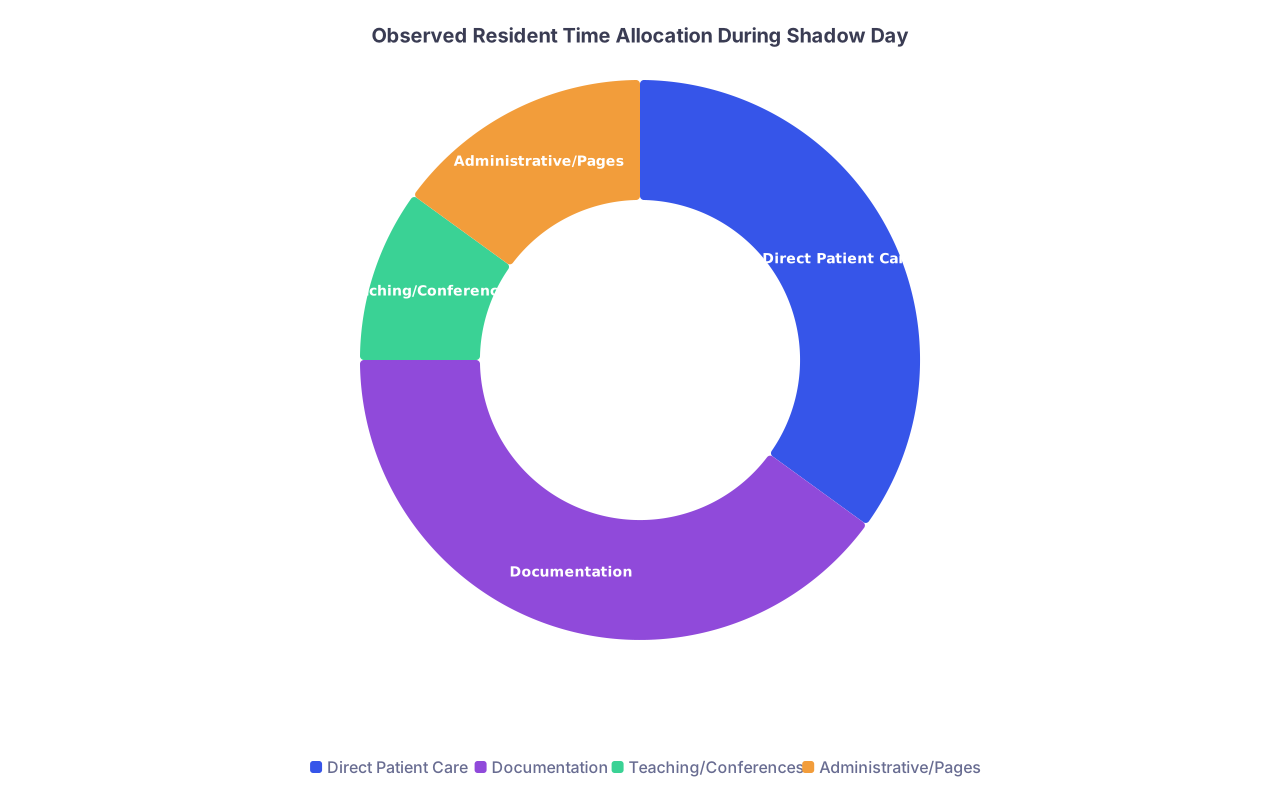
| Category | Value |
|---|---|
| Direct Patient Care | 35 |
| Documentation | 40 |
| Teaching/Conferences | 10 |
| Administrative/Pages | 15 |
No single day is perfect, but patterns are obvious. If everyone is clearly underwater, you will be too.
4. Nursing and interprofessional dynamics
Watch how:
- Nurses talk to residents (and vice versa).
- Pharmacists, RTs, and case managers are integrated into rounds.
You want:
- Respectful, efficient back-and-forth.
- Nurses feeling comfortable asking clarifying questions.
- Residents listening, not autopilot signing orders.
If you see open hostility or passive-aggressive wars (“We just do what we want; they never listen”), that is a serious training hazard in a program still finding its feet.
Step 8: Questions That Actually Reveal Something
Most applicants ask garbage questions:
- “What do you like about this program?”
- “How is the work-life balance?”
You will get rehearsed nonsense. Throw those away.
Ask targeted, concrete questions that force specifics.
With residents
Use “last time” questions:
- “Tell me about the last time a resident struggled academically. What did the program actually do?”
- “Last time someone had a serious family or health issue, how did the schedule change? Did they get real support?”
- “Last 3–4 months, what has been the most frustrating recurring problem on the wards or in the ED?”
Use “If you could” questions:
- “If you could change two things about this program tomorrow, what would they be?”
- “If your closest friend were deciding whether to rank this #1, what would you warn them about?”
And one direct calibration question:
- “Would you choose this program again if you had to do it over?”
Watch their face, not just their words.
With PD and leadership
Force them to show their homework:
- “What specific metrics are you tracking to make sure residents are not overwhelmed? Can you share an example of a change you made based on those numbers?”
- “What were the biggest issues ACGME or the GMEC raised at your last review, and how are you addressing them?”
- “Which parts of the program do you think are not where they should be yet?”
If you get defensive answers or vague platitudes, that is your answer.

Step 9: Special Red Flags Unique to New Residency Programs
New programs have a specific failure pattern. Watch for:
-
- Everyone talks about “coverage,” “helping with staffing,” and “service lines,” and almost never about “education,” “curriculum,” or “scholarship.”
- Schedules shift constantly because the hospital cannot staff adequately without residents.
Rapid, chaotic expansion
- “We started with 4 residents per class last year, now we are going to 10.”
- But faculty numbers and ancillary support have not changed.
Paper policies, no reality
- Beautiful curriculum documents.
- In practice, conferences are canceled regularly and rotation goals are ignored.
-
- You hear: “Our last PD left last year,” “Three core faculty moved on,” “We are hiring new leadership soon.”
- That is code for instability. You may match into a different program than the one you visited.
Residents too scared to speak honestly
- Every time you are alone with residents, a faculty or coordinator “just happens” to pop into the room.
- Residents give robotic, identical answers: “We love the collegial culture and supportive leadership” with zero specific examples.
At a new program, you want overcommunication and transparency. If anything feels hidden, assume the worst.
Step 10: After the Visit – Score It Like a Contract Decision
Do not rely on vague vibes. Within 24 hours of the visit:
- Sit down alone.
- Take out your one-page framework.
- Force yourself to rate each domain 1–5.
Use something like:
| Domain | Rating (1–5) | Notes (1–2 key observations) |
|---|---|---|
| Leadership & Vision | ||
| Workload & Safety | ||
| Education | ||
| Culture & Support | ||
| Systems & Logistics |
Your threshold should be ruthless:
- Any 1 in Workload & Safety or Culture & Support → Do not rank.
- Average score <3 → Only consider if you have essentially no other options and would still rather train there than go unmatched.
This is not a vacation reflection. This is you deciding whether to sign up for 3–7 years of your life.
Step 11: Combine Site Visit Intel With Hard Data
Do not throw away the quantitative side. Use both.
Hard data to cross-check:
- Board pass rates (if they have any yet).
- Case volume and procedure logs (ask to see sample anonymized resident case logs).
- Fellowship placement or post-residency jobs for early graduates.
- ACGME citations or warning letters (ask directly how their last review went).
Then compare your subjective impressions from the visit to:
- What they claim on the website.
- What they said in the interview day.
- What residents at other institutions in the same region say informally.
If the visit contradicts everything else, go with what you saw, not what they sold.
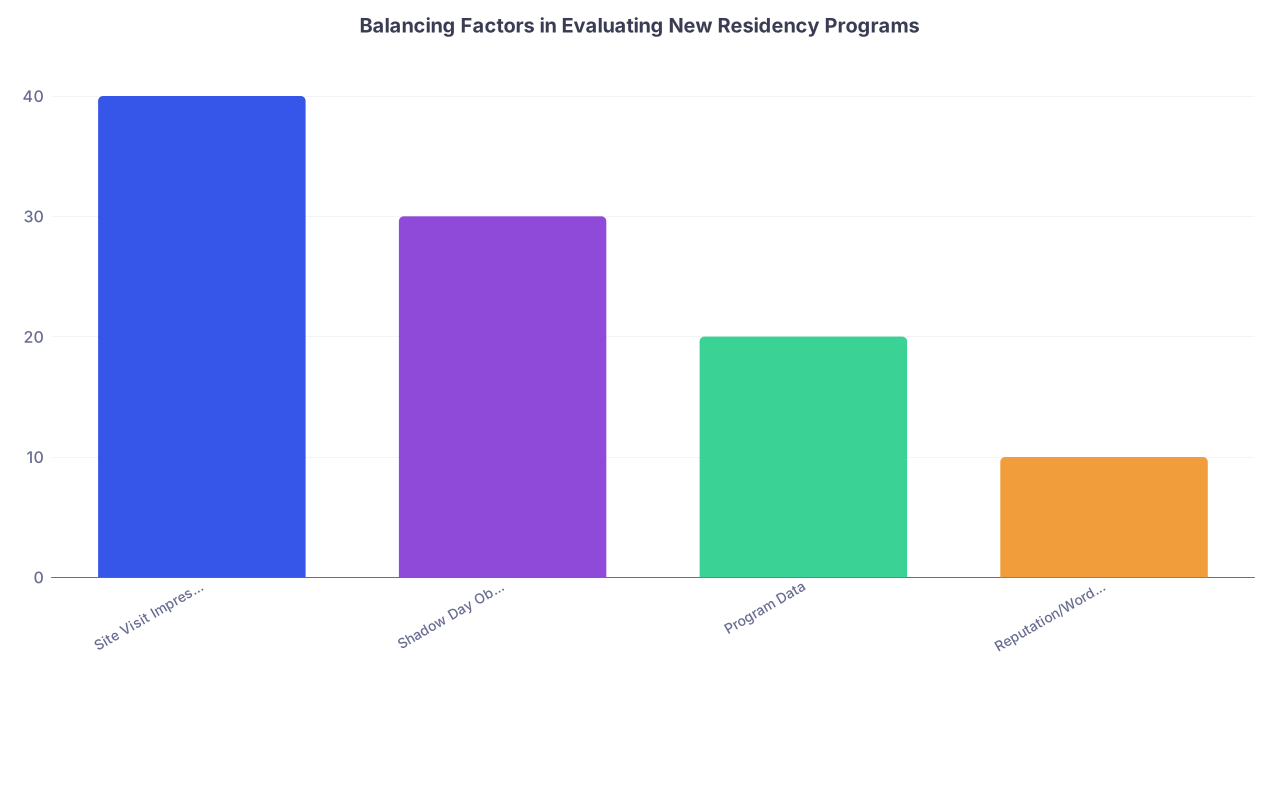
| Category | Value |
|---|---|
| Site Visit Impressions | 40 |
| Shadow Day Observations | 30 |
| Program Data | 20 |
| Reputation/Word of Mouth | 10 |
The weight above is my bias: what you see in person counts most.
Step 12: If You Cannot Visit – How to Approximate It
Sometimes geography, cost, or schedules make an in-person visit impossible. That does not mean you fly blind. You simulate as much of a site visit as you can.
Here is a stripped-down protocol:
- Ask for a virtual half-day “shadow”
- Sit in (muted) on:
- Morning report via Zoom
- Noon conference
- A brief segment of rounds via mobile device if they are willing
- Sit in (muted) on:
- Schedule 1:1 or small group calls with:
- At least 2–3 residents from different PGY levels
- PD or APD
- Ask residents to show you:
- Their actual call rooms or workrooms over video (if allowed)
- A real schedule block
- A sample curriculum calendar
You will still miss the hallway energy and micro-interactions, but you will at least see whether the structure is real or performative.
The Bottom Line
Here is what I want you to walk away with:
Treat site visits and shadow days like due diligence on a multi-year contract, not a courtesy tour.
Go in with a framework, ask targeted questions, and watch how people work, not how they present.New residency programs are high-variance.
Some are excellent with hungry, invested faculty and strong institutional backing. Others are residents-as-warm-bodies operations. Only a real visit or shadow day lets you tell the difference.Use what you see, not what you are told, to drive your rank list.
If the vibe is off, the residents seem crushed, or leadership is vague and defensive, believe that. No logo or location is worth three miserable years.
You get one shot at your first residency. Do the work now so you are not regretting it on night float, staring at an empty call room wondering how you missed the warning signs.