
It’s July 3rd. You’re three days into your brand‑new residency at a shiny “innovative” program that matched its first class this year. The website looked like Apple designed it. The PD gave a TED‑style talk on “reimagining training.” On interview day, everyone swore you’d have “unparalleled mentorship” and “cutting-edge experiences.”
Now you’re in the ED at 1:30 a.m., trying to admit a septic patient, and you realize: nobody knows who you’re supposed to call. The nurse says, “We usually page medicine.” You are medicine. The night float upper level they promised? Does not exist. The “robust teaching faculty”? Half are locums. And the fancy “curriculum”? It’s a PDF with placeholder text.
Let me tell you what actually happens inside brand‑new programs. The stuff alumni will sanitize later when they’re on the website saying, “We got so much autonomy and helped shape the program.”
They’re not lying. They’re just not telling you the whole story.
The Curriculum Myth: “We’re Building It Together” Really Means “We’re Winging It”
Here’s the first dirty secret: on Day 1, most new programs do not have a real, functional curriculum. They have a PowerPoint.
They sent a beautiful document to the ACGME. It met minimum standards. It had milestones, goals, didactics schedules, wellness sessions, QI projects, you name it. That document was written to get approval, not to actually run day-to-day training.
What you see in a new program:
- Noon conference gets canceled because, “We’re still finalizing who’s covering which sessions.”
- Your “protected time” for didactics is constantly interrupted because the hospital has no system to cross-cover your patients yet.
- Subspecialty rotations are vague: “You’ll spend time with cardiology.” Doing what? Being where? Nobody’s sure.
I’ve sat in the room when program leadership realizes in late June, “Wait, we do not have clear expectations written down for the ICU rotation.” They scramble. They copy-paste from some other program’s materials. They send you a 12-page PDF that nobody on the ICU attending side has actually read.
That’s why early residents describe PGY‑1 as: “We figured it out as we went.” That’s not some heroic pioneering spirit. That’s code for: the curriculum did not actually exist at the practical, operational level.
And alumni won’t say that publicly because it makes their own training sound flimsy. So they reframe it as “flexible” and “customizable.”
What it really was? Incomplete.
Faculty: Thin, Overstretched, and Sometimes Just Passing Through
Second big pain point: the faculty situation is almost always more fragile than advertised.
On paper: “Strong, committed core faculty with a passion for teaching.”
Reality in year one and two:
- Half the “core faculty” are community docs who signed on because the CMO begged them, not because they love teaching.
- A few academic‑minded attendings are fantastic, but they’re spread across too many roles: clinic, admin, recruitment, QI, and trying to build didactics.
- Some subspecialty coverage is “borrowed” from another hospital or done by locums who are gone in three months.
You notice it in subtle ways. You present a patient on rounds and the attending gives you solid clinical feedback, but nothing on documentation, billing, or systems issues—because they’ve never trained residents before and don’t even think that’s their role. Or your “faculty mentor” changes three times in the first year because people keep leaving or having their FTEs shifted.
Behind closed doors, PDs will admit this: it takes 3–5 years to stabilize a teaching faculty. People burn out. Some realize they hate teaching. Others jump ship when they realize admin support is weak.
You will not hear alumni say, “Yeah, three of our key faculty left in the first two years because the hospital wouldn’t give them protected time.” But it happened. It happens a lot.
Hospital Culture Lag: The System Isn’t Ready for You
This one residents feel almost immediately: the hospital was not socially or operationally ready for trainees.
The ACGME visits. Admin signs off. There’s a ribbon-cutting photo. But on the wards?
- Nurses are not clear on what you can or cannot do. So they work around you.
- Consultants aren’t used to being paged by residents, so they ignore you or call the attending directly.
- IT hasn’t built resident-specific Epic order sets or note templates. You’re hacking your way through.
- There’s no solid cross-cover structure. Nights feel like the Wild West.
A nurse once said to one of my interns at a new program, “Honestly, things were smoother before you all got here.” She didn’t mean it maliciously. It was just true—for her workflow. Residents introduce controlled chaos until the system adapts.
Here’s how culture lag plays out: for the first year or two, the hospital is still mentally a community hospital that happens to have residents, not a teaching hospital that uses residents as a core part of care delivery and education.
That transition is messy. You get conflicting messages daily:
- “Take ownership of your patients!”
- “Do not change anything without running it by the attending first.”
- “You’re the primary team.”
- “But also, we’ll call your attending directly if anything serious happens.”
Alumni gloss right over this. They’ll say, “We helped integrate residents into the system.” Translation: We lived through a period where nobody knew what our role was.
Procedures and Cases: Feast, Famine, and Manufactured Opportunities
Programs love to brag: “Tons of procedures. No fellows. You’ll get great hands-on experience.”
Here’s what really happens in the first couple of years of a new program.
Case volume is what it is. You cannot instantly conjure more STEMIs, appys, or bronchoscopies just because residents showed up. If the hospital was low volume before, it’ll be low volume with you there too.
So programs get creative. Sometimes uncomfortably creative.
You’ll see things like:
- Faculty pulling you into every possible LP, paracentesis, central line, even when you’re not on that team, because they’re trying to build a procedure log that looks good to the ACGME.
- Residents getting called for “procedures” that don’t really require them, simply so numbers look impressive for recruitment.
- Weird competition among residents for the few high-yield cases. A single intubation opportunity and suddenly there are three residents standing in the room.
Or the opposite problem: the hospital was already procedure-heavy because attendings did everything themselves. Now they have to slow down and “let residents try.” Big culture shock. Some never adapt. You’ll feel the tension in the room when an older surgeon mutters, “It’d be faster if I just did this.”
Alumni later will brag: “We had amazing autonomy and procedure counts.” True for some. But you won’t hear, “Yeah, I felt sick walking into my first community ICU job because I’d done 12 lines total.”
Call Schedules and Workload: The Guinea Pig Years
Call schedules and workload are where new programs quietly test how much they can get away with.
Here’s the game: On paper, they’re compliant with duty hours. But how much are they leaning on residents to shore up service lines that used to be covered by NPs, PAs, or hospitalists?
In the early years:
- You might have brutal stretches of nights because there are no upper-levels yet, or not enough residents per class.
- “Jeopardy” and backup systems might exist in name only. If you’re sick, it creates a cascading disaster because there’s no depth.
- Rotations get restructured mid-year because administration realizes service needs aren’t met.
I sat in one meeting where a C-suite exec said, straight-faced: “Now that we have residents, we can reduce locums coverage in the ICU and night hospitalists.” The PD shifted in their seat. They knew exactly what that meant: the interns and juniors were about to carry more weight than advertised.
Are you exploited? Depends. Some programs push too far and get slapped by the ACGME. Others self‑correct when they see burnout and near-misses. But almost all new programs go through a phase of using residents as cheap, flexible labor while they figure out the balance.
Your alumni are not going to go on a podcast and say, “Yeah, we covered way too much service and our education took a back seat for two years.” They’ll adapt their narrative to “We built resilience” or “We learned to manage high workload.”
Accreditation Anxiety: The Thing Nobody Talks About Directly
Another silent stressor: ACGME anxiety.
You matched into a “new” program. Maybe it’s in continued pre-accreditation status. Maybe it just got initial accreditation. Publicly, everyone is calm: “We’re on track, no concerns.”
Behind the scenes:
- Leadership is obsessing over case logs, survey responses, and duty hour reports.
- Every minor resident complaint gets over-interpreted as a potential ACGME threat.
- Didactic schedules, QI projects, and wellness events get “ACGME-ified”—performative flourishes right before site visits.
You will feel this as a resident even if no one says it out loud. Things change fast right after results from the ACGME resident survey come back. Suddenly there are meetings about “improving supervision” or “enhancing feedback mechanisms” because three people clicked the wrong answers.
Alumni will later say, “Our program responded quickly to feedback and evolved.” They won’t add, “We were terrified of losing accreditation, so we lived through a bunch of sudden policy swings.”
Is losing accreditation common? No. But the fear shapes everything in those early years. It can make leadership overly reactive, sometimes in good ways, often in chaotic ways.
Mentorship and Career Development: You’re Mostly on Your Own
This one hurts, especially for competitive fellowships.
Mature programs have pipelines. “Our cards fellowships love our residents.” “We send two people to GI every year.” That doesn’t exist yet at a new program. You’re the test batch.
Here’s what it looks like:
- The PD promises, “We’ll support you whatever your goals are.” Sincere. But vague. They may not have the connections or history to make it real yet.
- Faculty may have trained elsewhere and have contacts—but those contacts have no idea what to think of your new institution’s quality.
- Your first few fellowship applicants are judged partly as a proxy for “Is this new residency legit?”
I watched one stellar resident from a new IM program apply for GI. Great scores, good research, strong letters. Still struggled to get interviews at big-name fellowships. Why? PDs admitted off the record: “We just don’t know how rigorous your training is yet.”
That soft bias fades after several successful graduates. But you don’t get the benefit of hindsight. You’re the proof of concept.
So alumni, five years out, will tell you, “Our grads match into great fellowships now.” True. But you’ll rarely hear, “The first two waves had to work twice as hard to overcome the new-program stigma.”
Research and “Innovation”: Lots of Talk, Slow Infrastructure
Every new program brochure screams “innovation,” “scholarship,” and “QI culture.” The reality? Infrastructure for research takes years.
Early on you’ll see:
- No true research office. Maybe one “researchy” faculty member who’s already overwhelmed.
- IRB processes nobody has used in the context of resident projects.
- No database, no statisticians, no standing QI projects you can easily join.
So what do they do? They push low-level QI dressed up as research. A hand hygiene project. A simple chart review with a tiny n. Maybe a case report festival.
Nothing wrong with those. But if you’re aiming for academic careers or competitive subspecialties, you feel the ceiling quickly.
Later alumni will soften the story: “We had great opportunities to lead projects and present at regional conferences.” Some did. Many also spent hours reinventing wheels that a more established program would have handed them as polished, ongoing studies.
Politics and Personality Swings: Leadership Still Finding Its Identity
Probably the least discussed pain point: leadership churn and personality-driven chaos.
Almost every new program goes through some leadership drama:
- Founding PD steps down or is pushed out after the first or second class.
- APDs change as admin hires “more experienced” people or redistributes FTEs.
- GME office leadership at the hospital shifts, changing priorities overnight.
You feel this in subtle ways:
- Expectations change mid-residency. Suddenly they care a lot more about inpatient notes being done a certain way or about clinic metrics that never mattered before.
- The vibe of CCC and Clinical Competency Meetings shifts. Previously “family” style feedback becomes bureaucratic and cold—or the reverse.
- Residents learn to read which side of leadership to appeal to: the clinically‑oriented PD or the metrics‑obsessed DIO.
I’ve seen residents survive three PDs in one three-year cycle. Each with different philosophies. One hardcore “old-school,” one obsessed with wellness optics, one very academic. The residents became experts at adaptation. Alumni called it “resilience.” I’d call it chaos.
Why Alumni Don’t Tell the Whole Story
You might be wondering why so few people speak plainly about this.
Three reasons.
First, pride. Founding classes almost always feel a sense of ownership. They did build something. They remember the camaraderie and forget some of the pain.
Second, reputation management. When they apply for jobs or fellowships, they don’t want their own program viewed as unstable or second-rate. So they highlight the positives publicly and process the negatives privately.
Third, selective memory. Once they’re out, they frame the experience through the lens of “it all worked out.” The matched fellowship, the job offer, the nostalgia for the scrappy early days.
But you, if you’re considering or entering a new program now, need a more honest ledger.
, Culture lag, Excess service, Weak research, Leadership churn](https://cdn.residencyadvisor.com/images/articles_svg/chart-common-growing-pains-in-new-residency-programs-6862.svg "Common Growing Pains in New Residency Programs")
| Category | Value |
|---|---|
| Curriculum gaps | 85 |
| [Faculty turnover](https://residencyadvisor.com/resources/new-residency-programs/how-faculty-turnover-shapes-new-programs-in-the-first-3-match-cycles) | 70 |
| Culture lag | 80 |
| Excess service | 65 |
| Weak research | 75 |
| Leadership churn | 60 |
What You Can Actually Do If You’re In One
I’m not telling you all this to scare you away from every new program. Some of them become excellent. A few are already very good from day one because they spun off from a larger academic system and imported seasoned leadership.
But if you’re already in one—or you’re about to start—here’s how people who survive and thrive usually operate.
They get extremely clear, extremely early, on what they need from residency. Not vague: “good training.” Concrete things like:
- A certain number of procedures or certain ICU exposure.
- Serious mentorship for a specific fellowship.
- Enough structure that they’re not reinventing every wheel.
- Or, conversely, enough flexibility that they can carve their own track.
Then they reality-check the program against that list at 3, 6, and 12 months. Quietly. Honestly. Not with rose-colored glasses.
When they see gaps, they don’t just complain; they negotiate: more time in certain rotations, elective time at nearby established programs, protected blocks for research at external sites.
Smart residents in new programs also do one other thing very well: they build external validation.
Letters from outside institutions. Away rotations. National presentations. Involvement with specialty societies. They don’t rely solely on the local reputation, because they know it doesn’t exist yet.
And behind closed doors, that’s exactly what the most honest PDs advise their founding classes: “You’re great. The program is still unproven. Let’s give other people reasons to bet on you anyway.”
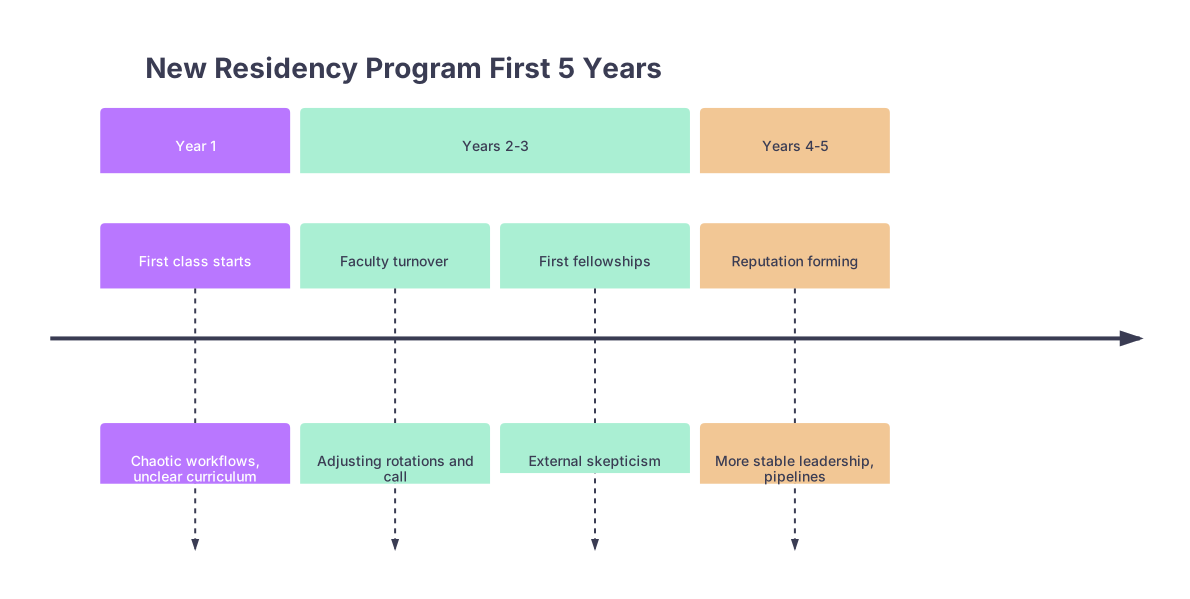
| Period | Event |
|---|---|
| Year 1 - First class starts | Chaotic workflows, unclear curriculum |
| Years 2-3 - Faculty turnover | Adjusting rotations and call |
| Years 2-3 - First fellowships | External skepticism |
| Years 4-5 - Reputation forming | More stable leadership, pipelines |
| Category | Normal Growing Pain | True Red Flag |
|---|---|---|
| Curriculum | Some disorganization, evolving schedules | No clear rotation objectives at all |
| Faculty | A few departures, roles shifting | Mass exodus of core faculty |
| Workload | Occasional heavy months | Chronic 80+ hour weeks, unreported |
| Culture | Confusion about resident role | Open hostility to residents |
| Career Support | Limited initial pipelines | PD dismissive of your career goals |
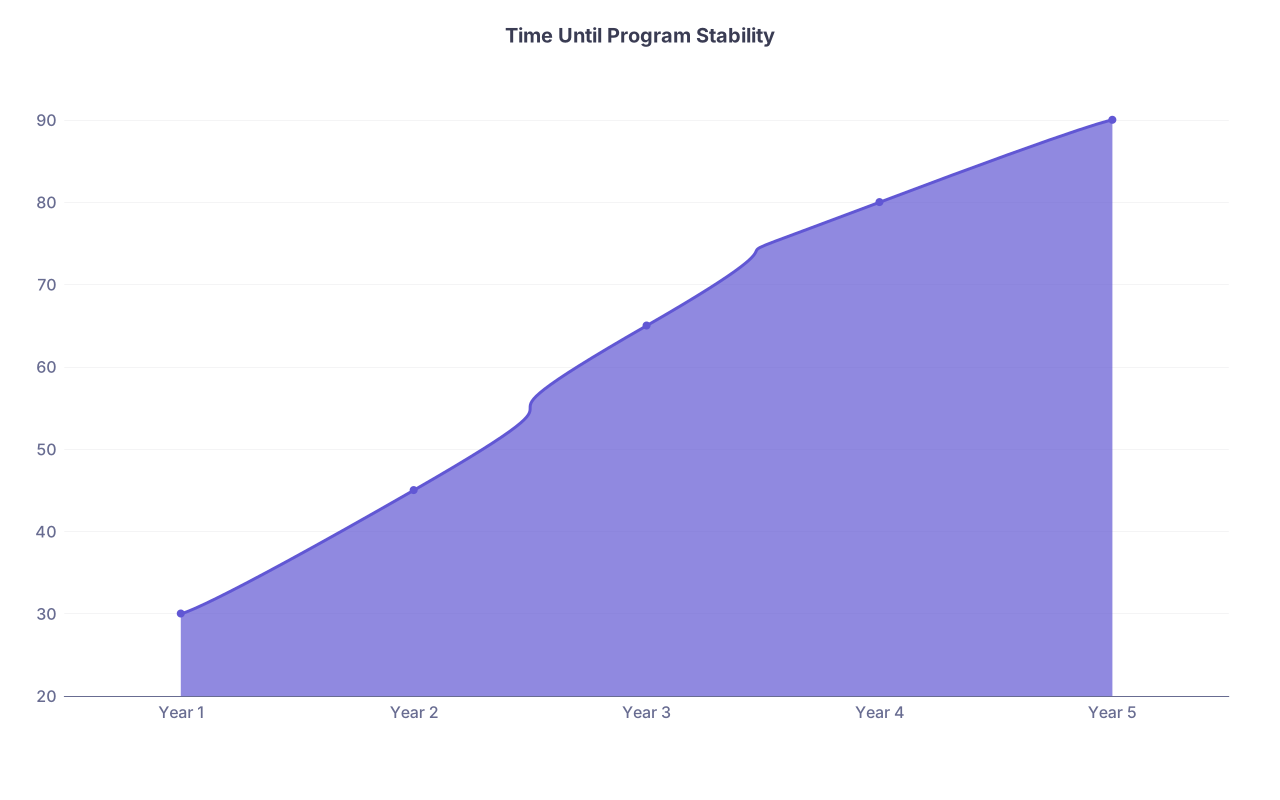
| Category | Value |
|---|---|
| Year 1 | 30 |
| Year 2 | 45 |
| Year 3 | 65 |
| Year 4 | 80 |
| Year 5 | 90 |



FAQ – What People Ask Me Off the Record
1. Is it a bad idea to rank a brand‑new program highly?
Not automatically. But you should treat it like a startup. Higher risk, potentially high reward. Look at who the PD and core faculty are, whether they came from solid programs, and how much institutional backing the hospital has actually committed. If leadership looks green and there’s no robust parent institution, I’d be cautious ranking it above well-established, mid‑tier but stable programs.
2. Will being in a new program hurt my fellowship chances?
In the first 3–5 years, yes, you’re fighting a mild headwind. Not a death sentence, but you’ll need stronger external validation: away rotations, letters from known faculty, conference presentations. Once a few grads match well, the stigma fades. If you’re dead set on derm, plastics, or GI from day one, I’d prefer a proven program unless the new one has heavyweight faculty in that exact field.
3. If I’m already in a new program and it’s rough, when should I consider transferring?
When patterns, not isolated events, show up. If after the first full year you’re seeing persistent duty hour violations, zero responsiveness to feedback, significant faculty exodus, and clear gaps in core training (ICU, ED, continuity clinic), you’re not overreacting by exploring transfer options. Quietly gather documentation, talk to trusted mentors outside your institution, and be strategic. Loyalty is admirable. But not at the expense of your competence or sanity.
Key points, so you don’t miss the forest for the trees:
- New programs almost always have real, messy growing pains—curriculum gaps, culture lag, leadership churn—that alumni later smooth over in their stories.
- The first few classes function as proof of concept. You carry more risk and more responsibility, so you must be intentional about seeking structure, mentorship, and external validation.
- A new program can still be the right choice, but only if you walk in with your eyes open—and you’re willing to help build the house while you live in it.