Why Chasing ‘Founder Resident’ Status Can Quietly Backfire on You
What happens when the “founder resident” line on your CV costs you the fellowship or job you actually want?
Let me be direct: the obsession with being a “founder resident” in a brand‑new residency program is getting out of hand. I’ve watched applicants get starry-eyed by that phrase, ignore a pile of red flags, and then spend three years fixing problems that should never have been their problem in the first place.
You’re being sold a story: “Join us as a founding class, shape the culture, be a leader.” Sounds great. Until you’re the person arguing with GME about basic call schedules, begging for subspecialty rotations that were “planned,” and explaining to fellowship PDs why your letters are from hospitalists instead of name‑recognized specialists.
Let’s walk through the traps you’re walking toward if you chase “founder” status for the wrong reasons—and how to tell when a new program is actually a smart risk vs. a quiet career handicap.
The Fantasy of the ‘Founder Resident’ – And How It’s Used Against You
New programs know they’re selling an unknown product. So they lean hard on marketing language: “innovative,” “non‑hierarchical,” “build something from scratch,” “first class of leaders.”
Here’s the mistake: you hear “founder” and think “advantage.” They mean “cheap labor and free consultants.”
Typical pitch I’ve seen:
- “You’ll have a direct line to leadership.”
- “You’ll help build the curriculum.”
- “You won’t be stuck in old traditions.”
- “We’re committed to resident wellness from day one.”
Translation, if you’re not careful:
- “We don’t fully know what we’re doing yet.”
- “We haven’t actually finalized the curriculum.”
- “We don’t have systems, policies, or culture built.”
- “We’re saying wellness because we know it sells.”
Being a “founder resident” can absolutely be a plus. But only if there’s a strong backbone in place: stable institution, committed leadership, established clinical volume, realistic GME support. Without those, “founder” is just a nice word pasted over chaos.
Mistake #1: Confusing ‘Freedom’ With Lack of Structure
You’ll hear: “No rigid hierarchy. You can shape this however you want!”
Sounds empowering. Often it just means: “Nothing is built yet, and you’ll suffer for it.”
Programs without solid structure create several recurring problems:
No clear escalation chain
At 2 a.m., when a septic patient is crashing and no one answers the pager, you don’t care that you’re a founder. You care that there’s a defined system to get backup. If they can’t tell you exactly who is available overnight and how supervision is guaranteed, that’s a problem.Vague expectations
“We’re flexible” can quickly become “We’ll decide what’s fair as we go,” which really means “You’ll work until things stop breaking.” Graduated autonomy, competency evaluations, promotion standards—these need to be written, not “we’ll figure it out later.”No tested workflow
Ask any resident in an early‑phase new program: those first years are an endless series of “This doesn’t work; let’s try something else.” That can be stimulating. It can also be exhausting. You didn’t sign up to be a full‑time process engineer while learning how to not kill people.
If you like innovation, great. Just don’t mistake “no guardrails” for “freedom.” In medicine, guardrails are there because people get hurt when they’re not.
Mistake #2: Ignoring the Accreditation and Stability Risks
Here’s where people get reckless. They see “ACGME accredited” and assume that’s the end of the story. It isn’t.
New programs live under a microscope. And not all of them do well.
, Rotation gaps, Poor advising, Accreditation issues](https://cdn.residencyadvisor.com/images/articles_svg/chart-common-early-problems-reported-in-new-residency-pr-1959.svg "Common Early Problems Reported in New Residency Programs")
| Category | Value |
|---|---|
| Schedule chaos | 80 |
| [Faculty turnover](https://residencyadvisor.com/resources/new-residency-programs/how-faculty-turnover-shapes-new-programs-in-the-first-3-match-cycles) | 60 |
| Rotation gaps | 55 |
| Poor advising | 50 |
| Accreditation issues | 20 |
Those numbers aren’t from a single study; they match what residents complain about again and again in new programs: unstable schedules, faculty leaving, promised rotations not happening, and occasional accreditation warnings.
Things you absolutely should not ignore:
Initial accreditation vs. continued accreditation
“Initial accreditation” means “You’re allowed to start and we’ll see how you do.” A new program with initial accreditation isn’t automatically unsafe—but it is on trial. Ask directly: Have there been any citations? Any concerns flagged by ACGME? Programs that dodge that question are telling you something.Hospital or system financial health
I’ve seen residents matched into programs where the sponsoring hospital later merged, cut service lines, or changed strategy. Suddenly the program’s existence was… negotiable. Look up financial news, bond ratings, major layoffs. Medicine is idealistic; hospital administrations are not.Key faculty dependency
If the entire program relies on one or two champions (“Dr. X basically runs everything”), your training depends on those people not burning out, leaving, or being pushed out. That’s fragile. Ask, “If Dr. X left, who would take over as PD or chief of service?”
Do not take “We’re new but growing fast!” as reassurance by itself. Growth can be good—or it can mean they’re building the plane while flying it, and you’re one of the passengers being told to help with the wings.
Mistake #3: Overestimating the CV Value of ‘Founder Resident’
Let me kill this myth: being a “founder resident” is not an automatic golden ticket for fellowship or jobs.
Program directors and employers care about:
- Quality and reputation of your training environment
- Who your letter writers are
- Breadth and depth of your clinical exposure
- Research or scholarly output
- How well you’re prepared on day one of fellowship/practice
“Founder resident” is a nice line. But it’s not a substitute for substance.
Here’s how it can actually backfire:
Skepticism about clinical exposure
Early years of a program often mean:- No senior residents to learn from
- Faculty still getting used to teaching roles
- Rotations in flux
Fellowship directors may quietly wonder: did you really see the volume/complexity your peers at established programs did?
Weak brand recognition
A new community program may be fantastic. But when your application lands in a pile, name recognition matters. People know what a “Cleveland Clinic IM resident” has usually seen. “Brand‑new community hospital program in Year 2” is a question mark. Not disqualifying. Just not an automatic asset.Letters from unknown faculty
If your mentors are great clinicians but invisible nationally, their glowing letters carry less weight than they should. Especially in ultra‑competitive fellowships, reviewers look for writers they trust.
Here’s the cruel part: you might genuinely work harder and shoulder more leadership than many residents at established programs… and still look weaker on paper.
Do you want to be a builder? Fine. But don’t trade away solid training and mentorship just to get that “founder” word on your CV.
Mistake #4: Underestimating the Emotional and Workload Cost
People romanticize “being part of something new.” What they don’t picture is the cumulative grind of:
- Redesigning the call schedule three times in one year
- Setting up didactics because faculty haven’t figured it out
- Arguing for basic things: workrooms, computers, meal cards
- Being the spokesperson to GME every time things break
You’re not just a resident. You’re unpaid middle management.
Two things I’ve heard almost verbatim from founder residents at new programs:
- “We spend half our chiefs’ meetings just fixing fires from the week before.”
- “I feel like I’m constantly explaining to the administration what a real residency is supposed to look like.”
That’s not leadership development. That’s unpaid consulting.
And yes, burnout risk is higher when everything is unstable. You don’t get the comfort of older residents saying, “This is how we handle this rotation,” or “It sucks now, but it gets better as a PGY‑2.” Because no one knows. You are the experiment.
Mistake #5: Believing Every “We Plan To…” Without Proof
New programs love the future tense:
- “We plan to add a MICU rotation at the academic center.”
- “We plan to start a cardiology fellowship here.”
- “We plan to affiliate with [Big Name University].”
- “We plan to build research infrastructure.”
Some of those things happen. Many do not. Or they happen in year 5 when you’re long gone.
You’re not training in their vision deck. You’re training in their current reality.
| Program Claim | What You Must Check |
|---|---|
| Future subspecialty rotations | Signed affiliation agreements? |
| Planned new fellowship | Approved by ACGME? Timeline? |
| Academic affiliation | Formal contract vs vague partnership? |
| Research opportunities | Active IRB, mentors, ongoing projects? |
| Simulation & teaching resources | Already built and staffed? |
If something is truly happening for you, they should be able to show evidence: contracts, timelines, GME communications, specific faculty named and committed.
If all you get is, “We’re working on it, and by the time you’re PGY‑3…”—assume there’s a good chance you’ll graduate before it materializes.
When a New Residency Program Is a Reasonable Risk
Not all new programs are disasters. Some are excellent opportunities—if you choose them for the right reasons and with your eyes open.
Green flags that a “founder” role might actually work in your favor:
- Large, stable health system with strong existing departments
- Program leadership with prior successful PD/APD experience elsewhere
- Existing fellowships in your field at the same institution
- Clear, detailed rotation schedules already locked in with named sites
- Mentors who are publishing, involved in national societies, and eager to invest in residents
- ACGME site visit feedback already addressed with specific changes
You want innovation built on top of a solid base, not innovation as an excuse for chaos.
Ask these questions and listen carefully:
“What concrete changes have you already made based on early feedback?”
If they have specific examples, good. That means they’re responsive.“How many of your core faculty are 100% committed to this site vs moonlighting from elsewhere?”
You want people who are actually there.“If I want to pursue [fellowship X], who here has successfully mentored people into that field previously?”
Vague answers should worry you.
If they have good, specific answers—then being a founder might be a real opportunity. If not, you’re signing up to be quality assurance.
Practical Checklist: Before You Bet Your Training on ‘Founder’ Status
Use this like a pre‑match safety check.

| Step | Description |
|---|---|
| Step 1 | Considering new program |
| Step 2 | High risk - Avoid |
| Step 3 | OK only if career goals are general |
| Step 4 | Reasonable risk - Consider |
| Step 5 | Stable institution? |
| Step 6 | Experienced PD and faculty? |
| Step 7 | Rotations clearly defined? |
| Step 8 | Strong mentorship and fellowships? |
| Step 9 | Willing to accept risk for location or life? |
Non‑negotiables you should verify:
- ACGME status and any citations
- Rotation schedule for all years, not just PGY‑1
- ICU, ED, night float, and subspecialty exposure
- Presence (or absence) of seniors above you in year one
- Concrete advisor/mentor assignments
- Call backup structure and attending availability
- Real track record of graduates, if any (for slightly older new programs)
And the big one: ask current residents privately, “If you could re‑match today, would you choose this program again?” The hesitation in their voice will tell you more than any brochure.
The Future of Medicine: Why New Programs Are Exploding (And Why You Should Be Careful)
There’s a bigger trend you need to see clearly.
New residency programs are exploding in number because:
- Hospitals want cheap labor and prestige
- Health systems want to claim they’re “academic”
- There’s pressure to increase the physician workforce
- GME money follows residents
Some programs absolutely care about quality and education. Others care about bodies to staff their wards while looking good on paper.
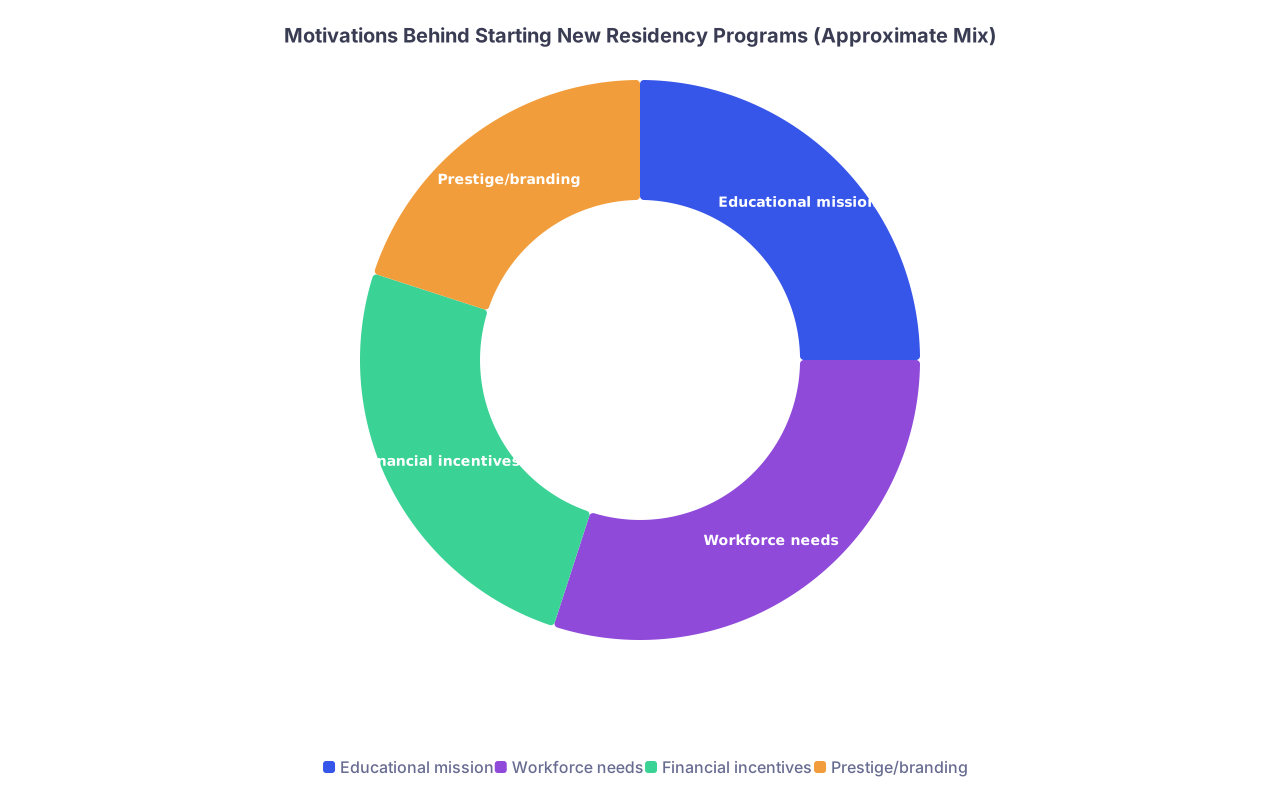
| Category | Value |
|---|---|
| Educational mission | 25 |
| Workforce needs | 30 |
| Financial incentives | 25 |
| Prestige/branding | 20 |
Do not assume everyone is acting in your best interest. You have to act in your best interest.
Your training years are not just a job. They shape how confident you feel with sick patients, what fellowships you can realistically pursue, and how burned out you are entering attending life. Trading that for a marketing label like “founder resident” can be a very bad deal.
When It Might Be Worth It To Choose Founder Status Anyway
There are times when—despite all these risks—choosing a new program is reasonable:
- You need to be in a specific city for family, health, or visa reasons
- You’re going into a broad field where elite fellowship isn’t your goal
- You’re genuinely excited by building systems and accept the trade‑offs
- The alternative programs available to you are truly toxic or unsafe
Just own that you’re making a trade, not unlocking a cheat code.
If you do go this route, protect yourself:
- Prioritize finding strong individual mentors, even outside your program
- Aggressively seek outside rotations or electives at name‑brand centers if allowed
- Get involved in specialty societies early for networking and letters
- Keep records of your case logs, procedures, and responsibilities—show your volume
- Be honest with yourself if the environment is harming your learning or health
You can make it work. Just don’t pretend the risks aren’t real.
Quick Reality Check Summary
If you remember nothing else, keep this:
- “Founder resident” is marketing, not magic. Training quality comes from structure, mentorship, and volume—not labels.
- New programs can quietly handicap you with unstable systems, weaker letters, and questionable exposure, even while telling you you’re a “leader.”
- Only take the founder gamble when the institution is solid, leadership is experienced, and you’re consciously choosing the trade‑offs—not falling for the brochure.
FAQ (Exactly 5 Questions)
1. Is it always a mistake to join a brand‑new residency program?
No. The mistake is joining because it’s new, not despite it. If the hospital is stable, leadership is experienced, the rotations are clearly defined, and your goals fit what they can realistically offer, a new program can be fine. But you should see it as a calculated risk, not an automatic advantage.
2. How can I tell if a new residency program is mainly about cheap labor?
Red flags: heavy emphasis on service needs during interviews, vague answers about didactics and evaluation, faculty who seem unaware of educational requirements, constant talk about “coverage” and “productivity,” and no clear investment in simulation, teaching time, or mentorship. If the schedule looks like a workhorse hospitalist job with “education” tacked on, you have your answer.
3. Will being a founder resident hurt my fellowship chances?
It can, if the program doesn’t provide strong subspecialty exposure, recognized mentors, and credible letters. Fellowship PDs look at the whole package. A new, unknown program without a track record forces them to guess about your training. Some will take the risk on you; others won’t. That uncertainty is the problem.
4. What specific questions should I ask current residents at a new program?
Ask: “What surprised you most after you started?” “What’s one thing that’s much worse than you expected?” “How often are schedules changed last‑minute?” “If you could rank again, would you put this program where you did?” And then—shut up and listen. Their tone matters as much as their words.
5. If I already matched into a new program, what can I do to protect my training?
Start early: identify mentors within and outside the institution; join national societies in your specialty; lock down away electives if possible; document your clinical experiences and procedures thoroughly; and give honest, specific feedback to leadership while also building your own network. Your goal is to supplement whatever the program lacks rather than waiting for it to magically mature while you’re there.