
It’s late January. You’re staring at your interview calendar, and one name on the list keeps catching your eye: a brand‑new residency program at a shiny hospital with a slick website, aggressive recruitment, and promises of “innovative training” and “limitless opportunities.”
They’re courting you hard. The residents (all PGY‑1s) in the meet‑and‑greet sound enthusiastic. The PD gives a stirring speech about “building something together.” They hint you’ll be “part of the founding cohort” and have “unmatched leadership opportunities.”
You’re tempted. Maybe your score isn’t what you wanted. Maybe the big‑name programs ignored you. Maybe this is your best interview.
This is exactly where people make preventable, career‑shaping mistakes.
New residency programs are not automatically bad. Some are outstanding from day one. But the risk profile is completely different from established programs—and applicants routinely ignore the red flags until they’re stuck.
Let me walk you through the mistakes I see over and over, and how to avoid becoming someone else’s experiment.
1. Assuming Accreditation Alone Means “Safe”
First mistake: you see “ACGME‑accredited” and your brain relaxes.
Do not do that.
ACGME accreditation just means the program met minimum structural requirements on paper and in early inspection. It does not mean:
- The clinical volume is appropriate for training
- The faculty actually know how to teach
- The hospital is financially stable enough to sustain the program
- Graduates will be competitive for fellowships or jobs
The most common misunderstanding: people treat “initial accreditation” like long‑standing full accreditation. It is not the same.
| Status Type | What It Really Means |
|---|---|
| Initial Accreditation | New program, theoretical design just approved |
| Continued Accreditation | Established, met standards over time |
| Probation | Serious concerns about compliance |
| Withdrawn/Withheld | Program closed or denied |
If a program is still in initial accreditation, you have to ask: how battle‑tested is their curriculum? Have they actually graduated anyone? Have they gone through a full ACGME cycle yet?
I’ve seen applicants shrug at “initial accreditation” like it’s a minor detail. Then three years later, the program gets hit with citations, leadership changes, or even closure threats. The residents are scrambling, transferring, or stuck in a program no one trusts.
How to not screw this up:
Ask directly on interview day or in follow‑up emails:
- “What is your current ACGME accreditation status?”
- “Have you had any ACGME site visits or citations yet? If so, what were they and how were they addressed?”
- “When is your next ACGME review scheduled?”
If the PD dances around this or gives word salad instead of specifics, that’s not “busy PD syndrome.” That’s a warning.
2. Believing Hype Instead of Looking at Case Volume and Breadth
Shiny scanners and marble lobbies do not train you. Cases do.
This is the core training risk with new programs: there’s no track record of graduates, and sometimes not even clear data on whether residents are actually getting the numbers they need.
Programs love vague phrases like:
- “High acuity, diverse patient population”
- “Broad range of pathology”
- “Cutting‑edge facility”
Those phrases are meaningless until you translate them into real data.
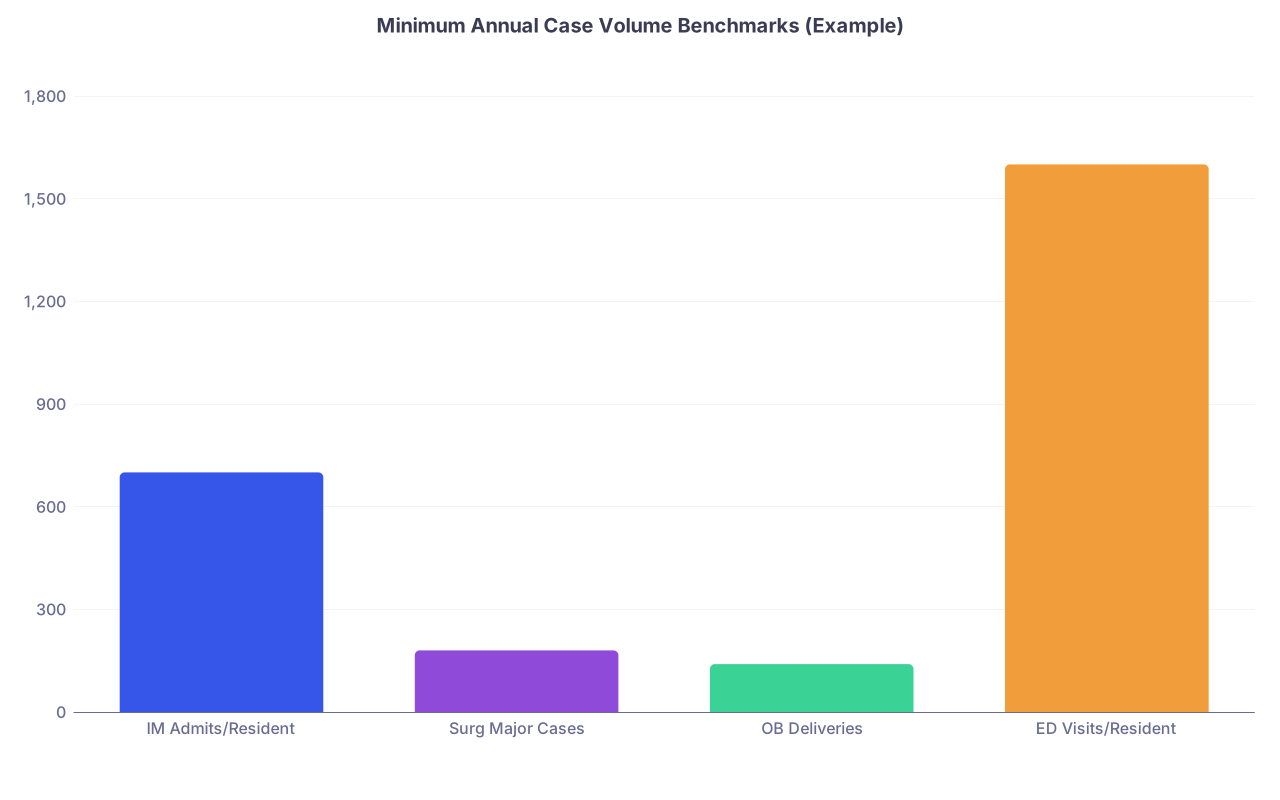
| Category | Value |
|---|---|
| IM Admits/Resident | 700 |
| Surg Major Cases | 180 |
| OB Deliveries | 140 |
| ED Visits/Resident | 1600 |
(No, those numbers are not universal standards. They’re just the kind of ballpark data you should be trying to understand.)
Things applicants constantly fail to ask about:
- How many admissions or primary cases per resident per year
- How many major procedures per resident (for surgical fields, EM, anesthesia, OB)
- Pediatric vs adult vs subspecialty exposure
- ICU, ED, and outpatient volumes per resident
- Does the hospital rely heavily on hospitalists or NPs/PAs for cases that residents need?
I’ve watched surgical interns match into new community programs that promised “great operative experience” and then discover:
- Most complex cases go to private surgeons at another site
- Residents get stuck doing mostly basic bread‑and‑butter while the “interesting” stuff goes to attendings or off‑site partners
- Fellows (from outside fellowships) eat the big cases
By the time they realize their case logs are anemic, they’re PGY‑4 with no easy way out.
How not to fall for this:
Ask for specific, program‑provided data:
- “Can you share approximate case numbers or logs per resident from this year so far?”
- “What percentage of [key cases] are done by residents versus attendings or advanced practice providers?”
- “Are there current or planned fellowships that will overlap with resident goals?”
If the answer is, “We’re still building that out,” understand what that really means: you might be the test subject while they “build.”
3. Ignoring Faculty Depth, Stability, and Teaching History
Another huge blind spot: people only count the number of faculty listed on the website, not who those people actually are or whether they are teachers or just names on paper.
Red flags with faculty in new programs:
- A PD with minimal actual teaching or GME experience
- Mostly fresh out‑of‑training attendings with no track record supervising residents
- Heavy reliance on locums, per‑diem physicians, or tele‑something services
- 1–2 overburdened “core” faculty spread across everything
You are not just evaluating how nice they seem. You’re evaluating whether this group can reliably train you for the next 3–7 years.
Look at this pattern I see way too often:
- New program launches with enthusiastic leadership
- 1–2 years in, volume and paperwork burn out the key faculty
- Those people leave or step back, leaving residents in limbo
- The hospital scrambles to hire, ends up filling holes with whoever will sign
Residents become collateral damage in an institutional learning curve.
Questions applicants rarely ask but should:
- “How long has the PD been in this role, and what was their prior experience with GME?”
- “How many core faculty are there specifically dedicated to residents, and what is their protected time?”
- “Have there been any major faculty departures in the last 12–24 months?”
- “Is your faculty primarily hospital employed, or are they private groups contracting with the hospital?”
If you sense that most faculty joined in the last 1–2 years and turnover is already happening, understand the message: the environment is unstable. And unstable faculty = unstable training.
4. Overlooking Call Schedules and Service vs. Education Balance
New programs are notorious for getting this wrong early: using residents as workforce rather than learners.
You’ll hear phrases like:
- “We’re still optimizing our schedule”
- “You’ll help us shape the call structure”
- “We’re flexible as we grow”
Translation: they have not figured out how not to abuse you yet.
Here’s what I’ve actually seen:
- PGY‑1s at new IM programs doing 6+ months of night float because there’s no nocturnist coverage
- EM residents running nearly solo overnight at community hospitals with weak backup
- Surgery interns covering three services across multiple hospitals because they’re understaffed
- OB residents being primary in‑house L&D coverage with distant or slow‑to‑respond attendings
It’s easy to promise “appropriate supervision.” It’s harder to actually schedule it when the hospital still wants to bill like a resident‑free service.
Do not skip the unsexy questions:
- “What is your current call schedule by PGY level?”
- “How many nights per month do your PGY‑1s typically work?”
- “Is there always an in‑house attending or senior resident, or is supervision home‑call?”
- “What recent changes have you made to the schedule based on resident feedback?”
If residents hesitate, glance at each other, or give wildly different answers, that’s not just social awkwardness. That’s a red flag.
5. Ignoring Hospital and System Financial Stability
A new residency program is expensive. Protected time, didactics, simulation, coordinators, faculty recruitment, call rooms, IT systems, accreditation fees. Someone has to pay for all of this.
If the hospital’s finances are shaky, you will feel it.
I’ve watched this sequence unfold:
- Health system is under margin pressure
- They launch a residency to recruit physicians and boost prestige
- After 2–3 years, revenue targets aren’t met, system starts cutting
- Academic time, simulation, conferences, and support staff all get squeezed
- Residency becomes an afterthought, residents become cheap labor
If the hospital or system is in repeated news cycles about closures, layoffs, service line cuts, or debt restructuring, do not pretend it’s irrelevant to you.
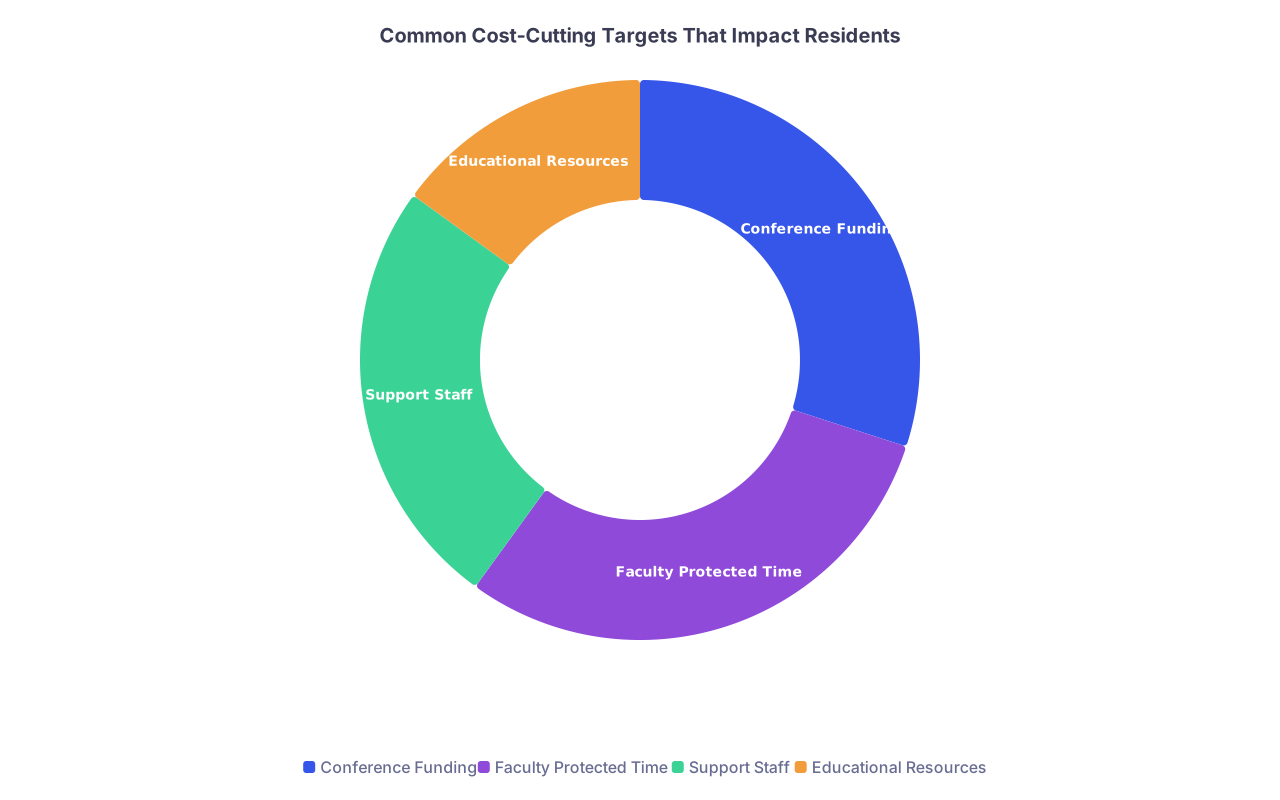
| Category | Value |
|---|---|
| Conference Funding | 30 |
| Faculty Protected Time | 30 |
| Support Staff | 25 |
| Educational Resources | 15 |
Concrete checks you should do:
- Google “[hospital name] financial problems,” “[health system] layoffs,” “[hospital] closure announcement.”
- Ask, “Has the hospital or system undergone major restructuring in the last 3–5 years?”
- “Has GME funding or staffing changed with any recent mergers or acquisitions?”
If the answer is, “We’re in a time of exciting transition,” press harder. “Exciting transition” can be corporate PR speak for “we are cutting costs aggressively.”
6. Being Blinded by “Leadership Opportunities” and Title Inflation
New programs sell one thing very hard: leadership.
“You’ll be the founding class.”
“You’ll shape the curriculum.”
“You’ll have unmatched opportunities to lead.”
That sounds great. Until you realize what they really mean is: “We haven’t built this yet and need you to patch the holes while we figure it out.”
Here’s the risk:
- You end up spending your limited training time fixing schedules, workflows, and policies instead of mastering medicine
- You become the de facto program coordinator / QI lead / EMR committee person without adequate support
- On paper you have ten “leadership roles” but your clinical foundation and board prep suffer
Residency is finite. You do not get a redo. Being a founding class can be great if the basics are rock solid. It is a disaster if you’re trying to build the plane while flying it.
Ask:
- “What major elements of the curriculum or schedule are still being built?”
- “Can you give examples of changes residents suggested that were actually implemented?”
- “How do you protect resident time for education while involving them in program development?”
If they talk endlessly about “resident leadership” but cannot show basic things—like a functional schedule, consistent didactics, and clear policies—someone is selling you work disguised as opportunity.
7. Not Demanding Transparency About Outcomes and Future Plans
The obvious problem with new programs: there are no graduates yet. So most applicants stop there: “Well, nobody has matched out yet, so nothing to see.”
That’s lazy thinking.
Even without graduates, they should have:
- A clear vision for fellowship placement and job outcomes
- Early partnerships with subspecialty groups and academic centers
- Faculty with strong reputations who can write heavyweight letters
- A plan for boards prep, in‑training exams, and remediation
I’ve seen PGY‑3s in brand‑new IM programs discover that:
- Their PD has no real connections with major fellowship programs
- There’s no structured support for research or scholarly activity
- In‑training exam scores are poor and no one has a remediation strategy
By then, you’re the one trying to sell an unproven program name to fellowship directors who have never heard of it.
Ask now, not later:
- “What are your expectations for graduates—fellowship vs hospitalist vs primary care?”
- “Which institutions do your faculty have strong connections with?”
- “What infrastructure do you have for research or quality improvement that leads to actual presentations or publications?”
- “How did your residents perform on the most recent in‑training exam, and what do you do for those who struggle?”
If the PD gets vague, changes the subject, or uses lots of buzzwords but no specifics, take the hint.
8. Red Flags in Resident Culture and Morale (Even in Year 1)
People assume you “can’t judge culture” in a new program. Wrong. You absolutely can.
I’ve watched founding classes in year one and you can already see:
Green flags:
- Residents speak frankly about challenges and what’s being fixed
- They know their PD and coordinator well and feel safe raising issues
- They can name specific improvements made based on their feedback
- They seem tired but not crushed, and they still talk about learning
Red flags:
- Residents hesitate to speak without faculty around
- They keep saying “things are still in flux” about everything that actually needs to be stable (call schedule, supervision, didactics)
- They look exhausted, disorganized, or checked out during interview day
- They give wildly inconsistent answers about rotation structure or backup
Watch for this dynamic: a PD and APDs doing most of the talking, with residents mostly nodding silently. That usually means either residents are too new to have opinions (which is its own risk) or they’ve learned that speaking honestly is not valued.
If you do a second look or virtual meet:
- Ask residents directly, “What’s one thing you wish you had known before matching here?”
- “What’s the worst part of the program right now?”
- “If you had to rank programs again today, would you still put this one where you did?”
If the answers sound rehearsed or suspiciously positive, assume you’re not getting the full story.
9. Glossing Over Weak or Nonexistent Ancillary Support
New programs often underestimate how much infrastructure residents need. You are not just evaluating attendings and hospital buildings; you’re evaluating all the glue that holds training together.
Common weak spots:
- Skeleton nursing staff with high turnover
- No consistent case management, social work, or pharmacy integration
- Poor IT support, clunky EMRs with no training, constant downtime
- Limited or chaotic access to imaging, consults, and procedures
What that looks like for you:
- You spend hours doing clerical and social work tasks instead of learning
- Admissions and discharges are slow because everything is manual
- Consults are delayed or blocked because there are no clear pathways
- Night shifts become dangerous because the whole system is understaffed
You are not just choosing a program. You’re choosing a system you’ll depend on at 2 a.m. when something is crashing.
Ask:
- “What is the typical nurse‑to‑patient ratio on the wards and ICU?”
- “Do you have in‑house respiratory therapy, pharmacy, and support staff 24/7?”
- “What changes has the hospital made to support the new residency (IT, ancillary staff, education spaces)?”
If you hear, “We’re working on hiring,” across multiple domains—nurses, RT, pharmacy, IT—then you are walking into an underbuilt system.
10. Ranking Based on Fear, Not Strategy
The final mistake: applicants panic and rank new programs high simply because they’re terrified of not matching.
Fear‑based ranking destroys careers.
Here’s the ugly truth:
It is often better to do a solid prelim year, reassess, and reapply than to lock yourself into a deeply dysfunctional categorical program that will limit your board prep, fellowship options, and sanity for years.
You cannot fix a fundamentally bad program as a resident. You do not control the budget, leadership, or hospital politics. You control where you choose to go. That’s it.
If you’re looking at a new program and thinking, “Well, I see a lot of issues, but I’m scared,” stop. Talk to a trusted advisor who will be honest with you—not someone whose priority is just “get you matched anywhere.”
FAQ (Exactly 3 Questions)
1. Are all new residency programs risky, or can some be great choices?
Some new programs are fantastic from day one—usually those backed by strong, stable health systems with experienced PDs and faculty who came from high‑quality established programs. They’re transparent with data, honest about growing pains, and have clear structures already in place. The risk is not “new = bad.” The risk is that “new” makes it much easier to hide or excuse serious deficiencies that would be obvious in an older program.
2. How high is “too high” to rank a new residency program on my list?
Rank it based on evidence, not age. If you’ve done the hard work—asked specific questions, vetted the hospital’s stability, checked faculty depth, confirmed case volume, and spoken candidly with residents—and it still compares favorably to older programs, ranking it high is reasonable. If you find yourself saying, “I’m not sure about X, Y, Z, but I’m desperate,” that’s when you’re putting it too high. Uncertainty across multiple domains is a sign to move it down.
3. What if I realize after matching that my new program has serious problems?
Document everything. Keep records of schedules, duty hours, unsafe situations, and broken promises. Talk to your PD first if it’s safe; some issues are fixable with honest communication. If problems are systemic—chronic duty hour violations, unsafe supervision, or abusive culture—you can escalate to your GME office, DIO, or, if needed, ACGME. Transfers are possible but difficult; the better path is aggressively vetting programs upfront so you’re not relying on escape plans later.
Key points, no fluff:
- Do not let “ACGME‑accredited” and glossy marketing lull you. Demand concrete data: case volume, faculty depth, schedules, supervision, and hospital stability.
- Listen for what is missing or vague. If they cannot give specifics on outcomes, infrastructure, or how they’ve responded to resident feedback, assume you are the experiment.
- Rank with strategy, not fear. It’s your career. One honest, brutal evaluation now is better than three years of damage control later.