
The worst mistake applicants make with new residency programs is trusting the brochure more than the data.
You cannot “vibe check” a program into being stable. You need a system. A checklist. And you need to run it cold.
This is that checklist.
You are not trying to guess the future. You are trying to reduce the odds that you end up in:
- A program that loses accreditation
- A program that implodes from leadership turnover
- A program that cannot graduate you board-eligible
Here is a stepwise, practical way to investigate the stability of any new residency program before you send them a rank, an application, or even a reply email.
Step 1: Define What “Stability” Actually Means
Do this first or you will get distracted by branding and shiny facilities.
For a new residency program, “stability” has four non-negotiable pillars:
Accreditation security
- Current accreditation status
- Realistic path to continued accreditation
- History of ACGME citations or warnings (if any)
Institutional backing
- Financial support from the hospital / system
- Clear commitment from GME leadership
- Adequate infrastructure: clinics, ORs, ICU, call rooms, EMR support
Educational structure
- Well-defined curriculum and rotation schedule
- Qualified faculty with real teaching time protected
- Robust case volume and clinical exposure
Track record proxies
- For new programs, there is no board pass rate yet
- You look at proxies: faculty history, institutional exam scores, fellowship matches from the institution, etc.
If a program cannot show strength in at least three of these, it belongs low on your list or off it.
Step 2: Start With Hard Accreditation Data
Do not guess accreditation. Look it up.
2.1 Check ACGME Status Directly
Go to the ACGME public program search and pull the program’s entry. For each new program, find:
- Accreditation status (Initial Accreditation, Continued Accreditation, etc.)
- Sponsoring institution
- Program start date
- Program director name
Red flags:
- “Initial Accreditation – Warning” this early in the program
- No listed program director or “interim” with no permanent PD announced
- Rapid changes in program name or sponsoring institution
| Status Label | Stability Signal |
|---|---|
| Initial Accreditation | Normal for new program |
| Initial Accreditation - Warning | Caution, investigate why |
| Continued Accreditation | Stronger stability signal |
| Probation | Avoid if possible |
| Withdrawn / Closed | Do not apply |
If you see “Warning” or anything that smells off, write it down. You are building a dossier, not trying to talk yourself into or out of something yet.
2.2 Confirm Sponsoring Institution Strength
You are not just joining a program. You are joining a GME ecosystem.
Check:
- Total number of ACGME-accredited programs in that hospital system
- How long existing programs have been running
- Any known issues with prior program closures
Hospitals that have kept multiple programs accredited for 10+ years tend to know what they are doing. A one-off new program in a hospital with zero GME history is a different animal.
Step 3: Assess Leadership Stability and Track Record
New programs live or die by leadership. There is no way around this.
3.1 Investigate the Program Director (PD)
You want concrete answers to:
- How long has the PD been in that role?
- Has the PD previously helped launch or run other accredited programs?
- What is their clinical and academic background?
Search:
- PubMed (research/academic activity)
- Google + Doximity + LinkedIn (career trajectory, prior roles)
- Hospital website (titles, leadership positions)
Good signs:
- PD previously faculty at a well-established residency in the same specialty
- Documented involvement in education (APD role, clerkship director, etc.)
- National roles: committee membership, specialty society involvement
Bad signs:
- PD with very little academic/teaching history who was purely clinical until 6 months ago
- High recent turnover: “We are in transition to a new PD” in a brand-new program
3.2 Look at the Core Faculty
At minimum, figure out:
- Number of core faculty vs residents (faculty:resident ratio)
- How long faculty plan to stay (ask them directly on interview day)
- How much protected time they have for teaching (ask this too)
If the same three attendings cover clinic, wards, OR, didactics, and admin with no protected time, you can predict how this goes. Burnout. Disorganization. Residents used as service labor to keep things afloat.
Step 4: Analyze Clinical Volume and Case Mix
A beautiful schedule template is worthless if the hospital does not have enough patients or complexity.
You need two things:
- Sufficient volume (you see enough patients)
- Sufficient variety (you see what the boards will test and what real practice demands)
4.1 Ask These Direct Volume Questions
On interview day or via email, ask:
- How many admissions per day on the main inpatient service?
- Average clinic volume per resident per half-day?
- Annual ED visits?
- For surgical fields: annual case volume per resident and case mix distribution
Programs that cannot give even ballpark answers are either too new to track data (risky) or disorganized (worse).
4.2 Check for Competing Learners
If the hospital is full of:
- Other residency programs in the same specialty
- Strong fellowships that take the complex/interesting cases
You need clarity on who gets what.
Ask:
- When there is a complex case, who scrubs in first – residents or fellows?
- How are procedures allocated between services?
- Are there resident-only clinics or OR days?
You are not being greedy. You are verifying that you will hit competency milestones without scrambling in PGY-3 to find basic cases.
Step 5: Scrutinize Funding and Institutional Commitment
Underfunded new programs are fragile. They cut corners. They use residents to plug staffing gaps. They run on promises instead of resources.
5.1 Look for Concrete Financial Signals
You will not see the budget. You will see its fingerprints.
Look at:
- Brand-new call rooms vs repurposed storage closets
- Dedicated didactic space with working AV vs “we usually find a room”
- Proper resident salaries and benefits in line with regional norms
- Adequate nursing, APP, and ancillary support
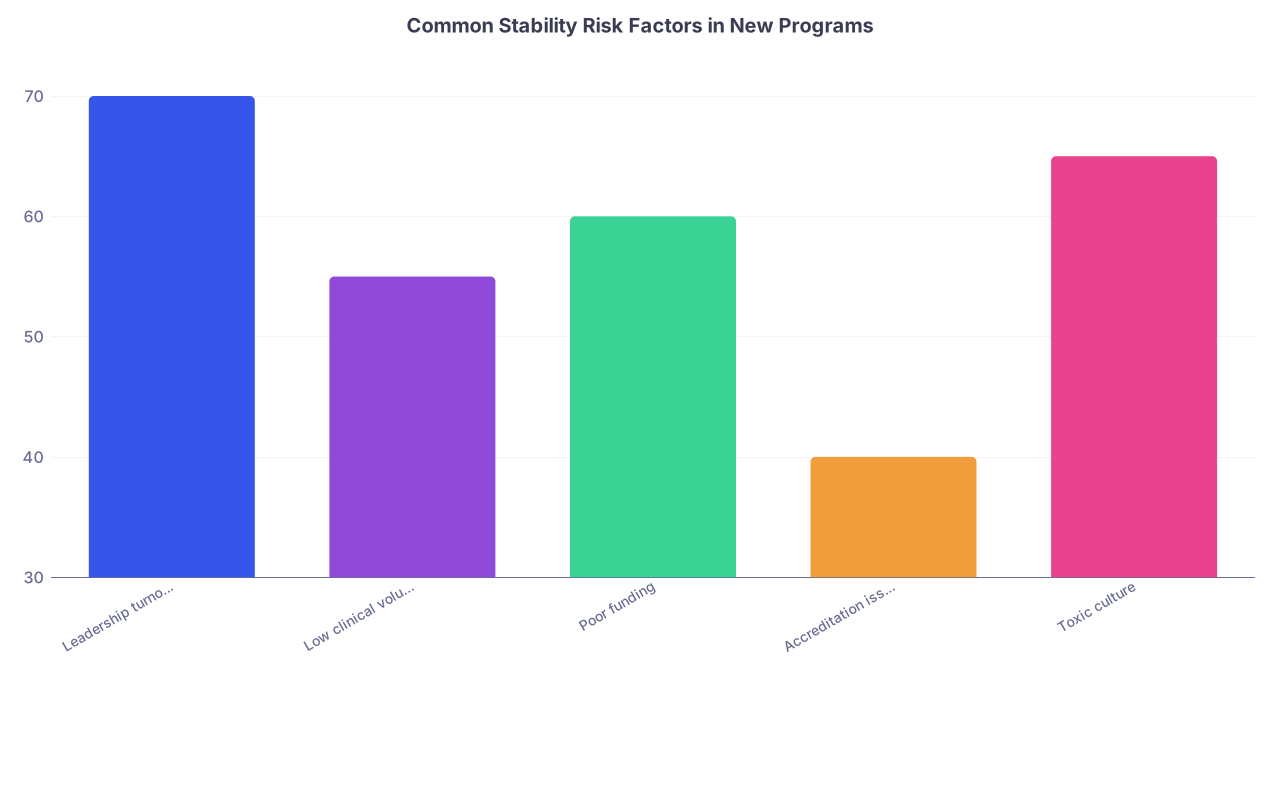
| Category | Value |
|---|---|
| Leadership turnover | 70 |
| Low clinical volume | 55 |
| Poor funding | 60 |
| Accreditation issues | 40 |
| Toxic culture | 65 |
If the hospital just opened a new tower, invested in new equipment, and is clearly building a teaching environment, that is very different from a small community site hoping residents will fix all their coverage problems.
5.2 Confirm GME and C-Suite Buy-In
During interview day, listen for:
- Presence of the DIO (Designated Institutional Official) at the introduction or Q&A
- Explicit statements from hospital leadership about why they opened this program and what the long-term plan is
Ask one pointed question to GME leadership if you get them:
“If volumes or finances become tight in the next five years, what is the hospital’s commitment to protecting residency training and accreditation?”
You are watching how fast and how clearly they answer.
Step 6: Dissect the Curriculum and Rotation Structure
New programs love glossy curriculum PDFs. You are not impressed by formatting. You care about structure and feasibility.
6.1 Check for Compliance and Coherence
For your specialty, verify:
- Required ACGME rotations are all present (e.g., for IM: ICU, CCU, wards, ambulatory, electives, night float, etc.)
- No rotation looks suspiciously vague: “Hospital Service” for 6 months straight is a red flag
- There is a balance between service and education, not 80% scutwork
Ask:
- “How often is the curriculum reviewed and updated?”
- “Have you had to modify any rotations after the first year based on feedback?”
Programs that admit they adjusted things in response to resident feedback are usually healthier than ones pretending they got it perfect on day one.
6.2 Evaluate Didactics and Exam Preparation
You want specific answers to:
- Frequency and format of didactics (daily? weekly half-day?)
- Who actually teaches (faculty vs pharma reps vs random)
- Availability of board review resources (question banks, review courses)
For new programs without board pass data, use these proxies:
- How did prior trainees from this institution (e.g., transitional year, prelims) perform on in-training exams?
- What is the PD’s plan for board prep, concretely?
Vague answers like “We strongly support residents in studying for boards” with no structure behind it are not reassuring.
Step 7: Investigate Culture, Workload, and Resident Experience
This is where you move beyond numbers and into pattern recognition. You do not guess culture. You interrogate it.
7.1 Talk to Residents – Correctly
Do not waste the resident Q&A asking “So what do you like about the program?” You will get canned answers.
Instead, ask:
- “What is one thing you would change about the program if you could?”
- “What has actually improved since the first cohort started?”
- “How does leadership respond when residents raise concerns?”
- “On your worst rotations, what does a typical day look like in hours?”
Also pay attention to what residents say between scheduled sessions. Hallway comments. Jokes about “surviving” certain months. That is where you get the truth.
7.2 Watch for Systemic Red Flags
Patterns I have seen in unstable new programs:
- Residents look exhausted and guarded on interview day
- They are vague about work hours and say “We are usually within duty hours” with a tight smile
- High number of off-cycle residents or people who transferred out
- No clear system for wellness, mental health support, or coverage during illness
Ask directly:
- “How many residents have left the program since it started, and why?”
If they dodge the question, you have your answer.
Step 8: Look at Program Trajectory, Not Just Current State
You are signing up for 3–7 years, not one recruitment season.
8.1 Track Growth Plans and Feasibility
New programs often claim:
- “We are planning to double in size.”
- “We will add fellowships soon.”
Ask:
- “What concrete steps have already been taken toward that growth?”
- “What has actually changed in the last 12 months?”
Growth without added faculty, sites, or infrastructure means more residents competing for the same pie.
8.2 Map the Timeline Visually
A quick mental or written map helps. For more structured thinkers, a simple process diagram:

| Step | Description |
|---|---|
| Step 1 | Identify New Program |
| Step 2 | Check ACGME Status |
| Step 3 | Assess Leadership and Faculty |
| Step 4 | Review Clinical Volume and Case Mix |
| Step 5 | Evaluate Funding and Institutional Support |
| Step 6 | Analyze Curriculum and Didactics |
| Step 7 | Interview Residents and Check Culture |
| Step 8 | Assess Trajectory and Growth Plans |
| Step 9 | Rank Confidently |
| Step 10 | Rank Lower Tier |
| Step 11 | Do Not Rank |
| Step 12 | Stability Verdict |
You should be able to walk through each box with actual information, not assumptions.
Step 9: Do External Recon – Beyond the Program’s Story
You are not limited to what the program tells you.
9.1 Use Public and Semi-Public Sources
Look at:
- Program reviews and forums (yes, with skepticism, but patterns matter)
- Social media accounts of the program and residents
- Publications or conference presentations featuring residents – this tells you whether residents have protected time for scholarly work
Cross-check:
- Does the marketing on Instagram match what residents described?
- Does the hospital show residents as part of core identity, or are they invisible?
9.2 Network Quietly
If you have:
- Alumni from your med school who rotated there
- Attendings who know faculty at that hospital
- Upper-level residents in your specialty with wider networks
Ask them one precise question:
“Off the record, would you send your own kid to this program?”
That question bypasses politeness. You will see it in their face even before they answer.
Step 10: Score the Program Using a Simple Stability Checklist
You are a scientist. Treat this like one.
Build a simple scoring sheet for each new program:
| Domain | Score 1–5 | Notes |
|---|---|---|
| Accreditation / ACGME | ||
| Leadership & Faculty | ||
| Clinical Volume & Variety | ||
| Funding & Resources | ||
| Curriculum & Didactics | ||
| Culture & Resident Support | ||
| Long-term Trajectory |
Scoring rule of thumb:
- 5 = Confident, strong evidence
- 4 = Good with minor concerns
- 3 = Mixed, unclear, or variable
- 2 = Concerning evidence
- 1 = Serious red flags
Add them up:
- 28–35: Stable enough to rank high if fit and location match
- 21–27: Rank mid–low; acceptable but with real risk
- ≤20: Think very hard before ranking, unless you have no safer options
This is not perfection. It is structure. Structure beats vibes.
Step 11: Compare New vs Established Programs Honestly
You are not choosing between “perfect established” and “disastrous new” in most cases. You are choosing between imperfect options.
Sometimes a new program with:
- Strong faculty from top-tier institutions
- Incredible case volume at an underserved hospital
- Dedicated leadership hungry to prove themselves
…is a better bet than a complacent, mid-tier program where you are just a warm body on the call schedule.
To keep your thinking rational, lay out your options side by side:
| Factor | New Program (Example) | Established Program (Example) |
|---|---|---|
| Accreditation | Initial, clean | Continued |
| Case Volume | Very high | Moderate |
| Faculty Reputation | Strong, recently hired | Mixed, some burned out |
| Culture | Unknown but energetic | Known, somewhat malignant |
| Location | Good | Excellent |
| Stability Score | 27 | 29 |
A two-point difference is not destiny. The qualitative details behind those numbers matter. But seeing this on paper stops you from being seduced by logos and addresses alone.
Step 12: Decide Your Risk Tolerance Like an Adult
Different people can rationally choose different paths with the same data.
Things to ask yourself:
- How much do I need geographic stability vs program prestige vs culture?
- Do I have backup options if this program worsens? (e.g., ability to transfer, family safety net)
- Am I the kind of person who thrives in building something new, or do I need structure already in place?
Then match that to your stability scores.
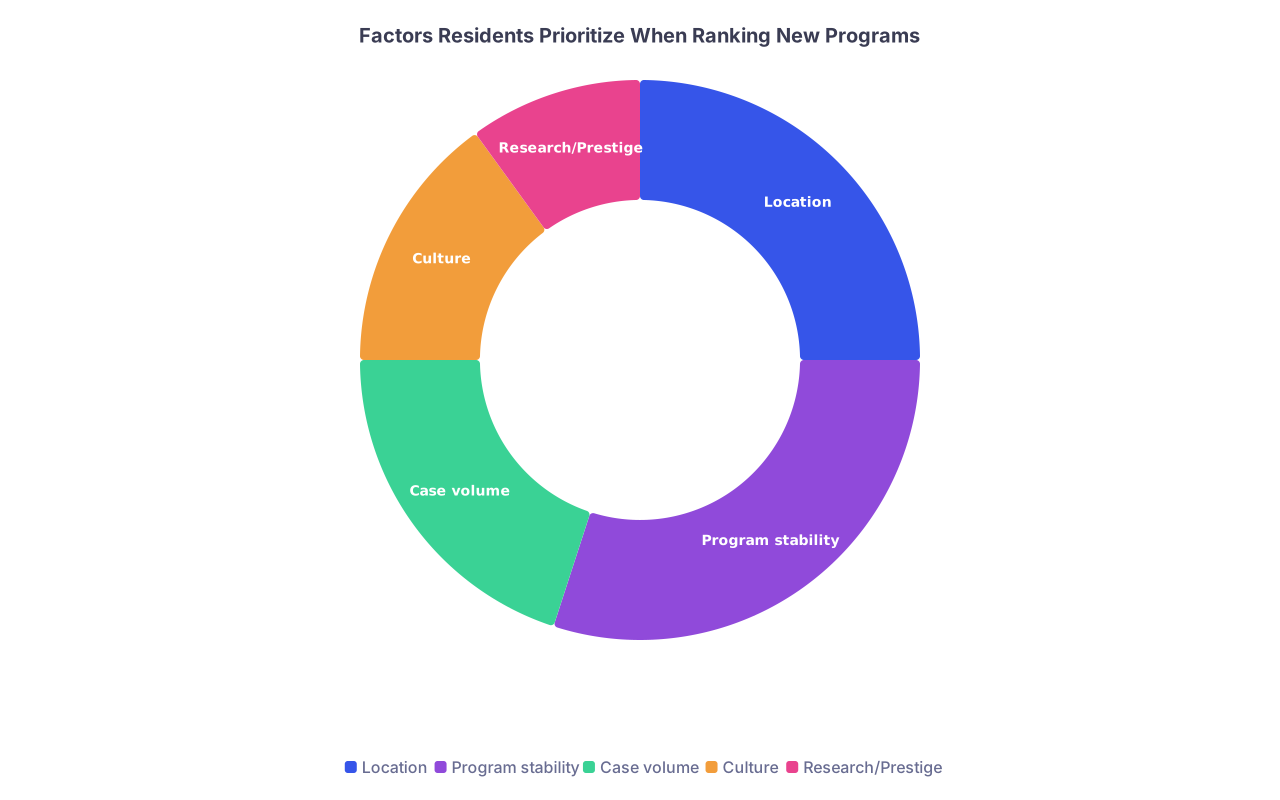
| Category | Value |
|---|---|
| Location | 25 |
| Program stability | 30 |
| Case volume | 20 |
| Culture | 15 |
| Research/Prestige | 10 |
There is no morally correct answer. There is only:
- Clear-eyed risk assessment
- Conscious choice
The real failure is pretending you are not taking a risk when you obviously are.
How to Use This Checklist in Real Life
Here is the practical protocol I have seen work:
Before interview season
- Build your scoring template as a simple spreadsheet using the domains above
- Pre-decide which factors are “hard stops” (e.g., any probation = no rank)
Before each interview
- Pull ACGME data and basic hospital info
- Fill in what you can (accreditation, institutional strength)
During interview
- Target your questions: leadership, volume, culture, future plans
- Write down answers the same day, not “later”
After interview
- Score each domain 1–5 while the memory is fresh
- Add qualitative notes: specific red flags or green flags
- Compare across programs only after you have scored all of them
Before ranking
- Sort by stability score
- Then adjust up or down based on location, personal fit, and life constraints
- But never ignore a domain where you wrote “serious concern” and then magically rank them top 3
This is how you convert anxiety into a plan. You will still feel uncertain. You will not feel clueless.
The Bottom Line
Three points and you are done:
- Treat new programs as high-variance investments. Some are excellent, some are disasters. You cannot tell which without structured investigation.
- Use a domain-based checklist. Accreditation, leadership, volume, funding, curriculum, culture, trajectory. Score them. Patterns will appear.
- Make a conscious risk decision. Do not let branding, charm, or desperation override hard red flags. You can choose risk, but do it with your eyes open and your data in front of you.