
It’s July 2nd. You’re walking into orientation, badge still stiff, and everyone keeps calling your program “new.” But it’s not brand‑new. You’re the second class. The guinea pigs… of the guinea pigs.
The first class took the wild hit of year one. No seniors. No systems. No one knew where the code cart was. Now it’s “better,” supposedly. Except your clinic workflow isn’t really set, the call schedule is being “revisited,” and the older attendings still say things like, “Wait, we have residents now?”
Here’s the situation:
You’re not in a mature, well‑oiled program. You’re also not in the blank-slate, build‑it‑from‑scratch first class. You’re in the messy middle. The “we should really fix that this year” class.
This is where the chaos can either make you miserable—or give you disproportionate influence over your training and your future career.
Let’s get concrete about what to actually do.
1. Understand Your Position: You Have Leverage, But Not Power
You need to be crystal clear on your role in the life cycle of a residency.
Year 1 class:
- Suffered the worst disorganization
- Built basic workflows and schedules
- Had zero seniors to protect or teach them
Year 2 class (you):
- First time there are “seniors” (PGY2s) but they’re barely out of survival mode
- Volume goes up, expectations go up
- Program leadership wants to “stabilize” and “standardize”
You have leverage because:
- ACGME data is just starting to accumulate. Leadership is hyper‑sensitive about feedback and accreditation.
- Recruitment matters more now. Your satisfaction and your word of mouth will affect future classes.
- Systems are still flexible enough that your complaints and suggestions can actually be implemented, not just “noted.”
But you don’t have power:
- You cannot threaten to tank the program.
- You cannot make demands like a mature resident union at a 30‑year‑old program.
- You’re replaceable. Harsh, but true.
So your mindset has to be:
“Behave like a responsible co‑architect, not a disgruntled customer.”
That means: specific, solution‑oriented, and reasonable.
2. Day 1–90: What to Assess and Document (Quietly but Systematically)
Do not spend your first month trying to “fix the program.” That’s how you get ignored.
Your first 1–3 months should be reconnaissance.
You’re trying to answer three questions:
- Where is the true chaos (safety / legal / accreditation risk)?
- Where is the tolerable chaos (annoying but survivable)?
- Where are the quick‑win fixes (small changes with big impact)?
Start a simple running log. Literally a locked note on your phone or a private Google Doc.
Use three headings:
- “Safety / compliance problems”
- “Workflow / education problems”
- “Annoyances / nice‑to‑fix”
Then, every time you see something off, record:
- What happened
- Where
- When
- Who was involved (roles, not names)
- Immediate impact
Example entries:
- “ICU night, 7/8, code meds locked in cabinet, no night pharmacy access, delay in epi for ~3 minutes.”
- “Clinic 7/15, no clear preceptor assignment; 3 residents all waiting for same attending; patients roomed 45+ minutes late.”
This log will later be gold:
- For CLER site visitors / ACGME questions
- For your program evaluation committee
- For backing up feedback when leadership says, “We haven’t really heard about that.”
Someone will always say that.
3. Building the Relationship with the First Class (Without Becoming Their Emotional Dump)
The PGY2s in a brand‑new program are a special breed. They’ve survived a feral year. Many of them are still angry.
You need them, but you cannot let their trauma define your experience.
Here’s the playbook.
Be explicit about your respect—and your boundaries
Early on, say something like this to one of the more reasonable PGY2s:
“I know last year was rough and you all took the hardest hit. I really want to learn what worked and what didn’t from you, and also help make this year better for everyone.”
Then quietly set internal boundaries:
- You’re not their therapist.
- You’re not their weapon against leadership.
- You’re not going to relive their worst year for the next 12 months.
If someone starts trauma‑dumping endlessly:
“Yeah, that sounds brutal. I’m glad some of that is changing this year. For me right now, I’m just trying to figure out how to do X well. What would you do differently if you were in my shoes?”
You acknowledge without signing up to be their emotional landfill.
Extract their intel, not just their pain
Ask targeted questions:
- “What’s the one rotation that felt unsafe last year?”
- “Who are the attendings who actually like teaching?”
- “What ended up being not worth fighting about?”
You’re filtering for signal:
- True safety issues
- True chronic problem faculty/services
- Battles that aren’t worth your time
That last one is underrated.
4. Chaos vs. Danger: Pick Your Battles Like an Adult, Not Like Twitter
New programs are messy. Some mess is just that—mess.
Your job is to distinguish:
- “This is annoying” from
- “This is dangerous” from
- “This is ACGME‑level bad”
Here’s a simple filter.
| Category | Example Issue | Response Level |
|---|---|---|
| Annoyance | No resident lounge, bad call room chairs | Mention in surveys, low urgency |
| Workflow problem | Constant EMR access delays on new rotations | Bring to chief/PD with solution |
| Safety issue | No backup attending for nights, delayed codes | Immediate escalation |
| ACGME/compliance risk | Chronic 100+ hr weeks, no day off for weeks | Document + formal reporting |
If you treat every inconvenience like a federal case, you’ll be ignored. If you downplay real danger, you’re complicit.
Write it out for yourself:
“What are my top 3 safety-level concerns right now?”
Those are the ones you bring up clearly, repeatedly, in the right channels.
5. Communication Strategy: How to Complain Without Being Dismissed
New programs are drowning in feedback. Most of it is vague, emotional, and unhelpful. Your goal is to be the opposite.
Use this structure when you talk to chiefs, PD, or coordinators:
- Start with the impact on patients or education, not your comfort.
- Give a concrete example, not general vibes.
- Propose at least one semi‑realistic solution.
- Ask how you can help implement.
Example (bad):
“Night float is brutal and unsustainable. Something needs to change.”
Example (better):
“On night float, we’re covering 4 services plus cross‑cover on 60–70 patients. Last week, two cross‑cover calls for hypotension got delayed 30–40 minutes because I was in a rapid response. I’m worried about patient safety.
Would it be possible to trial a cross‑cover NP or redistribute admissions so the night resident is not also first call for all pages? I’m willing to help track page volume for a few weeks to quantify the problem.”
See the difference? Same reality. Completely different traction.
6. The Accreditation Angle: Use ACGME Without Empty Threats
You will hear residents throw around “ACGME” like it’s a magic word.
“ACGME would hate this.”
“We should just report them.”
Most of that is noise. But you do have real levers here.
Three key points:
ACGME doesn’t care if your call room TV is from 2009. They care about:
- Duty hours and fatigue mitigation
- Supervision and safety
- Education quality and evaluation
- Resident wellness in a real, not cosmetic, way
Your program is under scrutiny. New programs get more attention in early years—officially and unofficially. Leadership knows this.
The most powerful ACGME tool you have is not an email rant. It’s patterns: repeated, documented, specific issues raised through official channels (surveys, PEC/CCC, GMEC).
Use the annual ACGME resident survey like it matters. Because here, it does. Coordinate with your class so your answers reflect reality, not wishful thinking or spite.
7. Making Things Better Without Becoming “That Resident”
Every new program has That Resident. Always angry. Always writing novels in feedback forms. Leadership stops listening after the third month.
Do not be that person.
Instead, pick 1–2 things you want to tangibly improve this year. That’s it.
Good targets for second‑class residents:
- Call schedule structure
- Onboarding / orientation for new rotations
- Evaluation process (who actually gives you feedback and when)
- A single high‑risk service (like ICU nights, ED coverage, OB nights)
Then do three things:
- Track baseline: what’s actually happening now (hours, patient loads, near misses, etc.).
- Propose a PILOT change, not a revolution. “For 2 months, can we try X?” is less threatening.
- Follow through and bring data back. “Since we added a second resident on Friday nights, cross‑cover pages dropped from 60 to 35 per night and we had no overnight RRTs called late.”
You want leadership to think:
“This resident is annoying sometimes, but they’re right and they do the work.”
That’s the sweet spot.
8. Self‑Preservation: Do Not Sacrifice Your Future to Fix Their Program
Let me be blunt: your primary job is not to rescue this residency. It’s to become a competent physician and protect your own career trajectory.
You need to actively guard:
- Your board prep
- Your letters of recommendation
- Your procedural numbers (if applicable)
- Your research / scholarly work time
New programs are infamous for “we’ll figure that out later” about scholarly activity, fellowships, or job placement.
You do not have that luxury.
Very early—like first 2–3 months—ask your PD and a trusted faculty member:
- “For people interested in [fellowship X / hospitalist jobs in Y region], what should they prioritize this year?”
- “Who in this hospital or system is respected in that field and would be good for me to meet?”
- “Can you help me plan my elective time with that in mind?”
Do not assume they’ve thought this through. Many haven’t. You have to push.
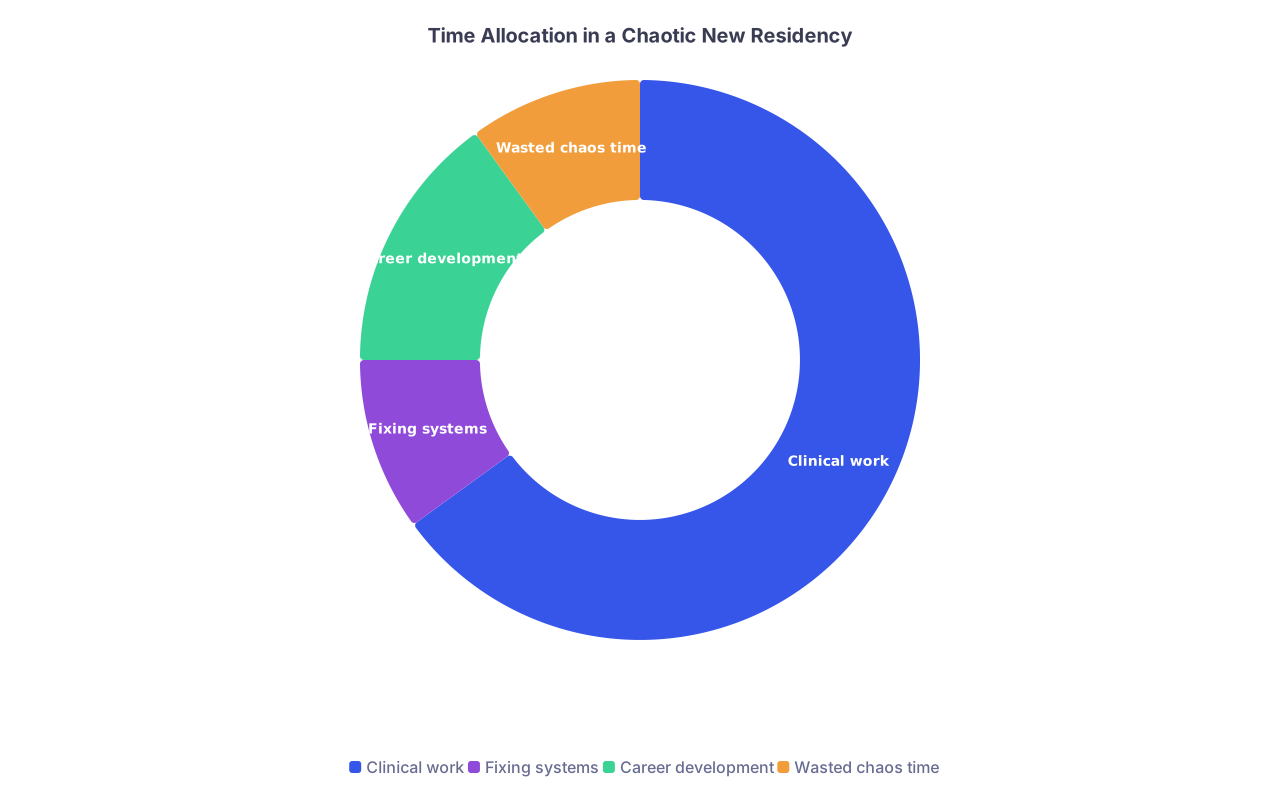
| Category | Value |
|---|---|
| Clinical work | 65 |
| Fixing systems | 10 |
| Career development | 15 |
| Wasted chaos time | 10 |
That’s roughly what your year will look like if you’re smart. Most people let “wasted chaos time” balloon to 25–30%. Don’t.
9. Social Dynamics: Building a Functional Culture Before Bad Habits Cement
By second year of a program, culture is still wet cement. You can still shape it. But you don’t have infinite time.
Focus on a few simple norms in your class:
“No one dies on call alone.”
Translate: we help each other sign out, answer pages, see admits during bad nights. This is how you avoid burnout and errors.“Complain up, support down.”
You vent to your co‑interns, seniors, chiefs, PD—NOT to med students, nurses, or patients about how terrible the program is. That’s amateur hour.“Feedback is normal, not hostile.”
You give each other specific, short, behavior‑based feedback. “Hey, on rounds, you tend to cut off the med student. Maybe let them finish their summary before you jump in.”
Small program? Even more crucial. One toxic person can poison the entire floor.
And don't underestimate the nurses. In a new program, they’re still deciding if residents are help or a liability. Treat them well, ask for their input, and apologize when you’re wrong. That will save you later when systems fail—which they will.
10. Using Institutional Structures: PEC, CCC, GME, and All the Other Alphabet Soup
Most second‑class residents have no clue how the internal machinery works. That’s a mistake.
You should understand three committees:
PEC (Program Evaluation Committee)
- Reviews program quality, makes improvement plans.
- Often has resident members. You want someone from your class there.
- This is where your “log of repeated issues” is gold.
CCC (Clinical Competency Committee)
- Evaluates your performance, determines if you’re progressing.
- Less about fixing the program, more about your career. But knowing their standards helps you focus.
GMEC (Graduate Medical Education Committee)
- Overseeing body for all residencies at your institution.
- Sometimes has resident reps from a “house staff council.” This is where program‑level dysfunction across departments gets addressed.
You don’t need to be on all of these. In fact, don’t. But your class should have:
- One person with a seat at the table (PEC or GMEC ideally)
- One person who’s good at quietly collecting and summarizing issues
- One person who has a working relationship with the PD and can speak frankly without self‑immolating
Those can overlap, but don’t dump all of it on a single martyr.
11. Planning for Exit: What If the Program Really Doesn’t Improve?
Uncomfortable topic, but we need to go there.
Sometimes new programs are just… bad. Not “rough around the edges.” Fundamentally mismanaged.
Red flags that it might be that bad:
- Chronic, documented, ignored duty‑hour violations with no attempt to fix
- Repeated safety events/near misses that leadership minimizes
- Hostile retaliation for honest feedback
- ACGME citations piling up with zero visible action
If you start thinking, “I might need to leave,” do NOT:
- Announce this widely
- Burn bridges on the way out
- Fire off a flaming ACGME complaint before you have a plan
Instead:
- Quietly talk to a trusted attending outside your program (or GME office). Phrase it as, “I’m worried about X/Y/Z, and I’m starting to wonder if this is the right training environment for me. What are my options, realistically?”
- Document, document, document. Dates, incidents, responses.
- Research transfer options (hard, but not impossible—especially in early years of training).
- At the same time, keep fulfilling your duties. You want your evaluations clean in case you do need to jump.
Worst‑case scenario? At least you’ll have a solid story, backed by evidence, when fellowship/job program directors ask, “Tell me about your training environment.”
12. The Upside: What You Get That Mature Programs Can’t Offer
Let me end on the part people forget: there is real upside to being the second class in a new residency program, if you play it right.
You get:
- Access. You’ll interact directly with the PD, chair, and senior leadership way more than you would in a huge, established program. Use that.
- Responsibility. You’ll be pushed into leadership and teaching roles faster. Teach the med students. Mentor the next class. This all shows up beautifully on your CV and in letters.
- Adaptability. You will learn how to function in chaos, improvise systems, and fix problems on the fly. That’s what real life looks like in a lot of hospitals.
- Story. Every fellowship and job interview will ask about your residency. Having a clear narrative of, “I helped build X, Y, Z in a new program” lands a lot better than, “I just went through the standard pipeline.”
Just do not let “I helped build the program” turn into “I sacrificed my own training to patch their holes.”
Balance. Always back to that.

| Step | Description |
|---|---|
| Step 1 | Start PGY1 in new program |
| Step 2 | Observe and document |
| Step 3 | Build relationships with PGY2s |
| Step 4 | Identify top 3 real problems |
| Step 5 | Propose small targeted changes |
| Step 6 | Protect your career goals |
| Step 7 | Decide - Stay and build or plan exit |

FAQ (Exactly 5)
1. How vocal should I be about problems as a second class resident?
Be vocal, but tactical. Bring up concrete, safety‑relevant or education‑relevant issues with specific examples and at least one proposed solution. Avoid constant complaining about minor inconveniences. You want leadership to see you as someone who improves systems, not just vents.
2. Is it a bad sign if the first class is very negative about the program?
It’s a yellow flag, not an automatic red. The first year of a new program is usually brutal. You should listen for patterns: safety concerns, retaliation, complete lack of responsiveness from leadership. If the negativity is mostly about growing pains (chaotic schedules, no lounge, bad food), that’s typical. If it’s about dangerous supervision gaps or ignored duty hours, take it seriously.
3. How do I know if things are bad enough to consider transferring?
Ask yourself:
- Are there ongoing, unaddressed safety issues?
- Are duty hour violations extreme and persistent?
- Is there a culture of retaliation for honest feedback?
- Are you getting adequate supervision and education, not just service work?
If multiple answers are “yes” for months despite you and others raising concerns, it’s time to quietly explore options with a trusted mentor or GME.
4. Can a new residency still get me a good fellowship or job?
Yes—if you’re strategic. Strong letters from respected faculty, solid board scores, clear scholarly work (even small projects), and a compelling narrative about your role in building a new program can absolutely offset the “newness.” Many fellowship directors care more about who is writing your letter and what you’ve actually done than how old your program is.
5. What’s one thing I should start doing in my first month?
Start a simple, private log of issues and wins. Track safety problems, pattern frustrations, and things that actually work well. That log will help you give specific feedback, push for targeted changes, and remind yourself later that some things really did improve—even if it felt slow in the moment.
Key points:
- Treat your role as “co‑architect with self‑preservation,” not martyr or passive victim.
- Be specific, documented, and solution‑oriented when you push for change—and pick only a few high‑impact battles.
- Protect your own training, relationships, and long‑term career while the program grows up around you.