
Residency curricula are not “copied and pasted” from big-name programs. When you build a new residency, you build the rotations almost from zero—and most places get at least one major thing wrong the first time.
Let me walk through how it actually works when a brand-new program designs rotations. Not the glossy brochure version. The real sequence of decisions, compromises, ACGME guardrails, and political landmines.
1. The Ground Rules: ACGME, Service Needs, and Reality
You do not start with “What would be ideal for resident education?” You start with three constraints:
- What the ACGME requires.
- What the hospital desperately needs residents to cover.
- What your physical and human resources can actually support.
The “curriculum from scratch” is basically a puzzle inside those constraints.
Step 1: Read (and re-read) the ACGME Program Requirements
Every specialty has two documents that matter:
- Common Program Requirements (same across all specialties)
- Specialty-specific Program Requirements (IM, EM, FM, Psych, etc.)
These documents dictate, in hard numbers, things like:
- Required clinical experiences (e.g., ICU months, continuity clinic sessions)
- Required minimums/maximums (e.g., no more than X months of one subspecialty)
- Exposure types (inpatient, outpatient, critical care, emergency, night float, etc.)
- Duty hour restrictions (averaging 80 hours per week, time off between shifts, days off)
A new program director will literally sit with a printed copy, a highlighter, and a blank 3-year (or 4-5 year, depending on specialty) template and start marking:
- “At least 6 months of ICU across 3 years.”
- “Continuity clinic 40 weeks per year.”
- “Discrete block of geriatrics.”
- “At least 200 continuity patients in panel.”
- “No more than X months of subspecialty electives.”
Those become fixed “must place” items in the rotation schedule. If you are designing from scratch and you do not build from those requirements, you will be rewriting your curriculum after the first ACGME site visit. I have seen that happen.
Step 2: Map Hospital Service Lines to Educational Requirements
You then overlay: what does your hospital actually have?
For example, a brand-new internal medicine residency at a midsize community hospital might have:
- A general medical floor with 40–60 beds.
- One ICU with mixed medical/surgical patients.
- A busy ED.
- Cardiology, GI, nephrology in-house.
- Limited ID, heme/onc, or endocrinology presence.
- No trauma center, no transplant, limited complex oncology.
You match this against your requirements. Where you have internal capacity, you plan in-house rotations (your ICU, your wards). Where you do not, you must:
- Create affiliate rotations (e.g., send residents to a larger tertiary center for transplant or trauma exposure).
- Use simulation and structured didactics to cover rare but required content.
- Be honest in your curricular design about gaps.
New programs often overestimate what they can “grow into” in the first 3–5 years. The ACGME does not accept “we plan to build an outpatient heme/onc clinic” as a replacement for “we have one now.”
Step 3: Service vs Education: The Uncomfortable Truth
Hospitals start residencies for many reasons. One of them is labor. Residents are cheaper than hospitalists or NPs for night coverage and admit-heavy services.
So the GME office and C-suite will push for:
- Coverage of ED admits.
- Night coverage for wards and ICU.
- Weekend coverage patterns that reduce attending burden.
Meanwhile, the program director has to protect:
- Required educational experiences.
- Time in clinic.
- Diversity of exposure.
- Reasonable call and night float.
New programs are most vulnerable here. The temptation is to design rotations that function like plug-in workforce. That is how you end up with an ACGME citation for “service over education” in year 3.
2. Turning Standards into a Block Schedule
Once the constraints are clear, you start building the block schedule. Most programs use 4-week blocks. A 3-year program has 39 blocks per resident; a 4-year program has 52.
The Process: Year-by-Year Build
You do not design PGY-1 through PGY-3 in parallel at first. You build PGY-1 around:
- Required foundational experiences.
- Hospital needs for interns.
- Supervision capacity.
Then you build PGY-2, then PGY-3, making sure the whole thing is balanced.
A simplified approach a new IM program might use:
PGY-1 priorities:
- Heavily inpatient: wards, ICU exposure, ED.
- Intro to continuity clinic.
- Only selective electives.
- High supervision.
PGY-2 priorities:
- More ICU.
- Supervisory roles on wards.
- Subspecialty consult rotations.
- Still robust continuity clinic.
PGY-3 priorities:
- Senior supervisory roles.
- Subspecialty depth.
- Electives (including away or research).
- Leadership/admin experiences.
Typical First-Pass Block Layout
| Year | Wards | ICU | ED | Clinic + Ambulatory | Subspecialty Rotations | Electives/Research |
|---|---|---|---|---|---|---|
| PGY-1 | 8 | 2 | 2 | 3 | 2 | 0–1 |
| PGY-2 | 6 | 3 | 2 | 3 | 3 | 1–2 |
| PGY-3 | 4 | 2 | 1 | 3 | 4 | 3–4 |
You then translate this into specifics: Which ward? Which ICU? Which attending group? Which clinic?
And you quickly hit your next bottleneck: faculty and site capacity.
3. Faculty, Sites, and Political Battles
You cannot design rotations in a vacuum. Every month of every rotation must have a real place for residents to go, with:
- Enough patient volume.
- Enough teaching faculty.
- Clear supervision lines.
- Physical space (workrooms, computers, call rooms).
Faculty Capacity: The Hard Ceiling
Say your telemetry / general medicine service can safely handle 3 admitting teams. Your faculty group can supervise 2 residents and 1 intern per team. That is 6 residents + 3 interns per block on that service.
If your PGY-1 schedule sends 8 interns and 4 PGY-2s to wards each month, you have a problem.
So curriculum planners do a “position map”:
- Count how many residents per year (e.g., 8 per class = 24 total when full).
- Define max team sizes for each service.
- Create a matrix of “slots” per rotation per block.
Only then can you assign blocks in a way that does not overwhelm any single service. This is where many shiny first-draft curricula die. On contact with the census and the hospitalist group.
Politics: Who Gets Residents, and When
Everything you add has a constituency:
- Hospitalists want residents on wards for throughput and admissions.
- ICU wants residents for procedures and coverage.
- ED wants residents to move patients and handle boarding.
- Subspecialists want residents to grow referral pipelines.
- Clinic leadership wants continuity and volume.
A brand-new residency program leadership team spends months in meetings like:
- “We cannot take residents every month; our clinic volume is seasonal.”
- “We need at least two residents per night on ICU call for this to be safe.”
- “If residents are in clinic Wednesday afternoons, we must shift didactics.”
Rotations are built at the intersection of these negotiations. That is why, at many new programs, the first version of the schedule looks more like a political compromise than an educational ideal.
4. Structuring Specific Rotations: From Idea to Reality
Now down to the level that actually affects residents: how a single rotation is designed.
Example: Inpatient Wards Rotation
Take a new IM program designing its core wards rotation. Key decisions:
Team structure:
- 1 attending, 1 senior, 2 interns, 1 student?
- Or 1 attending, 2 PGY-2/3, no interns initially because you are brand new?
Cap and census:
- Max 16 patients per team? 20? Cap per intern vs per team?
- Admit cap: how many admissions in 24 hours?
Call model:
- Traditional q4 call? (Less common now.)
- Night float system? Multiple shifts with “short call” and “long call”?
- Strict adherence to 80-hour workweek and 1-in-7 days off.
Educational structure:
- Daily sit-down teaching?
- Protected 1-hour morning report?
- Integration with subspecialty consults for teaching?
New programs get scrutinized on this. Surveyors will ask: Is the wards month:
- Educationally coherent?
- Safe regarding supervision?
- Reasonable in workload?
The rotation description in the accreditation application needs real structure: day-by-day or hour-by-hour expectations, not hand-wavy “residents round and admit patients.”
Example: ICU Rotation
ICU is a high-risk area. New programs are rightly nervous here.
Key build questions:
- Are residents primary, or is there an advanced practice provider (APP) team with residents shadowing initially?
- Who does procedures: residents, fellows, attendings?
- What is the resident-to-bed ratio?
- Is there a 24/7 in-house intensivist, or remote tele-ICU at night?
A brand-new residency rarely launches with residents as the main ICU workforce on day 1. More often:
- Year 1: Residents rotate as an extra layer with strong attending or fellow presence.
- Year 2–3: Residents take on more primary responsibility, with structured supervision.
Program leadership will often overbuild educational content here (daily checklists, structured teaching topics, procedure logs) because ICU complications are what land you in the ACGME’s crosshairs quickly.
5. Ambulatory, Continuity, and the “Clinic Problem”
Most new residencies underestimate the complexity of building outpatient curricula.
ACGME requirements for continuity clinic are strict:
- A set number of half-day clinics per week.
- Minimum number of patient encounters.
- Longitudinal continuity with the same patient panel.
New programs must:
- Create or expand a resident clinic space.
- Ensure enough preceptors with appropriate qualifications.
- Build scheduling systems for panels, follow-ups, and same-day sick visits.
The practical issues that derail things:
- EMR access and “resident as PCP” status.
- Who closes charts, handles inbox messages, refills?
- What happens to continuity when residents are on ICU or nights?
A common (and bad) early mistake: Making clinic too sporadic or letting service-heavy months “eat” clinic time. Then you have residents with tiny panels and weak ambulatory skills, and you fail both your educational mission and your ACGME continuity metrics.
Newer, smarter programs:
- Use “X+Y” models (e.g., 4 weeks inpatient + 1 week ambulatory) so clinic weeks are fully protected.
- Or heavily protect one half-day per week, even on busy rotations, with real back-up coverage.
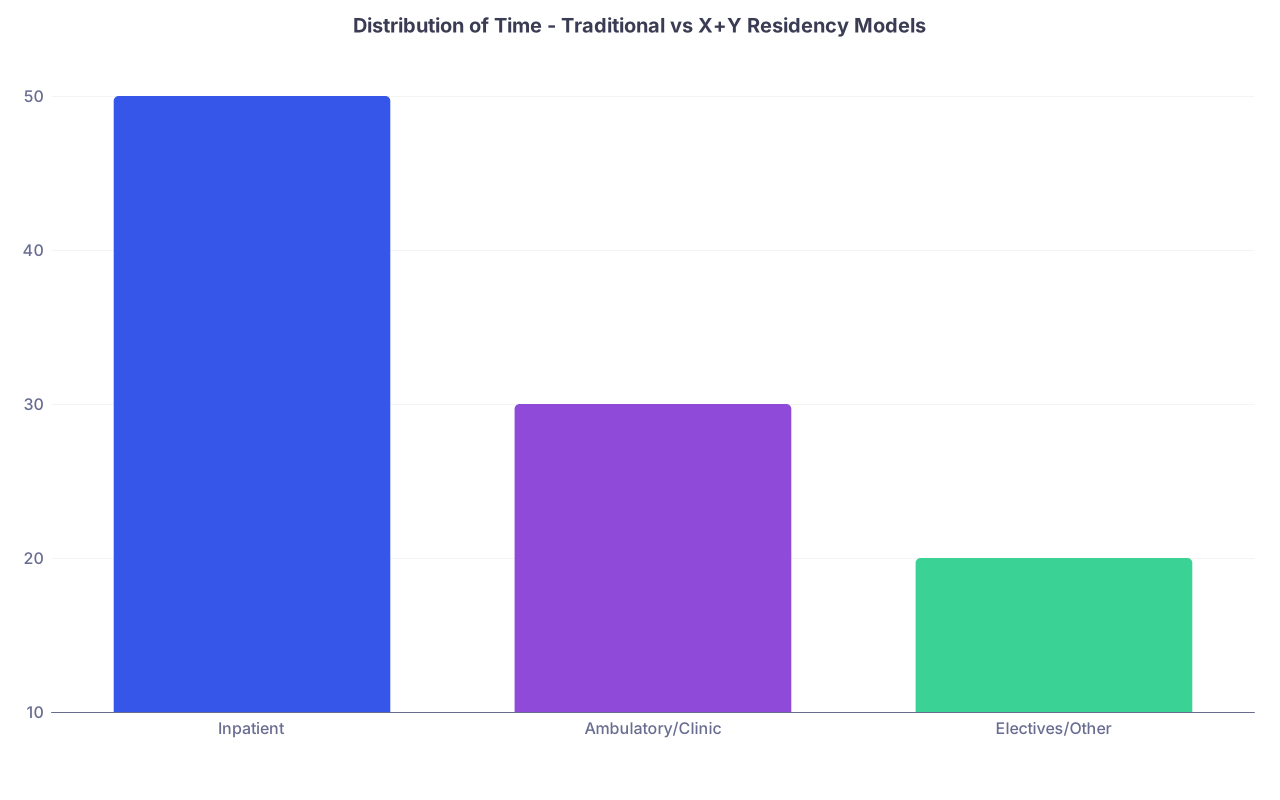
| Category | Value |
|---|---|
| Inpatient | 50 |
| Ambulatory/Clinic | 30 |
| Electives/Other | 20 |
(Think of this bar chart as a rough 3-year distribution; new programs tweak the proportions, but the tension between inpatient service and clinic is universal.)
6. Night Float, Call, and Coverage Models
You cannot build rotations without addressing nights. This is where resident burnout gets engineered—either avoided, or baked in.
Options new programs consider:
Traditional 24-hour call:
- Now used sparingly in most specialties.
- Heavy fatigue risk, but simpler to schedule.
Night float:
- A resident (often PGY-2+) covers nights for one or more services for a week or two at a time.
- Predictable; easier to enforce duty hours.
- Must balance continuity and education—night float can be purely service if you are not careful.
Hybrid:
- Modified 16-hour shifts.
- Separate cross-cover and admission shifts.
New programs often overshoot with night float, making it:
- Too long (e.g., 4 weeks at a time with minimal time off).
- Too broad (one resident covering wards + ICU + cross-cover calls).
- Too disconnected from daytime learning.
A more thoughtful build:
- Shorter blocks (1–2 weeks).
- Explicit ICU night vs ward night coverage separation.
- Required sign-out teaching sessions, not just hand-offs.
Duty hours are policed heavily in the first few years of a new program. If your schedule on paper “works” only because you are assuming 90-hour weeks and no post-call days, you are heading straight for citations.
7. Electives, Fellowships, and the “Pipeline” Question
New programs face a philosophical question: Do we train broad generalists, or do we intentionally build tracks that feed into fellowships?
Most new residencies start general. But thoughtful leaders plant seeds for future differentiation:
- Create elective slots early, even if you cannot fill them all optimally at first.
- Partner with regional fellowship programs (cards, GI, heme/onc, critical care) for away electives.
- Build at least one “advanced” rotation in core areas (e.g., advanced heart failure, inpatient oncology, high-risk OB, complex psych).
Early residents will test these structures. After 2–3 cohorts, you see patterns.
For example:
- New IM program notices 40% of residents want critical care or pulm.
- They respond by adding a second ICU site elective, a bronchoscopy exposure, and a more robust ultrasound curriculum.
Curriculum is not static. A new program that locks its rotations and refuses to adjust to resident interests will become uncompetitive quickly.
8. Simulation, Didactics, and Filling the Gaps
New programs almost always have curricular gaps that cannot be filled with real-world volume on day one. This is where simulation and structured didactics become essential.
Areas frequently propped up by sim and formal sessions:
- Code leadership and ACLS.
- Rare procedures (chest tubes, central lines in low-volume settings, cricothyrotomy).
- Obstetric emergencies in non-OB-heavy hospitals.
- Pediatric emergencies in adult-focused systems.
- Disaster medicine, mass casualty, toxicology.
Rotations are augmented with:
- Monthly simulation half-days linked to rotation themes.
- Case-based conferences.
- Morbidity and mortality (M&M) conferences that explicitly tie back to resident cases.
- Board review sessions built into protected didactic time.
A well-designed new residency will treat didactics and sim as integral rotation components, not add-ons. For example:
- ICU month includes mandatory weekly procedure workshops.
- Clinic block includes behavioral health integration modules and social determinants of health sessions.
9. The Iteration Cycle: Year 1 vs Year 3 vs Year 5
The most honest thing I can tell you: The “curriculum from scratch” you launch with will not be the curriculum you have in 3–5 years. Nor should it be.
Programs that succeed build in a feedback and iteration loop from day one.
How the Feedback Actually Flows
Real-world mechanisms:
- End-of-rotation evaluations (residents evaluating rotations and faculty).
- Program Evaluation Committee (PEC) meetings annually, reviewing the entire curriculum.
- Resident town halls or retreats where the chief residents collect specific, actionable complaints.
- ACGME annual resident survey—especially items about:
- Workload / duty hours.
- Educational value of rotations.
- Supervision and safety.
The first cohort of residents in a new program is brutally honest. They have no prior baseline and no loyalty to “how it has always been done.” They will say:
- “This ED month is 100% scut and no teaching.”
- “Night float is destroying our continuity clinic patients.”
- “The geriatrics rotation is just a renamed wards month.”
Good leadership listens and adjusts.
How Rotations Change Over Time
Typical changes between year 1 and year 3:
- Reducing time on bloated, service-heavy rotations (e.g., shaving a month off wards).
- Expanding high-yield experiences (e.g., more ICU, more dedicated ambulatory blocks).
- Redistributing night coverage (e.g., adding a second night resident, spreading out night float).
- Reframing underused rotations into something sharper (e.g., turning “random consult month” into a structured “perioperative medicine” rotation).
By year 5, most strong programs have:
- Clarified pathways (e.g., hospitalist track, ambulatory track, academic track).
- More electives, including research months if they have developed a scholarly culture.
- A rotation schedule that looks less like “we had to cover all these services” and more like an intentional educational design.
10. The Future: How New Programs Are Designing Differently
New residencies launching now are not just copying 1990s-style block schedules. Several trends are reshaping how rotations get built from scratch.
Shift Toward Longitudinal and Integrated Models
Instead of siloed blocks:
- Longitudinal clinic models (X+Y scheduling).
- Longitudinal experiences in geriatrics, palliative care, addiction medicine, quality improvement.
- Integrated behavioral health within ambulatory rotations rather than standalone, token months.
New programs design rotation sequences that consistently expose residents to:
- Social determinants of health.
- Population health management.
- Team-based care with pharmacists, social workers, and behavioral health.
This changes rotations like “clinic” from being just primary care visits to being a hub for panel management, QI projects, and interprofessional work.
Competency-Based and EPA-Driven Rotations
ACGME Milestones and Entrustable Professional Activities (EPAs) are not just buzzwords. Smart new programs design rotations backwards from competencies:
- “On this ICU month, residents must reach at least Level X in ventilator management and line placement.”
- “On this ambulatory block, they must demonstrate panel management, chronic disease optimization, and appropriate use of telehealth.”
Rotation evaluations then tie to those competence targets. Not just vague “Resident was good; would work with again.”
Incorporating Telemedicine and Non-Traditional Sites
Future-oriented new programs are not constrained to hospital walls:
- Telehealth continuity clinics.
- Home visit rotations with hospital-at-home teams.
- Community-based rotations with FQHCs, addiction treatment centers, and homeless outreach.
Designing from scratch is an opportunity. Legacy programs often have to retrofit telehealth and community rotations into ossified schedules. New residencies can build them in from day one.
11. What Residents Actually Feel in Year 1 of a New Program
From the resident side, all of this planning shows up as:
- Rotations that sometimes feel “still under construction.”
- Attendings and chiefs tinkering with schedules mid-year.
- Moments where service needs spike and the educational plan wobbles.
You will see:
- Emails saying, “We are adjusting next block’s night coverage pattern.”
- A hastily created “transition-of-care rotation” that used to be called “float.”
- Faculty figuring out how to teach efficiently while learning their own roles.
This is not automatically bad. Being first cohorts means:
- You can push hard on fixing broken rotations.
- Your feedback actually changes the curriculum.
- You often get more direct attention from program leadership than you would at a legacy giant.
But it is not as “pre-baked” or polished. New programs building curriculum honestly admit this, and recruit residents who want to help build rather than just consume.
12. The Core Takeaways for How New Residencies Really Design Rotations
Let me strip it down.
Rotations are built on ACGME rules, hospital service needs, and capacity limits. Anyone pretending they started with a blank canvas is skipping the part where the C-suite and requirements shape everything.
The first curriculum is a prototype, not a finished product. Smart programs plan for revision, build feedback loops, and adjust rotations quickly in the first 3–5 years.
The programs that age well design for the future, not the past. They integrate ambulatory care, community sites, simulation, telehealth, and competency-based goals from the ground up, instead of just recreating “wards-heavy” schedules with prettier fonts.
If you understand those three points, you understand how curricula are really built from scratch—and how to tell whether a “new” program has done the hard thinking, or just rearranged call schedules and hoped for the best.