It is late January. Interview season is winding down, your spreadsheet has 18 tabs, and one of them is labeled “New Programs (???)”. You are looking at a shiny new residency that just got ACGME accreditation. The website lists three “core faculty” with stock headshots, generic bios, and not much else.
You are trying to answer one question:
Is this a real training environment or a PowerPoint project?
Let me break down exactly what serious applicants actually look for in core faculty when they evaluate new residency programs—and what the ACGME really expects those core faculty to be doing behind the scenes.
1. What “Core Faculty” Actually Means (Not What Marketing Says)
“Core faculty” is not just whoever shows up to noon conference.
ACGME uses the term very specifically: these are the people formally responsible for the design, implementation, and ongoing evaluation of the residency program. They are the backbone of your education and the ones ACGME will hold responsible when things fall apart.
At minimum, serious applicants expect:
- Enough core faculty
- The right mix of backgrounds and training
- Real engagement in teaching and supervision, not just names on a form
ACGME has slightly different counting rules by specialty, but the themes are constant.
Typical expectations (roughly):
- Family Medicine: At least 3 core faculty plus PD, majority full-time at the main clinical site.
- Internal Medicine: A robust core group (commonly 5–7+) with protected time and active teaching roles.
- EM, Surgery, OB/GYN, Psych: Enough faculty to cover clinical services without drowning, while still providing protected teaching time and evaluation.
For new programs, the question is not just “Do they meet the minimum?”
The real question: “Does this core faculty group look like they can create and sustain a functional training ecosystem over the next 5–10 years?”
That is what serious applicants are quietly judging.
2. The Non-Negotiables: Numbers, FTE, and Actual Availability
When you look at a new program’s website and their core faculty list, you should be mentally running a quick feasibility check.
A. How many core faculty, and is it believable?
If you see:
- 1 Program Director
- 1–2 Associate / Assistant Program Directors
- 3–5 additional core faculty
…for a brand-new small program (say 6–8 residents per year), that is reasonable.
If you see:
- PD
- “Core Faculty” = 2 other people
- Class size = 10 residents per year
That is a red flag. The math on supervision, feedback, evaluations, remediation, curriculum design, and QI oversight does not work without people burning out quickly.
| Category | Value |
|---|---|
| Safe | 6 |
| Borderline | 4 |
| Concerning | 2 |
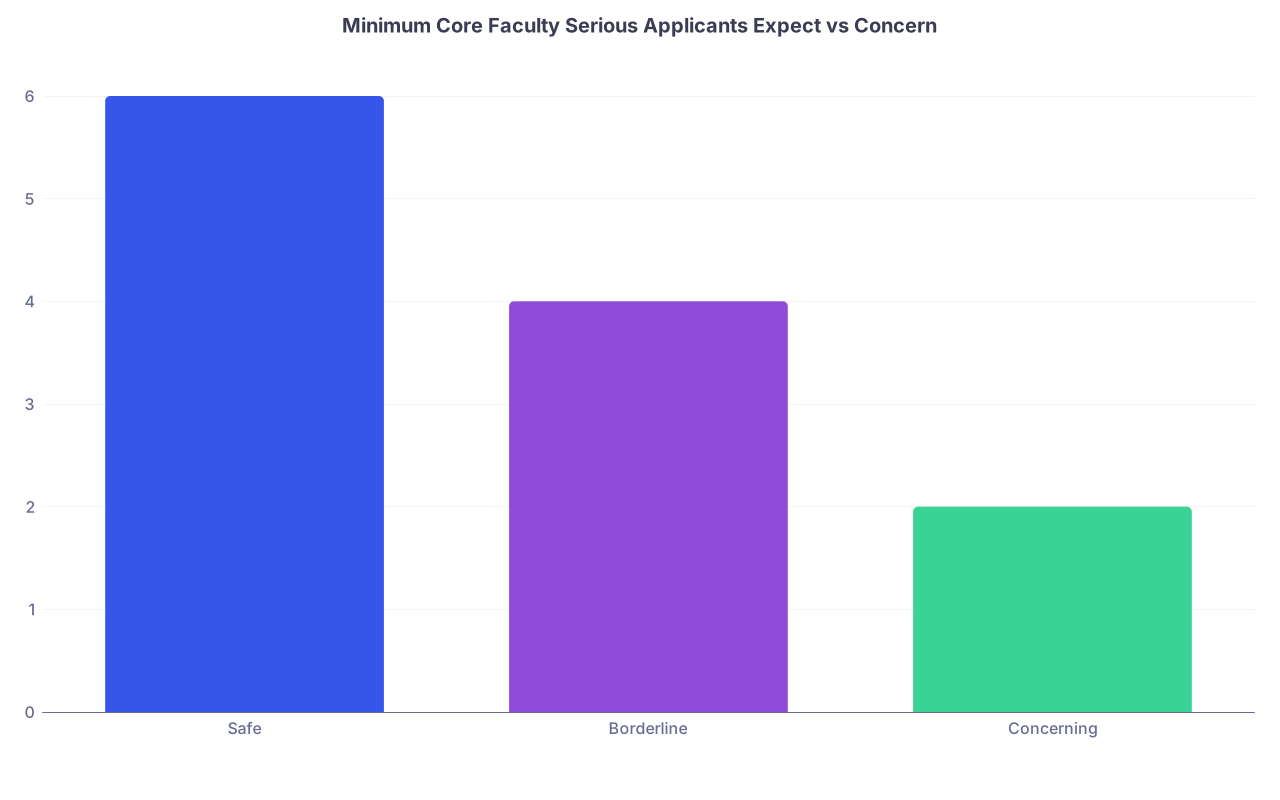
Interpretation here: for most core specialties, applicants feel comfortable when they see ~6+ engaged faculty, nervous around 4, and very worried below that unless there is a clearly explained model (e.g., strong hospitalist or group practice model with many involved non-core faculty).
B. FTE and protected time
One of the most under-discussed issues in new programs: “protected time” is often fantasy on paper and chaos in practice.
What you want to know:
- Does the PD have at least 0.5 FTE (or the specialty’s required minimum) for program duties?
- Do associate PDs and core faculty have documented educational time?
- Or is everyone “0.05 FTE for education” plastered on a 1.2 FTE clinical template?
You will not see FTE numbers on the website. But you can detect the reality by asking targeted questions:
Ask the PD directly:
“Roughly what percentage of your time is non-clinical and dedicated to residency?”
“Do your core faculty have protected time for supervision, feedback, and curriculum work, or is that mainly layered on top of clinical shifts?”
If the answers are vague, defensive, or “We are working on that with administration,” that is a warning sign.
C. Physical presence in your actual training environment
Another common trick in new programs: listing core faculty who are technically affiliated but not consistently present.
You want to see most core faculty:
- Physically on-site at your main hospital/clinic
- Regularly present on your bread-and-butter rotations
- Available during weekdays for teaching, feedback, and meetings
If half the “core faculty” are part-time telemedicine, off-site researchers, or rarely on the ward teams—you will feel that gap on call at 2 AM.
3. Qualifications That Actually Matter (And What You Can Ignore)
Not all lines on a CV are created equal. You are not applying to be their co-author; you are applying to be their trainee.
Here is how I rank what matters in core faculty for a new program.
A. Clinical competence and local credibility
If core faculty are not respected clinically within the hospital, your life will be harder. You pick this up in subtle ways:
- How nurses and pharmacists talk about them.
- How consult services respond when your attending’s name is on the note.
- Whether they get called for difficult cases or avoided.
On interview day or a second look, watch dynamics:
- Are faculty actually engaged in rounds or silently charting?
- Do they know the residents’ strengths and weaknesses by name?
- Does the rest of the hospital seem to defer to them on teaching and policy?
B. Educational track record
For a brand-new program, this is one of the highest-yield signals.
Look for evidence that at least some core faculty:
- Previously taught residents or medical students at another institution.
- Held roles such as APD, clerkship director, site director, simulation lead.
- Have prior GME committee work (CCC, PEC, GMEC) at another institution.
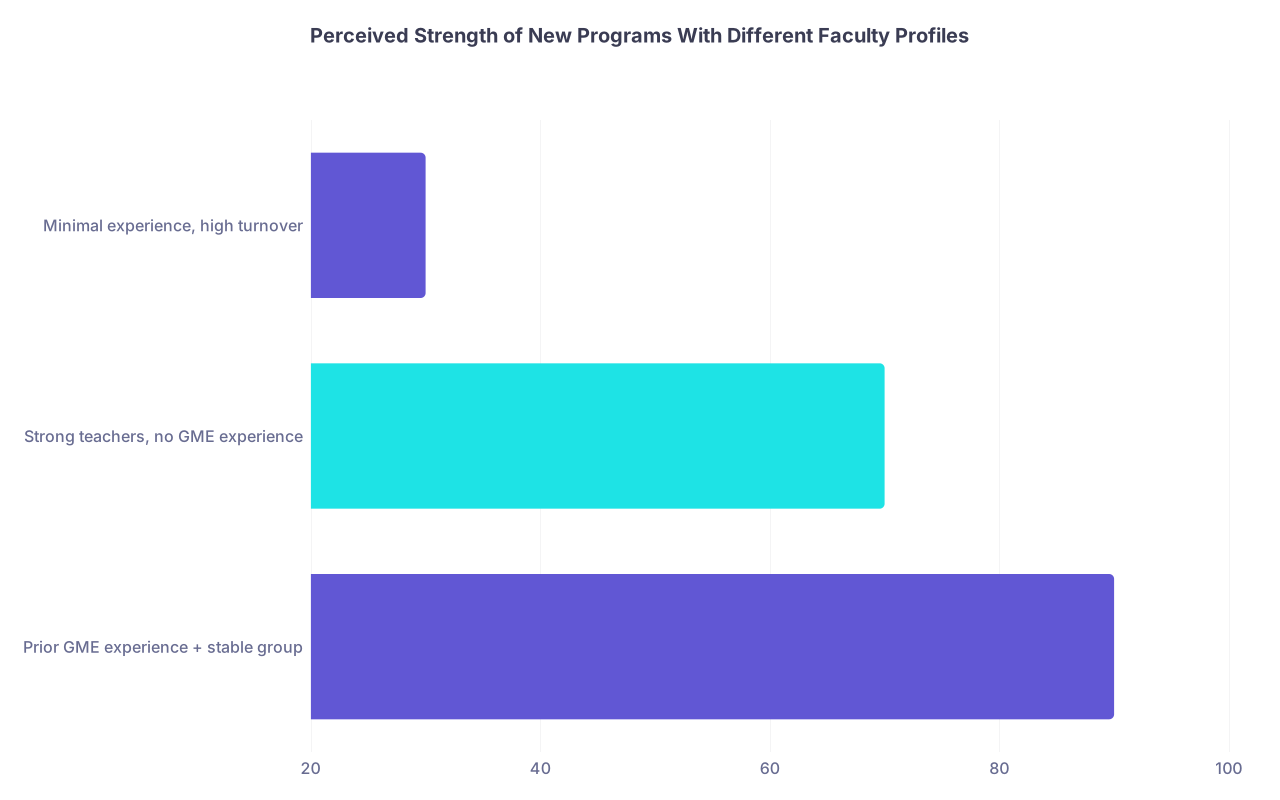
If the PD and most core faculty are all new to formal teaching, with no prior GME track record, you are signing up for them to learn the basics of residency education while you are already in the system. Some people do this well. Many do not.
That said, do not confuse “fancy” with “effective.” A PD who ran med student rotations for 8 years and is known as a great teacher at a mid-tier hospital may give you a far better training environment than a brand-new PD with a big-name fellowship and zero GME experience.
C. Scholarship: useful vs performative
You will see buzzwords: “scholarship,” “QIPS,” “educational research,” “national presentations.”
For your purposes in a new program, you care about three things:
- Do residents actually have accessible projects to join?
- Are there faculty who can realistically help you get a poster or paper done in 3 years?
- Does the scholarship track record include trainees as co-authors?
| Signal | Interpretation for Applicants |
|---|---|
| Multiple trainee co-authors | Strong mentorship culture |
| First-time faculty-only projects | Early build stage, mentorship unproven |
| QI with real hospital impact | Good opportunities for resident projects |
| Only basic science, no clinical | Harder for most residents to join |
Do not obsess over impact factor. Focus on whether residents are integrated in the work. A faculty member with 20 papers and zero trainee co-authors is telling you something.
4. Governance and Roles: Who Actually Runs This Thing?
Programs live or die on structure. A new program with “strong leadership” on paper but unclear division of responsibility will have growing pains that land directly on you.
A. Program Director (PD): required reality checks
For a new program, I strongly prefer PDs who:
- Have prior residency or fellowship leadership experience, OR
- Have at least several years of active teaching plus visible involvement in committees, education, or curriculum work.
Ask the PD:
- “What did you learn from your prior roles that you are applying here?”
- “What are the top 2–3 lessons you picked up from visiting other programs while designing this one?”
If they cannot answer in concrete terms, that is not a good sign. I have yet to see a strong program where the PD cannot articulate specific design choices they deliberately copied or rejected from other sites.
B. Associate / Assistant PDs: not just titles
You should see one of two patterns:
- PD + 1–2 APDs with clear portfolios (e.g., curriculum, wellness, evaluation, recruitment), or
- PD with a strong core faculty group where responsibilities are explicitly divided (e.g., “Dr. X runs CCC, Dr. Y manages scholarly activity, Dr. Z is simulation director”).
Ask:
- “Who runs the CCC?”
- “Who is the go-to for remediation or struggling residents?”
- “Who is your scholarly activity point person?”
If the PD answers “we all share those responsibilities,” that usually means no one has ownership and things will slip.
C. Core Faculty vs “teaching” vs “participating” faculty
New programs love inflating their faculty numbers by listing everyone who has ever staffed a clinic or supervised a student.
Here is the hierarchy that matters:
- Program leadership: PD, APDs
- Core faculty: formally appointed with educational responsibilities, evaluation roles, meeting attendance
- Key teaching faculty: regular ward attendings, continuity clinic preceptors, subspecialty educators
- Peripheral faculty: occasional preceptors, off-service supervisors
You care that the core and key teaching faculty group is large and stable enough to routinely see you, evaluate you, and advocate for you in CCC.
If the program leans heavily on peripheral community preceptors with little connection to the residency, feedback and advocacy for residents tend to be weaker.
5. ACGME Requirements: What’s On Paper vs What You Can Infer
You are not going to sit down and read every Program Requirements PDF. But I will pull out the parts about core faculty you can translate into real-world questions.
Common ACGME themes regarding core faculty:
They must participate in:
- Resident supervision
- Teaching
- Evaluation
- Scholarly activity
- CCC/PEC and program improvement
There must be enough core and teaching faculty to:
- Provide adequate supervision and case exposure
- Maintain duty hour compliance
- Support program curriculum and conferences
PD must have protected time and core faculty support.
Here is how to convert those into practical interview-day checks.

| Step | Description |
|---|---|
| Step 1 | Check Faculty List Online |
| Step 2 | High Risk - Few Faculty |
| Step 3 | Review Backgrounds |
| Step 4 | Ask PD About Training Plan |
| Step 5 | Ask Specific Role Questions |
| Step 6 | Potential Chaos |
| Step 7 | More Stable Structure |
| Step 8 | Enough Names? |
| Step 9 | Prior GME Experience? |
| Step 10 | Clear Division of Duties? |
You are trying to answer:
- Are there enough people?
- Do they have any idea what they are doing educationally?
- Is anyone actually in charge of specific core functions?
If you walk away still unsure of those three, that is your answer.
6. Red Flags in New Programs’ Core Faculty Lineup
Let me be blunt. Here are the patterns that consistently correlate with trouble.
A. PD with minimal time and vague support
You hear:
- “My clinical schedule is busy, but I make it work.”
- “We are still building out faculty roles.”
- “Administration is very supportive; they said they will give us what we need.”
Translation: they do not have the resources yet and are hoping it will work itself out after the first residents arrive.
B. Faculty stretched across too many sites
You see:
- Faculty based at multiple hospitals 30–60 minutes apart
- Lots of “affiliate” and “adjunct” titles
- Core faculty with major parallel roles (e.g., hospital CMO, system-level admin, full-time intensivist elsewhere)
The problem is not prestige. The problem is bandwidth. If everyone is split between obligations, no one is fully available to handle resident-level issues promptly.
C. No clear education identity
Ask three different faculty: “What makes this program’s education model distinct?”
If you get three unrelated answers, like:
- “We are community-based.”
- “We really emphasize wellness.”
- “We are research focused.”
…then no one has actually aligned around a coherent training philosophy yet.
Strong programs—even new ones—have faculty that answer in converging ways:
- “We intentionally built a high-volume, hands-on environment with strong procedural experience from day one.”
- “We designed this to combine community autonomy with academic-level didactics.”
If there is no clear identity, you will be the beta test for their trial-and-error phase.
D. Faculty turnover before first graduation
This one is subtle but damning.
If you are interviewing and already hear about:
- Replaced PD within first 1–2 years
- Multiple core faculty who “had other opportunities”
- Fragmented or nostalgic talk about “how we planned it initially”
That is a serious concern. Faculty leave for many reasons, but high churn in the core group early on is usually about conflict with administration, workload, or unrealistic promises about support.
7. Green Flags: What Strong New Programs’ Core Faculty Look Like
There are new programs that are absolutely worth a top ranking. They almost always share a few traits in their core faculty.
A. PD with a specific, credible blueprint
When you ask “How did you design this program?” they answer with specifics:
- “We borrowed the X rotation structure from [established program], but changed Y to fit our patient population.”
- “We built in protected half-days for resident longitudinal QI, mentored by Dr. Smith and Dr. Lee.”
- “Our didactic structure parallels [known program] where I used to teach, but with more simulation time in PGY-1.”
That tells you they understand what works elsewhere and are not improvising everything from scratch.
B. Faculty that already functioned as an informal teaching group
Many strong new programs are built where:
- The hospital already had a decent teaching culture with med students or off-site residents.
- The core faculty group has been co-teaching for years.
- They know each other’s styles and have already done quality projects together.
You can pick this up when residents (or even nurses) say things like:
- “Even before we had our own residents, Dr. X and Dr. Y were always the ones people sent students to.”
- “They have been running mock codes and M&M for years; the residency just formalized what was already there.”
C. Visible investment in education infrastructure
I look for:
- Real resident workrooms
- Conference space that is not just a hallway corner
- Documentation of CCC, PEC, and evaluation systems already in use
- Sim center access or at least some structured hands-on training resources
Often this shows up in how core faculty talk:
“We fought hard with admin to get this dedicated conference block and we protect it heavily.”
That is what you want. People who have already gone to war for your education.
| Category | Value |
|---|---|
| Prior GME experience + stable group | 90 |
| Strong teachers, no GME experience | 70 |
| Minimal experience, high turnover | 30 |
8. How to Actually Investigate Core Faculty as an Applicant
Let us get tactical. Here is how a serious applicant quietly audits core faculty quality.
Step 1: Pre-interview web review
You should be doing this:
- Pull all core faculty bios.
- Note: prior institutions, roles, fellowship training, scholarly activity.
- Look for repeated institutions (sign of prior collaboration) and prior GME roles.
You are asking: Is there at least a core of people with genuine prior teaching experience?
Step 2: Use the interview day strategically
Targeted questions for PD:
- “How many core faculty do you have, and how often do they meet as a group?”
- “What committees do your core faculty run—CCC, PEC, QI?”
- “What protected time do you and your core faculty have for educational work?”
Targeted questions for faculty:
- “What part of the residency curriculum are you personally responsible for?”
- “How often do you meet with residents one-on-one?”
- “What projects have residents done with you in the last year?”
Targeted questions for residents (or med students if the program is very new):
- “Who actually shows up to teaching?”
- “If a resident is struggling, who really handles it?”
- “Who would you go to if you had a serious concern about your training?”

Step 3: Pattern recognition after 3–4 interviews
By your 4th or 5th interview, you will notice the differences:
- Established programs: PD and faculty answer in consistent, structured ways.
- Strong new programs: slightly rough edges, but clear vision and engaged core faculty.
- Weak new programs: inconsistent answers, vague roles, overpromising with no operational detail.
Trust that pattern. If a program sounds “good” in glossy terms but cannot answer detailed questions about core faculty roles or protected time, your training will be improvised.
9. Where New Programs Can Actually Outperform Legacy Ones
I will give new programs this: when built well, their core faculty can sometimes be more accessible and invested than at big-name legacy programs.
Advantages you might see:
- Core faculty hungry to prove themselves, going the extra mile for resident education.
- Faster adoption of modern teaching methods (simulation, structured feedback, competency-based milestones).
- Less bureaucracy in changing schedules or trialing new electives.
I have seen residents at well-designed new programs graduate with:
- More procedural volume than some “elite” academic centers.
- Closer relationships with PD and core faculty.
- Stronger, more personalized mentorship because the faculty know every resident extremely well.
The difference is not “new vs old.” It is “coherent, staffed, and honest vs aspirational, understaffed, and chaotic.”
FAQ (Exactly 4 Questions)
1. How many core faculty should a serious applicant expect in a brand-new residency program?
For a small new categorical program starting with 6–8 residents per class, I would be comfortable when I see a PD plus at least 4–6 engaged core faculty with defined roles. That does not include every attending who occasionally teaches. If the entire core faculty list is three people and they are covering heavy clinical loads, that is a structural risk.
2. Is it a problem if none of the core faculty have prior residency program leadership experience?
It is not automatically disqualifying, but it raises the bar for how organized they need to be now. If no one has prior PD/APD/CCC experience, then you want to see clear systems, mentors from outside institutions, and evidence they have studied other programs closely. New leadership plus no structure usually means you will live through their learning curve.
3. How much should I care about research output when evaluating core faculty at a new program?
Care less about raw output and more about whether trainees are involved. One faculty member with 4–5 resident co-authored projects per year is more valuable to you than someone with 50 solo publications. For most core specialties, you mainly want accessible QI, clinical, or educational projects with realistic timelines and support.
4. What is the single biggest core-faculty red flag in a new program?
A PD who cannot clearly describe how faculty time is protected and how responsibilities are divided. If they cannot tell you who runs CCC, who leads scholarly activity, who owns simulation, and how often the core faculty meet, your life will be dominated by disorganization. That chaos hits residents first and hardest.
Key takeaways:
- Do not just count names on the website; ask if there are enough engaged core faculty with time and defined roles.
- Prior GME experience and visible structure in CCC, PEC, and curriculum design are strong positive signals in new programs.
- Use your interviews to probe how faculty actually function day to day—vision, availability, and honesty matter more than glossy promises.