
The biggest misunderstanding about ACGME Initial Accreditation is this: brand‑new programs think it is mostly about paperwork. It is not. It is about whether you look, feel, and function like a real residency from day one.
Let me break this down specifically.
What “Initial Accreditation” Actually Is (And Is Not)
ACGME Initial Accreditation is the probationary driver’s license of residency programs. You are allowed on the road. You are being watched very closely.
Here is the core structure:
- Programs start as “Pre‑Accreditation” while their application is under review.
- If the Review Committee (RC) approves, they grant “Initial Accreditation.”
- Only after a few years of outcomes data (graduation, board pass rates, ACGME surveys) can a program move to “Continued Accreditation.”
No one at ACGME expects a brand‑new residency to be perfect. What they expect is:
- A coherent educational design that actually follows the relevant Program Requirements.
- Evidence you have the inputs to make it work (faculty, patient volume, resources).
- A functioning Clinical Learning Environment that will not wreck resident education.
- A real assessment and improvement system, not a binder of policies you never use.
If your mindset is “we’ll fix that once we have residents,” you are already behind.
How New Programs Get Evaluated: The Actual Pipeline
Let’s walk through what really happens to a new residency from idea to Initial Accreditation.

| Step | Description |
|---|---|
| Step 1 | Concept and Sponsoring Institution |
| Step 2 | Institutional Approval |
| Step 3 | ACGME ADS Application Submitted |
| Step 4 | Review Committee Screening |
| Step 5 | Request Revisions or Clarifications |
| Step 6 | Accreditation Site Visit |
| Step 7 | Site Visit Report Compiled |
| Step 8 | Review Committee Decision Meeting |
| Step 9 | Initial Accreditation |
| Step 10 | Revisions or Reapplication |
1. Sponsoring Institution and institutional accreditation
You cannot get program accreditation without a properly accredited Sponsoring Institution (SI).
That SI must have:
- Current ACGME Institutional Accreditation.
- A functioning GMEC (Graduate Medical Education Committee).
- A Designated Institutional Official (DIO) who actually knows what they are doing.
If your hospital is just now pursuing ACGME Institutional Accreditation, your program will be scrutinized harder. RC members know that institutions new to GME underestimate the infrastructure required.
2. Application in ADS: the “story” of your program
You submit the program application through ADS (ACGME’s Accreditation Data System). This is not a formality. The RC reads it carefully. Line by line.
You must describe, with specifics:
- Program aims.
- Curriculum and block rotations.
- Clinic structure (if applicable).
- Faculty roster and qualifications.
- Evaluation and CCC processes.
- Scholarly activity environment.
- Duty hour monitoring.
If your answers are generic (“Residents will see a variety of patients in multiple settings”), reviewers immediately know you copy‑pasted and have no operational details.
3. Pre‑site visit RC screening
Before anyone flies out:
- The RC, or reviewers for that RC, look at your ADS application.
- They flag major deficiencies: missing rotations, insufficient faculty, unclear oversight.
At this stage they can:
- Ask for clarifications or revisions.
- Defer scheduling a site visit until obvious gaps are fixed.
- In rare cases, effectively tell you “not ready” without a visit.
Programs that treat this like a rubber stamp get burned.
4. The accreditation site visit
Once the RC is satisfied enough to proceed, ACGME’s site visit staff schedule a site visit.
Key points that many new PDs misunderstand:
- The site visitor is not your enemy and not your friend. They are a fact‑finder.
- They do not decide accreditation status. They write a structured report for the RC.
- They will compare what you say on visit day to what is written in your ADS application and what exists in your hospital.
You will have:
- A Program Director (PD) interview.
- Faculty leadership interview(s).
- Institutional leadership interview (DIO, maybe CMO, CNO).
- Usually a review of physical facilities (clinics, call rooms, workrooms, conference spaces).
- For some specialties, a focused look at case volumes and patient mix.
If you already have residents (for example, neuro or fellowship programs that started under Pre‑Accreditation), the site visitor will also meet them and look at evaluations and duty hours.
5. Review Committee decision
After the visit:
- The site visitor writes a report that follows ACGME templates and addresses each relevant requirement.
- The RC reviews that report at a scheduled meeting.
Possible outcomes:
- Grant Initial Accreditation.
- Grant Initial Accreditation with citations and/or Areas for Improvement.
- Defer a decision pending additional information.
- In rare cases, do not grant Initial Accreditation (effectively a denial).
Here is how that looks practically.
| Outcome Type | What It Means For The Program |
|---|---|
| Initial Accreditation, no notes | Rare. RC believes you are solidly prepared. |
| Initial Accreditation + citations | You are approved but specific requirements unmet |
| Initial Accreditation + AFIs | Borderline items to watch, not formal violations |
| Decision deferred | RC needs more data or clarification |
| No Initial Accreditation | Major deficiencies; likely re‑application needed |
AFI = Area for Improvement. These are “we are watching this” items, not violations.
What ACGME Actually Looks For: Pillars Of Evaluation
Let us get blunt. RC members are all practicing educators. They can spot fluff instantly.
They look at five big buckets.
1. Faculty and leadership: can you actually teach?
The number one failure point in new programs is not curriculum. It is people. Specifically:
- Is the Program Director qualified under the specific Program Requirements?
- Do they have protected time and authority?
- Are there enough core faculty and key clinical faculty?
- Do these faculty have teaching experience or at least a plausible development plan?
Common red flags I have seen on new program site visits:
- “Core faculty” who have never supervised residents or students.
- PD who is 0.2 FTE for GME but is also service chief, busy clinician, and has 4 QI projects.
- No faculty development plan, or a plan that is just “we’ll attend a conference.”
RCs know that weak faculty means weak assessment, weak feedback, and ultimately unsafe graduates.
2. Clinical volume and case mix: will residents see enough, fast enough?
Every set of RC‑specific Program Requirements has sections spelling out:
- Required rotations or experiences.
- Required case logs/volumes (especially surgery, procedural specialties).
- Required clinic time and continuity experience (primary care, IM, peds, etc.).
For a new program, the RC is asking:
- Does this hospital (or system) actually have the patient volume and pathology to meet those requirements for multiple residents per year?
- Are there competing learners (other residencies, APPs, med students) that will dilute the experience?
Site visitors and RC reviewers will look at:
- Hospital discharge volumes and DRG mix.
- Clinic visit counts and payer mix.
- Procedure numbers by faculty.
- Existing teaching services.
If your answer is basically “volume will go up once we have residents,” you are taking a big risk. RCs do not like speculative capacity.
Here is the mental model they use.
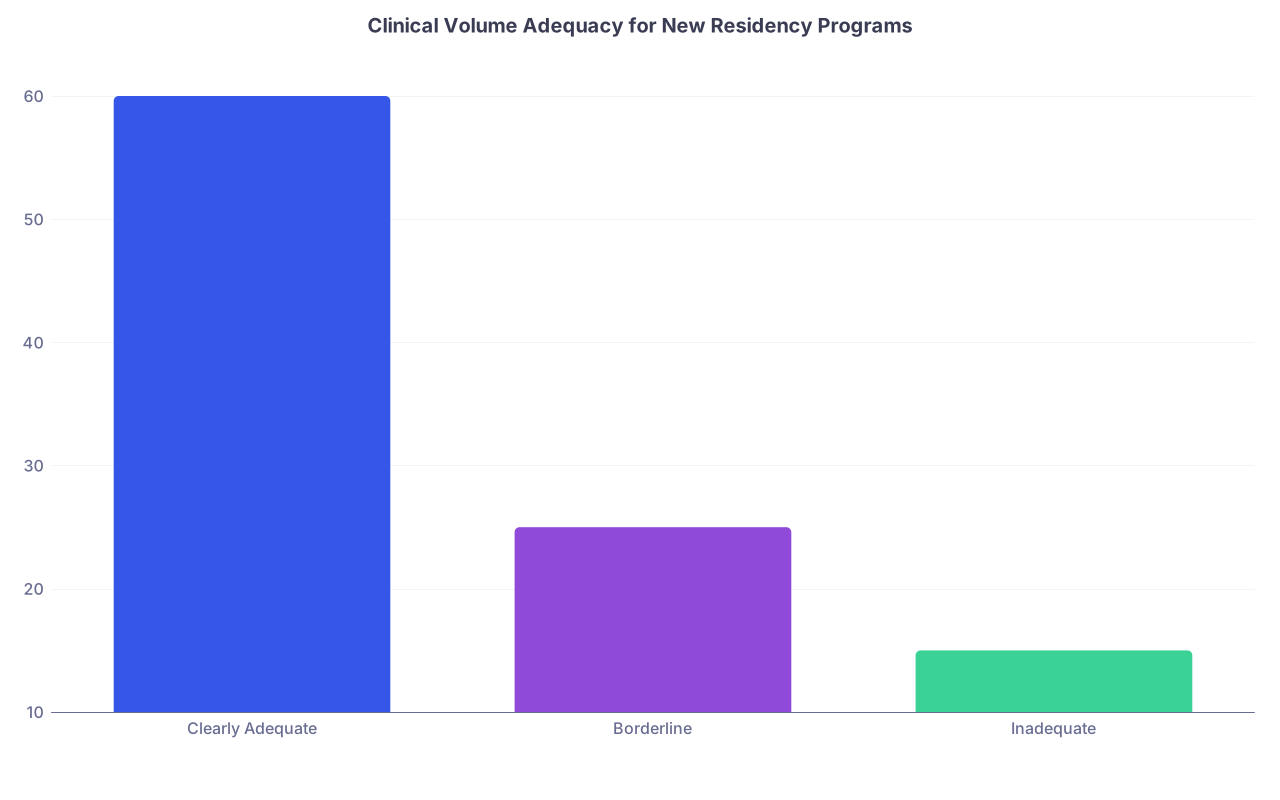
| Category | Value |
|---|---|
| Clearly Adequate | 60 |
| Borderline | 25 |
| Inadequate | 15 |
Roughly:
- “Clearly adequate”: Stable, documented volume that already exceeds needs for projected resident numbers.
- “Borderline”: Volume might work but is thin; RC will scrutinize rotation structure and schedules.
- “Inadequate”: You are borrowing volume from vaporware. RC will say no.
3. Curriculum design: structure is non‑negotiable
Brand‑new programs often underestimate how specific the curriculum needs to be.
You need:
- A complete rotation schedule for each PGY year, with block structure that matches requirements.
- Educational content: conferences, simulations, didactics, journal clubs.
- Defined supervision structure on each rotation.
Lazy answers like “Residents will have regular didactics on various topics” do not fly. You need:
- A written didactic schedule template (even if you adjust it later).
- Named faculty responsible for specific series (e.g., M&M, board review, journal club).
- A plan to track attendance and participation.
4. Assessment, CCC, and Milestones: you must be operational on day 1
RCs know that real damage to residents happens when assessment is a mess. That is why they obsess about this.
You must show:
- A documented evaluation system: tools, timing, raters, and how you use them.
- A functioning Clinical Competency Committee (CCC) with written policies.
- A plan for semiannual Milestones review, feedback to residents, and promotion decisions.
- How you remediate struggling residents. Not in principle. In steps.
Ask yourself, and be honest: if a resident is unsafe on night float in month 3, what exactly will you do? Who gets notified? How is it documented? What authority does the PD have to change their schedule?
If your answer is “the PD will talk to them,” expect a citation.
5. The Clinical Learning Environment (CLE): is this a place residents should actually train?
ACGME does not just accredit the program. They also care about the environment created by your institution:
- Duty hours and workload monitoring.
- Supervision levels: Are there attendings present and actually supervising?
- Fatigue management resources.
- Patient safety, quality improvement, handoffs, professionalism.
For brand‑new GME institutions, this is often the Achilles heel. The hospital may think “we treat our nurses and NPs fine, we will just add residents.” That logic fails quickly.
Residents require:
- A clear chain of command for clinical care.
- Protection from being dumped with scut work that does not have educational value.
- Proper workrooms, call rooms, and IT access.
Site visitors will walk these spaces. If your “resident workroom” is currently a storage closet with two chairs and no computers, do not be shocked when that shows up in the report.
How Initial Accreditation Differs By Specialty
Not all Review Committees think the same way. Some are strict, almost pessimistic. Others are more willing to give new programs a shot.
Here is the general pattern.
| Specialty Group | Relative RC Strictness | Common Focus Area |
|---|---|---|
| Surgical Specialties | High | Case volume and operative autonomy |
| Emergency Medicine | High | ED volume and supervision |
| Internal Medicine / Peds | Moderate | Continuity clinic, patient mix |
| Psychiatry | Moderate | Outpatient and community resources |
| Neurology / Neuro subs | Moderate–High | ICU/ED exposure, neuroimaging access |
Surgical RCs care obsessively about:
- Case log potential (not just total cases but key index procedures).
- OR access relative to other learners.
- Continuity of operative experience.
Emergency Medicine RCs will grill you on:
- Annual ED visit volume.
- Proportion of high‑acuity cases.
- Procedure opportunities (RSI, central lines, chest tubes).
IM and Pediatrics are more concerned about:
- Clinic structure and continuity panel sizes.
- Breadth of inpatient services (ICU, subspecialty, consults).
- Chronic disease management experience.
The point: you need to read your RC‑specific Program Requirements like a contract, because that is how the RC will read your application.
Common Failure Modes I See In New Programs
Here is where programs get into trouble, over and over.
1. Token Program Director with no real authority
Hospitals sometimes pick a politically safe PD who has:
- Minimal FTE for the role.
- No direct line to the CMO or CEO.
- No control over resident schedules or clinic templates.
On a site visit, this is obvious. The PD cannot answer basic questions about:
- How they will intervene when faculty underperform.
- How much time they actually have protected for administration and teaching.
- How they influence hiring or firing of faculty.
RCs will absolutely cite this. In some cases, they will essentially force the institution to rethink leadership if they want accreditation.
2. Phantom faculty and “volunteer” clones
Listing a long faculty roster in ADS looks impressive. Until:
- Half of them are part‑time, telemedicine only, or mostly outpatient when you need inpatient.
- Several have privileges at three hospitals and almost no presence at yours.
- There is no coherent teaching team for key rotations like ICU or ED.
I have seen site visitors flip directly from the ADS faculty list to the hospital credentialing records. If it does not line up, trust evaporates.
3. Overpromising volume from new service lines
New programs love to say “we are starting a new cardiac surgery service next year” or “oncology volumes are about to double.”
RCs have heard it all before. They want current, documented volume:
- 12 months minimum of discharges, OR cases, clinic visits.
- Ideally, 24 months of trend.
If your business plan depends on expansion that has not happened yet, you may need to shrink your initial resident complement or delay opening.
4. No realistic plan for duty hours
New programs frequently underestimate:
- Cross‑coverage needs at night.
- How long it takes interns to staff clinic plus inpatient.
- Indirect care time (charting, phone calls, patient portals).
If your schedule requires residents to be in clinic, on wards, and at mandatory conference with no breathing room, RCs will see the conflict.
You need a duty hour plan that actually protects time for:
- Didactics.
- Longitudinal clinic (when applicable).
- Post‑call rest.
Duty hour citations right out of the gate make you look sloppy.
How to Make Your Program Look “Ready” To An RC
There is a difference between being “technically compliant” and giving the RC confidence.
You want the latter.
1. Build infrastructure before residents arrive
You should be able to show, on site visit day:
- A functioning CCC, even if you run a mock CCC using hypothetical residents or med students’ evaluations.
- Evaluation forms loaded in your GME or learning management system.
- A schedule of didactic conferences for the upcoming 6–12 months.
- Completed or planned faculty development sessions around Milestones, feedback, and direct observation.
Demonstrate that if residents started next Monday, you could run the program.
2. Align program aims with your institution’s real strengths
RCs like programs that know who they are. If you are a 150‑bed community hospital, do not pretend you are Mass General.
Examples of credible aims:
- A rural FM program focused on full‑spectrum, community‑based care.
- An IM residency emphasizing hospitalist and community primary care with strong QI.
- A psych program oriented around community mental health with integrated behavioral health clinics.
If you say “we will be a research powerhouse” with zero current NIH funding, two faculty with any publications, and no protected research time, you are inviting skepticism.
3. Show your quality and safety integration
This is an underrated differentiator. Strong programs can show:
- Resident roles in QI projects (even planned ones with faculty mentors and general topic areas).
- Attendance expectations for M&M, quality committees, or safety huddles.
- How you will orient residents to incident reporting systems and root cause analysis.
ACGME and CLER expectations have pushed RCs to care a lot about this. If your institutional quality leadership cannot describe how residents will plug into QI work, that will be flagged.
4. Be brutally honest internally about weak spots
Every new program has gaps. RC members know this and do not expect perfection. What bothers them is denial.
If you are light on a service – say, rheumatology – then:
- Show exactly how you will cover it (telehealth consults, regional rotations, etc.).
- Document the agreements (MOUs, affiliate site letters).
- Define which residents go, when, and how continuity is preserved.
An honest, well‑engineered workaround looks far better than pretending the gap does not exist.
The Future: How Initial Accreditation Is Evolving
ACGME’s approach is not static. Three trends are shaping how new residencies will be evaluated over the next decade.
1. More emphasis on outcomes, sooner
Historically, true outcomes (board pass rates, fellowships, job placement) took years to appear. Now ACGME is:
- Looking earlier at resident competence using Milestones data.
- Using ACGME Resident/Fellow and Faculty Surveys aggressively, even in young programs.
- Monitoring early case logs and duty hours trends.
That means your first cohort matters hugely. If you recruit poorly and your initial group struggles, your transition from Initial to Continued Accreditation may be ugly.
2. Increased scrutiny on expansion in saturated markets
Large metro areas already flooded with trainees are seeing more RC caution, especially in:
- EM, IM, and some surgical subspecialties.
- For‑profit or investor‑owned hospitals starting residencies primarily as a workforce strategy.
RCs are starting to ask more pointed questions:
- Is there enough volume for yet another program?
- Will this program displace or dilute existing ACGME‑accredited training?
If you are trying to launch the third EM program in a city with flat ED volumes, expect hard questions.
3. Integration with workforce and community needs
ACGME is not a workforce planning agency, but the politics are shifting. There is growing focus on:
- Rural and underserved training sites.
- Diversity, equity, and inclusion in recruitment and learning environments.
- Community‑engaged training models.
New programs that fit these priorities, and can prove it, will likely see more support and less suspicion.
To make this concrete:
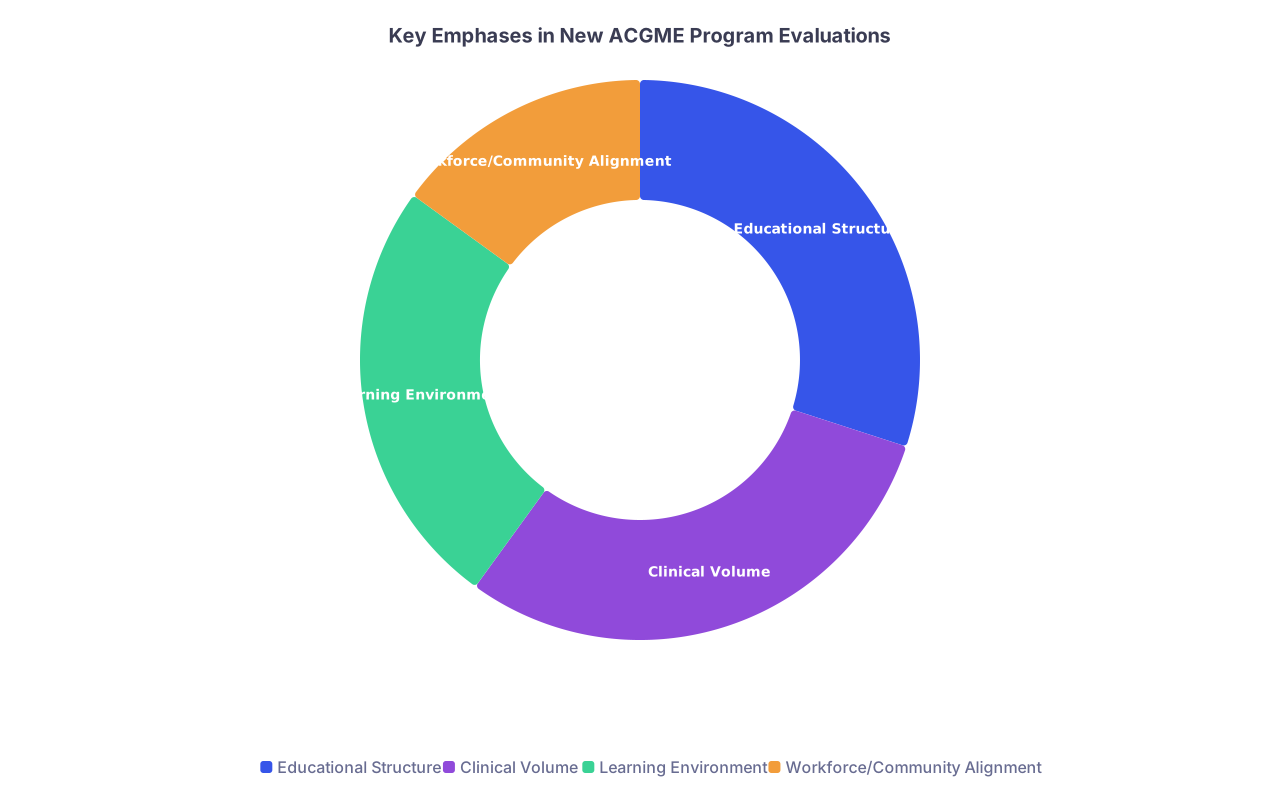
| Category | Value |
|---|---|
| Educational Structure | 30 |
| Clinical Volume | 30 |
| Learning Environment | 25 |
| Workforce/Community Alignment | 15 |
Educational structure and clinical volume still dominate. But the other pieces are gaining weight.
If You Are Planning A New Program Right Now
Here is the blunt checklist I use when advising hospitals on whether they are truly ready:
Can you name a PD who:
- Meets ACGME qualifications.
- Has at least 0.5 FTE protected time (for core residencies).
- Has real authority and institutional backing.
Can you show 2–3 years of hard data that your clinical volume:
- Meets RC requirements for your desired resident complement.
- Will not be massively diluted by other learners.
Do you have:
- A real, functioning GMEC.
- A DIO who can quote ACGME requirements without notes.
- Institutional willingness to invest in GME infrastructure (staff, IT, space).
Do you already have or can you quickly build:
- Faculty who want to teach and will actually be around.
- An evaluation and CCC system that works in practice, not just on paper.
- Physical space (workrooms, call rooms, conference space) that a site visitor will not roll their eyes at.
If you cannot answer “yes” to most of that, you are not ready. You can still plan. You should not yet apply.
FAQs
1. How long does it typically take from submitting an application to receiving Initial Accreditation?
For most new residencies, expect 9–18 months. A strong, well‑prepared application with clear volume data and a responsive PD can get through faster (closer to 9–12 months). Programs that submit vague curricula, incomplete faculty lists, or shaky institutional support end up in back‑and‑forth with the RC and can drag the process out well beyond a year.
2. Can a program start recruiting residents before Initial Accreditation is granted?
You can plan, draft recruitment materials, and even signal intent informally, but you should not make formal offers or participate in the Match without at least Initial Accreditation or clear ACGME guidance for that specific situation. Most reputable med schools and applicants are rightly wary of training in a program without ACGME status, so trying to “pre‑recruit” is a bad idea and can damage your reputation.
3. What happens if we receive Initial Accreditation with several citations?
You still have accreditation. The citations describe specific requirements you are not meeting. You must correct them and demonstrate progress in follow‑up reviews and annual updates. Some citations are relatively easy fixes (e.g., improving documentation of CCC meetings). Others, like inadequate case volume or weak PD authority, are serious and can threaten your transition to Continued Accreditation if not fixed quickly and convincingly.
4. How different is the scrutiny for a new program in a brand‑new GME institution versus one in a long‑established teaching hospital?
Completely different. New GME institutions are examined much more closely, especially around institutional infrastructure: GMEC function, DIO effectiveness, policies, and the overall learning environment. Established teaching hospitals with multiple accredited programs already have a track record and infrastructure, so the RC can focus more narrowly on the new program’s specifics. If you are the first residency in your hospital, expect the site visitor to spend much more time with institutional leaders and reviewing system‑level processes.
5. Does ACGME care about salaries, benefits, and support services during Initial Accreditation?
Yes, but mostly through the institutional lens. The RC and site visitors expect residents to receive reasonable salaries and benefits comparable to other programs in the region, plus access to key supports: occupational health, mental health services, fatigue mitigation resources, and educational resources. If your proposed salary is far below local norms or you lack basic support services, that will raise questions about the institution’s commitment to GME and the overall clinical learning environment.
Key points to keep in your head: Initial Accreditation is not about filling out forms; it is about convincing experienced educators that your program can safely and effectively train residents on day one. Faculty, volume, structure, and environment all matter, and weak spots in any of these can derail you. If you design the program like a serious, mature residency from the start—rather than something you will “grow into later”—your chances with the ACGME go up dramatically.