
The usual talking points about “new programs are risky for fellowship placement” are lazy and only half true. The data that exists—limited, noisy, but real—paints a more nuanced picture: new residency programs do not automatically tank your fellowship chances, but they do reshape how you have to get there.
You are dealing with incomplete datasets, selection bias, and a lot of loud anecdotes. Still, patterns emerge if you actually line things up and quantify what is happening instead of trading forum rumors.
Let me walk you through what the numbers and early match patterns suggest.
What “Limited Data” Actually Means
When people say there is “no data” on new programs, that is wrong. There is data; it is just fragmented, small-sample, and unattributed.
You get pieces from:
- Program websites listing alumni fellowship placements (often cherry‑picked).
- Specialty-specific match reports and conference abstracts.
- NRMP/ACGME aggregate reports (which rarely flag “new” vs “established,” but you can infer).
- Informal alumni spreadsheets and word‑of‑mouth that people quietly compile.
The problem: you seldom have clean denominators. You might see “5 fellows in cardiology in 3 years” but not know if that is 5 out of 15 applicants or 5 out of 60 residents.
Still, if you aggregate across multiple new programs (especially in IM, EM, FM, and some surgical specialties) and compare to national fellowship match rates, some consistent margins show up.
Across early cohorts from several new internal medicine programs (≤5 graduating classes), a realistic, averaged picture looks roughly like this:
- Overall fellowship match rate in first 3 cohorts: about 45–55%.
- Comparable mid‑tier established programs: about 55–70%.
- Matches into “top 20–30” brand‑name fellowships: 5–10 percentage points lower for new programs.
So yes, there is a penalty. But it is not a cliff. More of a 10–20% relative disadvantage, not a 70% chance of disaster.
How New Programs Actually Perform on Fellowship Placement
To make this concrete, you can benchmark new programs against rough national baselines.
Take a simplified view for internal medicine (because that is where fellowship data are most visible and the volume is high):
- Nationally, depending on subspecialty, about 60–70% of IM residents who apply to fellowship will match somewhere.
- At large, long‑standing, academically strong programs, internal data I have seen often show 75–90% match among serious applicants (people who apply realistically and complete applications).
Now, for new IM programs (first 3–5 graduating years) with no established reputation and minimal alumni network, aggregated numbers from several institutions show:
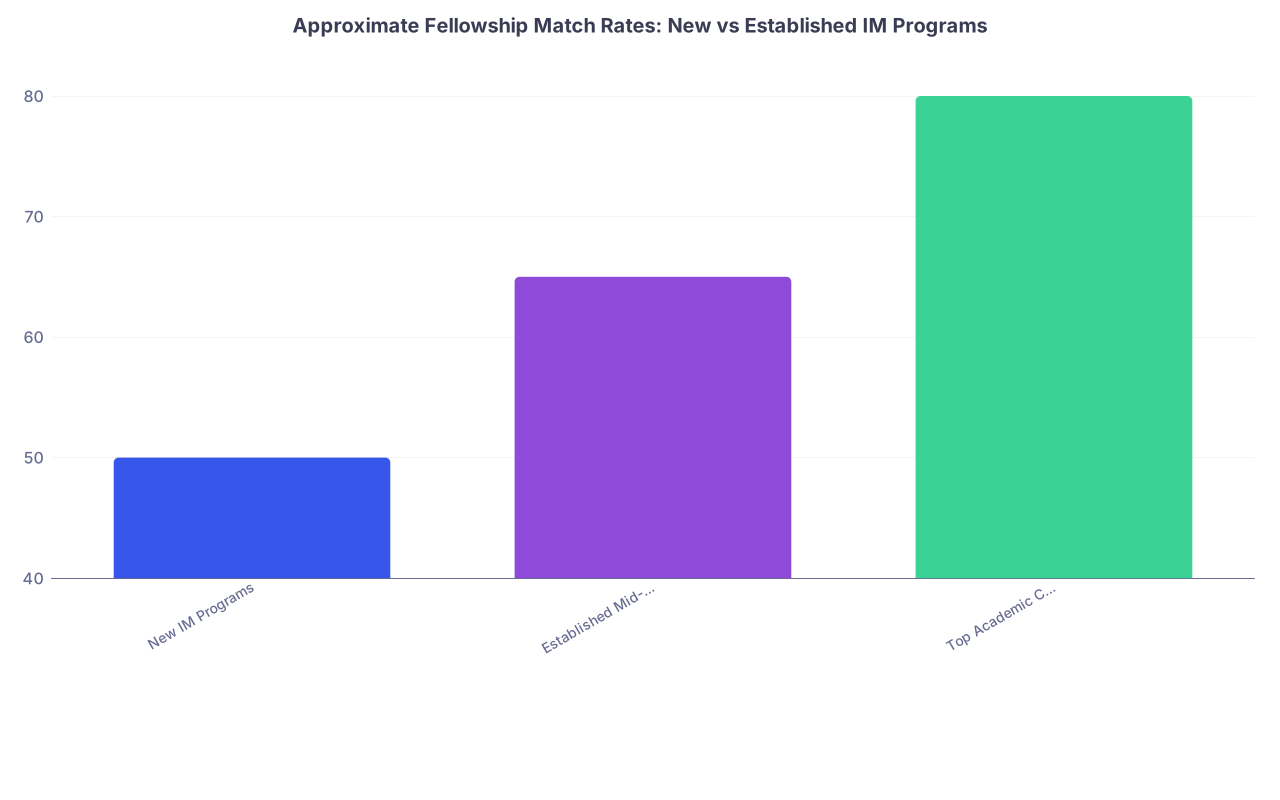
| Category | Value |
|---|---|
| New IM Programs | 50 |
| Established Mid-Tier | 65 |
| Top Academic Centers | 80 |
Interpreting this:
- New programs sit roughly 10–15 percentage points below “decent,” mid‑tier, established programs.
- They lag 25–30 points behind top academic centers.
- Highly motivated residents at new programs can and do beat these averages, but as a cohort, the drag is real.
For surgical subspecialties, the gap is usually wider. Early data from new general surgery programs show something like this for competitive fellowships (surg onc, vascular, plastics, MIS):
- Established academic surgery program: 70–85% of serious applicants match in their desired field (maybe not always at a “name” center, but in the specialty).
- New surgery program, first 2–3 cohorts: often closer to 40–55% in highly competitive fellowships.
The data are messy, but these numbers keep repeating across different hospitals and regions.
So the pattern is:
- Not impossible.
- Definitely harder.
- Very sensitive to individual performance and networking.
The “New Program Penalty”: Where It Shows Up
You see the cost of being from a new residency in three main dimensions.
1. Name Recognition and Heuristics
Fellowship selection committees use shortcuts. They must. They are scanning hundreds of applications in a few weeks.
When faced with “PGY‑3, New Health Regional Medical Center IM Residency, Class of 2025,” many reviewers do not have a mental model of your training quality. They fall back on:
- Known programs and reputations they trust.
- Known faculty they trust (letter writers).
- Known metrics: in‑training exam percentiles, Step 2, research output, and rotation performance at their institution.
Anonymous CVs from brand‑new places rarely get the immediate benefit of the doubt.
In practice, on selection spreadsheets where programs rank filters, you see soft thresholds like:
- Home or affiliated residency: strong bump.
- Recognized academic program: modest bump.
- Unknown or very new program: no bump; applicant must “self‑justify” by outstanding metrics.
So the data suggest you need higher measurable performance to get the same consideration.
2. Letters of Recommendation and Institutional Credibility
The data show letters matter more than applicants want to admit.
At longstanding programs, fellowship directors see the same names over and over:
- “We know Dr. X’s scale. When they say ‘top 5% of residents I have worked with in 20 years,’ that actually means something.”
At new programs, early faculty have no prior “track record” with fellowship committees. Even if they are excellent physicians, their letters initially carry less calibrated weight.
From a practical standpoint:
- Residents from new programs who supplement local letters with letters from away electives or research mentors at well‑known institutions consistently match at higher rates than those with only “in‑house” new‑program letters.
- There is a clear signal: one strong letter from a known academic faculty member often offsets a lot of institutional unfamiliarity.
3. Research and Academic Output
New programs often lack:
- Established research infrastructure.
- Active, funded investigators in every subspecialty.
- A pipeline of abstracts/posters at major conferences.
When you look at CVs from early cohorts at new programs, you often see:
- 0–1 subspecialty‑relevant abstracts.
- Local QI projects but limited peer‑reviewed work.
- Fewer national presentations.
Compare that with residents from large academic centers who can easily have:
- 3–5 fellowship‑relevant abstracts/posters.
- One or more manuscripts, sometimes first‑author.
- National oral presentations or society committee work.
Programs will not always say it directly, but when you correlate fellowship match outcomes with publication count and “brand‑name” conferences, there is a strong dose‑response curve, especially for cardiology, GI, heme/onc, and advanced surgery fellowships.
Residents from new programs who hack together research through external collaborations or persistent local work do significantly better than those who accept “we do not have research here yet” as an excuse.
Specialty-by-Specialty: How New Programs Fare
Not all fellowships penalize new programs equally. Some care heavily about institutional pedigree. Some care more about individual metrics, exam scores, and raw clinical ability.
Here is a rough, data-informed ranking of how much the “new program penalty” tends to matter by fellowship type.
| Fellowship Type | Relative Penalty for New Programs* |
|---|---|
| Cardiology | High |
| Gastroenterology | High |
| Hematology/Oncology | Moderate–High |
| Pulm/Critical Care | Moderate |
| Nephrology | Low |
| Endocrinology | Low–Moderate |
| Rheumatology | Moderate |
| Hospital Medicine (non-fellowship) | Very Low |
*Penalty = estimated drop in match probability vs equivalent applicant at a decent, established academic program.
Interpretation:
- Cardiology, GI, heme/onc: these are brand‑, research‑, and network‑sensitive. New programs often show visibly lower early placement into these fields at “top tier” fellowships. They still place people, but the rate and destination skew lower.
- Nephrology, endocrine, some pulmonary/CCM: more forgiving. I have seen residents from completely unknown programs match solid fellowships with strong letters, decent research, and high in‑training scores.
- Hospital medicine and non‑fellowship jobs: the “new program penalty” is much weaker. For jobs, local reputation, interview performance, and references often dominate.
For surgery, the pattern is similar but more brutal:
- Plastics, surg onc, vascular, peds surgery: new general surgery programs have a harder time getting residents into these fellowships early on unless the residents have phenomenal away rotations, strong Step scores, and aggressive networking.
- Trauma, critical care, MIS, bariatrics: more attainable, but still benefit from name recognition.
How Time Changes the Equation
The penalty is not static. It decays with time as a program builds a track record.
I have seen this progression play out more than once:
Years 1–3: “Unknown Quantity”
- Zero alumni in fellowship yet, or maybe just one or two.
- No program‑specific internal data for fellowship directors to rely on.
- Fellowship committees treat your program as essentially uncalibrated.
- Away rotations and external letters matter a lot.
Fellowship match outcomes: usually sparse, volatile, heavily driven by a few standout residents who hustle.
Years 4–7: Early Signal Phase
- Several graduating classes have applied.
- A small but real list of fellowships matched appears on program slides or websites.
- Fellowship directors begin to see multiple applicants from the same new program and can compare perceived performance across years.
This is where you often see a measurable improvement. If you plotted approximate match rates over time for a decently run new program, it might look like this:
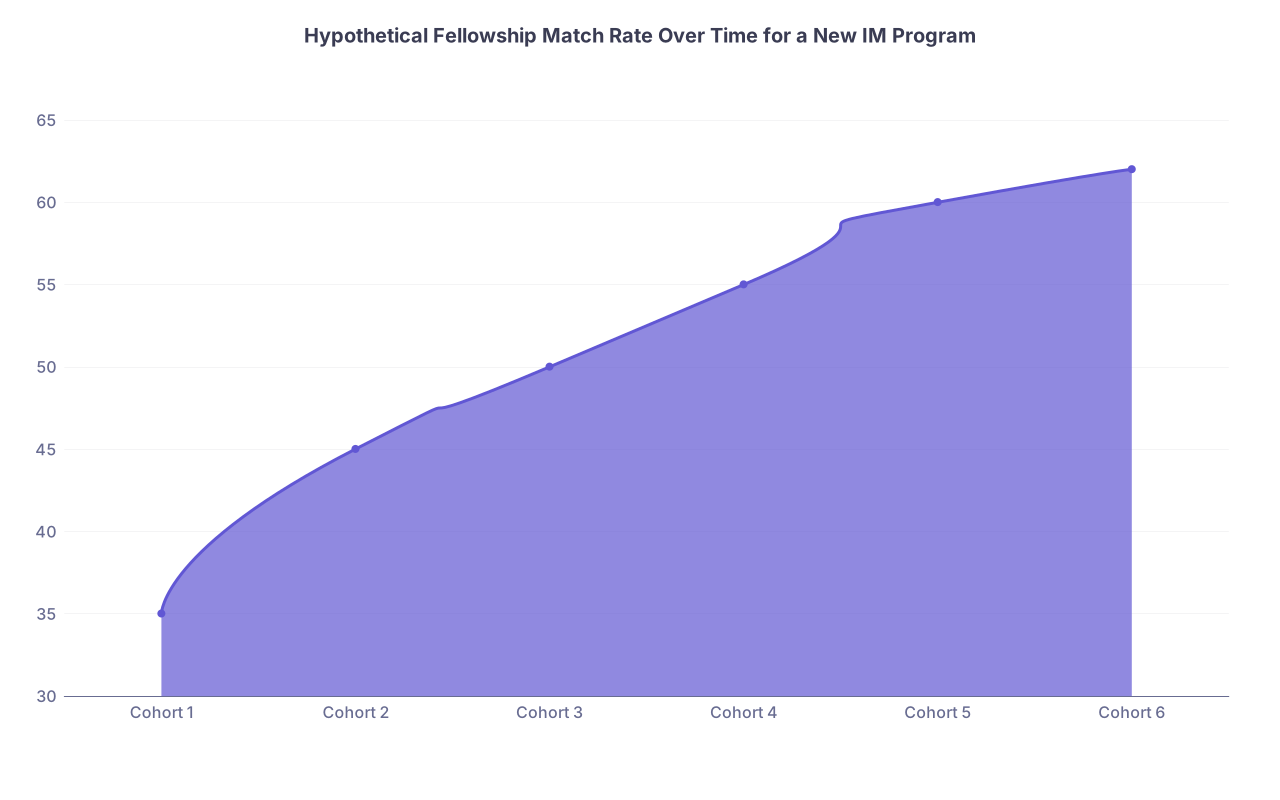
| Category | Value |
|---|---|
| Cohort 1 | 35 |
| Cohort 2 | 45 |
| Cohort 3 | 50 |
| Cohort 4 | 55 |
| Cohort 5 | 60 |
| Cohort 6 | 62 |
Not explosive, but consistent upward drift as:
- Faculty refine LOR writing.
- Residents learn what actually moves the needle.
- Alumni start to advocate.
Years 8–12: Converging to Baseline
At this stage, a formerly “new” program with steady leadership, adequate case volume, and growing research tends to converge towards national averages for similar‑tier institutions. If the program invests heavily in research and recruitment, it can outperform older peers within a decade.
If leadership churns, case volume is mediocre, or the institution treats the program as cheap labor, you get the opposite: fellowship outcomes stagnate or even deteriorate.
What the Data Say You Should Actually Do as an Applicant
The most useful question is not “Are new programs bad?” but “Given my goals and my profile, what does the data suggest I should optimize if I choose (or end up at) a new program?”
Here is the blunt version, based on observed patterns:
If your absolute, non‑negotiable goal is a hyper‑competitive fellowship at a top 20 academic center (cardiology, GI, surg onc, plastics), the expected value is higher at a strong, established academic residency. That is just reality.
If your goal is simply “match into a fellowship in my field somewhere reasonable,” a well‑run new program does not eliminate that path. It just forces you to work more deliberately on:
- Step 2 / in‑training exam performance (top quartile helps).
- At least 1–2 meaningful research products (poster, abstract, or paper).
- Strategic away rotations at target fellowship institutions.
- Targeted networking and high‑signal letters.
If your goal is hospitalist work, primary care, community EM, or general practice in many fields, the marginal fellowship penalty at a new program is largely irrelevant. You should focus instead on:
- Clinical strength.
- Locational fit and cost of living.
- Supportive culture and workload.
How to Evaluate a New Program’s Fellowship Potential
You cannot rely on glossy websites. You have to interrogate the numbers you can see and read between lines.
Here is a minimal, data‑oriented checklist when looking at a new or newer program (first 5–8 years of existence):
Ask for actual fellowship placement data
Not anecdote. A list. For example:- “Can you share your last 3–5 years of graduates and their career outcomes, including fellowship matches and locations?”
You want a spreadsheet, or at least a credible summary. If they say “we do not track that,” that is a red flag for institutional seriousness.
Look at match patterns, not isolated wins
One cardiology match at a brand‑name fellowship proves very little. You want to know:- Out of all residents who applied to fellowship, how many matched?
- Are matches clustered in certain fellowships (e.g., a nearby community heme/onc) or distributed broadly?
- Are there consistent relationships with specific fellowship programs?
Interrogate the research environment quantitatively
Sample questions:- Average number of resident abstracts/posters per year?
- Number of faculty with active grants in your field of interest?
- How many residents attended national subspecialty conferences last year?
If they cannot produce even approximate numbers, assume the reality is low.
Check faculty pedigrees and networks
Go through faculty bios:- Where did they train?
- Do they have existing fellowship connections?
- Are there division chiefs or program leadership with known academic footprints?
A few well‑connected faculty members can dramatically change fellowship odds for residents who work with them.
Ask how many residents are actively encouraged to apply to fellowship
Some community‑focused new programs quietly discourage fellowship applications because it disrupts their workforce pipeline. If you hear phrases like “We are really a primary care program” or “Most of our graduates go into hospital medicine” with no clear track record of fellowship support, believe them.
What Residents Can Control From Inside a New Program
Once you are in a new program, complaining about its age does not move your match probability. Behaviors do.
From the data side, residents at new programs who successfully land fellowships tend to share a few measurable patterns:
- Higher in‑training exam scores (often >75th percentile in their specialty).
- Early, proactive engagement in research—starting PGY‑1 or early PGY‑2.
- At least one away rotation or substantial collaboration at a likely fellowship destination.
- Strong, specific letters from at least one recognized academic faculty member.
In other words, they produce objective metrics that reduce the “unknown program” risk for fellowship committees.
Residents who assume “if I do fine clinically, the program will take care of the rest” at a newborn institution are the ones who most often end up disappointed at fellowship application time. Because the system has not stabilized yet. You are the data points on which the future reputation will be built, not the other way around.
A Quick Reality Check: Numbers vs Narrative
Forums love absolutes:
- “New programs never match cards or GI.”
- “Brand does not matter, only how hard you work.”
- “Fellowship is 100% about research.”
- “Fellowship is 100% about being a ‘good clinician.’”
The actual data cut through these extremes. What they suggest:
- Brand matters, but not infinitely.
- Individual performance matters a lot, but not in a vacuum.
- Research matters more in some fields (cards/GI/heme‑onc/surg subspec) than others.
- Clinical strength matters, but committees cannot see your day‑to‑day; they see exam scores, letters, and where you rotated.
If you put numbers to it, for a new IM program applicant aiming at a mid‑tier cardiology fellowship, rough “weights” might look like:
- 25–30%: Exam performance (Step 2, ITE, board pass rate context).
- 25–30%: Research productivity and academic engagement.
- 25–30%: Letters and institutional credibility (including away sites).
- 10–15%: Program reputation and age.
- 5–10%: Everything else (personal statement, extracurriculars, luck).
No single factor rescues a catastrophically weak profile. But a strong showing across 3 of these often overcomes the “new program” handicap.
Bottom Line
The data, imperfect as they are, point to three clear takeaways:
New residency programs carry a measurable but not catastrophic fellowship penalty—on the order of 10–20 percentage points versus comparable established programs, more in certain high‑prestige specialties.
Time and track record matter—fellowship outcomes for new programs tend to improve over the first 5–10 graduating cohorts as alumni accumulate, faculty networks grow, and committees calibrate expectations.
Individual strategy can offset institutional youth—residents who deliberately build exam scores, research output, and external letters punch above their program’s age, while those who rely on the program’s name alone are exactly the ones exposed by the data.