
The geography of new residency programs is not random—and if you ignore it, you are handicapping your future before you even submit ERAS.
The Big Picture: Where New Programs Are Actually Appearing
The data shows a clear pattern: new residency programs are disproportionately opening in high-growth, physician-shortage, lower-cost regions. Think Sunbelt, Mountain West, and the suburban/exurban South. Not Boston, San Francisco, or Manhattan.
Several forces are converging:
- Population growth shifting toward the South and West
- Chronic physician shortages in rural and semi-rural counties
- Hospital systems leveraging residency programs as a workforce strategy
- New and expanding medical schools needing local GME slots
We can summarize the geography like this:
| Region | Share of New Programs | Key States Driving Growth |
|---|---|---|
| South (incl. Southeast & Texas) | ~40–45% | TX, FL, GA, NC, TN, AL |
| West & Mountain West | ~20–25% | AZ, CO, UT, NV, ID |
| Midwest | ~15–20% | OH, MI, MO, IN, IA |
| Northeast | ~10–15% | PA, NJ, NY (non-urban mostly) |
| Pacific Coastal Urban (CA, WA major metros) | <10% | CA Central Valley, Inland Empire more than SF/LA core |
You do not need exact ACGME spreadsheets in front of you to feel this trend. Look at announcements over the last few match cycles: new internal medicine, family medicine, psychiatry, and EM programs popping up in places like McAllen, TX; Ocala, FL; Provo, UT; and suburban Carolinas. Meanwhile, the big academic giants are more likely to expand existing programs by a few spots than to create entirely new residencies from scratch.
If you are still acting like the map looks the way it did in 2005, you are already behind.
Urban vs Non-Urban: The Quiet Shift
The simplistic narrative is “big cities vs rural,” but the data splits more cleanly into three buckets:
- Major coastal metros (NYC, Boston, SF, LA, DC)
- Secondary/tertiary metros (Charlotte, Nashville, Phoenix, Tampa, San Antonio)
- Rural and micropolitan regions
New residency creation is most aggressive in buckets 2 and 3. Why?
- Land and facility costs are lower.
- Hospitals in these regions have the most severe staffing pressure.
- Local politicians and health systems treat GME as an economic development tool.
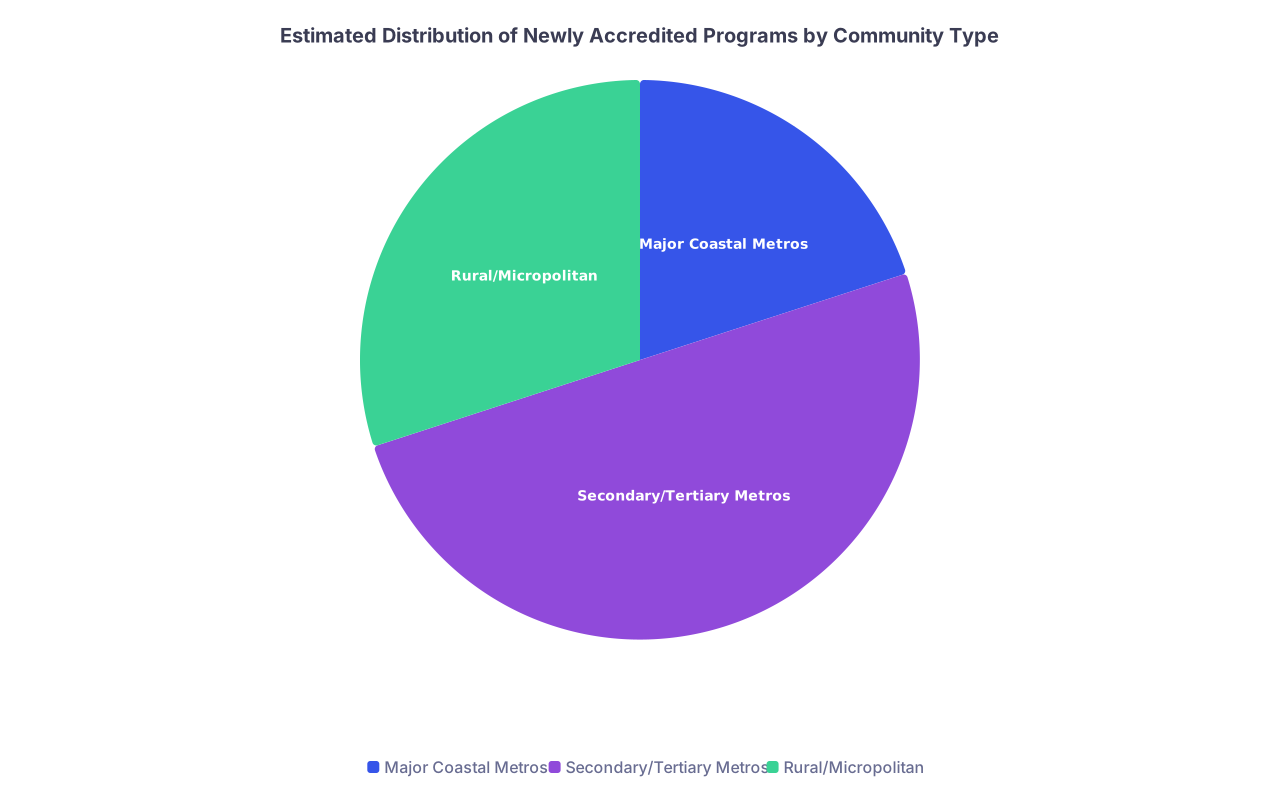
Here is a stylized comparison based on recent ACGME approvals and press releases:
| Category | Value |
|---|---|
| Major Coastal Metros | 20 |
| Secondary/Tertiary Metros | 50 |
| Rural/Micropolitan | 30 |
Rural and micropolitan areas are overrepresented relative to their population share. Yet the majority of applicants still behave as if the “real” programs are only in big cities.
That mismatch between where programs exist and where applicants want to be is precisely where your strategic edge lies.
Specialty-Specific Geographic Patterns
Not all specialties spread the same way. The data shows clear geographic fingerprints by specialty.
Primary Care (IM, FM, Pediatrics)
Primary care is the engine of new program growth. Hospitals chase ACGME-accredited primary care programs to:
- Produce local physicians who are statistically more likely to stay
- Improve access metrics in underserved areas
- Hit value-based care metrics that require adequate outpatient coverage
Typical pattern:
- New family medicine and internal medicine programs in smaller cities (population 50k–250k)
- Heavy representation in community hospitals, sometimes with university “affiliations” but not true university ownership
- Pediatrics lagging behind IM/FM numerically but still growing in similar geographies, especially in states with high Medicaid pediatric populations (e.g., Texas, Florida)
If you want a primary care specialty and are geography-flexible, the math is simple: your odds are better if you target these growth regions instead of fixating on traditional academic hubs.
Psychiatry and Behavioral Health
Psychiatry is a special case. Demand is exploding everywhere, but capacity growth is uneven.
The data shows:
- Many new psychiatry residencies in the South and West, often attached to regional behavioral health centers
- Some states with historically low psychiatrist-to-population ratios (think AL, MS, AR, ID) sponsoring brand-new programs
- Public-private partnerships where states subsidize GME to address mental health crises
Consequence: Geographic flexibility in psych gives you disproportionate leverage. If you insist on only applying to Boston, NYC, or the Bay Area, you are fighting over a limited and relatively static pool of slots. If you add new psych programs in Texas, Carolinas, Mountain West, your effective competition drops.
Surgical Specialties and Competitive Fields
This is where growth is slower and more clustered:
- New general surgery programs appear, but far fewer than IM/FM
- New ortho, ENT, derm, plastics, and neurosurgery programs are rare and usually tied to emerging academic centers in fast-growing metros (e.g., Phoenix, Austin, Tampa)
- The highest-prestige surgical programs remain in traditional academic cities, and expansion is usually +1–2 positions rather than new institutions
If you are chasing competitive surgery, the geographic trend is less about “new program or not” and more about:
- Suburban academic centers gaining fellowships and gradually building brand
- Community programs in mid-sized cities starting to show serious case volume and breadth but lagging in reputation
For these fields, the data suggests new programs might slightly increase total spots, but they rarely open glamorous new geographic options. You still have to be realistic and broadly applied.
State-Level Hotspots and Cold Spots
The growth in new residency programs is not spread evenly across states. A few states have aggressive GME expansion policies, while others are practically stagnant.
Look at a simplified, illustrative set of states:
| State | Trend in New Programs (Recent Years) | Dominant Settings |
|---|---|---|
| Texas | Strong growth | Community hospitals, small cities |
| Florida | Strong growth | Health system networks, suburbs |
| North Carolina | Moderate–strong growth | Academic-community hybrids |
| California | Mixed, regionally concentrated | Inland, Central Valley |
| New York | Moderate, mostly upstate/suburban | Community and safety-net |
Patterns behind these differences:
- States with population booms and aging demographics (TX, FL, NC, AZ) push GME aggressively.
- States with big legacy GME bases (NY, MA, PA) grow more by expansion than by brand new institutions, especially downstate.
- High-cost, regulatory-heavy markets (SF Bay, Manhattan) see slower creation of entirely new programs; institutions prefer to expand existing infrastructure.
If you are from a state aggressively funding GME expansion, you have a structural advantage if you are willing to stay in-state. Home-state bias plus new slots equals higher odds.
New vs Established Programs: Risk, Reputation, and Reality
Many applicants still reflexively avoid brand-new residency programs. That is not data-driven behavior. That is fear.
Let me break the trade-offs numerically and practically.
Perceived Risks of New Programs
What students usually worry about:
- No alumni network
- Unknown board pass rates
- Unclear fellowship or job placement
- Potential growing pains in administration and workflow
All valid concerns. But historically, complete disasters are rare. ACGME accreditation standards are not soft, and institutions investing millions into GME do not want a PR debacle.
Actual Structural Advantages of New Programs
The data and anecdotes show some counterintuitive upsides:
- New programs often have higher faculty-to-resident ratios initially.
- Case volume per resident can be very strong if the hospital was previously staffed by hospitalists or locums.
- Program leadership tends to be hungry, responsive, and very motivated to “prove” the program’s quality.
Think about it like a startup vs legacy corporation dynamic. Some new programs behave like scrappy overachievers.
Match Competitiveness Differential
Here is the nuance that matters for you: new programs, especially in less popular geographies, are often undervalued in the match.
They may:
- Receive fewer applications per spot
- Be ranked lower by many applicants who do not do their homework
- End up with a higher proportion of IMGs or DOs initially, then diversify as they build a track record
This is not a moral judgment. It is just volume and perception. And it means that, statistically, your chance of matching is higher at a solid new program in a secondary city than at a similar-caliber program in a glamorous metro.
How This Affects Your Application Strategy
Now the part you actually care about: what this geographic shift means for your odds and your career.
1. Location Flexibility = Match Probability
Applicants who model match probability as a function of specialty, board scores, and research alone are missing one of the big predictors: geographic flexibility.
You increase your match probability in three ways:
- Applying to more programs.
- Applying to a broader competitiveness spectrum.
- Applying to regions where demand exceeds supply of applicants.
Most people do (1) and (2) and completely ignore (3).
If you are willing to rank programs in Texas, Florida, the Carolinas, Mountain West, and rural Midwest—especially new or newer programs—your effective applicant-per-position ratio often drops.
Is that always measurable by precise public data? No. But talk to PDs and look at NRMP outcomes. Programs in “less desired” locations talk openly about unfilled spots or needing to dig deeper into their rank lists—even as similar programs in coastal cities fill easily.
2. Think in Systems, Not Cities
Many new programs are part of multi-hospital systems. That matters.
A new IM program in a mid-sized Texas town that sits in a large health system might give you:
- Rotations at flagship tertiary centers
- System-wide hiring preference after graduation
- Access to subspecialty mentorship through telehealth or short-away rotations
So do not just look at city names. Look at:
- The parent health system size and footprint
- Existing fellowships within the system
- Historical hiring trends (do they keep their residents as attendings?)
This is often more important than whether the ZIP code sounds glamorous.
3. Career Intent: Underserved vs Urban Academic
Your geographic strategy should match your endgame.
If you want:
- Long-term practice in an underserved area
- Loan repayment programs tied to shortage areas
- Better odds of leadership roles earlier in your career
Then training in one of these high-growth, high-need regions is not a compromise. It is alignment.
Data from multiple studies is consistent: physicians are more likely to practice where they train. You cannot reasonably plan to serve rural populations and then refuse to train anywhere outside a top-10 coastal city.
On the other hand, if your goal is academic medicine in a big-name university program with NIH-level research, new community programs in small cities will rarely be an optimal launchpad. That is not elitism; it is just path dependence.
Realistic Scenarios: How Different Applicants Should Respond
To make this concrete, let’s walk through three archetypes.
Applicant A: Mid-Range Stats, Aiming for IM or FM
- Step 2 in the low 220s–230s
- Minimal research, solid clinical evaluations
- Prefers big cities but not dead-set on any one
If Applicant A insists on only major coastal metros, the data is ugly. Competition is high, many programs are flooded with applications, and mid-range stats become a serious liability.
If Applicant A strategically includes:
- New and recent IM/FM programs in Texas, Florida, the Carolinas, and Mountain West
- Community-based programs in secondary cities (not just capitals)
- A mix of well-established and newer programs with good faculty rosters
Match probability jumps. Because they are now competing where program growth is fastest and applicant interest is relatively lower.
Applicant B: Strong Stats, Wants Psychiatry
- Step 2 in the 250s
- A few psych publications
- Geographic preference but some flexibility
This applicant can likely match in multiple regions. The question is not “Can I match?” but “Where do I best leverage the geography?”
If Applicant B adds new psychiatry programs in GME expansion states, they gain:
- Higher chance of early leadership roles
- Potential for very high clinical volume and broad pathology exposure
- More negotiating power if they stay in-region for attending jobs
They may still rank top-tier academic psych programs in coastal metros high. That is fine. But their realistic backup options should track where new programs are booming.
Applicant C: Competitive Surgery Hopeful
- Step 2 in the low 240s
- Some research, but not top-tier
- Wants ortho or ENT, but is open to general surgery if needed
For truly competitive surgical subspecialties, new programs will not save a fundamentally mismatched application. There simply are not enough new slots in those fields.
But if Applicant C:
- Adds new general surgery programs in mid-sized cities
- Considers community-university hybrid programs in growth regions
- Stops treating “less popular geography” as radioactive
They materially improve their odds of landing a categorical general surgery spot. From there, fellowships and subspecialty options remain possible, especially if they perform at the top of their cohort.
How to Vet New Programs Without Guesswork
You should not blindly trust every shiny new program. But you also should not dismiss them automatically. Use a structured filter.
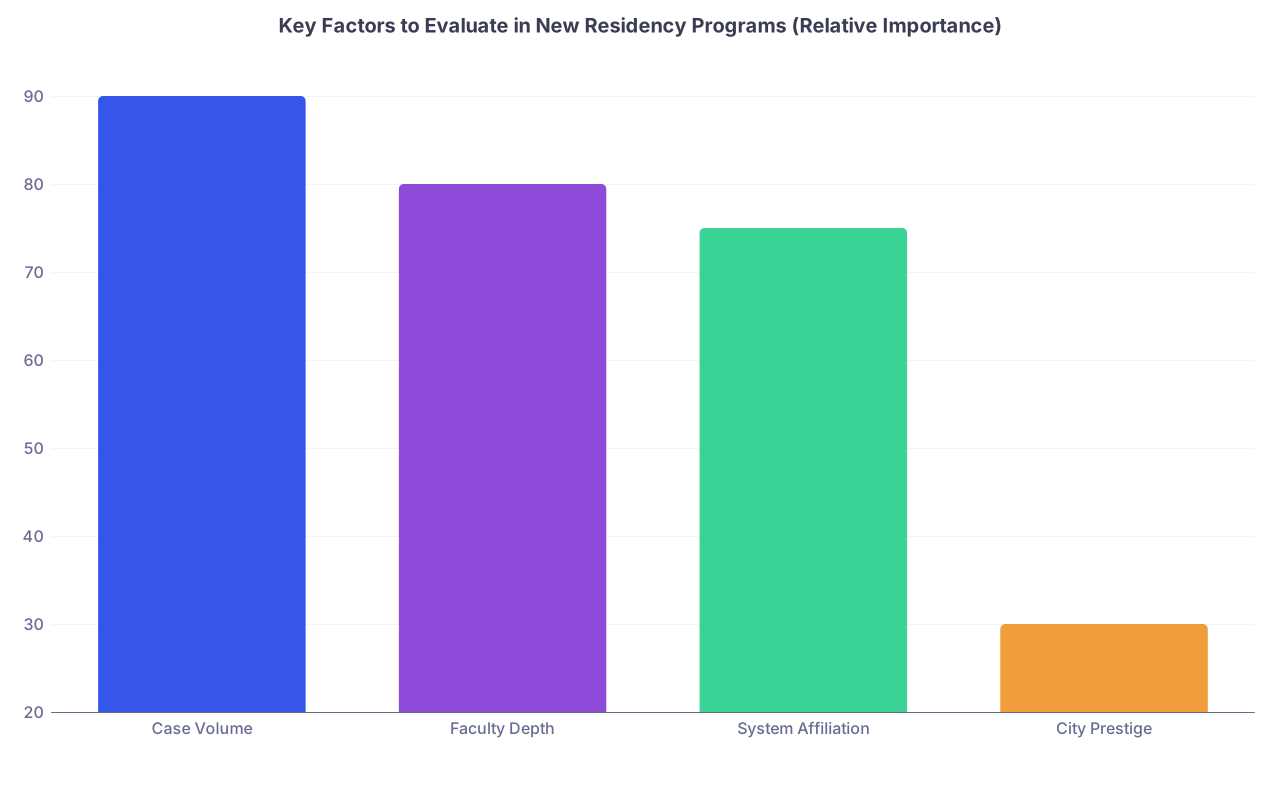
Look for hard data and concrete indicators:
- Hospital case volume and complexity: Do they have high ED visits, ICU beds, surgical volume?
- Faculty depth: Are there enough core faculty with serious clinical or academic backgrounds?
- System affiliations: Is the program tied to a university or large health system with fellowships?
- Early outcomes: Board pass rates, fellowship matches, job placement, even if dataset is small
| Category | Value |
|---|---|
| Case Volume | 90 |
| Faculty Depth | 80 |
| System Affiliation | 75 |
| City Prestige | 30 |
City prestige consistently ranks high in applicant decision-making. It ranks much lower in predicting whether you will be competent, employable, and satisfied clinically.
If a new program has high volume, strong faculty, and system reach, it is usually a safer bet than applicants assume.
The Future Trajectory: What the Next 5–10 Years Likely Look Like
Extrapolating current trends, several things are very likely:
- Continued GME expansion in high-growth Sunbelt and Mountain West states
- More primary care and psychiatry programs than surgical or ultra-competitive subspecialty programs
- Modular growth within health systems—new tracks, new campuses, and increased class sizes
- Incremental but persistent shift of training capacity away from a few coastal academic hubs toward a broader, more distributed national footprint
The implication for you is straightforward: the map of “where residency happens” is flattening. Not absolutely—elite academic centers will remain—but relatively. Competent training with good outcomes is increasingly available in places your classmates sneer at.
That is a market inefficiency. You can exploit it.
Key Takeaways
- New residency programs cluster in the South, West, and non-urban or secondary metro areas. If you are geography-flexible, your match odds improve.
- Primary care and psychiatry are leading the expansion, with surgery and competitive specialties growing more slowly and selectively.
- New programs in less glamorous locations are often undervalued yet structurally solid; evaluating them on data (volume, faculty, system ties) instead of prestige gives you a strategic edge.