
What if the “shiny new” residency program you rank highly turns out to be a live experiment—with you as the test subject?
Let me be blunt: being in the inaugural class of a residency program can be a career-defining opportunity—or a career-wrecking mistake.
People do not talk about the second part enough.
Everyone loves to praise “pioneers,” “building something from the ground up,” and “shaping the culture.” You will hear that exact phrase during interviews, by the way: “You’ll have the chance to shape the culture here.” Sounds flattering. Also sounds like free labor for fixing problems the program should have figured out before recruiting residents.
I have watched new programs launch with good intentions and very poor execution. Residents stuck with inadequate case volume. No board review structure. Absentee PDs. Broken scheduling. Accreditation scares. Graduates scrambling to explain all of this in fellowship interviews.
You do not want to be surprised by this after Match Day. Let’s walk through the hidden risks so you do not rank a brand-new program higher than it deserves.
The Accreditation Trap: “We’re new, but fully compliant” (Are they?)
Here is a mistake that bites people: assuming ACGME accreditation equals safety.
It does not. It just means the floor is not on fire yet.
There are stages and nuances you need to understand clearly.
| Status / Situation | What It Often Means |
|---|---|
| Initial Accreditation | New, unproven structure |
| Initial with warning | Serious concerns already |
| Reviewed after citations | Problems flagged by ACGME |
| No graduates yet | Zero board pass data |
| Rapid expansion of spots | Possible service expansion |
The subtle danger: you will hear lines like “We’re fully accredited” without the details. Programs rarely volunteer:
- Whether they have citations
- What those citations are
- How many times they have been reviewed
- Whether they are under a microscope for resident supervision, duty hours, or education
Do not make the mistake of accepting “we’re accredited” as a complete answer. Push:
- “Do you currently have any citations, and what are they for?”
- “Have there been any site visits or special reviews in the last 2–3 years?”
- “Where are you in the ACGME review cycle?”
If they dodge, minimize, or “we’ll let the coordinator send you that,” treat that as a red flag. Transparent programs brag about clean reports. Problem programs go vague.
Infrastructure That Exists Only on PowerPoint
The ugliest surprise for many first classes: what you saw on interview day was more aspiration than reality.
You are at high risk for this specific set of mistakes:
- Believing “coming soon” rotations will magically exist on time
- Trusting that “we’re hiring” faculty means quality mentors will be there when you arrive
- Assuming call systems and workflows are “still being built” in a good way, not a chaotic way
Here is how it plays out. You match. You arrive. And then:
- The “planned” cardiology clinic is actually a half-day per week some weeks, canceled others
- The “teaching attendings” are mostly locums focused on throughput
- “Simulation curriculum” is one Sim session every few months, often canceled
- Your continuity clinic EMR template is barely built, and you are improvising workflows while drowning in patients
Ask very concrete questions:
- “How many full-time core faculty are here today, and how many are still being recruited?”
- “Can I see a current rotation schedule, not just the projected one?”
- “How many residents are in each PGY year right now?”
- “How much of the schedule or curriculum is still being finalized?”
If you get a lot of future tense—“will,” “plan to,” “hope to”—you are signing up to fix their problems for them.
Clinical Volume: You Cannot Learn From Patients Who Are Not There
The most dangerous hidden risk: poor case volume.
This is the one that wrecks board prep, fellowship chances, and confidence.
New residency programs are often attached to hospitals that:
- Are trying to grow service lines
- Do not yet have complex referrals
- Have limited subspecialty support
- Have patient populations skewed in unhelpful ways (too healthy, too few procedures, or too fragmented across sites)
You will see this especially in surgery, EM, OB/GYN, and any procedure-heavy field.
Programs will talk about “anticipated growth” and “we’re on track to increase volume.” That does not help you if you are in the first class and the patients are not here yet.
Ask like a person whose board eligibility depends on it:
- “Last year, how many cases did the average resident log in X category?” (if they have no residents yet, ask: “How many procedures did attendings perform?”)
- “Are there any concerns about meeting ACGME minimums for case logs?”
- “What percent of cases are resident-performed vs attending-performed?”
- “What has been the historical ED volume? ICU volume? OB deliveries per year?”
Watch for weasel answers: “Our numbers are comparable to other community programs” without specifics. That usually means “We have not looked closely enough or do not want to show you.”
Here is what often happens in low-volume new programs:
- Residents end up “chasing” procedures across multiple sites
- PGY-3s and 4s still feel uncomfortable with bread-and-butter procedures
- Case logs get padded with marginal cases, and you know you are undertrained
You can survive a lot of residency chaos. You cannot fix a fundamental volume problem.
The Growing Pains You Will Personally Suffer
New programs always have “growing pains.” People say that like it is a minor inconvenience. It is not. These are the specific ways you become the guinea pig.

| Step | Description |
|---|---|
| Step 1 | New Residency Starts |
| Step 2 | Unstable Schedules |
| Step 3 | Coverage Gaps |
| Step 4 | Duty Hour Problems |
| Step 5 | Resident Burnout |
| Step 6 | Unclear Curriculum |
| Step 7 | Board Prep Neglected |
| Step 8 | Exam Anxiety |
| Step 9 | Weak Advising |
| Step 10 | Poor Fellowship Guidance |
| Step 11 | Limited Outcomes |
Common growing-pain realities:
Scheduling chaos
Rotations change last-minute. Clinic days get moved or canceled. Call schedules are “revised” repeatedly. You cannot plan your life or your study time.Policy written after the crisis
Someone gets into a mess—moonlighting, leave, pregnancy, remediation—and the program realizes they have no policy. So they invent one on the fly, with you as the example.Evaluation systems that do not work
Milestones not tracked correctly. Feedback is verbal and vague. CCC (Clinical Competency Committee) is disorganized. No one can tell you concretely where you stand until there is a problem.Duty hour and wellness lip service
A new program talks a lot about wellness. Meanwhile, the actual coverage burden falls on a tiny number of residents, so you end up covering sick calls, extra shifts, and systems failures. Then someone tells you to fill out a wellness survey.No alumni to push back
Mature programs have alumni who complain, advocate, and protect current residents. New programs have… you. If leadership is poor, you have little leverage. No established reputation. No one upstream to call nonsense.
Not all growing pains are fatal. But if leadership is weak, you will be the one absorbing the consequences.
Leadership: The Single Biggest Variable New Applicants Underestimate
I have seen this pattern repeatedly: strong PD and chair → even a new program can be a great place. Weak PD/chair → disaster, no matter how new or old.
In a new program, leadership is everything because there is no institutional inertia yet. No “we have always done it this way.” That can be good. Or very, very bad.
Red flags in leadership for a new program:
- PD is clinically overloaded and removed from day-to-day resident life
- Chair or DIO uses residents as a cheap labor pool to staff expanding services
- High turnover among core faculty in the last 1–2 years
- PD who talks mostly about service coverage, not education
- Vague answers about how resident concerns are addressed
During interviews, listen closely to language:
Bad signs you might hear:
- “We are still figuring out how we will handle X.” (for something basic like remediation, leave, call structure)
- “We expect our residents to be very independent.” (code for poor supervision or overwork)
- “Our residents are integral to keeping the hospital running.” (translation: service over education)
And ask residents directly:
“How often do you see the PD on the wards or in clinic?”
“When something goes wrong, do you feel supported or blamed?”
“Have any residents left the program? Why?”
If they hesitate. Or they say, “Off the record…” and then tell you about chaos—believe them.
Reputation & Fellowship: You Are Selling a Story With Limited Data
You need to be ruthless about one thing: your future self explaining this program to fellowship directors or employers.
If you are the first class, there is:
- No board pass rate history
- No fellowship match list
- No alumni in the places you want to go
- Often limited name recognition for the hospital or institution
Some specialties are more forgiving than others. A new community IM program trying to place people into competitive cardiology or GI fellowships? You are already starting with a weaker hand.
You will be forced to “sell” your training:
- “Our program was new, but I had strong volume in X, Y, Z.”
- “I worked closely with Dr. ____ who previously trained at ____.”
- “I scored highly on in-training exams and created my own board-review structure.”
That can work—if the training was strong and your CV shows it. It fails if your program was chaotic, your letters are from unknown faculty, and your experience looks thin on paper.
Ask programs very specific future-oriented questions:
- “Have you already established relationships with nearby fellowships or institutions?”
- “Where do you anticipate your graduates going? Community practice, academic, mix?”
- “Are any of your core faculty involved in regional or national organizations?”
If they cannot draw a credible picture of your trajectory after graduation, do not convince yourself you will “figure it out later.” You will be fighting uphill for recognition.
The Service Load Problem: Being the Only Workhorses in the System
New residency programs are often started for one major reason: hospitals need physician coverage. Residents are cheap.
Nobody will say that to your face. But you will feel it in the call room at 2:00 AM.
The specific risk early classes face:
- Too few residents for the clinical volume that does exist
- No advanced practice providers or hospitalists yet
- Attendings expecting you to function like an extra colleague, not a learner
- Rotations where you are treated as essential staff, not trainees
This is how you end up with:
- Q3 or Q4 call in specialties that elsewhere have night float or stronger backup
- “Just stay until it is done” expectations that mysteriously do not count as duty hour violations
- Clinics stacked with new patients because “we need to build the panel”
Ask targeted, uncomfortable questions:
- “Do you currently use NPs/PA-Cs or hospitalists for coverage at night/weekends?”
- “Have residents ever reported duty hour violations? What changed afterward?”
- “When services are short-staffed, who picks up the slack—faculty, moonlighters, or residents?”
If every answer implies “the residents are the buffer,” expect to be exploited.
How to Vet a New Program Without Getting Snowed
You can avoid most first-class disasters if you stop accepting glossy narratives and start demanding specifics.
Here is a simple sanity-check comparison you should do:
| Factor | Strong New Program | Weak New Program |
|---|---|---|
| Leadership | Stable, visible, accessible | Overextended, vague, absent |
| Faculty | Hired and present | “Coming soon” |
| Case Volume | Documented, adequate | “Projected to grow” |
| Curriculum | Written, implemented | “Under development” |
| Resident Feedback | Structured and actionable | Informal and ignored |
And then validate with what residents actually experience.
Talk to them. Not just on interview day. Off-cycle. Over email or Zoom. Ask:
- “If you had to do it again, would you choose this program?”
- “When was the last time something went seriously wrong here, and how was it handled?”
- “Do you feel like a learner or like cheap workforce most days?”
- “Is anyone talking honestly about the downsides of being a new program?”
If everyone sounds like they are reading from the same glossy brochure, be suspicious. Real residents in real programs have nuanced, sometimes negative things to say.
When Being the First Class Might Be Worth It
I am not saying you should automatically avoid first classes. That would be lazy thinking.
Sometimes it is strategically smart. For example:
- A new program at a major, well-known academic center with strong existing fellowships and faculty
- A hospital that already had residents from another sponsoring institution and is just transitioning to its own program
- A subspecialty program where you have direct mentorship from a nationally known figure and excellent case volume is guaranteed from day one
In those scenarios, the institutional backbone exists. You are not walking into a blank slate; you are walking into a re-labeled version of something functional.
But even then: you should rank with your eyes open. Do not put a risky first class above several solid, established programs unless:
- You have confirmed case volume and faculty depth
- You trust leadership after asking hard questions
- You are comfortable representing this program to future employers or fellowships without any alumni track record to point to
If you cannot say yes to all three, do not make the “this sounds exciting” mistake. Exciting is not the same as safe.
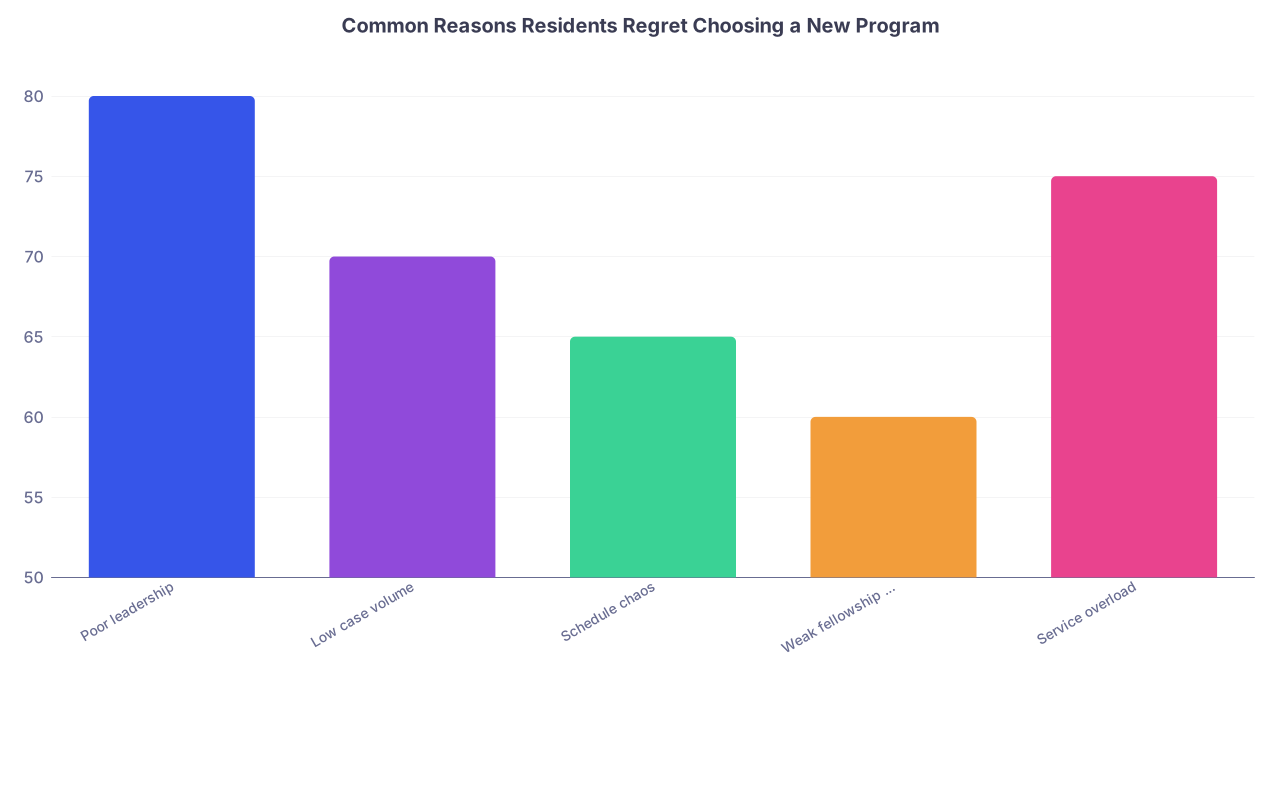
| Category | Value |
|---|---|
| Poor leadership | 80 |
| Low case volume | 70 |
| Schedule chaos | 65 |
| Weak fellowship prospects | 60 |
| Service overload | 75 |
Concrete Warning Signs You Should Not Ignore
Let me summarize the biggest red flags that should make you downgrade a new residency program on your rank list:
- PD or chair gives vague or defensive answers about ACGME status or citations
- Multiple key rotations or clinics are described in future tense only
- Faculty hiring is “ongoing” and a significant portion of core faculty are not yet on-site
- Residents hesitate when describing workload, wellness, or support
- No clear board review plan; in-training exam performance is not tracked or discussed
- Schedule or curriculum described as “flexible” in a way that sounds like “unstable”
- No credible relationships or pipelines to fellowships or employers you care about
- High turnover among early residents or faculty, even in year 1–2
One or two minor flags can be workable in a strong institution. But if you are stacking risk upon risk, do not convince yourself you are the exception who will “make it work.”
You are not just choosing a three-year experience. You are choosing the foundation of your clinical confidence and your reputation.
FAQ (Exactly 5 Questions)
1. Is it always a bad idea to join the first class of a new residency program?
No. It is not always a bad idea, but it is often riskier than applicants realize. It can be reasonable when the program sits within a strong, established institution with solid faculty, existing clinical volume, and clear support from leadership. A new IM program at a major academic center with long-standing fellowships is a different beast than a brand-new program at a small community hospital trying to grow quickly. You need to judge the institutional backbone, not just the marketing.
2. How can I tell if a new program has enough case volume if there are no residents yet?
You look at the hospital’s numbers and history, not the future promises. Ask for annual ED visits, surgeries, deliveries, ICU admissions, and clinic volumes. Ask what attendings’ procedure logs look like. Check whether the hospital is a regional referral center or constantly transfers complex cases out. You will usually get a sense very quickly: either they can quote hard numbers and explain them, or they wave their hands and talk about “anticipated growth.” Believe the numbers, not the aspirations.
3. What questions should I ask current residents to get honest information?
Avoid generic “Do you like it here?” questions. Instead ask: “Have you ever thought about leaving, and why?” “What was the worst week you have had here?” “What changed after residents raised concerns about X?” “Do you feel more like a learner or like staffing?” Also ask them if the program lived up to what was promised on interview day. That gap—between promises and reality—tells you more than any brochure.
4. Will being in a new program hurt my chances for competitive fellowships?
It can, especially in the first few years, if the program has weak faculty connections, minimal research, or low name recognition. Fellowship directors like known quantities: established programs with track records. If you are aiming for a highly competitive subspecialty, you must compensate with strong in-training scores, meaningful research, and letters from recognizable faculty. If the new program cannot realistically provide those, you are taking a real risk with your fellowship prospects.
5. How should I rank a brand-new program compared to mid-tier established ones?
Unless there is a compelling, clearly documented upside—top-tier institution, strong faculty pedigree, proven hospital volume—you should usually rank stable, established programs above untested new ones. A “boring but solid” residency with known board pass rates and predictable schedules is almost always safer for your career than an “exciting new opportunity” that may be disorganized, under-resourced, or exploitative. Before you submit your rank list, sit down and ask: “If everything goes wrong at this new program, do I still end up adequately trained and employable?” If you cannot confidently answer yes, move it down.
Open your rank list right now and mark every brand-new program with an asterisk—then, for each one, write down three specific risks you would personally face as a first-class resident there. If you cannot name them, you are not evaluating that program carefully enough.