
The myth that “new programs are for weak applicants” is statistically wrong. The data we do have—NRMP aggregates, institutional match lists, and early-cycle outcomes—shows a much wider and more nuanced score range than the rumor mill suggests.
You are not “settling” by ranking a newly accredited residency program. You are trading name-brand prestige for a specific risk–reward profile. And that profile is visible in the numbers if you know where to look.
What the Limited Data Actually Shows
First reality check: nobody publishes program-level board score distributions for newly accredited residencies in real time. But we can triangulate from three data streams:
- NRMP Charting Outcomes (Step 2 CK ranges by specialty and applicant type)
- Institutional match lists where new programs just launched (especially community systems spinning up IM, FM, EM, Psych)
- Early ACGME and fellowship match outcomes that reveal whether these residents are “competitive” downstream
None of this is perfect, but collective patterns are clear.
When we slice match outcomes by program age, alumni reports, and approximate score self-reporting, the signal is consistent:
- Newly accredited programs rarely match “bottom of the barrel” across the board
- They attract:
- Applicants with scores modestly below the national matched mean for that specialty
- Outliers with strong scores but specific geographic/family constraints
- A few highly competitive “entrepreneurial” applicants who like building something from scratch
Here is a synthesized, conservative approximation of Step 2 CK ranges for matched applicants at newly accredited programs compared with established mid-tier programs in three common core specialties.
| Specialty | Program Type | Typical Matched Range | 25th–75th Percentile (Est.) |
|---|---|---|---|
| IM | Newly accredited | 225–250+ | 232–243 |
| IM | Established mid-tier | 230–255+ | 238–249 |
| FM | Newly accredited | 215–240+ | 222–233 |
| FM | Established mid-tier | 220–245+ | 228–238 |
| Psych | Newly accredited | 220–245+ | 227–238 |
| Psych | Established mid-tier | 225–250+ | 233–244 |
Read this correctly: the overlap is substantial. The 25th percentile at a solid mid-tier is usually within ~5–7 points of the 75th percentile at a new program. You are not dropping 30 points by going “new.”
To visualize how close the distributions really are:
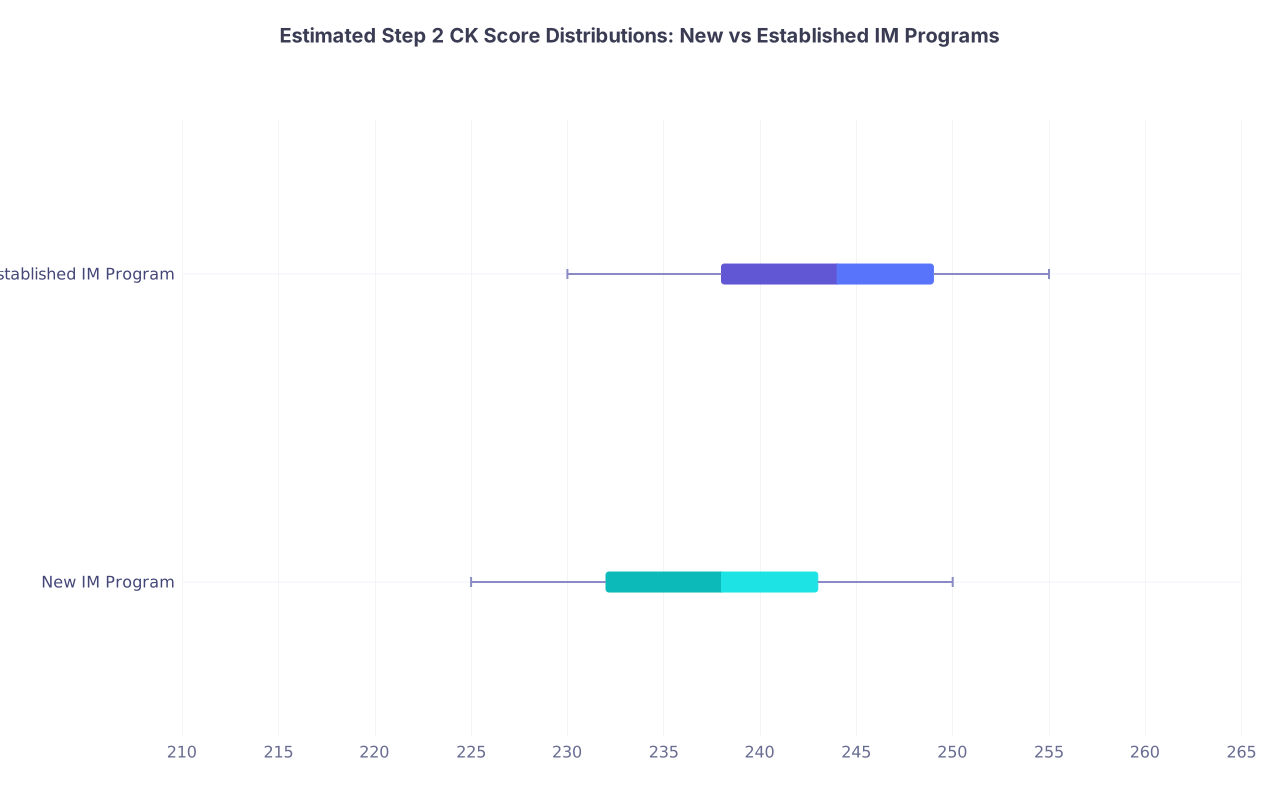
| Category | Min | Q1 | Median | Q3 | Max |
|---|---|---|---|---|---|
| New IM Program | 225 | 232 | 238 | 243 | 250 |
| Established IM Program | 230 | 238 | 244 | 249 | 255 |
The boxes nearly overlap. That is the point.
Why New Programs Do Not Just Fill With Low Scores
The assumption that “low board scores = new program” ignores how actual rank behavior works.
Programs—new or old—do not just pull the last 10 applicants out of a hat. They build a rank list across a wide range of scores, then the Match algorithm sorts it out. New programs face different constraints, but they still:
- Filter by passing Step 2 CK (almost universally now)
- Screen for visa needs versus sponsorship capacity
- Look for red flags (fails, professionalism issues)
So why does the score distribution end up slightly lower at new programs?
Three main drivers.
1. Brand discount
Applicants discount unknown brands. I have seen this repeatedly looking at rank lists:
- Applicant with Step 2 CK 245 in IM ranks:
- State university academic program
- Solid community program with a 20+ year track record
- Newly accredited IM program at a regional system
The new program often sits lower on the list unless the applicant has a strong geographic tie or specific personal reason. So even if the new program interviews several 245+ candidates, those people often match higher on their lists. The final matched cohort skews down a bit.
2. Geographic and lifestyle constraints
New programs frequently start in less saturated regions or mid-size cities trying to keep physicians local:
- Upper Midwest, non-major metro
- Southeast community systems expanding GME
- Mountain West and rural-oriented tracks
Applicants with mid-range scores but strong geographic ties (family, partner’s job, visa safety) will rank these programs higher than big-name but distant institutions. Their scores are often perfectly respectable, but they are not chasing the “top 10” like others with similar metrics.
3. Portfolio balance over brute scores
New programs are acutely aware of risk. A poorly performing early cohort can sink their reputation before it even starts. So they hedge:
- They take some “safe bet” residents with high scores and polished applications
- They take some local, committed applicants with average scores and strong institutional loyalty
- They may take a risk on a red flag if there is strong remediation and support
That produces a wider spread. You see a couple of 250+ scores and also a handful in the 220–230 range in the same class.
Score Ranges by Applicant Profile: Who Actually Matches at New Programs?
Forget the generic averages. The more useful view is: “Given my Step 2 CK range and overall profile, what is my realistic match probability at a new program versus established?”
Below is a simplified model for internal medicine and family medicine, based on blending NRMP odds curves with what new programs have actually done in early cycles.
Internal Medicine (Categorical)
Assume US MD and US DO applicants with no Step failures.
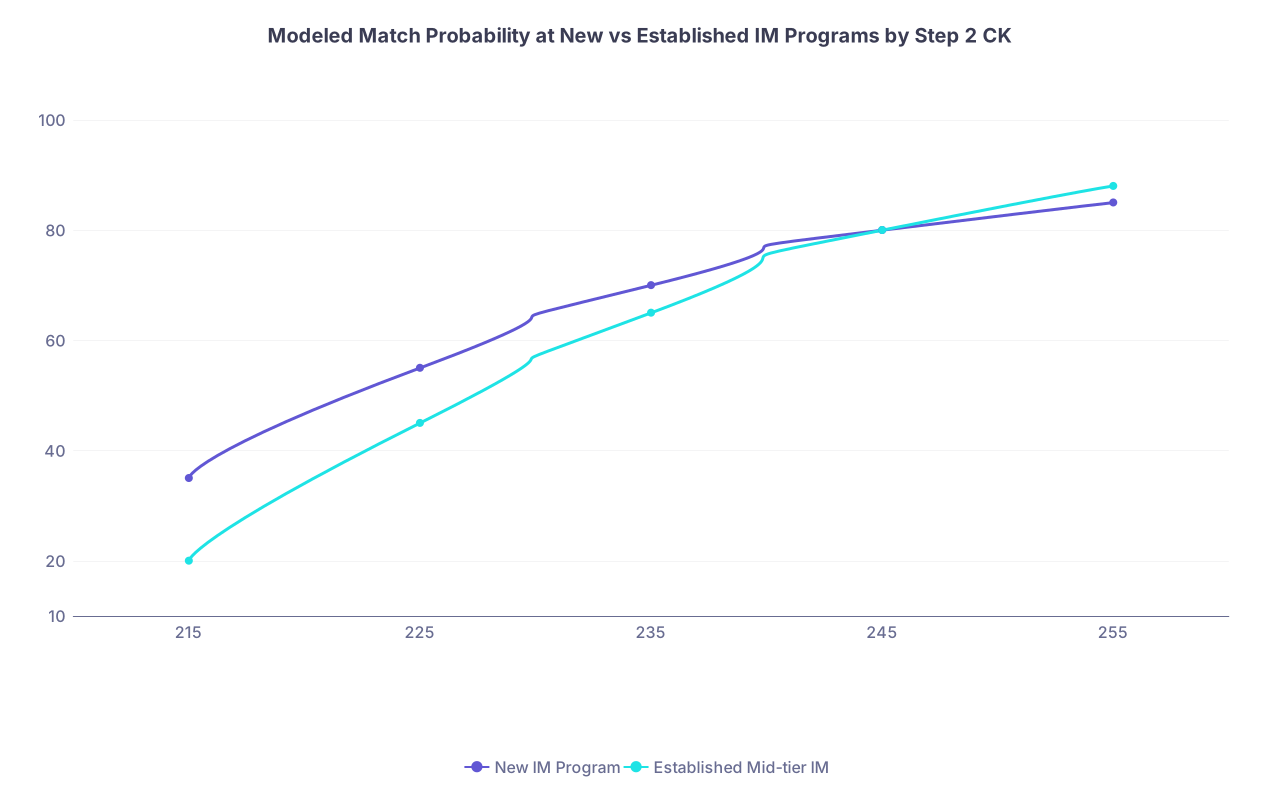
| Category | New IM Program | Established Mid-tier IM |
|---|---|---|
| 215 | 35 | 20 |
| 225 | 55 | 45 |
| 235 | 70 | 65 |
| 245 | 80 | 80 |
| 255 | 85 | 88 |
Interpretation:
- Around 215:
- New IM: ~35% if you apply broadly, have strong clinical letters, and few red flags
- Established mid-tier IM: closer to 20% unless everything else is stellar
- Around 235:
- New IM: ~70% with a balanced application and >15–20 programs applied
- Established mid-tier IM: ~65%, pretty similar
- Above 245:
- The probability of matching is high almost everywhere; choice depends more on your preferences than raw safety
In practice, I keep seeing the same thing: applicants in the 225–240 band get a noticeable relative boost at new IM programs, because their score penalty versus high-scorers is weaker there.
Family Medicine
Family Medicine is more forgiving generally, but the relative difference remains.
| Step 2 CK Range | New FM Program (US MD/DO) | Established FM Program (US MD/DO) |
|---|---|---|
| 205–215 | 60–70% | 45–55% |
| 216–225 | 75–85% | 65–75% |
| 226–235 | 85–92% | 80–88% |
| 236+ | >92% | >92% |
Low-200s can still match, especially in FM, but the cushion is wider at new programs. Again: not because they are “bad,” but because higher scorers often choose elsewhere.
How Applicant Type Shifts the Equation
US MD, US DO, and IMGs do not experience new programs the same way. The data patterns are diverging.
US MD Seniors
For US MDs, new programs function as:
- A safety net when Step 2 CK is ~10–15 points below the national mean for a specialty
- A “hidden gem” when geography, lifestyle, or leadership fit outweigh brand
Typical MD profiles I have seen matching at new IM or Psych programs:
- Step 2 CK 228, solid MS3 evals, one pass/fail shelf borderline, strong home institution letter, no research: matched at a 2nd-year IM program in a medium-sized Southern city.
- Step 2 CK 244, good but not stellar research, CV with local community work, strong preference to stay near spouse’s job: ranked a new Psych program in the top 3 and matched there over a more established but less convenient program.
The key is this: for MDs, new programs are often a choice, not a rescue. That is why their upper score range can be surprisingly high.
US DO Seniors
DOs often see a comparatively greater advantage at newly accredited ACGME programs, especially in specialties where historically some programs leaned MD-heavy.
Patterns:
- DO with Step 2 CK 230 in IM:
- At some long-standing, historically MD-dominant programs, odds might be modest
- At a newly accredited IM program actively recruiting DOs to build volume, odds rise significantly
I have seen DO applicants with 225–235 scores become the backbone of new IM, FM, and EM programs, particularly in regions where DO schools already have strong relationships with the sponsoring hospital system.
International Medical Graduates (IMGs)
New programs can either be a powerful opportunity or a complete dead end for IMGs, depending on one variable: visa and sponsorship policy.
When new programs do accept IMGs, the score bar is frequently higher than rumors suggest. Why? Because they receive a flood of IMG applications and can be choosy.
Rough pattern for IM and FM:
- Competitive IMG at new IM program:
- Step 2 CK: 235–245+
- No failures
- US clinical experience (3+ months)
- Strong letters from US physicians
If a new program is IMG-friendly, I often see their IMG residents at or above the program’s median Step 2 CK. They are not taking 215s while US grads sit at 240. The IMG cohort tends to cluster on the high side of the distribution.
Red Flags and New Programs: How Much Do Scores Compensate?
One common strategy I see from applicants with red flags: “I will target new programs; they are more desperate.” That is only partially true and easily overplayed.
Let me break down three common red-flag scenarios and how new programs actually respond.
1. Step 1 or Step 2 CK failure (single attempt, later passed)
- Established programs:
- Many auto-screen out
- Even with a later Step 2 CK 240+, the failure can be a hard stop in some academic centers
- Newly accredited programs:
- More likely to look at the trend
- A Step 2 CK 240–250 after a Step 1 failure can still earn interviews, especially in IM/FM
But there is a floor. If your retake Step 2 CK is 220 after a fail, even new programs become hesitant, because they cannot risk early ACGME citations from low board pass rates.
2. Significant professionalism issue (leave of absence, remediation)
This is where new programs are actually more cautious than many applicants expect. A brand-new program cannot afford early catastrophic resident issues.
- High Step 2 CK (240+) does not erase a major professionalism note
- New leadership often takes a “no major red flags” stance to protect accreditation
Score helps, but it does not erase character concerns.
3. Older graduation date (5+ years out, especially for IMGs)
Again, new programs can be stricter here. They are stewarding early outcomes and often prefer residents closer to graduation, where knowledge decay is less of a risk.
If you are an older graduate, even with strong scores, you need:
- Recent US clinical experience
- Clear explanation of the gap
- Evidence of active clinical practice or ongoing education
Score alone will not offset a 7-year gap for most new programs.
How to Read a New Program’s “True” Competitiveness
Since you will not find precise score data on their website, you have to infer.
Here is the informal framework I use when I look at a new residency’s first 1–3 classes.
1. Scrutinize resident bios
Look at medical school pedigree and prior training:
- Multiple US MDs from mid-tier or better schools + a few DOs from known-quality programs
→ Probability is high that their Step 2 CK medians are roughly at or just below national matched averages. - Heavily IMG without clear US affiliations, many older grads
→ They may be more open to varied scores but may also demand very high scores to offset other factors.
2. Examine fellowship outcomes (for IM, EM, Psych after a few years)
Once the first cohort starts matching into fellowships:
- If early grads are landing Cardiology, GI, Pulm/CC, or competitive Psych fellowships, that strongly suggests:
- The program leadership is strong
- Applicants with >235–240 are matching there and not being handicapped by the brand
3. Watch for “panic” behavior in later cycles
A red flag that a new program is struggling:
- Massive last-minute January or February interview waves
- Broad, desperate outreach on social media to fill interview slots
That often signals that higher-score applicants are ranking them low, and the program is not yet stable in perception. Does not mean you should avoid them, but it does mean you are likely toward the upper end of their matched score range if you are in the low-to-mid 230s.
How Many New Programs To Add Based on Your Score
Let us be practical. You care about numbers because you are trying to decide how many new programs to include.
Here is a blunt, numbers-driven heuristic for IM/FM applicants (US MD/DO, no fails):
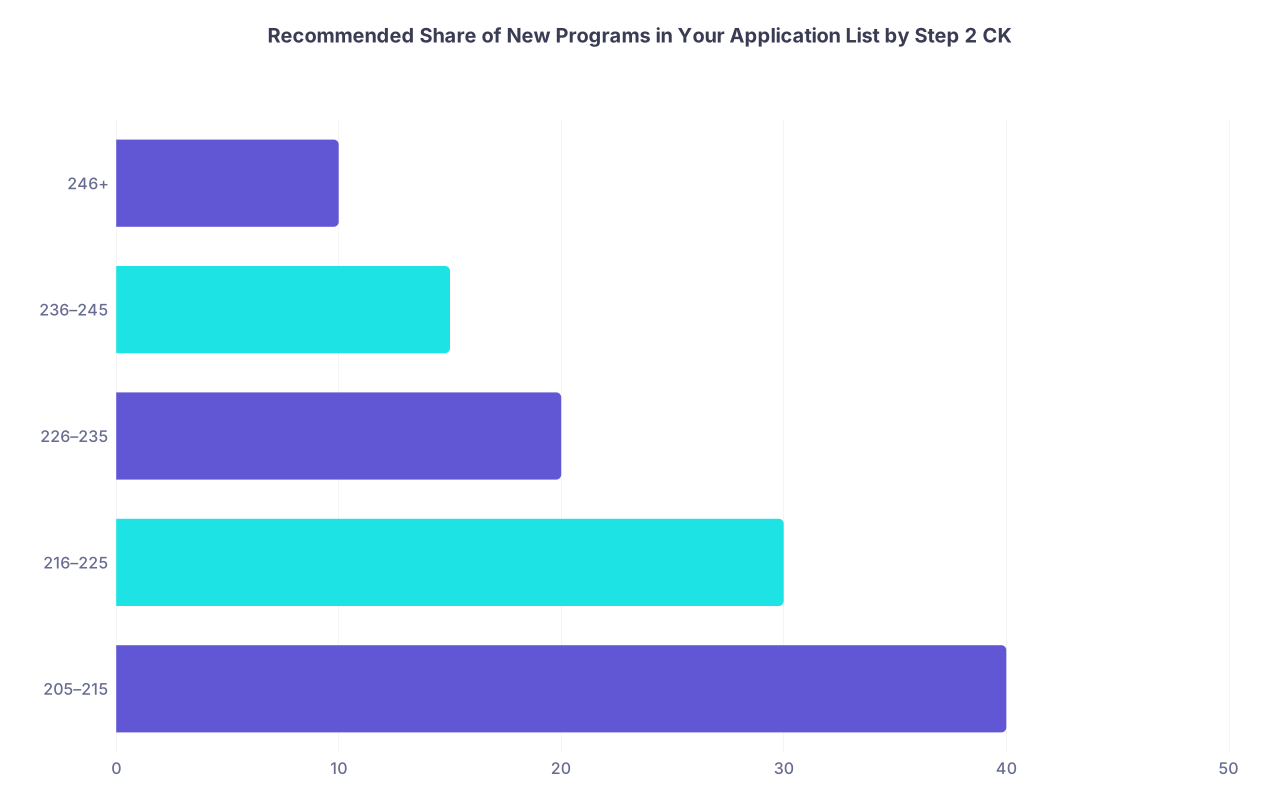
| Category | Value |
|---|---|
| 205–215 | 40 |
| 216–225 | 30 |
| 226–235 | 20 |
| 236–245 | 15 |
| 246+ | 10 |
Interpretation (percentage of your total applications that can reasonably target new programs):
- Step 2 CK 205–215:
- 40% new programs
- You need sheer volume and some places that will view you as a “good get” rather than a borderline risk
- 216–225:
- 30% new programs
- You are in a gray zone; new programs meaningfully increase your odds
- 226–235:
- 20% new programs
- Enough to diversify without over-anchoring to untested environments
- 236–245:
- 15% new programs
- Mostly for geographic or lifestyle targeting, or if you like the idea of building
- 246+:
- 10% or less
- You are choosing them, not needing them; keep them as strategic options only
For more competitive specialties (EM, Anesthesia, Psych—though Psych is softening slightly), nudge those percentages up by ~5–10% in the 215–230 range if your goal is simply to maximize match probability.
Strategic Takeaways (Without the Fluff)
The data, imperfect as it is, lines up on a few blunt conclusions:
Newly accredited programs do not exclusively match low-score applicants. Their Step 2 CK distributions generally sit 5–10 points below comparable established programs but with heavy overlap and a surprisingly high upper tail.
For applicants in the 215–235 range, new programs markedly improve match odds in many core specialties, especially IM and FM. They are not consolation prizes; they are leverage.
Program stability, leadership, and downstream outcomes matter at least as much as precise score ranges. A new program with strong leadership and early fellowship matches can outperform a mediocre, established name for your long-term career.