
The worst mistake you can make with a brand-new residency program is trusting the sales pitch instead of the evidence.
New programs love glossy brochures, “innovative” language, and promises of “building something together.” That is all noise. You need signal. You are about to tie three to seven of the most important years of your life to a program that has never graduated anyone. That demands a brutally systematic vetting process.
Here is how to do it like a professional, not a victim.
1. Start With the Two Non‑Negotiables: ACGME and Board Eligibility
If a new program cannot guarantee these, walk away. No exceptions.
A. Confirm accreditation status precisely
Do not accept “we’re working on it” or “we’re in the middle of the process” as answers.
You want exact language:
- ACGME Accreditation Status
- “Pre-Accreditation”
- “Continued Accreditation”
- “Initial Accreditation”
- “Initial Accreditation with Warning”
- “Probationary”
- Or “Application Submitted / Not Yet Accredited” (huge red flag for you)
Go to the ACGME public site and look up:
- Sponsoring institution
- Program name
- Program ID
- Current status
- Date of last site visit
If the PD or coordinator cannot tell you the exact status and where to see it in writing, that is not a minor administrative oversight. That is a structural problem.
B. Ask bluntly about board eligibility
You want a clear, unambiguous answer to:
“If I complete this program on time and in good standing, will I be board eligible with [ABIM / ABFM / ABS / ABEM / etc.]? Yes or no?”
Then cross-check:
- Go to the relevant American Board (ABIM, ABFM, etc.)
- Look up their training requirements.
- Confirm that:
- The program meets required years.
- The sponsoring institution qualifies.
- Any special pathways (transitional year, prelim year) are clearly addressed.
If the PD says “we expect to be” or “it should be fine,” that is not enough. You are betting your career on their paperwork being right.
2. Reverse‑Engineer the Training: Will You Actually Learn What You Need?
Forget the mission statement. You need to see the machinery of training.
A. Dissect the block schedule and case exposure
You are not looking for pretty graphics. You are looking for volume and diversity.
Ask for:
- Detailed block schedule for PGY-1 through PGY-3/4/5
- Service descriptions with:
- Average daily census
- Resident caps
- Typical patient mix
- Locations:
- Main hospital
- Clinics
- Outside rotations
Then do this:
Check against RRC requirements
For your specialty, pull up the ACGME Program Requirements (PDF).
Go line by line with:- Required months (e.g., ICU, continuity clinic, subspecialties)
- Required procedures or competencies
- Required clinic sessions per week
Match each requirement to an actual rotation
Literally map it:- Required: 130 continuity clinic sessions → Does their schedule hit that?
- Required: X ICU months → Show me where.
If they cannot show consistency between what the ACGME requires and their schedule, you will end up scrambling later.
| Requirement Type | What You Need to See in Writing |
|---|---|
| Continuity Clinic | Count of sessions per week and per year |
| ICU Exposure | Number of blocks and responsibilities |
| Subspecialty Rotations | Named rotations with faculty listed |
| Night Float/Call | Clear schedule and supervision level |
| Procedures | Where and how you will meet minimums |
B. Demand hard numbers on volumes and procedures
This is where new programs bluff. Do not let them.
You should ask specific questions like:
- “How many adult inpatients does the main hospital admit per year?”
- “What is the ED annual volume?”
- “How many [key procedures] did attendings perform last year?”
- “How many of those will be resident‑performed?”
For procedure-heavy specialties (EM, surgery, OB/GYN, anesthesia), ask:
- “Where do your residents log central lines, intubations, C-sections, etc.?”
- “Do you already have procedure logs for fellows or faculty from these sites?”
If they cannot show prior trainee experience (fellows, previous residents from other programs, or documented volumes) you are the test subject. That is not always bad, but you need to know it.
3. Follow the Money and Power: Who Actually Controls This Program?
A new residency program is only as stable as its institution and leadership. Charismatic PDs come and go. Infrastructure and money stay (or vanish).
A. Analyze the sponsoring institution’s track record
Ask these directly:
- “What other residency or fellowship programs does this institution sponsor?”
- “Have any programs here ever closed or lost accreditation?”
- “What is the institution’s current accreditation status?”
Then do your own digging:
- Look up all programs at that hospital on ACGME.
- If it is the institution’s first GME program:
- That means they are learning GME logistics on you.
- Not automatically bad, but higher risk.
Red flags:
- For-profit hospital chain with aggressive expansion and closure history.
- Recent merger / acquisition chaos.
- Known financial distress or public layoffs.
B. Strip the PD and Chair down to their actual track record
Do not be dazzled by titles.
Find out:
- PD’s prior roles:
- Have they ever been a PD or APD before?
- Did that prior program have good outcomes (board pass rates, fellowship match)?
- Chair’s stability:
- How long have they been in this role?
- Any history of churning through PDs?
Questions to ask:
- “Where did you previously train residents?”
- “Can you share the board pass rate at your last program?”
- “How long do you realistically expect to stay in this role?”
If both the PD and Chair are new to GME leadership and the institution is new to GME, you have a triple‑startup problem.
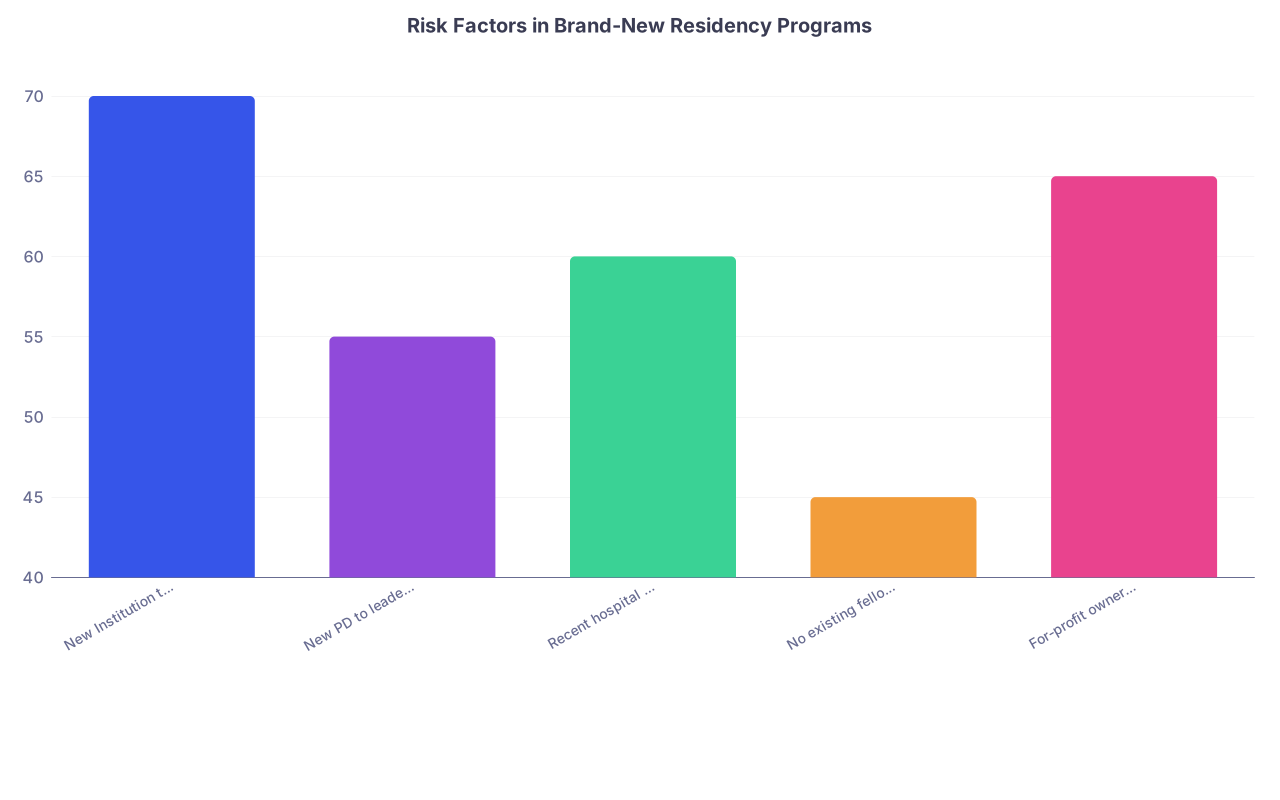
| Category | Value |
|---|---|
| New Institution to GME | 70 |
| New PD to leadership | 55 |
| Recent hospital merger | 60 |
| No existing fellowships | 45 |
| For-profit ownership | 65 |
4. Interview Day: Ask the Questions Most Applicants Are Too Polite to Ask
New programs rely on a certain applicant naivety. Do not play that role.
A. Questions specifically for brand-new programs
Use these almost word for word:
On stability and closure
- “If this program were to close for any reason, what is your written contingency plan for residents?”
- “Have you discussed transfer arrangements with nearby programs, and do you have that in writing?”
On accreditation and oversight
- “What did your most recent ACGME site visit report highlight as areas to improve?”
- “What systems are in place to make sure duty hours, supervision, and evaluation meet ACGME standards from day one?”
On resident workload
- “With no senior residents initially, how are you preventing PGY-1s from doing the work of three levels at once?”
- “Who will handle ‘senior resident’ responsibilities in the first year?”
On teaching culture
- “Which attendings here have the most experience teaching residents or fellows?”
- “Are there any services where residents will be a ‘new addition’ to an established attending-only model?”
If answers are vague, defensive, or full of buzzwords (“robust oversight,” “dynamic growth,” “unique opportunity”) without specifics, mark that down.
B. Evaluate the honesty of the answers, not just the content
You are not looking for perfection. You are looking for:
- Transparency about known weaknesses
- Concrete, step-wise plans to fix them
- Evidence of work already done (not just “we will…”)
If a PD tells you, “Year one will be messy, here are three problems we expect and how we have designed around them,” I trust that more than someone who insists everything will be “smooth.”
5. Talk to the Only People Who Cannot Be Stage‑Managed
Everyone you officially meet on interview day is filtered. You need unfiltered.
A. Find current prelims, fellows, or nearby residents
New categorical programs often exist at hospitals that already host:
- Transitional year or prelim residents
- Fellows (cardiology, GI, critical care, etc.)
- Rotating residents from other institutions
You want them.
Ask the coordinator (or better, find them on your own):
- “Can I talk to any current trainees who rotate here but are not in this program?”
Questions to ask them privately:
- “How do attendings treat trainees when leadership is not watching?”
- “Do you feel supported at 2 a.m. when a patient is crashing?”
- “Are there any services that are notorious for dumping work on trainees?”
- “Have you seen signs of residents or students being used as cheap labor?”
The off‑script comments matter more than anything you hear in the formal Q&A.
B. Use students who have rotated there as intel
Check:
- Your med school classmates
- Online forums (with caution)
- Social media groups for your specialty
What you want to know:
- Did they feel like learners or workhorses?
- Was feedback real or performative?
- Did people actually enjoy coming to work?
Do not let one bitter student or one glowing fan overly sway you. Look for patterns. If multiple people say “the attendings are nice but super disorganized,” believe that.
6. Audit the Support Systems You Will Need When Things Go Wrong
Something will go wrong. At every program. The question is: what backup systems exist.
A. Duty hours, wellness, and backing off unsafe situations
Ask:
- “Who monitors duty hours and who has the authority to change schedules if there are violations?”
- “Has the institution ever been cited for duty hour violations in other programs?”
- “If I feel an attending is asking me to practice beyond my competence, what is the escalation path?”
You want to hear:
- There is a GME office with a DIO (Designated Institutional Official).
- There is a house staff council or resident forum, even if small.
- Specific examples of prior actions taken to fix unsafe patterns.
If they say, “We have not had any issues yet,” and give no clear structure beyond “come talk to us,” that is weak.
B. Formal resident voice: do you actually have it?
Even in year one, there should be:
- Scheduled resident meetings with PD.
- A mechanism to anonymously report concerns.
- A framework for resident representation on committees.
If you are “building all that later,” it means residents will be complaining into a void for at least a year.

| Step | Description |
|---|---|
| Step 1 | Resident identifies problem |
| Step 2 | Talk to chief or senior |
| Step 3 | Discuss with PD |
| Step 4 | GME office or DIO |
| Step 5 | Institution leadership or HR |
| Step 6 | ACGME Resident Survey if unresolved |
If any of those boxes (especially GME office and DIO) do not exist or are “still being developed,” understand what that means: your problems will often stay your problems.
7. For “Build-It-With-Us” Programs: How to Protect Yourself
Some people genuinely like being the first wave. You get leadership roles, program‑shaping power, and sometimes very close mentoring. It can be fantastic. Or a trap.
A. Clarify what “pioneering” actually means in your daily life
Ask for specifics:
“What exactly is not built yet that residents will help create?”
- Curriculum?
- Evaluation tools?
- Policies?
- Clinic workflows?
“Realistically, what percentage of my time will be spent on ‘building’ versus direct patient care and learning?”
If they cannot answer with any numbers or concrete examples, they are romanticizing chaos.
B. Guardrails you should insist on (or at least strongly prefer)
For a first-cohort or early-cohort position, I would want:
Existing EMR and order set stability
You do not want to be present for an EMR go‑live and a brand‑new residency at the same time. Disaster.Existing nursing and ancillary staffing
If the hospital is also ramping up nursing, RT, lab, etc., you will be doing non-physician work constantly.Clear educational time protections
Written, scheduled, and defended:- Protected didactics
- Simulation time
- Board review structure
You are not a consultant. You are a trainee. You help shape things around the margins, not build the foundation from scratch.
8. Quantify the Risk: A Simple Scoring Framework
When I work with applicants sorting through new programs, I push them to score things instead of hand‑waving “vibes.” Here is a simple model you can adapt.
Rate each 1–5 (1 = terrible, 5 = excellent):
- Accreditation and board eligibility clarity
- Institutional GME experience (other programs, no closures)
- Faculty teaching track record
- Case volume and procedure opportunities
- Stability of leadership (PD, Chair, institutional)
- Support systems (GME office, DIO, resident voice)
- Transparency about weaknesses
- Personal fit (location, culture, life considerations)
Then:
- 32–40 = Reasonable to strong choice, even if new
- 24–31 = Cautious. Compare heavily with established programs
- <24 = Only consider if you have no safer options or very specific reasons
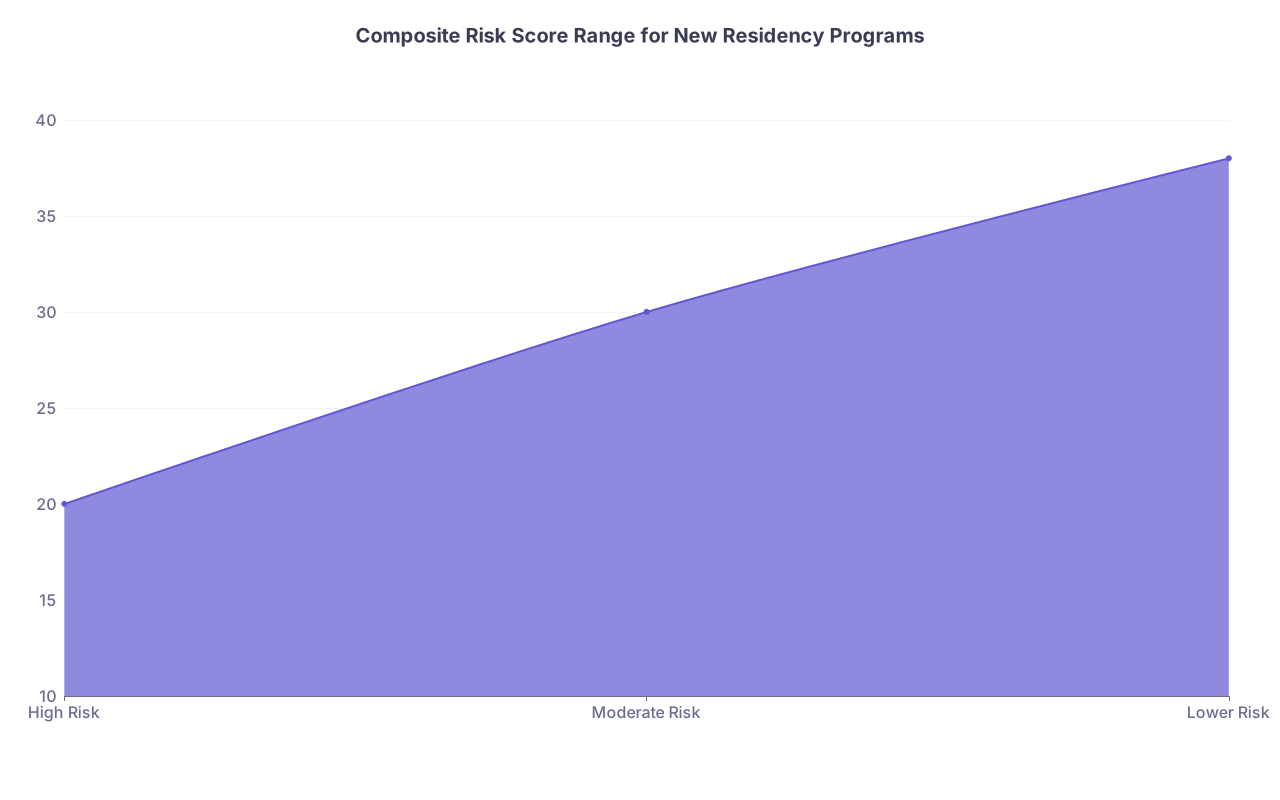
| Category | Value |
|---|---|
| High Risk | 20 |
| Moderate Risk | 30 |
| Lower Risk | 38 |
You will not get perfect information on all eight, but even partial scoring forces you out of “I liked the people” mode into critical analysis.
9. When It Makes Sense to Say Yes to a Brand-New Program
I am not anti–new program. Some of the best training environments I have seen were in young programs with hungry faculty.
A new residency can be a good bet if:
- The institution is rock solid (large academic or long-standing community hospital).
- The faculty mostly trained and taught at strong, established programs.
- The case volume is clearly high, and residents are not needed to make the hospital functional.
- Leadership is honest about early challenges and already has mitigation plans.
- You have a specific angle:
- Strong interest in leadership / medical education
- Desire to stay in that geographic area long term
- Preference for tighter-knit, small-class culture
Conversely, a new program is usually a bad bet when:
- It is the only GME effort of a small, unstable hospital.
- Leadership has shallow CVs and vague answers.
- You sense a heavy emphasis on “service needs” instead of education.
- They dodge questions about duty hours, supervision, or contingency plans.
10. How to Compare a New Program to an Established But Imperfect One
This is the real dilemma: do you pick a shiny new program with potential or an older one with mediocrity baked in?
Be cold-blooded about it.
Prioritize, in this order:
Board eligibility / accreditation stability
If either is shaky, that program loses. New or old.Volume and competency
Which place will actually make you a competent doctor in your field? Not which place feels fancier.Support and safety
You need backup, especially in intern year. Who has proved they can provide it?Career outcomes
For established programs, look at:- Board pass rates
- Fellowships or job placements For new programs, look at:
- Faculty networks
- Institution’s name recognition
- Chairs’ and PDs’ previous trainee outcomes
Only after those do you let lifestyle, geography, and minor perks tip the scale.

11. How to Do Your Homework in 7 Days
If you are reading this with a rank list deadline closing in, here is a one‑week, high-yield plan.
Day 1–2: Paper and website audit
- Pull ACGME program and institutional data.
- Download specialty‑specific ACGME requirements.
- Map their block schedule to those requirements.
- Score Accreditation, Institutional GME experience, Volume (3 of 8 categories).
Day 3–4: Conversation blitz
- Email the coordinator with 4–5 specific questions:
- Accreditation status
- Board eligibility confirmation
- Contingency plan for closure
- Duty hours oversight
- Request contact info for:
- A current trainee at the hospital (prelim/fellow)
- A faculty member not in leadership
Day 5: Off‑the‑record intel
- Reach out to:
- Med school classmates who rotated there
- Online resident groups in your specialty
- Ask for candid, short voice or text messages about:
- Workload culture
- Teaching culture
- Institutional chaos vs stability
Day 6: Score and compare
- Fill in the 8‑item scoring framework.
- Compare directly to your other programs.
- Identify:
- Any “fatal flaws”
- Any “big differentiators in its favor”
Day 7: Decide like an adult, not a passenger
- Ask yourself:
- “If this program does not improve from today and just stays exactly like this for 3–5 years, would I still be okay training here?”
- If your answer depends on hope more than data, rank it accordingly (which usually means lower).

End with action, not theory.
Right now, pick one new residency program on your list, open its ACGME page and website, and force yourself to assign a 1–5 score for accreditation clarity, institutional GME experience, and case volume. If you cannot get to at least a “4” on all three with evidence, you have work to do before you trust that program with your training.